Fabricante de impresoras de inyección de tinta planas de tamaño pequeño
86-18566233796 [email protected]

Blog Laminación en frío (sensible a la presión): cómo funciona, mejores usos, ventajas y desventajas y consejos

Laminación en frío (sensible a la presión): cómo funciona, mejores usos, ventajas y desventajas y consejos

17 de enero de 2026 Blog

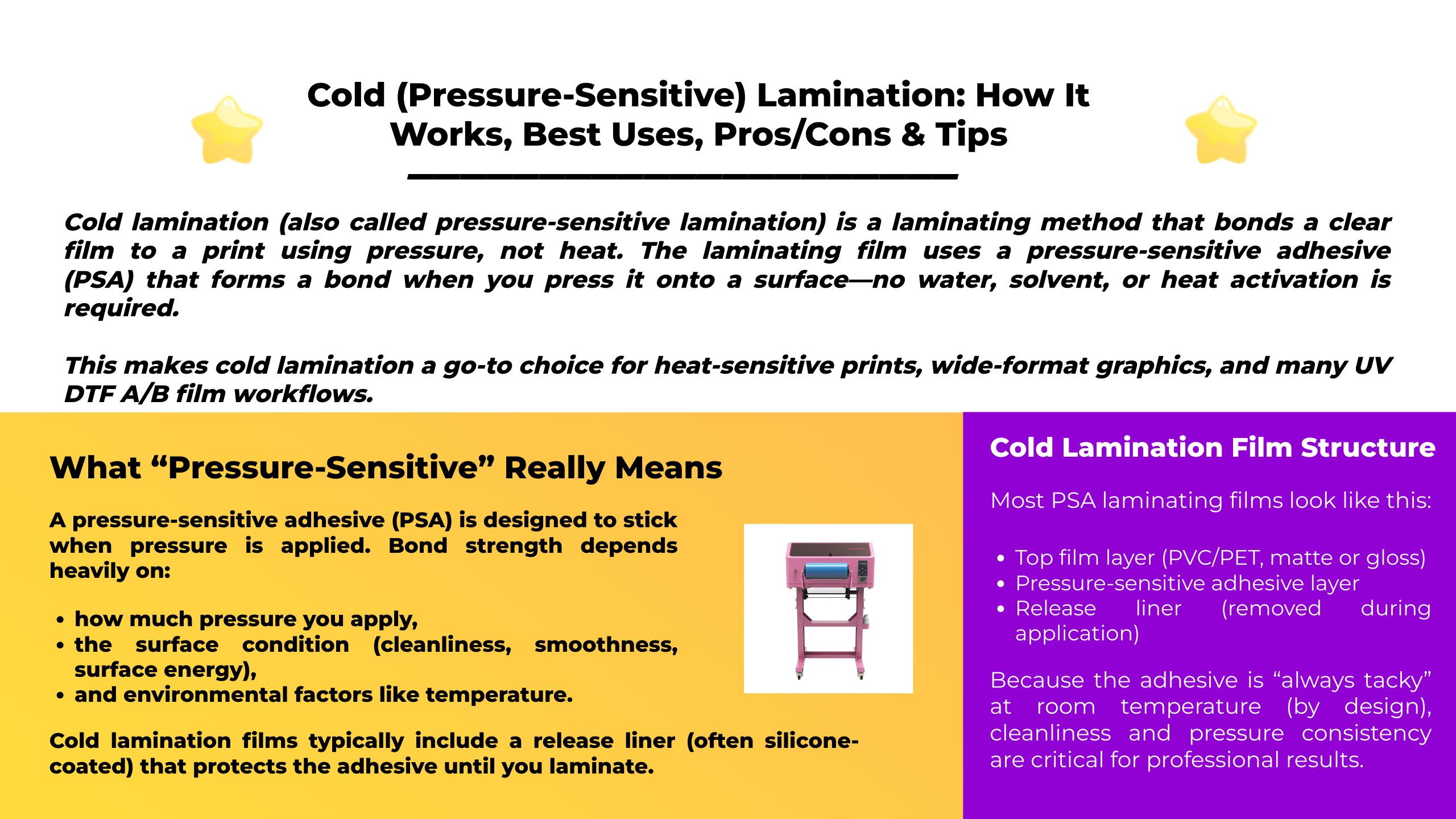
Laminación en frío (also called pressure-sensitive lamination) is a laminating method that bonds a clear film to a print using presión, not heat. The laminating film uses a adhesivo sensible a la presión (PSA) that forms a bond when you press it onto a surface—no water, solvent, or heat activation is required.

This makes cold lamination a go-to choice for heat-sensitive prints, wide-format graphics, and many UVDTF película A/B workflows.

What “Pressure-Sensitive” Really Means

A adhesivo sensible a la presión (PSA) is designed to stick when pressure is applied. Bond strength depends heavily on:

  • how much pressure you apply,
  • the surface condition (cleanliness, smoothness, surface energy),
  • and environmental factors like temperature.

Cold lamination films typically include a revestimiento de liberación (often silicone-coated) that protects the adhesive until you laminate.

How Cold Lamination Works (Step-by-Step)

Method A: Cold roll laminator (most common for production)

  1. Load the laminate roll and align your print/media.
  2. Peel/introduce the adhesive film (depending on film type and machine setup).
  3. Feed the print through rollers.
  4. Rollers apply incluso presión to bond the PSA film to the print.
  5. Trim edges and allow the laminate to “settle” if needed.

Cold lamination is commonly described as using rollers to apply pressure that bonds the adhesive-backed film—without heat.

Method B: Hand lamination (small jobs)

  • Peel the liner, tack one edge, then squeegee from center outward to push air out.
  • Works for short runs but is more operator-dependent.

Cold Lamination Film Structure

Most PSA laminating films look like this:

Because the adhesive is “always tacky” at room temperature (by design), cleanliness and pressure consistency are critical for professional results.

When to Use Cold Lamination

La laminación en frío es especialmente útil cuando el calor podría causar daños o distorsiones, ya que no requiere temperatura para activar el adhesivo.

Aplicaciones comunes

  • Fotografías e impresiones de inyección de tinta. (donde el calor puede deformar o afectar las tintas)
  • Gráficos de vinilo y carteles de gran formato
  • Calcomanías y etiquetas
  • Laminación de película UV DTF A/B (impresión en película A, laminación con película B)

Pros and Cons of Cold (Pressure-Sensitive) Lamination

Pros

  • No heat needed (safer for heat-sensitive media)
  • Often simpler operation (no warm-up time, fewer temperature variables)
  • Great for wide-format and PSA workflows

Contras

  • More sensitive to polvo and contamination (bubbles/silvering)
  • Tracking/alignment matters more (wrinkles/skew)
  • PSA films can behave differently across temperatures (tack changes with conditions)

Key Settings That Matter (Practical Checklist)

SettingWhat to aim forWhat happens if wrong
PresiónEven, sufficient roller pressureLow pressure = weak bonding / bubbles
VelocidadStart slow, increase after stable resultsToo fast = trapped air, wrinkles
AlignmentFilm and media must feed squareSkew = creases and waste
CleanlinessDust-free path + clean mediaDust = bubbles / “silvering”

Cold lamination performance depends strongly on pressure and surface conditions—PSA bonding is not “forgiving” of dirt/oil.

Troubleshooting Cold Lamination Problems

1) Bubbles / “silvering”

Causas: dust, uneven pressure, too high speed
Arreglar: clean rollers/media, slow down, increase pressure slightly, squeegee from center outward.

2) Wrinkles or skew tracking

Causas: roll tension issues, misalignment
Arreglar: reload rolls square, use side guides, reduce speed until tracking is stable.

3) Edge lifting / poor adhesion

Causas: contaminated surface (oil), insufficient pressure, low surface energy substrate
Arreglar: clean substrate properly, apply firmer pressure, consider higher-tack laminate for difficult surfaces (film options vary by supplier).

Cold Lamination for UV DTF (AB Film) — Why It’s Popular

In many UV DTF workflows, you print on Film A and then laminate with Película B to create a transferable decal. This lamination step is typically pressure-based, making cold lamination a natural fit.

Shop advantage: You can produce consistent transfers without managing temperature profiles that might affect films or adhesives.

Preguntas frecuentes

Is cold lamination the same as “self-adhesive” lamination?

They’re closely related. Cold lamination commonly uses pressure-sensitive adhesive films (PSA) that bond under pressure, usually protected by a release liner.

Does cold lamination need electricity?

Some cold laminators are manual, and many sources note cold lamination can be run without heating (no warm-up/cool-down). However, production roll laminators may still be motorized for speed and consistency.

Why does cold lamination fail in winter?

PSA tack can drop at low temperatures, and overall adhesive behavior changes with temperature. Keeping materials at stable room conditions often improves results.

Takeaway

Laminación en frío (sensible a la presión) is the best choice when you want lamination without heat, using PSA film plus roller pressure to bond cleanly—especially for heat-sensitive prints, vinyl graphics, and UV DTF AB film workflows.

If you tell me your application (UV DTF AB film vs posters/vinyl) and your laminator width (A3/30cm/60cm), I can give you a tighter “best settings + SOP” section for a product/guide page.

Te puede gustar

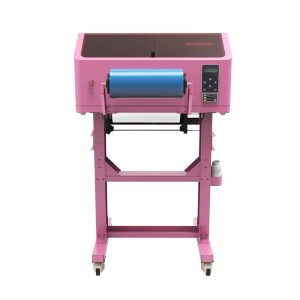
Modelo destacado: impresora A3 UV DTF

Producción UV DTF de calidad profesional para calcomanías, etiquetas y envoltorios de vasos. Tamaño compacto, producción estable y flujo de trabajo de transferencia en frío sin esfuerzo.

A3 UV DTF Printer

Especificaciones clave

Parámetro Valor
Ancho máximo del medioA3 / 350mm
CanalesCMYK + Blanco + Barniz
ResoluciónHasta 1440 ppp
Flujo de trabajoPelículas A/B UV DTF · Laminación en frío
Mejor usoCalcomanías, etiquetas, envoltorios para tazas y diseños de gadgets.
ROTURARiin / EraRip / Photoprint (compatible con ICC)

Puede ser como tú también

  • Impresora EraSmart

    impresora uv
    Impresora DTF
    Impresora DTG
    Máquina de prensa de calor
    Impresora publicitaria

  • Herramientas de impresora

    Horno DTF
    Revista de actualidad
    Máquina de tallado
    Taza de transferencia de calor
    Maquina laminadora

  • Consumibles

    Tinta de impresión
    Estuche para celular
    Producto de vidrio
    Líquido de limpieza
    Bastoncillo de algodón

  • Contáctenos

    WhatsApp: +8618566233796
    WeChat: +8618566233796
    Móvil: +8618566233796
    Web:www.erasmart.com
    Comercio:www.erasmartmall.com

  • Solicitar una cotización

    ¡Solo proporcione algunos detalles y lo ayudaremos a obtener cotizaciones rápidas!