小型サイズのフラットベッドインクジェットプリンターメーカー

DTF プリントが洗濯後にひび割れてしまうのはなぜですか?原因、修正、予防
DTF 印刷では、T シャツ、パーカー、ユニフォーム、トートバッグ、その他互換性のある繊維製品にカラフルで詳細なデザインを作成できます。しかし、印刷業者にとって最もイライラする問題の 1 つは、洗濯や着用後に転写に亀裂が生じ始めていることに気づくことです。
場合によっては、熱プレス直後は完璧に見えても、数回洗濯すると細かいひび割れが生じることがあります。場合によっては、最初の洗濯前であっても、衣類を伸ばすと亀裂が発生します。
DTF プリントは、プリントされた転写物が伸縮、着用、洗濯などの機械的ストレスに耐えられない場合、亀裂が入る可能性があります。 不適切なパウダーの硬化、不適切なヒートプレス設定、過剰なインクの厚さ、互換性のない消耗品、生地の特性、および衣服の過酷な手入れがすべて原因となる可能性があります。
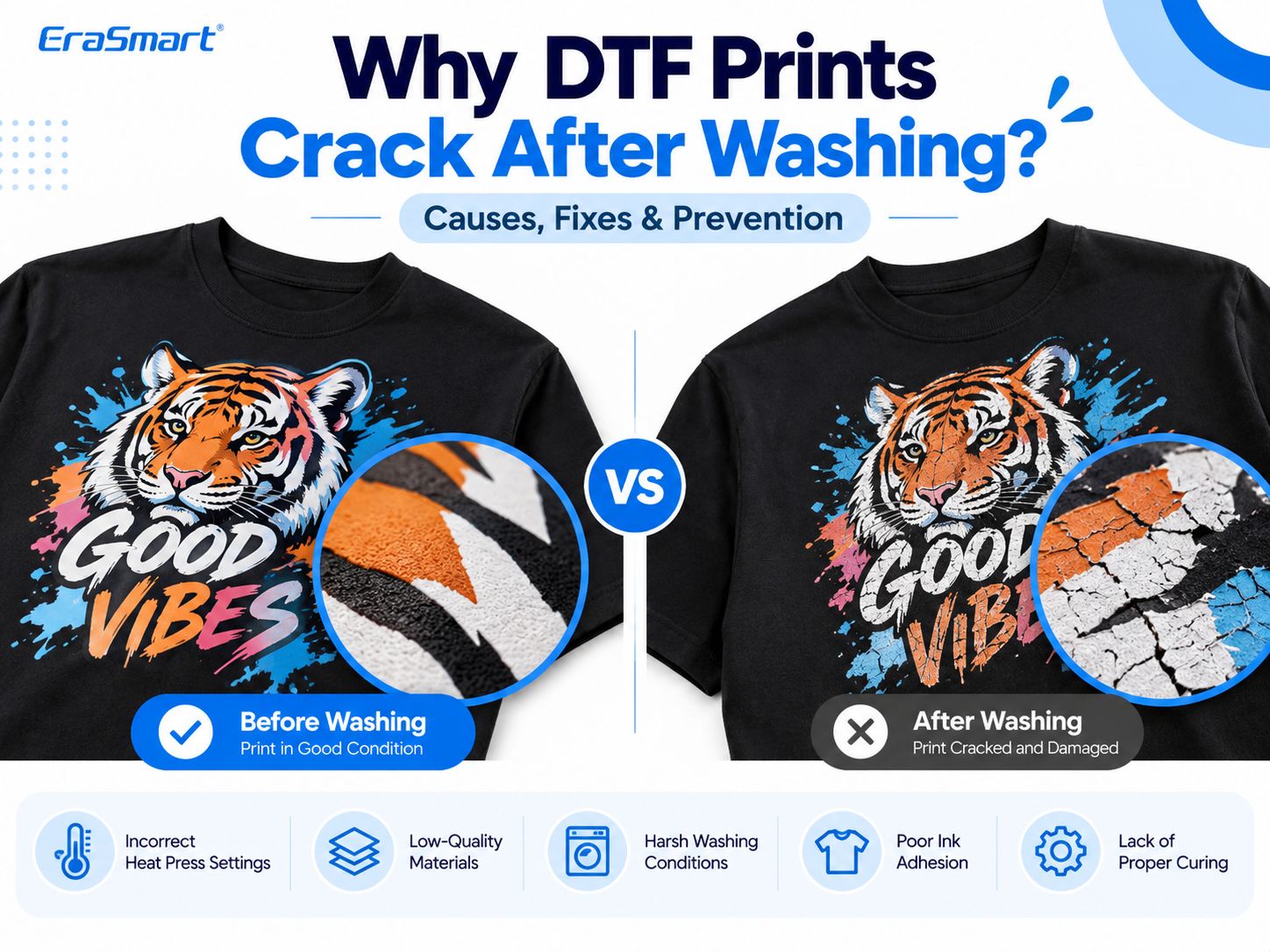
重要な点は、 ひび割れは必ずしも洗濯機に問題があったことを意味するわけではありません。
洗浄は、転写にすでに存在する弱点を単に露出させる可能性があります。
このガイドでは、DTF の亀裂を特定する方法、剥離や色褪せと区別する方法、一般的な原因を調査する方法、損傷した衣類を評価する方法、およびより信頼性の高い生産プロセスを構築する方法について説明します。
簡単な答え: DTF プリントがひび割れするのはなぜですか?
調査する必要がある最も一般的な要因は次のとおりです。
- 接着剤粉末の硬化が不適切。
- ヒートプレスの温度、圧力、時間が間違っている。
- 印刷層が厚すぎるか、柔軟性がありません。
- DTF インク、フィルム、パウダー、ファブリックの不適切な組み合わせ。
- トランスファーの柔軟性を超えたストレッチを繰り返した。
- 過度の洗濯、乾燥、または摩耗によるストレス。
- 生産バッチ間のプロセスの一貫性が低い。
DTF プリントのひび割れは、検査によって診断する必要があります。 損傷がいつ発生したか、亀裂が発生した場所、グラフィックも生地から剥がれているかどうか。
例えば:
| 問題が発生したとき | 何を調査するか |
|---|---|
| 押した直後 | プレス条件、硬化、材料適合性 |
| 最初のストレッチ中に | 厚み、柔軟性、生地の弾力性を転写します。 |
| 最初の洗濯後 | 初期接着、硬化、プレス、洗浄条件 |
| 繰り返し洗濯した後 | 摩耗、繰り返し屈曲、洗濯応力、素材の耐久性 |
| 特定の衣類のみ | 生地の種類、コーティング、伸縮性、衣服の構造 |
| 1 つの生産バッチのみ | インク、フィルム、パウダー、設定、オペレーターまたは環境の変更 |
目的は、単にシャツの目に見えるひび割れを止めることだけではありません。
原因を特定して、顧客の注文全体で同じ障害が発生しないようにするためです。
DTF のひび割れ、剥離、色褪せ: 違いは何ですか?
トラブルシューティングを行う前に、正確な障害を特定してください。
DTFのひび割れ、剥がれ、退色は同時に発生する場合がありますが、同じ問題ではありません。

DTF クラッキング
ひび割れとは、印刷されたグラフィックに目に見える亀裂が生じることを意味します。
一般的な兆候は次のとおりです。
- 細い線が入ったデザイン。
- 印刷面が壊れているか、断片化している。
- 衣服を伸ばすとひび割れが発生します。
- 生地に付着したままで、視覚的に分離するデザインのセクション。
亀裂は多くの場合、機械的ストレス、柔軟性の不足、または転写生産プロセスの問題に関連しています。
DTFピーリング
剥離は、転写されたグラフィックの一部がテキスタイルから浮き上がったり、剥がれたりするときに発生します。
典型的な兆候には次のようなものがあります。
- 端が生地から浮き上がります。
- コーナーが分離します。
- デザインの大部分が剥がれています。
- 転写物と衣類の間の接着不良。
剥離は主に癒着に関連した症状です。
考えられる原因には、不適切なプレス、不十分な接着剤の塗布、適合しない生地、または不完全な粉末の硬化が含まれます。
DTFフェージング
色あせは、色の鮮やかさが薄れたり、外観が変化したりするときに発生します。
考えられる症状は次のとおりです。
- 色の濃さが減少しました。
- 洗いざらしのアートワーク。
- コントラストの損失。
- 色ムラが出る。
色あせには、インクの性能、色の安定性、洗濯条件、または徐々に摩耗する可能性があります。
色あせたプリントは必ずしもひび割れているわけではなく、ひび割れたプリントでも元の色の多くが残っている場合があります。
なぜ違いが重要なのか
それぞれの症状には、異なるトラブルシューティングのアプローチが必要です。
グラフィックに亀裂が入っていてもしっかりと貼り付けられている場合は、熱プレスの圧力だけを変更しても問題が解決しない可能性があります。
グラフィックが生地から剥がれている場合、色の濃度を改善しても接着力が回復するとは限りません。
印刷が薄れている場合、粘着パウダーを増やしても原因が解決しない場合があります。
運用設定を変更する前に、障害を特定してください。
より広範な診断については、次のサイトを参照してください。 EraSmart DTF トラブルシューティング ガイド。
DTF プリントがひび割れる原因は何ですか?
DTF 印刷は多段階のプロセスです。
一般的なワークフローには次のものが含まれます。
アートワーク→PETフィルムに印刷→粘着パウダー→硬化→熱プレス転写→縫製
各段階は、最終製品の柔軟性、接着力、耐久性に貢献します。

1. 不適切な粉末硬化
DTF 接着剤粉末は、特定の粉末および生産システムに適した条件下で処理する必要があります。
粉末が十分に硬化していないと、その結合挙動が不安定になる可能性があります。
過度の加熱も、配合によっては接着剤や転写構造に悪影響を与える可能性があります。
どちらの状態も生産パフォーマンスの低下につながる可能性があります。
2. 不適切なヒートプレス設定
温度、圧力、プレス時間が不適切であると、転写材が衣類にどのように接着するかに影響を与える可能性があります。
圧着が不十分ですと接着力が弱くなる場合があります。
過度の熱やプレスは、一部の素材を損傷したり、転写の仕上がりに悪影響を及ぼす可能性があります。
3. インクの厚さが濃すぎる
厚く連続した印刷層は、より柔軟で適切に設計された転写層に比べて、繰り返しの曲げに耐えられない可能性があります。
これは、伸縮性のある衣類上の大きな単色のグラフィックに特に当てはまります。
4. 互換性のない消耗品
すべての DTF インク、PET フィルム、接着剤パウダーの組み合わせが同じように機能するわけではありません。
材料の適合性は以下に影響します。
- 柔軟性。
- 粘着力。
- 転移感。
- 硬化動作。
- 洗浄性能。
- 再現性。
5.生地の伸縮性
衣服は通常の使用中に大幅に伸びる可能性があります。
印刷層がその動きに対応できない場合、亀裂が生じる可能性があります。
6. 過酷な洗濯条件
機械による激しい撹拌、不適切な洗剤、過剰な熱、過度の乾燥は損傷を促進する可能性があります。
ただし、これらの条件は、元の転送品質と並行して評価する必要があります。
DTF プリントが脆くなるのはなぜですか?
柔軟な衣服とそのプリントされたグラフィックは、常に同じように伸びたり曲がったりするとは限りません。
テキスタイルは、相互に動くことができる繊維と糸で作られています。
DTF グラフィックには、布地に接着された連続的または部分的に連続したプリント転写構造が含まれています。
衣類が伸びると、その結果として生じる変形に対応できるように転写する必要があります。
転写が意図した用途に対して硬すぎる場合、亀裂が生じる可能性があります。
柔軟性に影響を与える可能性のある要因
インクと白の下地の厚さ
インクの量と分布は、転写の厚さと感触に影響を与える可能性があります。
接着剤粉末配合
異なるホットメルト接着剤システムは、接着力、柔らかさ、柔軟性の異なる組み合わせを提供します。
粉体塗装量
接着剤が少なすぎると、接着の信頼性が低下する可能性があります。過剰または不均一な塗布は、一貫性のない転写構造を作成する可能性があります。
硬化とプレス
熱処理は接着剤の挙動に影響を与えます。
衣服の伸縮性
比較的安定した綿製の T シャツに適した転写は、伸縮性の高いスポーツ用衣類では同様に機能しない可能性があります。
設計構造
大きくて切れ目のないグラフィックは、より小さな分割された要素で構成されるアートワークとは異なる動作をする可能性があります。
最終的な結果は、材料とプロセスの完全な組み合わせによって決まります。
生地の伸びが DTF の亀裂を引き起こす仕組み
ストレッチは以下の場合に特に重要です。
- スポーツウェア。
- アクティブウェア。
- レギンス。
- コンプレッションウェア。
- ストレッチTシャツ。
- エラスタンまたはスパンデックスを含む衣類。
- 動きの多いエリア全体に大きなグラフィックを施した衣服。
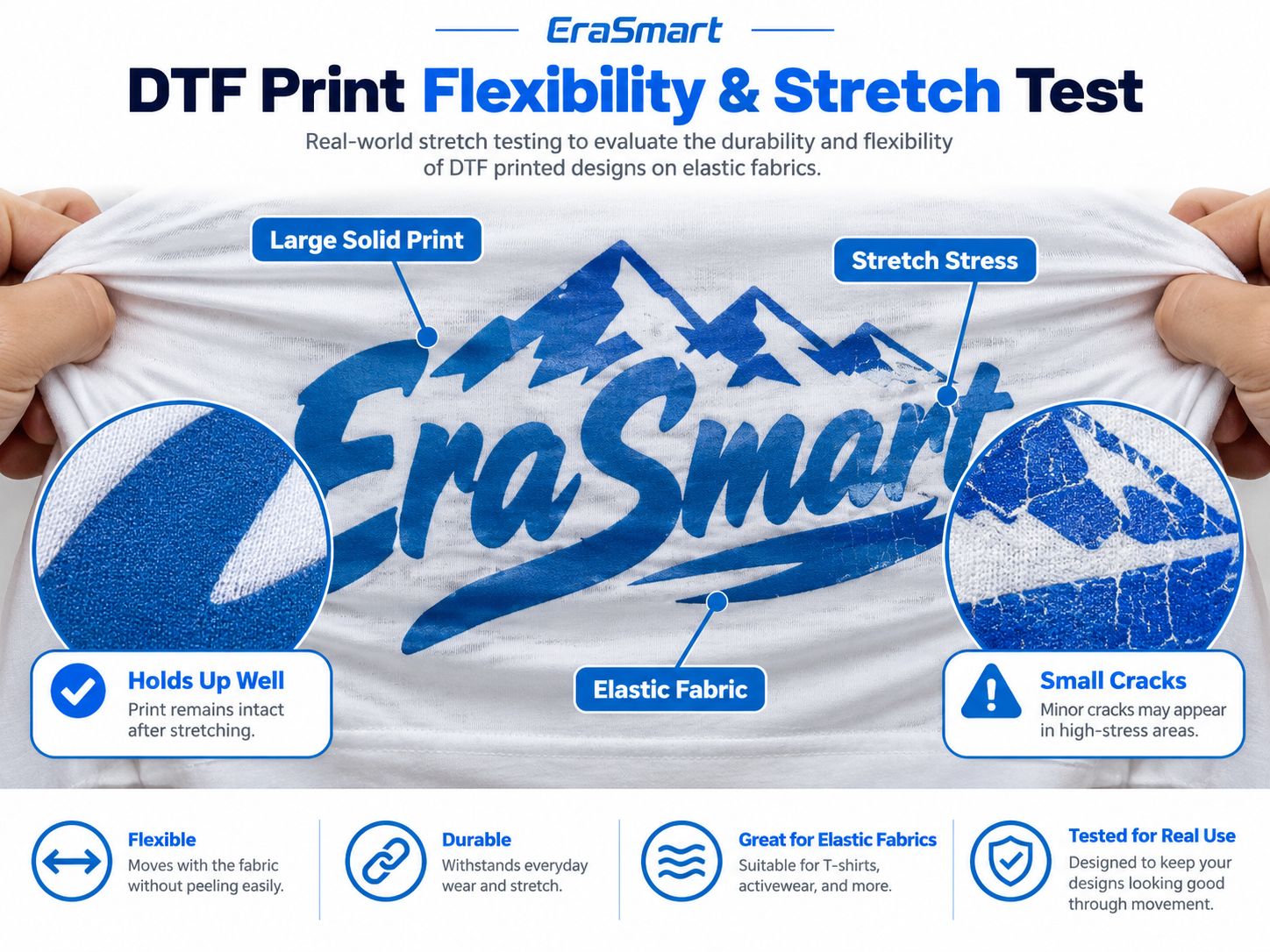
大型ソリッドデザイン
連続インクの大きなブロックは、衣類の動きに合わせて広い範囲にわたって変形する必要がある場合があります。
これにより、印刷層に目に見える応力が生じる可能性があります。
要素間の距離がより広い設計では、異なる機械的応答が得られる場合があります。
ただし、アートワークを分割しても、不適切なインクや接着剤システムが自動的に修正されるわけではありません。
伸縮性の高い領域
グラフィックがどこに配置されているかを検討してください。
比較的安定した T シャツの前面のプリントは、次のようなプリントとは異なる力を受ける可能性があります。
- 伸縮性のあるウエストバンド。
- ぴったりとフィットする袖。
- 伸縮性の高いスポーツウェアです。
- 膝や肘の部分。
ストレッチパフォーマンスを評価する方法
生産予定の生地から作られた代表的なサンプルを使用してください。
- 承認されたアートワークを印刷して転送します。
- 指定された硬化およびプレスプロセスに従ってください。
- 消耗品サプライヤーが要求する取り扱い条件にトランスファーが達するまで待ちます。
- 実際の使用を代表するレベルまで衣服を伸ばします。
- 通常の状態と引き伸ばされた状態でグラフィックを調べます。
- 破損、エッジの浮き、永久的な損傷がないかどうかを確認します。
- 製品の使用目的に応じてテストを繰り返します。
顧客が遭遇するであろう条件をはるかに超えてサンプルを過度に拡張し、その極端な結果を通常使用時のパフォーマンスとして扱うことは避けてください。
硬化不足と硬化過多: DTF 転写に与える影響
硬化は重要な製造段階ですが、誤解されることがよくあります。
最終転写を衣類に適用する前に、接着パウダーを正しく処理する必要があります。

硬化不足とは何ですか?
硬化が不十分であるということは、粉末が意図したワークフローに十分な熱処理を受けていないことを意味します。
考えられる警告サインは次のとおりです。
- 接着剤粒子が不完全に溶けている。
- 接着剤の塗布量が一貫していない。
- その後の転写テストでの接着不良。
- 不規則な表面外観。
硬化が不十分な転写はすべて同じに見えるわけではありません。
見た目だけでは完全な品質テストとはなりません。
過硬化とは何ですか?
過剰硬化とは、推奨プロセスと比べて過剰な熱にさらされることを指します。
接着剤とフィルムのシステムによっては、過度の熱や時間がかかると以下に悪影響を及ぼす可能性があります。
- 粘着性の動作。
- フィルムの状態。
- 転送の柔軟性。
- その後の接着性能。
最終的なプリントにひびが入っても、それ自体ではパウダーが過剰に硬化したことを証明するものではありません。
硬化の問題を確認する方法
実際の粉末および硬化装置に対してメーカーが推奨するプロセスから始めます。
次に、次のことを確認します。
- 加熱が転送全体にわたって均一であるかどうか。
- 接着剤が一貫して処理されているかどうか。
- コンベア速度または滞留時間が変化したかどうか。
- ヒーターの温度が正確に制御されているか。
- 新しい粉末バッチまたは配合が導入されたかどうか。
- 完成した転写物が接着力と柔軟性のテストに合格するかどうか。
比較試験中は硬化条件を一定に保ちます。
硬化温度とヒートプレス温度を混同しないでください
これらは異なる段階です。
| プロセス | 目的 |
|---|---|
| 印刷時の室温 | プリンター、インク、フィルム、粉体の使用環境を維持します。 |
| 粉末硬化温度 | 印刷フィルム上に粘着粉を処理します。 |
| 衣類のヒートプレス温度 | 準備された転写物をテキスタイルに接着します |
正しい設定は、実際のプリンター、フィルム、パウダー、生地、および機器によって異なります。
すべての DTF システムに単一の汎用硬化温度を適用しないでください。
環境制御のより広範な説明については、を参照してください。 温度と湿度が DTF 印刷に与える影響。
ヒートプレス設定がひび割れや剥離に与える影響
ヒートプレスは、DTF 転写プロセスの最終接着段階です。
適切なプレスプロセスでは、次の必要な組み合わせが提供される必要があります。
- 温度。
- プレッシャー。
- 連絡時間。
- グラフィック全体にわたって一貫した接触。
- 正しい皮むき手順。
温度または時間が不十分です
接着剤の加圧条件が適切でない場合、接着が不完全となる場合があります。
これにより、引き延ばしや洗濯時に剥離やその他の耐久性の問題が発生する可能性があります。
過度の温度または時間
過度の露出は、特定の転写システムやファブリックに悪影響を与える可能性があります。
洗濯耐久性を向上させるには、プレス温度を上げることが常に正しい方法だとは考えないでください。
不均一な圧力
圧力が不均一になると、転写の一部の部分が他の部分とは異なる接着を引き起こす可能性があります。
潜在的な寄与要因には次のようなものがあります。
- 衣服の表面が凹凸のある状態。
- 縫い目。
- ボタンまたはジッパー。
- しわ。
- プラテンの接触が不安定です。
- 位置決めが正しくありません。
間違ったピーリング手順
ホットピールプロセスを使用するフィルムもあれば、温間または冷間ピーリングが必要なフィルムもあります。
Follow the instructions for the particular film.
Peeling too early or using the wrong procedure may damage the transfer.
Better Pressing Practice
When investigating durability issues:
- Check the actual platen temperature.
- Confirm the applied pressure and contact time.
- Inspect garment positioning.
- Verify the film’s peel requirements.
- Compare an approved control sample with the defective sample.
- Adjust one variable at a time.
- Repeat adhesion, stretch, and washing tests.
The goal is a validated process, not simply the highest possible temperature or pressure.
Can Too Much White Ink Cause DTF Cracking?
Excessive ink buildup may contribute to a thicker, less flexible transfer structure.
However, white ink is also essential for many DTF applications, especially printing bright colors onto dark garments.
The objective is not to eliminate white ink.
It is to use the appropriate amount for the artwork, fabric, and production system.
White Ink Underbase
White ink supports color opacity and visibility.
If the white layer is too weak, colors may look dull on dark fabric.
If the overall printed structure is unnecessarily thick, flexibility and hand feel may be affected.
What Should You Check?
- White ink nozzle condition.
- Underbase consistency.
- RIP settings.
- Overall ink coverage.
- Transfer thickness.
- Finished garment flexibility.
Do not arbitrarily reduce white ink density without checking the resulting opacity and transfer quality.
For additional guidance, read the ホワイトインク印刷ガイド。
Can the Wrong DTF Powder Cause Cracking?
Adhesive powder is one of the most important components of a DTF transfer.
It helps bond the printed image to the fabric.
But different adhesive formulations can behave differently.
Powder Selection Matters
A powder may be selected according to:
- Fabric composition.
- Required flexibility.
- Finished hand feel.
- Pressing conditions.
- Intended end use.
For example, a highly elastic garment may require a different material evaluation from a relatively stable promotional cotton T-shirt.
Powder Amount Matters
Uneven or excessive powder application can create problems in transfer consistency.
Insufficient powder may leave some areas with inadequate adhesive.
The correct application should follow the recommended consumable workflow.
Powder Condition Matters
Moisture exposure, contamination, or powder clumping can also affect production consistency.
For an in-depth explanation, see Why Is DTF Powder Clumping?。
フィルム、インク、パウダーは連携する必要があります
消耗品を 1 つだけ変更すると、転送全体のパフォーマンスが変わる可能性があります。
パウダーを切り替える前に、以下の適合性を評価してください。
インク + PETフィルム + 粘着パウダー + 硬化 + 生地 + 熱プレス
詳細については、 DTF 消耗品ガイド。
最初の洗濯後に DTF プリントに亀裂が入るのはなぜですか?
お客様は最初からプリントに欠陥があると考えることが多いため、最初の洗濯後のひび割れは特にイライラさせられます。
場合によっては、その懸念は正当化されるかもしれません。
転送は、押した直後は視覚的に許容できるように見えますが、次の点で問題が残ります。
- 接着剤による接合。
- 柔軟性。
- 硬化。
- インクフィルムの互換性。
- 生地の互換性。
洗浄プロセスでは、グラフィックが繰り返しの動き、湿気、洗剤、その他のストレスにさらされます。
If the transfer was already marginal, visible damage may appear quickly.
What Should You Check First?
1. Inspect an unwashed sample
Does a sample from the same production batch show cracks during stretching?
2. Review the curing record
Were the powder-curing settings correct and consistent?
3. Review the pressing record
Were time, temperature, pressure, and peeling performed correctly?
4. Check the garment
Was it the same fabric and garment construction as the approved sample?
5. Check washing conditions
Were the customer care instructions followed?
6. Compare other garments from the same batch
If several products fail under similar conditions, investigate the shared production process.
If only one garment fails, consider differences in fabric, handling, and laundering as well.
Do not conclude that one factor caused the failure without investigating the evidence.
Why Do DTF Prints Crack After Several Washes?
Some graphics perform well initially but deteriorate gradually.
Possible contributing factors include:
- Repeated stretching and flexing.
- Mechanical abrasion.
- Wash-cycle intensity.
- Detergent compatibility.
- Drying temperature.
- Gradual wear.
- Transfer formulation and application quality.
A graphic that is repeatedly stretched may show fatigue differently from one on a relatively stable part of the garment.
It is also important to distinguish normal long-term wear from unusually rapid failure.
If prints begin cracking much sooner than expected for the intended product, carry out controlled comparison testing.
Can You Fix an Already Cracked DTF Print?
損傷の種類と程度によって異なります。
微細な表面亀裂
印刷層が物理的に破壊されると、再加熱しても元のアートワークを確実に復元することはできません。
ヒートプレスを行うと一部の損傷部分の外観が変わる場合がありますが、保証された修理手順として扱うべきではありません。
エッジの剥離
問題が亀裂ではなくエッジの浮きである場合は、回復について別の考慮事項が必要になる可能性があります。
ただし、再プレスは、転写サプライヤーが許可した場合と、元の接着の問題を調査した後にのみ試みてください。
エッジが再び接着しているように見える場合でも、製品の耐久性テストが必要な場合があります。
ひどくひび割れたグラフィックス
商業顧客からの注文の場合、多くの場合、交換または再印刷の方がより信頼性の高い解決策となります。
Trying to disguise a severely damaged transfer can lead to further complaints.
Before Reprinting
Identify the likely cause.
Otherwise, the replacement may fail in exactly the same way.
Fix the process before replacing the product.
How to Prevent DTF Prints from Cracking
Prevention starts before printing and continues through final product testing.

Step 1: Prepare Suitable Artwork
Use artwork at the intended dimensions and resolution.
Consider the mechanical requirements of the design.
Large solid graphics on high-stretch garments should be evaluated for flexibility.
Step 2: Maintain Consistent Ink Output
Run appropriate nozzle checks.
Check white ink circulation and output consistency.
Use compatible ink and established print settings.
Step 3: Apply Powder Evenly
Confirm that adhesive powder is distributed consistently over the printed image.
Avoid contaminated, heavily clumped, or unsuitable powder.
Step 4: Cure According to the Consumable Requirements
Use the validated process for the specific adhesive powder, film, and curing equipment.
Do not rely on one universal temperature and time.
Step 5: Press Correctly
確認する:
- 温度。
- プレッシャー。
- Time.
- Garment positioning.
- Film peeling requirements.
Avoid making several changes at once.
Step 6: Test the Finished Transfer
評価する:
- 粘着力。
- 柔軟性。
- Stretch performance.
- Washing durability.
- Appearance after drying.
Record successful settings so that production can be repeated consistently.
DTF Cracking Troubleshooting Chart
The following chart provides a starting point for identifying common problems.

| 症状 | 考えられる原因 | First Checks | 推奨方向 |
|---|---|---|---|
| Cracks after the first wash | Curing, pressing, flexibility, washing | Unwashed control sample, production records | Test the complete transfer workflow |
| Cracks when stretched | Transfer too stiff for application, material mismatch | Ink thickness, fabric elasticity, consumables | Evaluate flexible transfer combinations |
| Print feels hard or brittle | Thick structure, adhesive formulation, thermal processing | Powder type, ink coverage, curing | Compare validated materials and settings |
| Graphic edges peel | Adhesive bonding problem | Powder coverage, press settings, fabric | Investigate adhesion separately from cracking |
| Some areas crack, others remain intact | Uneven printing, curing, pressing, or garment stress | Coverage uniformity, platen contact | Improve consistency and retest |
| Color fades without cracking | Color performance, washing, abrasion | Print profile, ink, laundering | Investigate color stability |
| Cracks appear only on one fabric | Fabric stretch or surface differences | Fabric construction, coating, elasticity | Validate the transfer for that fabric |
| Entire batch fails | Shared production problem | Consumable batches, settings, equipment | Hold production and investigate common variables |
Use this chart to guide diagnosis, not to assign a guaranteed cause from one visible symptom.
How to Test DTF Wash and Stretch Durability
Testing is one of the most reliable ways to prevent customer complaints.
A good test procedure should reflect the garments, production workflow, and intended use.
1. Prepare Representative Samples
実際のものを使用します。
- Fabric.
- DTF ink.
- PET film.
- Adhesive powder.
- Curing conditions.
- Heat-press settings.
For meaningful comparisons, keep these variables consistent.
2. Inspect the Initial Transfer
Before washing, record:
- 印刷の外観。
- エッジ接着。
- 柔軟性。
- 色。
- 表面状態。
写真は後で変更を比較するのに役立ちます。
3. 制御されたストレッチテストを実行する
実際の使用を代表する範囲内で衣服を伸ばします。
探す:
- 細かい亀裂。
- 永久骨折。
- エッジリフティング。
- 外観の変化。
サンプルを一方向にだけ引っ張るのではなく、衣類の関連部分をテストします。
4. 反復可能な洗浄テストを実行する
一貫した洗浄手順を確立します。
記録:
- 洗浄温度。
- 洗濯プログラム。
- 洗剤。
- 負荷条件。
- 乾燥方法。
- サイクル数。
異なるインキ、パウダー、プレス条件を比較する場合も同様の手順で行ってください。
正式な繊維テストの場合、 ISO 6330:2021 — テキスタイル: テキスタイル試験のための家庭内での洗濯および乾燥手順 標準化された洗濯手順を提供します。
しかし、 using a specified laundering procedure does not by itself certify that a DTF print is crack-proof. The finished graphic still needs to be assessed against appropriate durability criteria.
5. Inspect After Each Test Stage
探す:
- Cracking.
- Peeling.
- Color change.
- Distortion.
- Surface wear.
Document when the first defect appears.
6. Compare Against the Approved Reference
A useful production test compares:
Reference Sample vs New Material or New Setting
For example, if you are testing a new adhesive powder, keep the other variables as consistent as possible.
This makes the results easier to interpret.
7. Record and Standardize the Successful Process
Once a transfer passes the relevant checks, document the approved production conditions.
Keep records of:
- Ink and batch.
- Film and batch.
- Powder and batch.
- Fabric.
- Artwork.
- RIP settings.
- Curing process.
- Pressing conditions.
- Wash-test observations.
- Stretch-test observations.
This creates a more repeatable production process.
How Should Customers Wash DTF-Printed Garments?
Proper garment care can help reduce avoidable stress on printed graphics.
Care instructions should be based on the fabric, ink, adhesive, and completed garment.
Common recommendations for suitable DTF garments may include:
- Turn the garment inside out before washing.
- Use a gentle washing program.
- Avoid unnecessarily high wash temperatures.
- Use a suitable mild detergent.
- Avoid aggressive bleaching unless the finished product is specifically approved for it.
- Limit excessive mechanical abrasion.
- Follow the garment’s approved drying instructions.
- Avoid applying a hot iron directly onto the printed design unless the process is specifically approved.
正しい洗濯指示が製品全体について検証される必要があります。
注意深く洗浄することは役に立ちますが、間違って生成された転写を補償することはできません。
適切な衣類のお手入れにもかかわらずプリントにすぐにひびが入った場合は、プリントと転写のプロセスを調査してください。
一貫した DTF 生産が 1 つの成功したサンプルよりも重要である理由
1 回の最初の検査に合格したプリントは、長期にわたる一貫した生産の証拠にはなりません。
たとえば、ショップは以下を使用してテストを成功させる可能性があります。
- 粉末バッチ 1 つ。
- インク供給は 1 つです。
- フィルムタイプは1種類。
- 衣服の素材は 1 つです。
その後、オペレーターは粉末を変更したり、生産速度を上げたり、衣類のサプライヤーを切り替えたりします。
印刷プロセスは同じように見えますが、完成した転写パフォーマンスは変わる可能性があります。
This is why DTF quality control should include both:
Process Consistency
そして
Finished-Product Testing
Changes to materials or equipment settings should trigger appropriate revalidation.
For broader workflow guidance, see DTF 印刷の一般的な問題。
Final Answer: How Do You Stop DTF Prints from Cracking?
DTF cracking is usually a sign that the printed transfer is not performing adequately under the mechanical and environmental conditions of its intended use.
The most important factors to investigate are:
- 転送の柔軟性。
- Ink and white ink coverage.
- Adhesive powder compatibility.
- Powder curing.
- Heat-press settings.
- Fabric characteristics.
- Stretching and washing conditions.
When cracking occurs, use a controlled troubleshooting process:
Identify the Symptom → Inspect the Transfer → Check Materials → Review Curing → Review Pressing → Test → Standardize
Do not assume every crack is caused by insufficient heat.
Do not assume every durability failure is caused by the washing machine.
And do not attempt to solve all DTF problems by increasing ink, powder, temperature, or pressure.
The best results come from matching the complete transfer system to the intended garment and validating that combination through realistic testing.
For further guidance, explore:
よくある質問
Why do my DTF prints crack after washing?
Possible causes include insufficient flexibility, incorrect powder curing, unsuitable pressing conditions, incompatible materials, and harsh laundering. Check the complete production process rather than assuming washing is the only cause.
Why do DTF prints crack after the first wash?
The first wash may reveal weaknesses in the transfer’s adhesion or flexibility. Compare the washed garment with an unwashed sample from the same production batch.
Can DTF prints crack when stretched?
Yes. If the printed structure cannot tolerate the deformation of the garment, visible fractures may develop. This is especially relevant for highly elastic fabrics or large continuous graphics.
Is DTF cracking the same as peeling?
No. Cracking involves fractures through the graphic. Peeling involves the graphic lifting or separating from the fabric.
Does too much white ink cause DTF cracking?
Excessively thick ink layers may affect flexibility, but white ink is necessary for many DTF applications. Review the complete ink structure rather than reducing white ink without testing.
Can under-cured DTF powder cause durability problems?
Yes. Incomplete adhesive processing can contribute to inconsistent bonding and transfer performance. Verify curing conditions for the actual powder and equipment.
Can over-curing cause DTF cracking?
Excessive thermal exposure may negatively affect certain transfer systems. However, cracking alone does not prove over-curing. Compare validated processing conditions and test the finished transfer.
Can incorrect heat-press pressure cause cracking?
Incorrect pressure can affect transfer bonding and may contribute to durability problems. Check temperature, pressure, time, garment positioning, and film requirements together.
Why does my DTF print feel hard?
A stiff transfer may result from its ink coverage, adhesive formulation, design structure, or processing conditions. Compare the finished feel with an approved reference sample.
Why do DTF prints crack on polyester or stretch fabric?
Different fabrics have different elasticity and surface characteristics. The transfer must be suitable for the actual garment and expected movement.
Can I fix a cracked DTF print with a heat press?
A physically fractured printed layer is not reliably restored by reheating. Re-pressing may be considered for certain adhesion problems only when supported by the transfer supplier, but it is not a guaranteed repair for cracking.
Should I use more powder to prevent cracking?
Not automatically. Excessive or uneven adhesive application can create other problems. Use the appropriate powder and coverage for the intended transfer system.
Does washing temperature affect DTF durability?
Washing temperature, agitation, detergent, and drying conditions may influence long-term performance. Follow care instructions validated for the finished garment.
How many washes should a DTF print last?
There is no universal number that applies to every DTF ink, film, powder, fabric, and production process. Wash-durability claims should be based on actual testing.
How do I test DTF prints before selling them?
Use representative garments, controlled stretch testing, repeatable laundering conditions, and visual inspections for cracking, peeling, fading, and other changes.
How do I prevent DTF cracking in commercial production?
Standardize compatible consumables, ink coverage, curing, pressing, garment selection, and quality testing. Revalidate the process whenever important materials or production settings change.
Build a More Reliable DTF Printing Workflow with EraSmart
If your DTF production is experiencing:
- Cracking after washing.
- Peeling transfers.
- Poor flexibility.
- Inconsistent powder curing.
- Weak wash durability.
- Excessively stiff graphics.
- Batch-to-batch quality variation.
The best starting point is to evaluate the entire production system.
EraSmart provides DTF printing equipment and workflow solutions for customized apparel and compatible textile applications.
を探索してください EraSmart DTF プリンター range to compare printing equipment for your production requirements.
When discussing a durability problem, the following information can help identify the likely cause:
- DTF printer model.
- Ink and powder type.
- PET film type.
- Fabric composition.
- Curing process.
- Heat-press settings.
- Washing conditions.
- Photographs of the damaged print.
あなたも好きかもしれません
著作権2020©Erasmart。 | サイトマップ