Küçük boyutlu düz yataklı mürekkep püskürtmeli yazıcı üreticisi

Metal Üzerine UV Baskı: Proses, En İyi Metal Çeşitleri, Yüzey Hazırlığı ve Uygulamaları
UV printing makes it possible to print full-color graphics, white ink and varnish effects directly onto many suitable metal surfaces, including aluminum, stainless steel, coated steel, brass and copper.
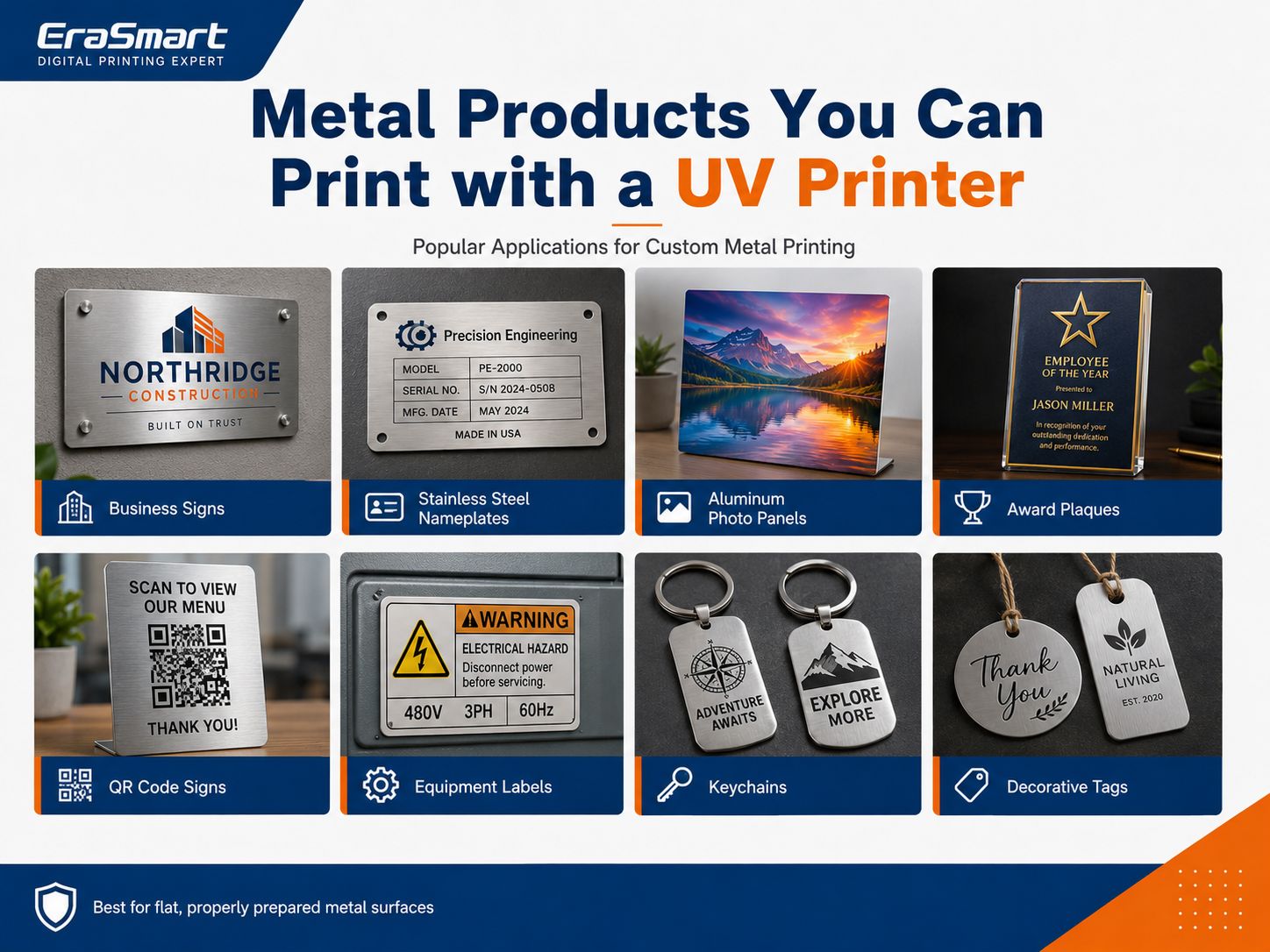
For custom print shops, sign makers, gift businesses and small manufacturers, this opens applications such as:
- metal işaretleri
- stainless-steel nameplates
- aluminum photo panels
- ekipman etiketleri
- QR kod işaretleri
- decorative metal tags
- ödüller
- markalı plakalar
- promosyon ürünleri
However, successful UV printing on metal depends on more than the printer.
Metal is a smooth, non-porous substrate. UV ink normally remains on the surface instead of absorbing into the material, which means oil, fingerprints, oxidation, anodizing, paint, powder coating, protective films and other surface treatments can significantly affect adhesion.
The professional workflow is therefore:
Identify the metal surface → clean and degrease → prepare the artwork → choose CMYK/white/varnish layers → print a sample → test adhesion → standardize the setup → begin production
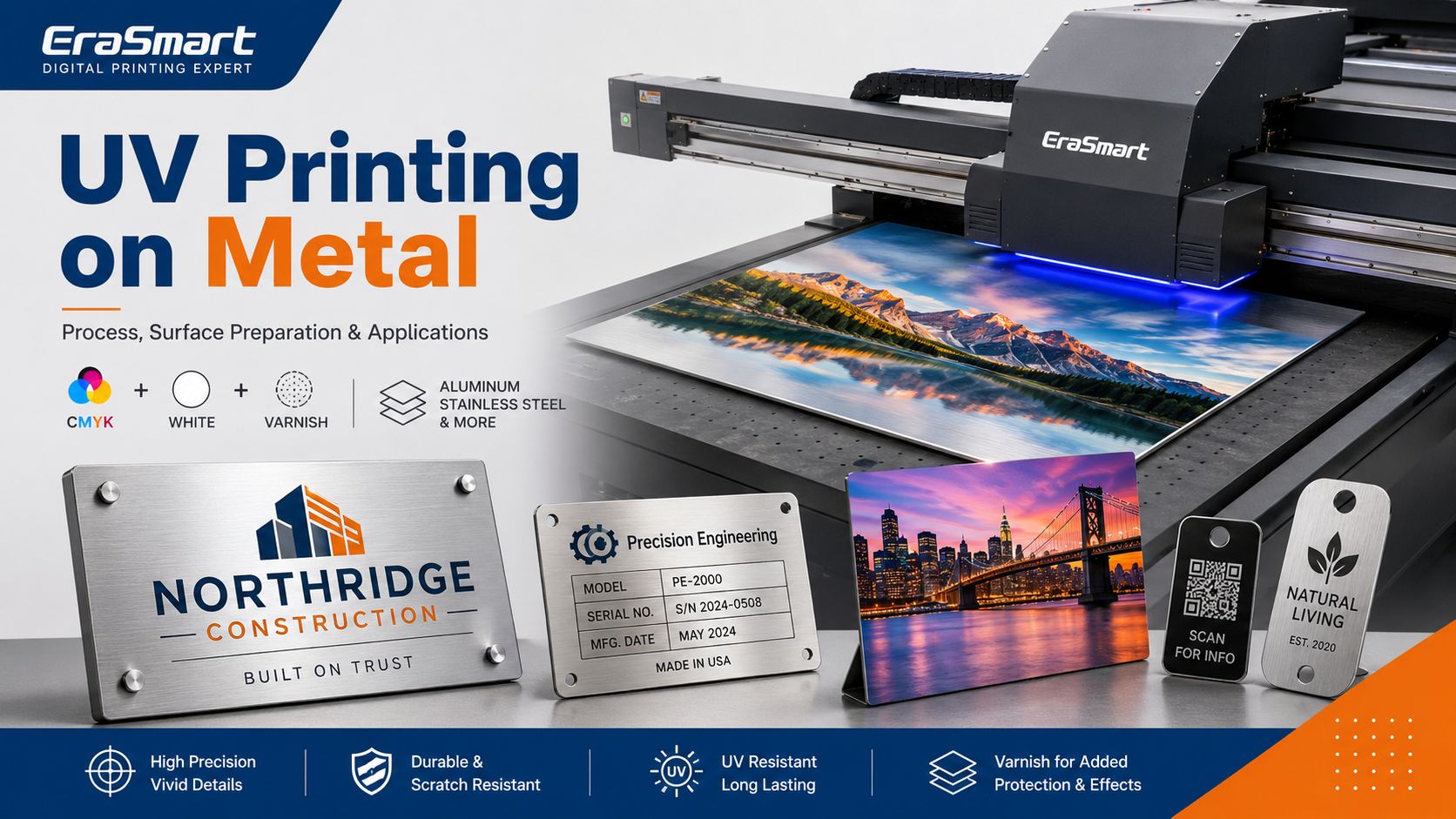
This guide explains how UV printing on metal works, which metals are commonly used, how to prepare metal surfaces, when white ink or primer may be needed, how to test adhesion, and how to choose an EraSmart UV yazıcı for different metal products.
Quick Answer: Can a UV Printer Print on Metal?
Yes. A UV flatbed printer can print directly onto many suitable metal surfaces.
But “printable” does not automatically mean “perfect adhesion.”
Different metals and coatings require different preparation.
| Soru | Pratik Cevap |
|---|---|
| Can UV printers print on metal? | Yes, after material testing |
| Common metals | Aluminum, stainless steel, coated steel, brass, copper |
| Does metal absorb UV ink? | No, UV ink generally cures on the surface |
| Is white ink useful? | Yes, especially on dark, silver or transparent-looking backgrounds |
| Is primer always required? | No; it depends on the exact surface |
| Is a heat press required? | HAYIR |
| Main production challenge | Surface preparation and adhesion |
| En iyi uygulamalar | Signs, nameplates, panels, tags, awards and branded products |
En önemli kural basit:
Test the exact metal product you intend to sell.
Two aluminum sheets that look almost identical can have different coatings and therefore different adhesion performance.
How Does UV Printing on Metal Work?
UV printing is a digital direct-to-surface process.
Instead of transferring an image from paper or film, a UV flatbed printer jets UV-curable ink directly onto the metal.
A simplified process is:
- Prepare the digital artwork.
- Process the file in RIP software.
- Create CMYK, white and varnish layers as required.
- Position the metal on the printer bed.
- Jet UV ink onto the surface.
- UV LED ışığı baskı sırasında mürekkebi iyileştirir.
- Inspect the finished print.
- Test adhesion before production approval.
Unlike water-based or solvent-based inks that rely heavily on absorption or evaporation, UV ink is cured through a light-triggered polymerization process.
Mürekkebin kendisi hakkında daha derin bir açıklama için bkz. UV Mürekkep Nedir?.
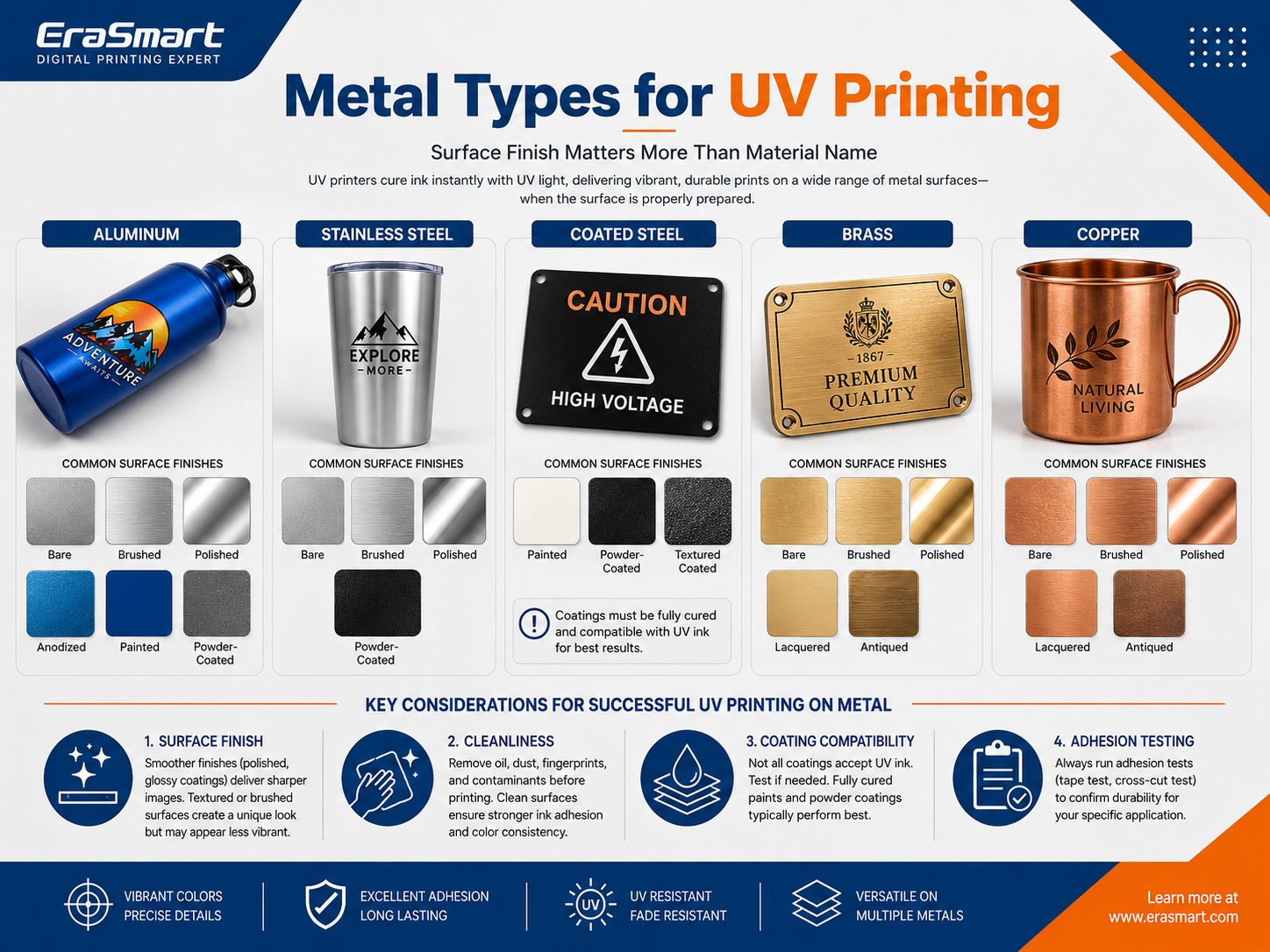
Which Metals Can You UV Print On?
Many metal products can be customized with a UV printer, but the surface finish often matters as much as the metal type.
Ortak malzemeler şunları içerir:
- aluminum
- stainless steel
- coated steel
- brass
- copper
- painted metal
- anodized aluminum
- powder-coated metal
Aluminum
Aluminum is widely used for:
- tabela
- isim levhaları
- fotoğraf panelleri
- ödüller
- promosyon ürünleri
- ekran panelleri
- equipment identification
However, “aluminum” can describe several very different print surfaces.
Bare Aluminum
The natural metallic appearance can become part of the design, but adhesion needs to be tested carefully.
Brushed Aluminum
Brushed aluminum provides a premium metallic texture.
When CMYK is printed without a complete white underbase, some of that metallic effect can remain visible through the artwork.
Anodized Aluminum
Anodizing changes the aluminum surface and can provide a consistent decorative finish.
Different anodized coatings should still be tested individually.
Painted or Coated Aluminum
A coated sheet may provide a more uniform printing background.
But remember:
The UV ink is bonding to the coating—not directly to the aluminum underneath it.
Kaplama bu nedenle yapışma sisteminin bir parçası haline gelir.
Stainless Steel
Stainless steel is popular for:
- premium nameplates
- business signage
- markalı plakalar
- decorative products
- ekipman etiketleri
- plaklar
Common finishes include:
- bare stainless steel
- brushed stainless steel
- polished stainless steel
- painted stainless steel
- coated stainless steel
Stainless steel can be more challenging because it is smooth and non-porous.
Potential contaminants include:
- parmak izleri
- yağ
- polishing compound
- üretim artığı
- protective-film adhesive
Proper degreasing and adhesion testing are therefore especially important.
A future material-specific guide can go deeper into UV printing on stainless steel, including brushed vs polished surfaces and adhesion-promoter selection.
Coated and Powder-Coated Steel
Coated steel is common in:
- ekipman panelleri
- işaretler
- industrial housings
- branded components
- ürünleri göster
In this case, printing performance depends strongly on the coating.
A fully cured compatible coating may provide a good printing surface, while another coating may have poor surface energy and weak UV ink adhesion.
Never approve a coated metal based on appearance alone.
Brass
Brass can create a premium traditional look for:
- plaklar
- ödüller
- işaretler
- decorative branding
- luxury gifts
Because brass surfaces may oxidize or receive lacquer and polishing treatments, clean and test the exact blank.
Copper
Copper offers a distinctive natural color and is useful for:
- dekoratif plaklar
- sanat ürünleri
- prim hediyeler
- markalı parçalar
Oxidation, protective coatings and surface polishing can all influence printing performance.
Bare Metal vs Coated Metal
A useful way to evaluate metal is by surface condition rather than only by alloy.
| Metal Surface | Main Visual Advantage | Main Printing Consideration |
|---|---|---|
| Bare metal | Natural metallic appearance | Yapışma |
| Brushed metal | Premium texture | Grain affects appearance |
| Polished metal | Reflective finish | Fingerprints and adhesion |
| Anodized aluminum | Consistent decorative finish | Anodized coating varies |
| Painted metal | Controlled background color | Paint compatibility |
| Powder-coated metal | Finished commercial surface | Coating chemistry |
| Lacquered metal | Premium protective appearance | Ink-to-lacquer adhesion |
This is why material testing is central to professional metal UV printing.
For other substrate types, see our UV Yazıcı Malzemeleri Kılavuzu.
How to Prepare Metal Before UV Printing
Surface preparation is one of the most important stages in the entire workflow.
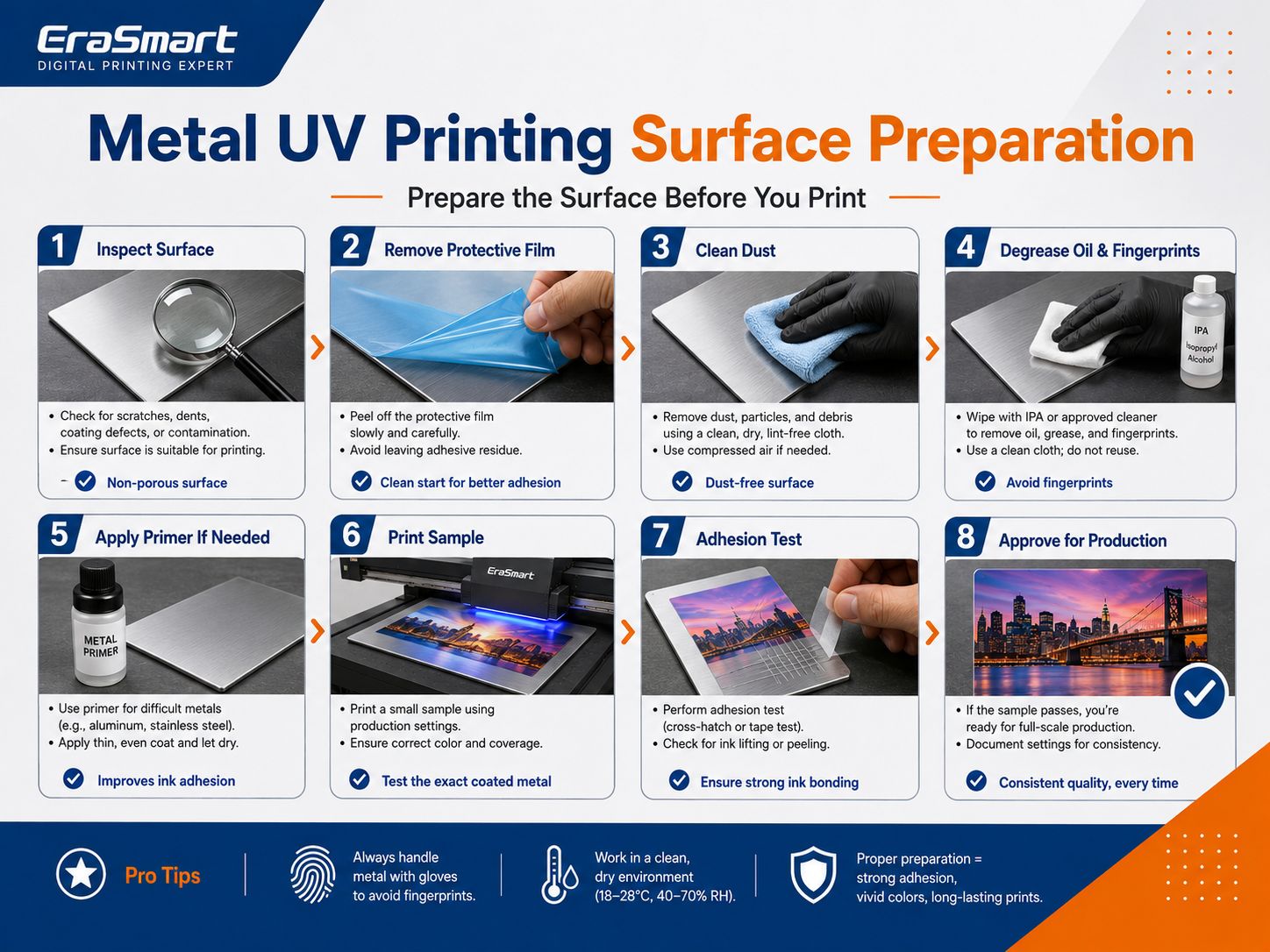
Step 1: Identify the Exact Surface
Determine whether the metal is:
- bare
- brushed
- polished
- anodized
- boyalı
- powder coated
- lake
- otherwise treated
Do not treat all metal as one substrate preset.
Step 2: Inspect the Surface
Aramak:
- çizikler
- ezikler
- oxidation
- kirlenme
- coating defects
- eğrilme
- koruyucu film
A premium print cannot hide every substrate defect.
Step 3: Remove Protective Film When Appropriate
Some metal blanks arrive with a protective film.
Remove it according to the blank manufacturer’s workflow before printing on the intended finished surface.
Check that no adhesive residue remains.
Step 4: Remove Dust
Uygun, tüy bırakmayan bir temizleme yöntemi kullanın.
Particles can interfere with:
- baskı kalitesi
- yapışma
- ince metin
- varnish effects
Step 5: Degrease the Metal
Metal can easily retain:
- parmak izleri
- machining oil
- polishing residue
- manufacturing grease
Use a compatible cleaning method for the specific metal and coating.
After cleaning, handle the printable area carefully to avoid contaminating it again.
Step 6: Evaluate Primer or Adhesion Promoter
Some metal surfaces may benefit from an appropriate primer or adhesion promoter.
But primer is not universally required.
Doğru yaklaşım şudur:
test without primer → evaluate adhesion → test compatible pretreatment if necessary → compare results
Always follow the ink, substrate and pretreatment supplier’s compatibility requirements.
Step 7: Print a Sample
Aynısını kullanın:
- maden
- yüzey kalitesi
- sanat eseri
- mürekkep katmanları
- curing configuration
that you intend to use in production.
Adım 8: Yapışma Testi
Do not judge success only by appearance.
The print may look perfect immediately after printing but still have insufficient adhesion for the intended application.
Do You Need Primer for UV Printing on Metal?
Bazen.
There is no responsible universal answer.
Astar gereksinimleri şunlara bağlıdır:
- metal type
- yüzey enerjisi
- kaplama
- polishing
- oxidation
- UV mürekkep formülasyonu
- curing
- gerekli dayanıklılık
- son başvuru
Some coated or treated metal blanks may perform adequately without additional pretreatment.
Some polished, bare or difficult surfaces may require a compatible adhesion promoter.
Öyleyse:
Do not apply primer automatically, and do not assume primer is never necessary.
Alt tabakayı tam olarak test edin.
CMYK, White Ink and Varnish on Metal
Metal gives designers an additional variable that white paper does not:
the substrate itself has color and reflectivity.
This means white ink can dramatically change the final appearance.
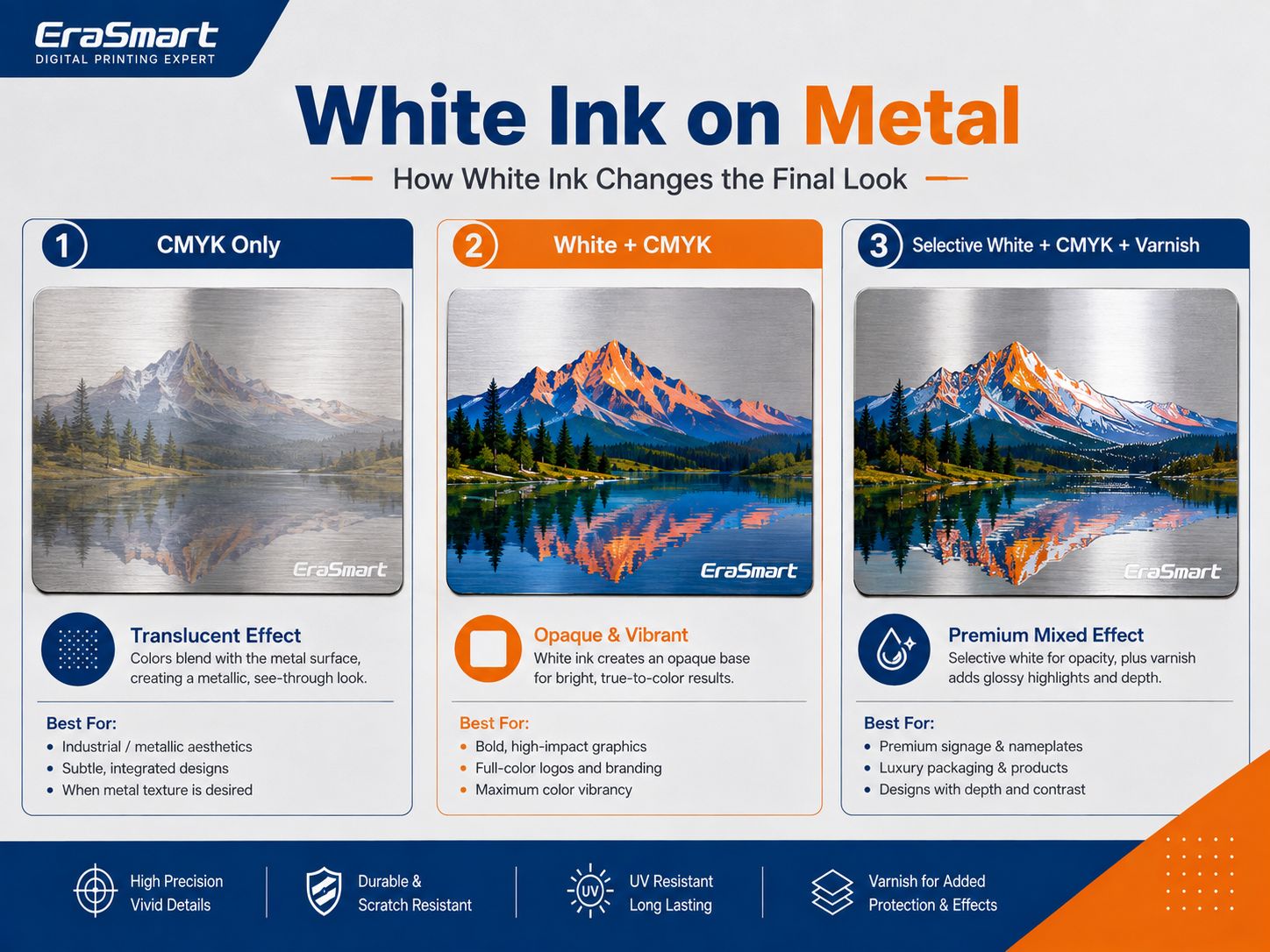
Yalnızca CMYK
Printing CMYK directly onto silver or brushed metal allows the metal to influence the artwork.
This can create:
- metallic highlights
- translucent-looking color
- integrated metal texture
- industrial design effects
This approach is useful when the metallic background is intentionally part of the design.
However, color will not look exactly like the same artwork printed on white paper.
Beyaz + CMYK
A white underbase reduces the influence of the metal color.
Bu şu durumlarda faydalıdır:
- fotoğraflar
- colorful logos
- brand colors
- resimler
- dark metal
- brushed stainless steel
- silver aluminum
White + CMYK can produce a more opaque and predictable full-color result.
Seçici Beyaz + CMYK
Selective white allows only part of the design to receive a white underbase.
Örneğin:
- white under the logo
- no white under the background
- full color in one area
- visible brushed metal in another
This creates a premium combination of:
natural metallic texture + controlled full color
Vernik
On supported EraSmart configurations, varnish can add:
- nokta parlak
- vurgulanan logolar
- dekoratif doku
- yükseltilmiş etkiler
- premium contrast
Varnish should be treated as a design layer—not automatically applied everywhere.
For more detail, see the UV Mürekkep Kılavuzu: CMYK, Beyaz ve Vernik.
How to UV Print on Metal Step by Step
Once the metal has passed initial material testing, build a repeatable workflow.
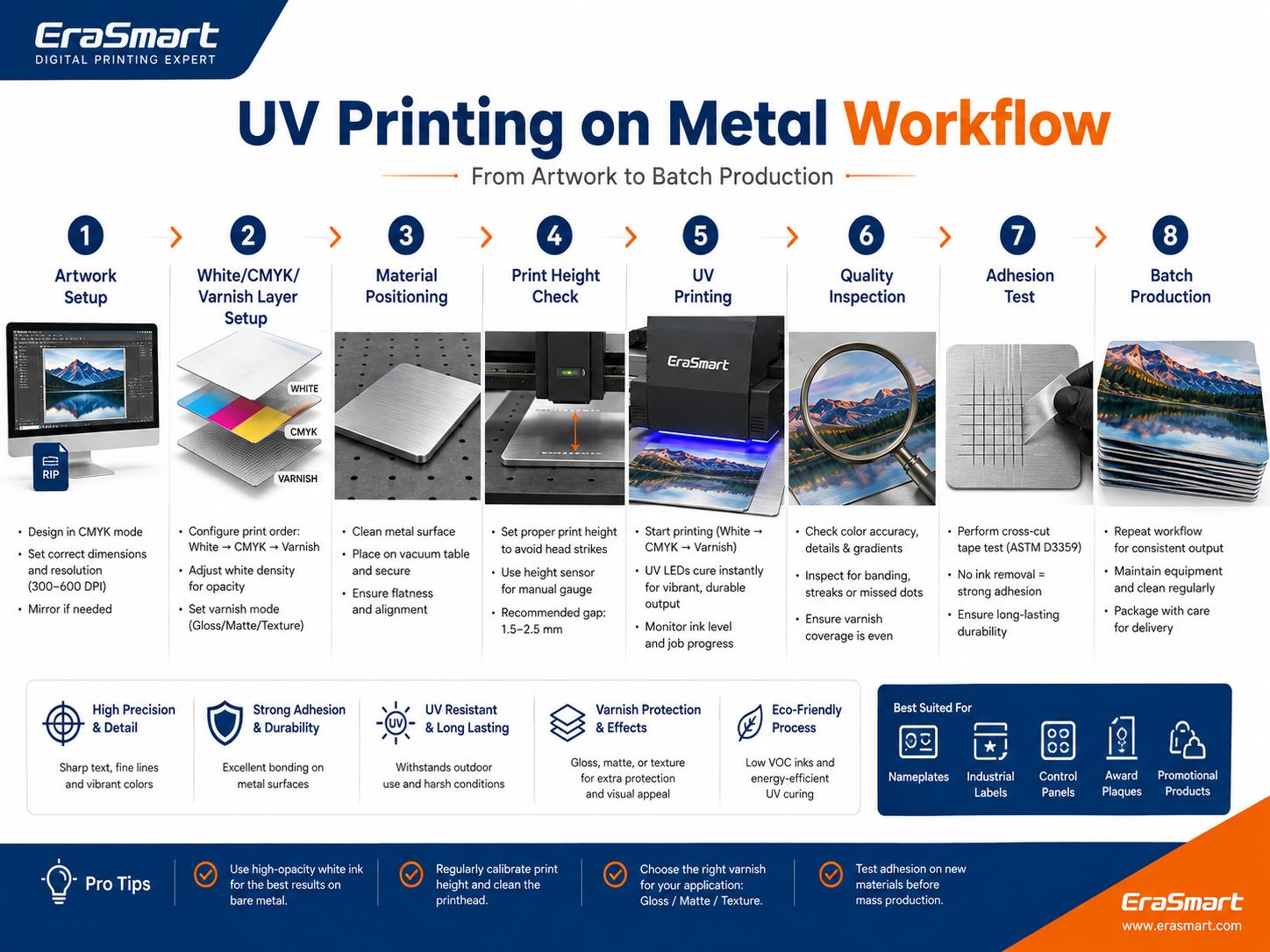
Adım 1: Resmi Hazırlayın
Onaylamak:
- son boyutlar
- görüntü çözünürlüğü
- logolar
- metin
- kanama
- yazdırma konumu
Vektör çizimleri aşağıdakiler için tercih edilir:
- metin
- QR kodları
- logolar
- serial information
- çizgi grafikler
Around 300 DPI at final size is a practical starting point for high-quality raster artwork viewed at close distance.
Step 2: Prepare CMYK, White and Varnish Layers
Decide whether the job requires:
- Yalnızca CMYK
- Beyaz + CMYK
- Seçici Beyaz + CMYK
- Beyaz + CMYK + Vernik
The choice should follow the desired visual effect.
Step 3: Position the Metal
Flat metal pieces should sit securely on the printing platform.
For repeat orders, consider using:
- şakalar
- demirbaşlar
- köşe referansları
- şablonlar
- fixed positioning coordinates
Adım 4: Baskı Yüksekliğini Ayarlayın
Correct printhead clearance is essential.
A badly warped metal sheet can create inconsistent printhead distance and should not be treated as a normal production blank.
Adım 5: Bir Örnek Yazdırın
Before starting the full order, check:
- renk
- beyaz mürekkep
- kayıt
- küçük metin
- vernik
- konumlandırma
6. Adım: Baskıyı İnceleyin
Aramak:
- şeritlenme
- eksik nozullar
- alignment errors
- toz
- surface defects
- inconsistent white
- uneven varnish
Adım 7: Yapışmayı Test Edin
Evaluate whether the print is suitable for the actual product requirement.
Step 8: Standardize Batch Production
Onaylandıktan sonra:
- RIP ön ayarını kaydedin
- record the material
- temizleme işlemini kaydedin
- jig'i kilitle
- record positioning
- document the white/varnish structure
This turns an experimental print into a repeatable production workflow.
How to Test UV Ink Adhesion on Metal
Adhesion should be evaluated according to the end use.
İlk Sürtünme Kontrolü
Bariz yapışma arızasını tespit etmek için kullanışlıdır.
If ink immediately lifts under light handling, the surface preparation or ink/substrate combination should be reviewed.
Bant Tabanlı Dahili Kontrol
A controlled tape check can help compare production samples.
If your customer requires compliance with a specific recognized adhesion-test standard, follow the exact standard and test conditions rather than relying on an informal shop test.
Scratch and Abrasion Evaluation
Products such as:
- anahtarlıklar
- ekipman etiketleri
- frequently handled signs
may require more abrasion resistance than decorative wall art.
Test accordingly.
Temizleme Direnci
If the final product will be wiped or cleaned regularly, test it using cleaning conditions representative of actual use.
Do not describe a UV-printed product as meeting an industrial, automotive, chemical, outdoor or other regulated durability standard unless the finished product has actually been tested to that standard.
UV Printing vs Sublimation on Metal
Both methods can create full-color metal products, but their workflows are different.
| Özellik | UV Baskı | Yüceltme |
|---|---|---|
| Direct to metal | Yes, on suitable surfaces | HAYIR |
| Special coating | Depends on metal | Sublimation coating required |
| Beyaz mürekkep | Evet | HAYIR |
| Isı presi | HAYIR | Evet |
| Dark metal | Beyaz alt taban mümkün | Generally unsuitable for normal sublimation |
| Vernik | Desteklenen UV sistemlerinde mevcuttur | HAYIR |
| Variable short-run work | Harika | Harika |
| Main requirement | Yapışma | Sublimation-compatible coating |
Sublimation remains a strong option for purpose-made coated photo panels.
UV printing offers greater flexibility when white ink, direct printing, different surface types or varnish effects are required.
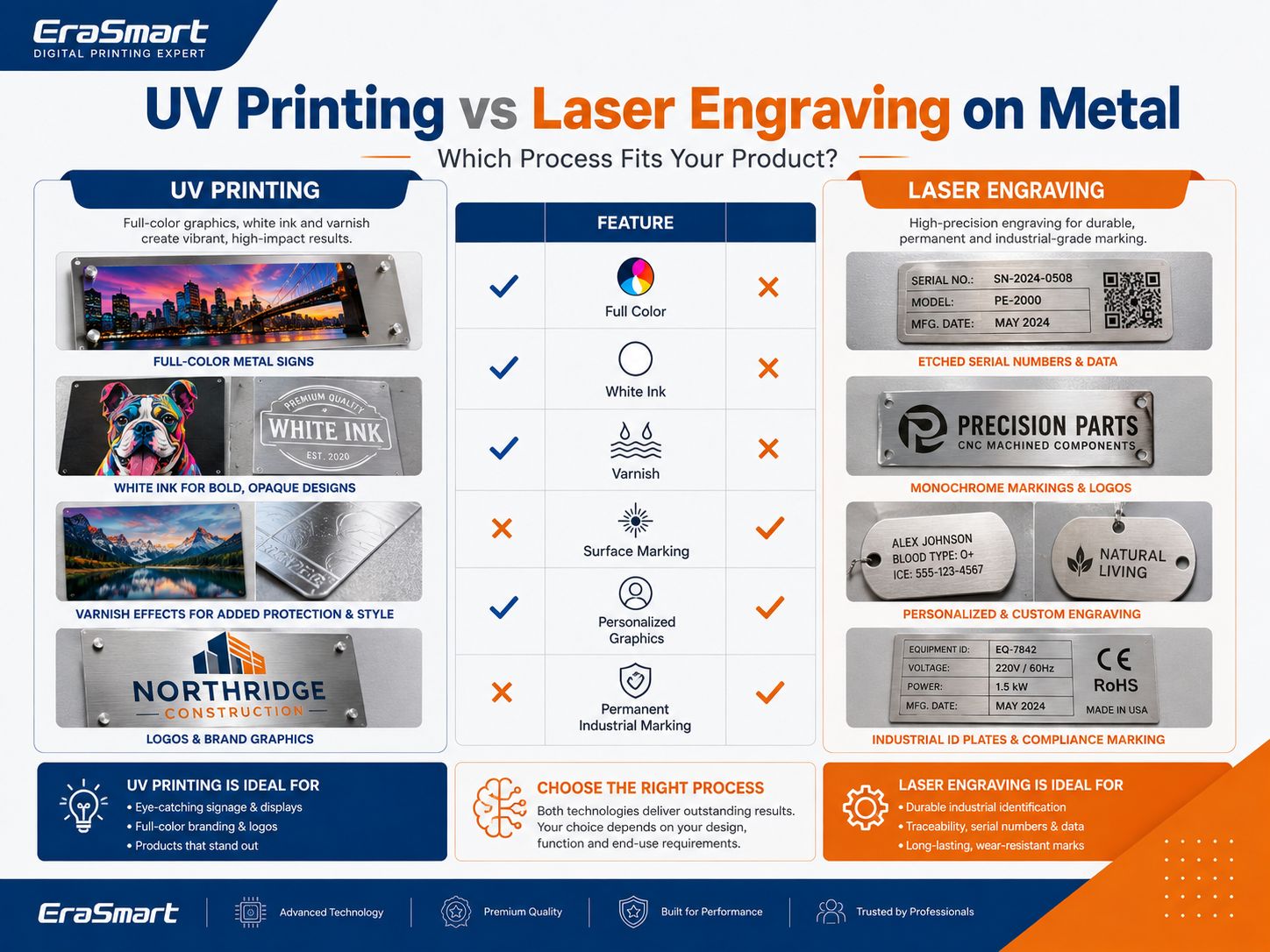
UV Printing vs Laser Engraving on Metal
UV printing and laser engraving should not be treated as competing versions of the same technology.
They solve different problems.
| Özellik | UV Baskı | Laser Engraving / Marking |
|---|---|---|
| Tam renkli grafikler | Harika | Sınırlı |
| Photographs in color | Evet | No conventional full-color ink |
| Beyaz mürekkep | Evet | HAYIR |
| Vernik efektleri | Yes, on supported systems | HAYIR |
| Adds ink layer | Evet | HAYIR |
| Alters/marks surface | Not the primary process | Evet |
| Decorative branding | Harika | İyi |
| Serial/data marking | Possible as printed graphics | Güçlü uygulama |
| Permanent industrial marking | Not its primary strength | Güçlü uygulama |
| Personalized graphics | Harika | Harika |
Choose UV printing when the product requires:
- colorful logos
- fotoğraflar
- sanat eseri
- beyaz mürekkep
- vernik
- decorative branding
Choose an appropriate laser-marking process when the primary requirement is:
- engraved information
- permanent identification
- seri numaraları
- traceability
- industrial surface marking
Some businesses use both technologies.
UV Flatbed vs UV DTF for Metal Products
EraSmart her ikisini de sunuyor UV düz yataklı yazıcılar Ve UV DTF yazıcılar.
The right workflow depends on product shape.
Choose Direct UV Flatbed Printing For:
- metal plakalar
- alüminyum tabelalar
- stainless-steel nameplates
- fotoğraf panelleri
- Etiketler
- rozetler
- ödüller
- düz promosyon ürünleri
The object goes directly onto the printer platform.
Consider UV DTF For:
- finished metal bottles
- bardaklar
- irregular products
- difficult-to-position objects
- surfaces where direct flatbed positioning is impractical
With UV DTF, the artwork is printed onto an A/B film system and then transferred to the compatible product surface.
Adhesion still needs to be tested on the finished surface.
Bu ayrım önemlidir:
A standard flatbed printer should not automatically be described as a complete 360° cylindrical printing system.
Metal Products You Can Print with a UV Printer
Metal UV printing covers both consumer customization and B2B production.
Metal Signs
Uygulamalar şunları içerir:
- iş işaretleri
- kapı işaretleri
- yön işaretleri
- ofis tabelası
- dekoratif işaretler
- QR işaretleri
Stainless-Steel Nameplates
Olası ürünler şunları içerir:
- company nameplates
- equipment identification plates
- desk plates
- branded plaques
If a plate must meet a specific industrial identification standard, verify the finished product according to that standard.
Aluminum Photo Panels
Full-color photographs and artwork can be printed directly onto compatible aluminum surfaces.
White ink can be used when greater opacity is required.
Equipment Labels
Potansiyel uygulamalar şunları içerir:
- machine identification
- control-panel graphics
- equipment branding
- instruction plates
Again, do not claim safety-label or regulatory compliance unless the complete product has been tested and approved for that specific requirement.
QR Kod İşaretleri
Metal QR code signs can be used for:
- menüler
- yorumlar
- Wifi
- payment links
- ürün bilgisi
- sosyal medya
Always scan the finished physical product before delivery.
Awards and Recognition Products
Yaratmak:
- employee awards
- corporate plaques
- event awards
- recognition pieces
White ink and varnish can help increase the perceived value of decorative designs.
Keychains and Tags
Small metal blanks can be personalized with:
- logolar
- isimler
- sanat eseri
- fotoğraflar
- event branding
A fixture can improve positioning when printing multiple identical blanks.
Promotional and Branded Products
Örnekler şunları içerir:
- logo plates
- sergi parçaları
- souvenir tags
- markalı masa ürünleri
- promosyon hediyeler
Why Fixtures Matter for Batch Metal Printing
Suppose a customer orders 100 identical stainless-steel nameplates.
Manually placing every plate by eye is inefficient.
Yerine:
- Build a positioning jig.
- Define the fixed print location.
- Lock the RIP coordinates.
- Record the cleaning process.
- Onaylanmış bir örnek yazdırın.
- Repeat the same workflow.
For variable-data products, the physical blank can remain in the same location while names, codes or artwork change digitally.
This is one of the major advantages of digital UV production.
Which EraSmart UV Printer Is Suitable for Metal Printing?
Printer selection should follow the product dimensions and production workflow, not simply the largest machine available.
EraSmart A3 PRO UV Yazıcı — Çift XP600
. EraSmart Dijital Mürekkep Püskürtmeli A3 UV Yazıcı — Çift XP600 is designed for personalized customization and small-batch UV production.
Temel özellikler şunları içerir:
| Spesifikasyon | A3 PRO |
|---|---|
| Baskı kafaları | Çift XP600 |
| Effective Print Area | 350 × 450 mm |
| Baskı yüksekliği | 0–130 mm |
| Çözünürlük | 1440 dpi'ye kadar |
| Mürekkep Yapılandırması | CMYK + WW + VVVVVV |
| Beyaz mürekkep dolaşımı | Evet |
| Zamanlama Otomatik Temizleme | Evet |
| Emme platformu | Evet |
| Yükseklik Ölçümü | Kızılötesi |
| HUZUR İÇİNDE YATSIN | Riin / ÖzelRip |
Metal is one of the materials officially listed for this system.
The A3 PRO is a practical option for products such as:
- smaller signs
- metal photo panels
- isim levhaları
- Etiketler
- anahtarlıklar
- ödüller
- dekoratif tabaklar
- promosyon ürünleri
White ink circulation is particularly useful because white UV ink contains heavier pigments that require appropriate management.
EraSmart A2 UV Yazıcı
For larger metal products, the EraSmart A2 UV Yazıcı provides a larger working area.
| Spesifikasyon | A2 UV Yazıcı |
|---|---|
| Baskı kafaları | Çift XP600 |
| Yazdırma Alanı | 420 × 600 mm |
| Baskı yüksekliği | 0–130 mm |
| Çözünürlük | 1440 dpi'ye kadar |
| Mürekkep Yapılandırması | CMYK + WW + VVVVVV |
| Otomatik Temizleme | Evet |
| Emme platformu | Evet |
| HUZUR İÇİNDE YATSIN | Riin / ÖzelRip |
The larger platform can be useful for:
- larger signs
- larger photo panels
- larger nameplates
- decorative metal panels
- multiple smaller products arranged in one print layout
The right machine depends on the dimensions of the products you intend to produce repeatedly.
Common Problems When UV Printing on Metal
UV Mürekkep Kolayca Çizilir
Olası nedenler şunları içerir:
- yağ
- parmak izleri
- uyumsuz kaplama
- inadequate surface preparation
- uygun olmayan astar
- yapışma sorunları
Start by testing the exact metal surface rather than immediately changing print resolution.
Colors Look Weak
Olası nedenler:
- metallic substrate influencing CMYK
- insufficient white underbase
- artwork prepared for a white background
Try a White + CMYK or selective-white workflow.
White Ink Is Not Opaque Enough
Kontrol etmek:
- beyaz mürekkep durumu
- dolaşım
- püskürtme durumu
- RIP beyaz ayarları
- layer structure
White ink requires regular maintenance.
Küçük Metin Bulanık Görünüyor
Kontrol etmek:
- source artwork
- yüzey dokusu
- material flatness
- printhead distance
- meme durumu
Use vector text wherever possible.
Printing Position Changes Between Pieces
Kullanmak:
- fikstür
- şaka
- fixed edge reference
- kayıtlı koordinatlar
instead of manually estimating every position.
Vernik Düzensiz Görünüyor
Kontrol etmek:
- artwork mask
- yazıcı kafasının durumu
- alt tabaka düzlüğü
- varnish layer configuration
Varnish should be tested as part of the complete product rather than added automatically.
How to Choose a UV Printer for Metal
Before buying a printer, first define the products.
Sormak:
What Is the Largest Product?
A 100 × 150 mm tag and a 500 mm metal sign need very different print-bed sizes.
Ürün Düz mü?
Flat products are ideal for standard flatbed UV printing.
Curved bottles and tumblers may require a different workflow.
Beyaz Mürekkebe İhtiyacınız Var mı?
White is especially valuable for:
- stainless steel
- black metal
- dark coatings
- fotoğraflar
- brand-color accuracy
Verniğe İhtiyacınız Var mı?
Varnish is useful for premium effects, but not every product needs it.
Kaç Adet Üreteceksiniz?
Dikkate almak:
- one-off customization
- küçük partiler
- repeat B2B orders
- jig requirements
- workflow automation
What Surface Will You Actually Print?
Do not buy a printer based only on the word “metal.”
Test your real:
- aluminum blank
- stainless-steel plate
- coated panel
- award plate
- tag
before building a commercial workflow.
Final Answer: Is UV Printing Good for Metal?
UV printing is a flexible method for producing full-color graphics, white ink and decorative varnish effects directly on many suitable metal surfaces.
Common applications include:
- alüminyum tabelalar
- stainless-steel nameplates
- fotoğraf panelleri
- ödüller
- equipment plates
- Etiketler
- QR işaretleri
- promosyon ürünleri
However, the most important factor is not simply maximum printer resolution.
It is the metal surface.
The correct production logic is:
Identify → Clean → Degrease → Pretreat if required → Print Sample → Test Adhesion → Approve → Standardize → Batch Produce
Kullanmak:
- Yalnızca CMYK when the metallic surface should remain part of the design
- Beyaz + CMYK when stronger opacity and color are required
- Seçici Beyaz + CMYK when you want to combine metallic texture with vivid graphics
- Vernik when premium spot effects support the product design
For flat metal products, an EraSmart UV flatbed is the most direct workflow.
For certain bottles, tumblers and irregular finished objects, UV DTF baskı may provide a more practical transfer-based alternative.
Above all:
Do not assume that every metal surface behaves the same. Test the exact product before commercial production.
SSS
Can a UV printer print directly on metal?
Yes. UV flatbed printers can print directly on many suitable metal surfaces, including aluminum, stainless steel, coated steel, brass and copper. Surface preparation and adhesion testing are important.
Which metal is best for UV printing?
There is no universal best metal. Coated or properly prepared aluminum is common, while stainless steel, brass, copper and other metals can also be printed after testing.
Can UV printers print on stainless steel?
Yes. Brushed, polished and coated stainless-steel products can be UV printed, but the smooth non-porous surface makes cleaning and adhesion testing especially important.
Does metal need primer before UV printing?
Not always. Primer depends on the exact metal, coating, ink system and required adhesion. Test the substrate first.
Can you UV print on bare aluminum?
Yes, but bare aluminum should be cleaned and tested carefully. Depending on the surface and required durability, pretreatment may be necessary.
Do I need white ink when printing on metal?
Her zaman değil.
Use CMYK only when you want the metallic background to influence the design.
Use white beneath CMYK when you want more opaque and predictable colors.
Can UV printers print photographs on metal?
Yes. Full-color photographs can be UV printed onto compatible metal surfaces. A white underbase is often useful when the metal background should not influence the photograph.
Can a UV printer print QR codes on metal?
Yes. Use sufficiently large, sharp and high-contrast artwork. Always scan the finished physical QR code before delivery.
Can a flatbed UV printer print metal tumblers?
A standard flatbed is primarily suited to flat products. Cylindrical printing requires an appropriate rotary or object-positioning workflow. For many finished cups and bottles, UV DTF may be a more practical alternative.
Is UV printing permanent on metal?
Do not assume that every UV print is permanent. Durability depends on the metal surface, coating, preparation, ink, curing and final environment.
Is UV printing better than laser engraving on metal?
They serve different purposes. UV printing is better suited to full-color decorative graphics, white ink and varnish effects. Laser engraving or marking is often better suited to permanent serial numbers, traceability and engraved industrial identification.
Can UV-printed metal be used outdoors?
Potentially, but outdoor performance depends on the substrate, coating, ink system, surface preparation and environmental exposure. Test the complete finished product for the intended outdoor application before making durability claims.
Which EraSmart UV printer can print metal?
. EraSmart A3 PRO Çift XP600 supports a 350 × 450 mm print area and 0–130 mm print height, while the EraSmart A2 UV Yazıcı provides a larger 420 × 600 mm platform. Both list metal among their supported materials.
Build a Repeatable Metal Printing Workflow
If you are evaluating a UV printer for metal products, send EraSmart:
- metal type
- yüzey kalitesi
- ürün boyutları
- ürün fotoğrafları
- beklenen aylık hacim
- required white ink effect
- whether varnish is needed
- intended indoor or outdoor use
Uygun olanı karşılaştırmanıza yardımcı olabiliriz EraSmart UV Yazıcı and test workflow for your actual metal products.
Prepare the surface. Test the adhesion. Standardize the workflow. Then scale production.
Sen de gibi olabilirsin

Telif Hakkı 2020 © Erasmart. | Yer haritası