Küçük boyutlu düz yataklı mürekkep püskürtmeli yazıcı üreticisi

86-18566233796 [email protected]

Blog What Is an Inkjet Printer and How Does It Work? A Practical Guide for Custom Printing Businesses

What Is an Inkjet Printer and How Does It Work? A Practical Guide for Custom Printing Businesses

June 17, 2026 Blog

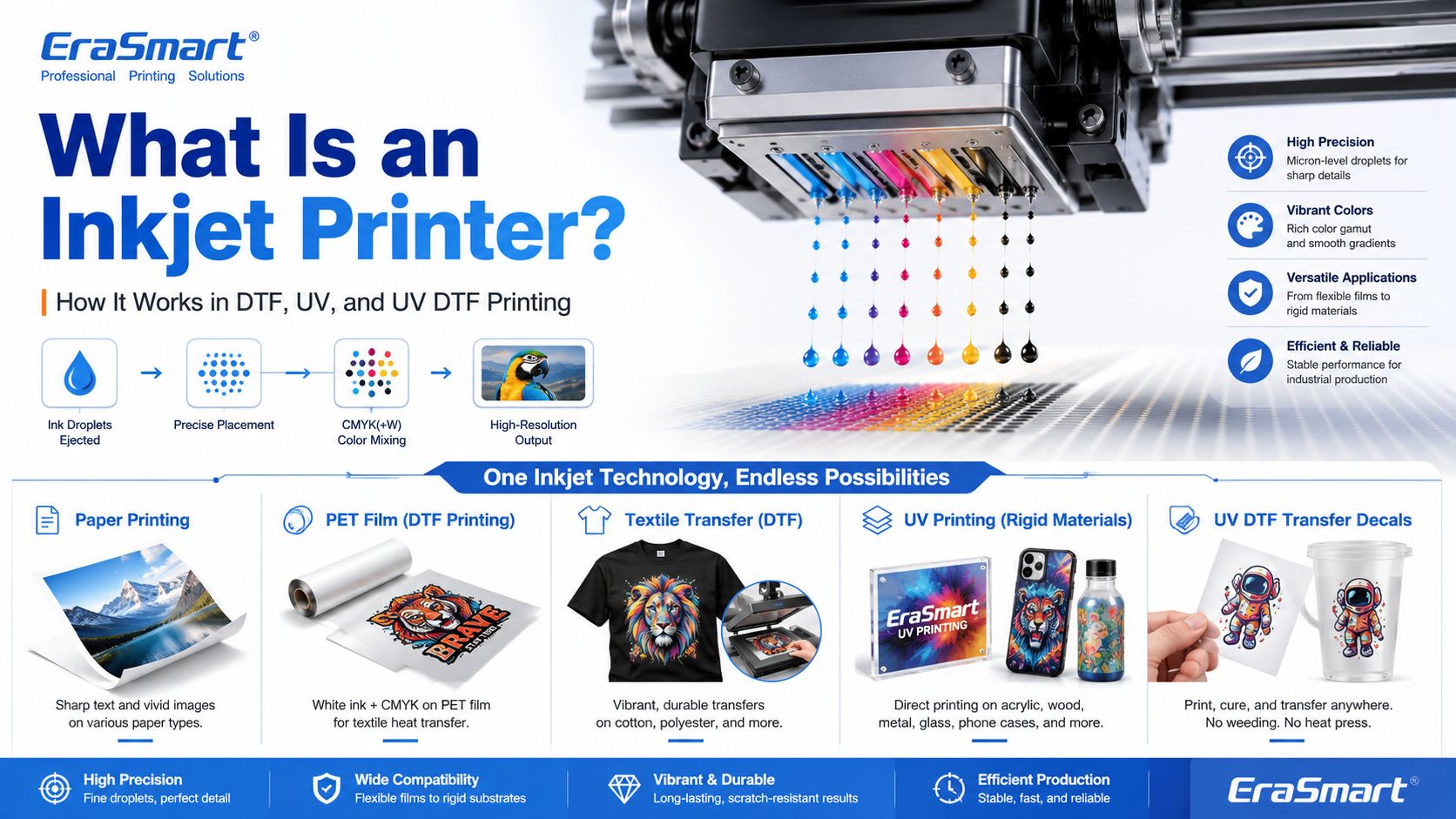
An inkjet printer is a digital printing device that creates images by ejecting tiny droplets of ink onto a surface. Instead of using plates, screens, or physical stencils, an inkjet printer receives digital image data and places controlled ink droplets in precise positions to form text, graphics, photos, labels, transfers, or product decoration.

Most people first know inkjet printers from office or home photo printing. But inkjet technology is much broader than desktop paper printing. Today, inkjet systems are used in DTF printing, UV flatbed printing, UV DTF transfers, packaging samples, product labels, signage, promotional products, textile decoration, industrial marking, and custom product manufacturing.

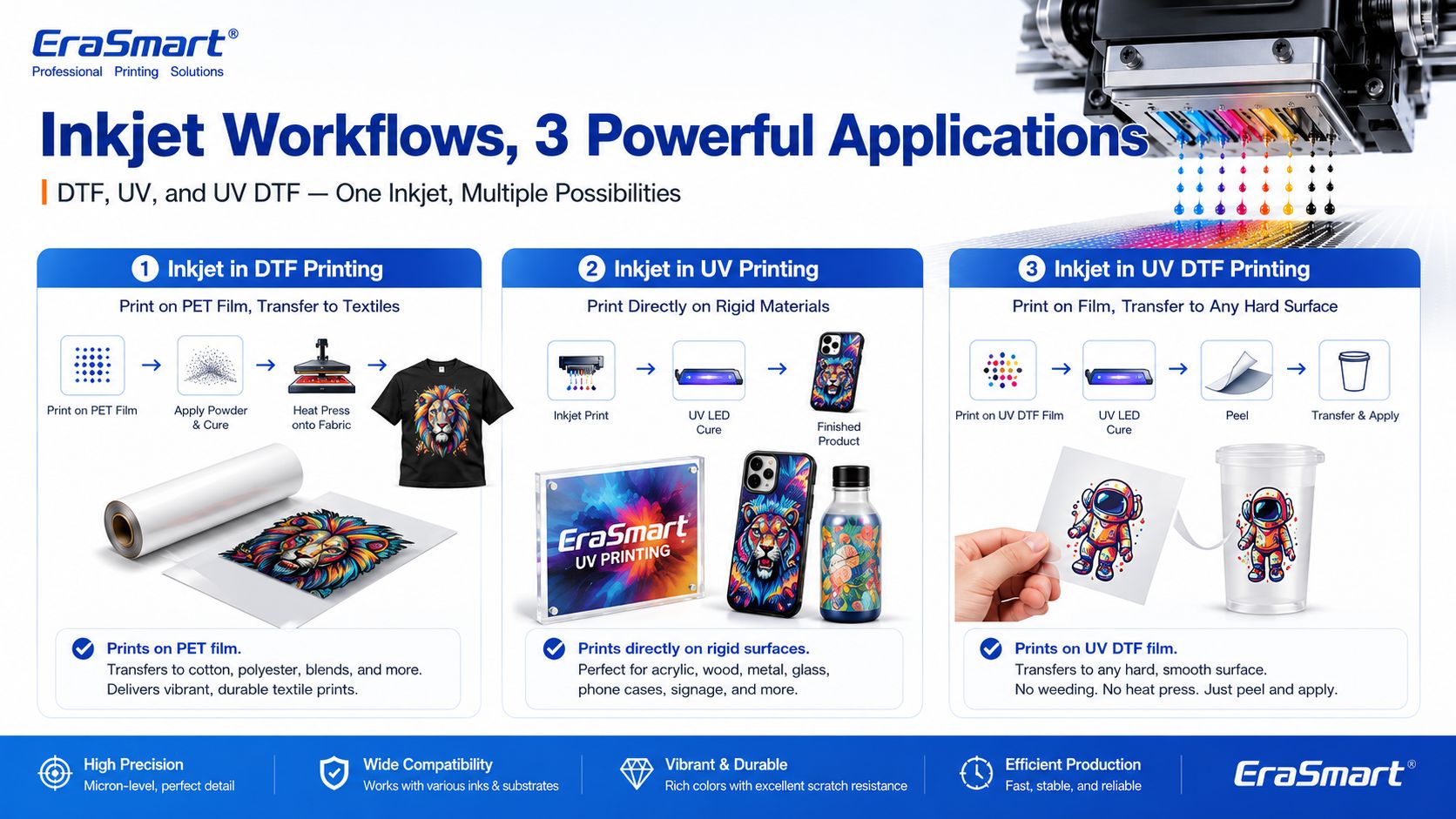
For EraSmart customers, this topic matters because many modern custom printing machines are built on inkjet principles. A DTF yazıcı uses inkjet technology to print garment designs onto transfer film. A UV yazıcı uses inkjet technology to print UV-curable ink directly onto rigid materials. A UV DTF yazıcı uses inkjet printing to create hard-surface decals and transfers on A/B film.

In simple terms, inkjet printing is the foundation. DTF, UV, and UV DTF are specialized business workflows built around that foundation.

Quick Answer: What Is an Inkjet Printer?

An inkjet printer is a printer that sprays or ejects tiny droplets of liquid ink through microscopic nozzles to create a printed image.

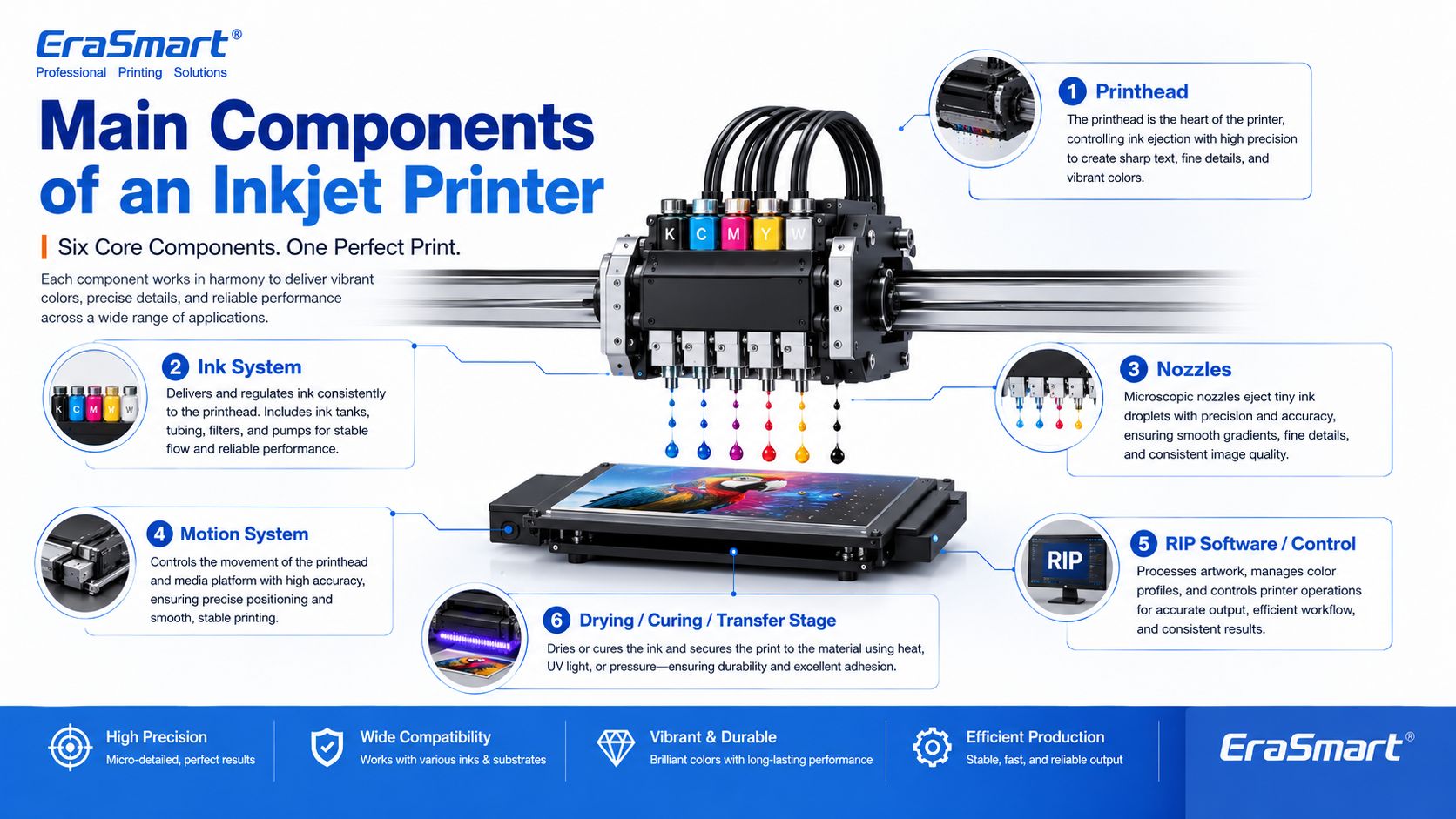
A basic inkjet printing system includes:

  • digital artwork file
  • RIP or printer control software
  • ink supply system
  • baskı kafası
  • microscopic nozzles
  • movement system
  • printable surface
  • drying, curing, or transfer process

The printhead is the key component. It controls where ink droplets land, how much ink is ejected, and how accurately the image is formed.

How Does an Inkjet Printer Work?

Inkjet printing may look simple from the outside, but inside the printer there is a precise digital control process.

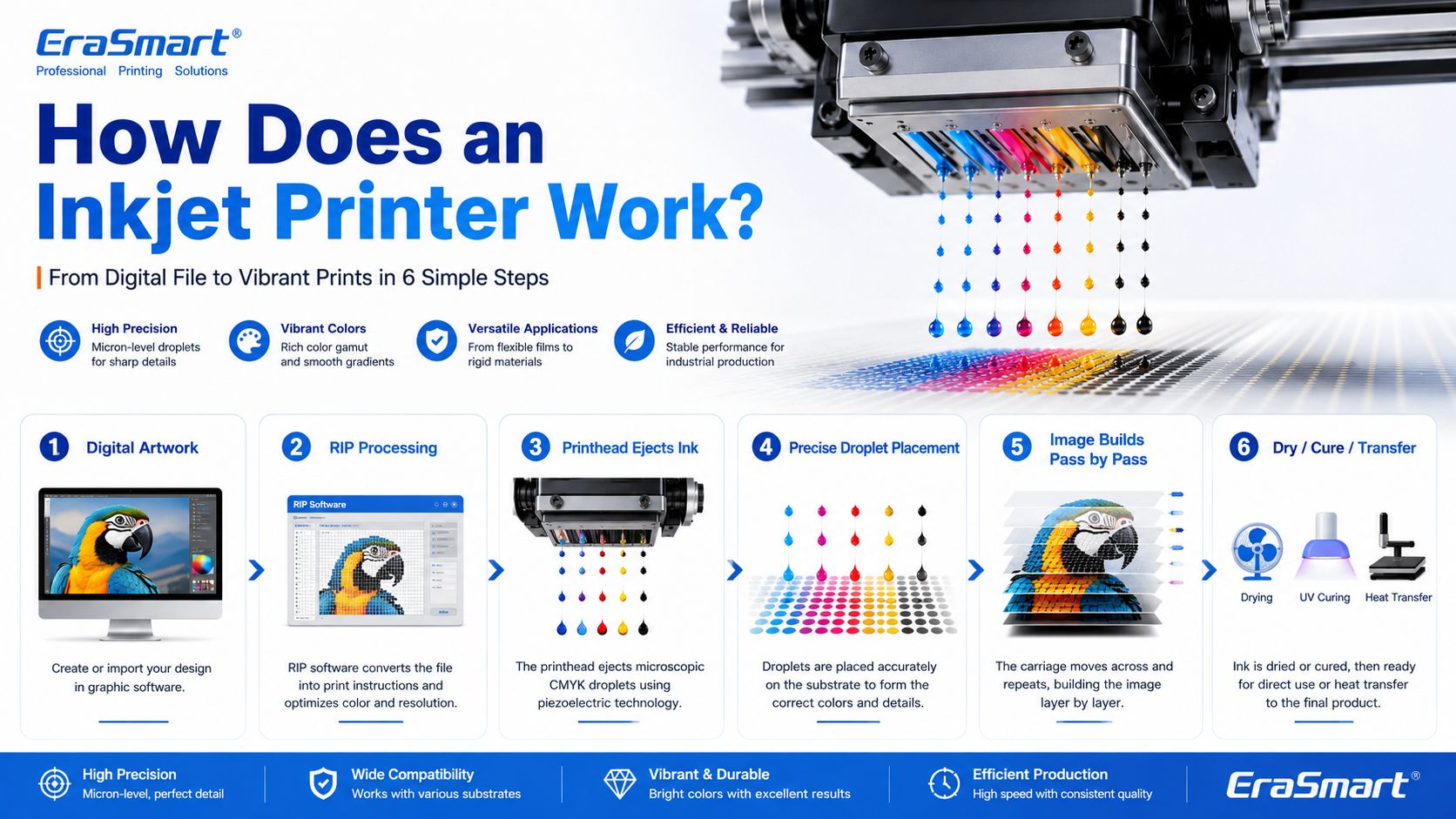
A simplified workflow looks like this:

  1. The computer sends image data to the printer.
  2. The printer software processes the file into printable dot information.
  3. The printer moves the printhead or material into position.
  4. The printhead ejects tiny droplets of ink through nozzles.
  5. The droplets land on the target surface in controlled positions.
  6. The printer builds the image line by line or pass by pass.
  7. The ink dries, cures, absorbs, or transfers depending on the printing method.

In an office inkjet printer, ink is usually printed onto paper and dries or absorbs into the paper surface. In an industrial or custom printing system, the process may be more specialized. For example, UV ink is cured by UV light, while DTF ink is printed onto PET film and later heat transferred onto fabric.

Main Components of an Inkjet Printer

1. Printhead

The printhead is the most important part of an inkjet printer. It contains many tiny nozzles that eject ink droplets. The printhead determines much of the printer’s resolution, droplet control, speed, and print quality.

In custom printing, printhead condition directly affects:

  • sharpness
  • color consistency
  • line accuracy
  • white ink quality
  • nozzle stability
  • production reliability
  • maintenance requirements

This is why printer maintenance is so important in DTF and UV printing. If the printhead nozzles are clogged or unstable, the final print may show banding, missing lines, weak colors, or poor detail.

For apparel printing users, EraSmart’s DTF Yazıcı Bakım Kılavuzu is a useful resource for understanding why nozzle checks, cleaning, white ink circulation, and daily care matter.

2. Ink System

The ink system stores and delivers ink to the printhead. Different inkjet printers use different types of ink depending on the application.

Common ink types include:

  • dye ink
  • pigment ink
  • sublimation ink
  • textile ink
  • DTF mürekkebi
  • UV ile kürlenebilen mürekkep
  • solvent or eco-solvent ink
  • industrial marking ink

For EraSmart customers, the most relevant ink systems are DTF ink, UV ink, white ink, and varnish.

A DTF yazıcı commonly uses CMYK ink plus white ink. The white ink helps designs appear clearly on dark garments. A UV yazıcı may use CMYK, white ink, and varnish to print on hard surfaces such as acrylic, glass, metal, wood, plastic, leather, and packaging materials.

If you want to understand how CMYK, white ink, and varnish work together in product customization, see EraSmart’s UV Ink Guide: CMYK, White Ink, and Varnish.

3. Nozzles

Nozzles are microscopic openings in the printhead. They eject ink droplets in controlled patterns.

Nozzle performance affects:

  • print resolution
  • detail clarity
  • ink density
  • renk doğruluğu
  • pürüzsüz degradeler
  • edge sharpness
  • production stability

Nozzles can become clogged if ink dries, settles, or becomes contaminated. This is especially important for white ink systems because white ink contains heavier pigment particles and needs proper circulation and maintenance.

4. Motion System

Inkjet printers need accurate motion control. Either the printhead moves across the material, the material moves under the printhead, or both are coordinated.

The motion system affects:

  • print alignment
  • image registration
  • repeatability
  • production speed
  • print size accuracy
  • multi-pass quality

In UV flatbed printing, the platform and printhead movement must be stable so the image lands accurately on rigid objects. In DTF printing, film feeding must be smooth so the transfer image remains consistent.

5. RIP Software and Print Control

RIP software converts artwork into printer-ready instructions. It controls color output, resolution, ink layering, white ink channels, varnish layers, print passes, and other production settings.

For custom printing businesses, RIP setup is important because it affects:

  • color performance
  • white ink underbase
  • image sharpness
  • ink usage
  • baskı hızı
  • material compatibility
  • repeatability

A good printer is only part of the system. Correct artwork preparation and RIP settings are also necessary for professional results.

6. Drying, Curing, or Transfer System

Inkjet printing is not finished when ink leaves the nozzle. The ink must also become stable on the final product.

Different workflows use different finishing methods:

Inkjet WorkflowWhat Happens After Printing
Office inkjetInk dries or absorbs into paper
DTF baskıPowder is applied, cured, then heat pressed onto fabric
UV baskıUV light cures the ink almost instantly
UV DTF baskıUV ink is printed on film, laminated, then applied as a transfer
YüceltmePrinted transfer is heat pressed into polyester or coated blanks

This is why inkjet technology can support many industries. The core droplet technology is similar, but the finishing process changes based on the product.

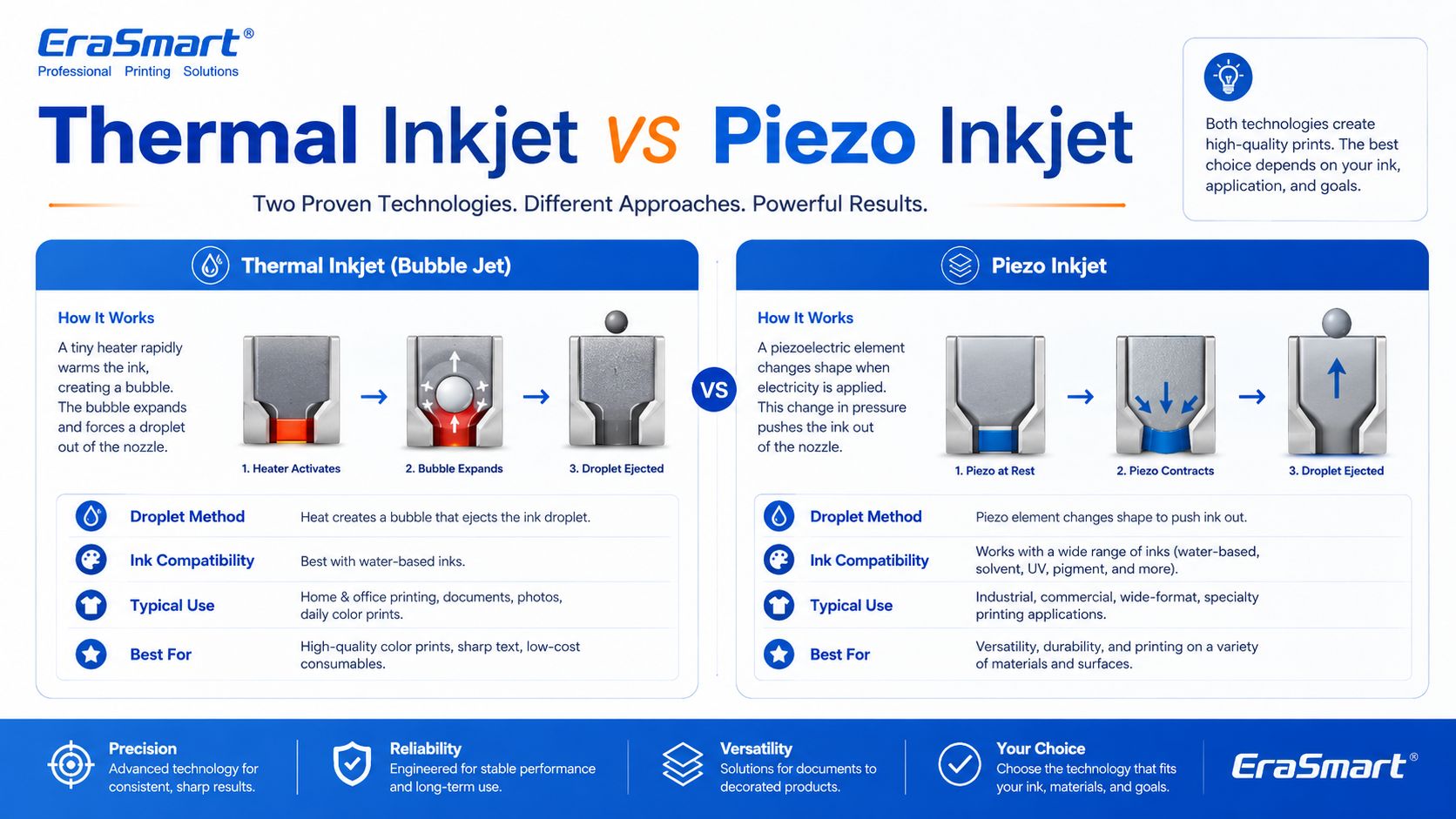
Thermal Inkjet vs Piezo Inkjet

There are two major inkjet technologies: thermal inkjet and piezo inkjet.

Thermal Inkjet

Thermal inkjet uses heat to create a vapor bubble inside the ink chamber. The pressure from this bubble pushes a droplet of ink out of the nozzle.

Thermal inkjet is common in many desktop and office printers. It can produce high-quality prints on paper, but the ink must be compatible with heat-based ejection.

Piezo Inkjet

Piezo inkjet uses a piezoelectric element that changes shape when voltage is applied. This mechanical movement creates pressure and ejects ink droplets through the nozzle.

Piezo inkjet is widely used in many professional and industrial printing systems because it can work with a broader range of inks. Since the ink is not heated for ejection, piezo technology is suitable for inks that may not perform well in thermal systems, including many specialty inks used in industrial and custom printing.

For DTF, UV, and UV DTF applications, piezo-style inkjet technology is especially important because these workflows require precise ink control and compatibility with specialized ink types.

Drop-on-Demand vs Continuous Inkjet

Inkjet printing can also be divided by how ink is delivered.

Drop-on-Demand Inkjet

Drop-on-demand means ink droplets are ejected only when needed. This is common in many graphic and custom printing applications because it offers precise control and efficient ink use.

DTF, UV, and UV DTF printers generally operate around controlled digital droplet placement, which is why they can reproduce detailed designs and full-color artwork.

Continuous Inkjet

Continuous inkjet ejects a continuous stream of ink droplets. Some droplets are directed to the surface, while others may be recycled. This method is often used in industrial coding and marking, such as printing dates, batch codes, and product identification on packaging lines.

For EraSmart customers, drop-on-demand inkjet is the more relevant concept because custom apparel and product printing require accurate image reproduction rather than simple coding.

Inkjet Printing in DTF Printers

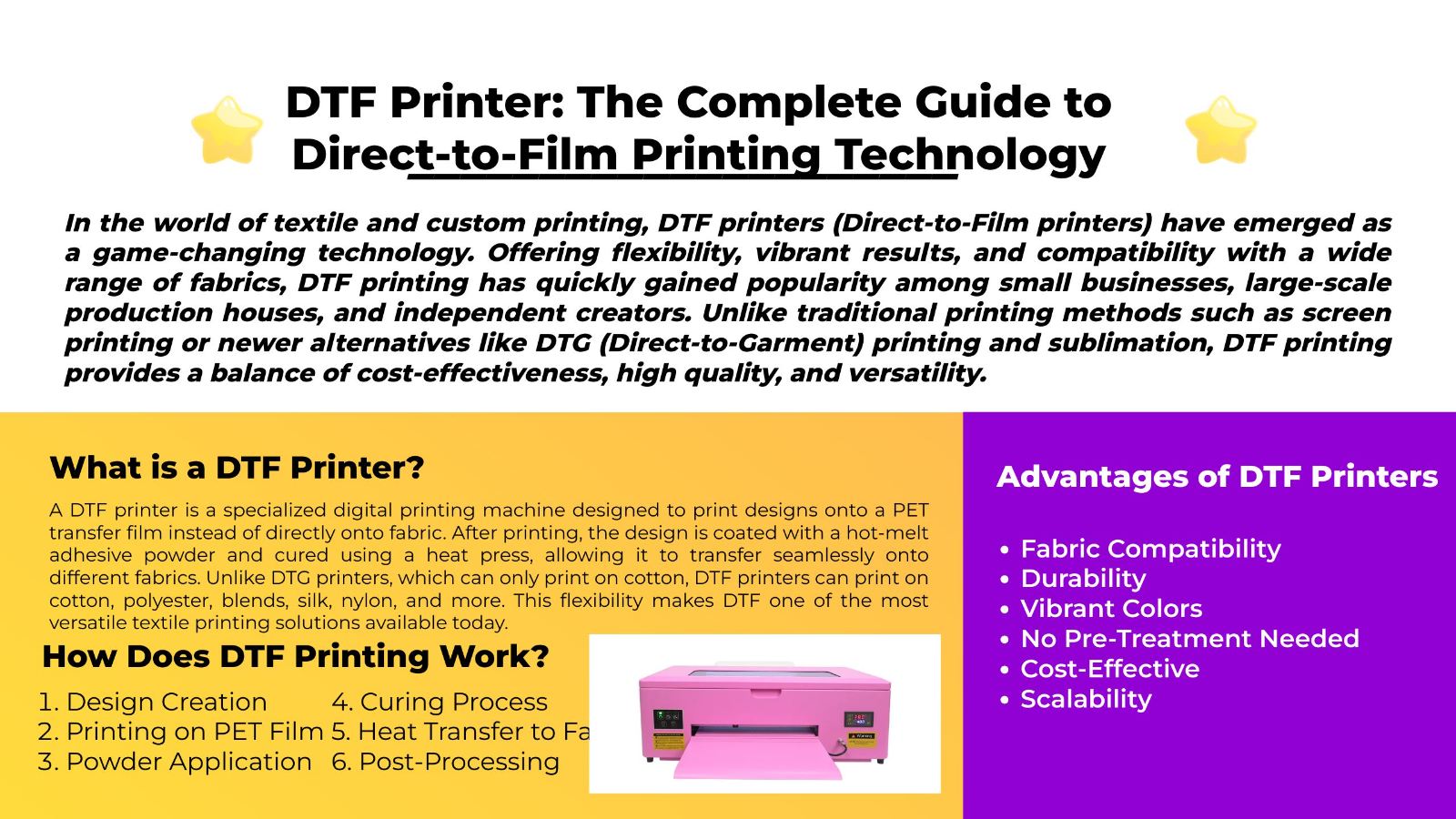
A DTF printer is a specialized inkjet printer for garment transfer production. Instead of printing directly onto a shirt, it prints the design onto PET transfer film.

The typical DTF process includes:

  1. Print CMYK and white ink onto PET film
  2. Sıcakta eriyen yapışkan toz uygulayın
  3. Tozu iyileştirin
  4. Transferi kumaşa ısıyla basın
  5. Filmi soyun
  6. Gerekirse baskıyı bitirin

This process is useful for custom apparel because it supports:

  • tam renkli sanat eseri
  • koyu giysiler
  • small-batch orders
  • personalized designs
  • pamuk, polyester, karışımlar ve daha fazlası
  • talep üzerine baskı üretimi

If you are interested in building an apparel business, EraSmart’s DTF yazıcı category includes different models for startups, small studios, growing shops, and higher-volume production. You can also read the DTF Prodüksiyon İş Akışı to understand the full process from artwork to finished garment.

Inkjet Printing in UV Printers

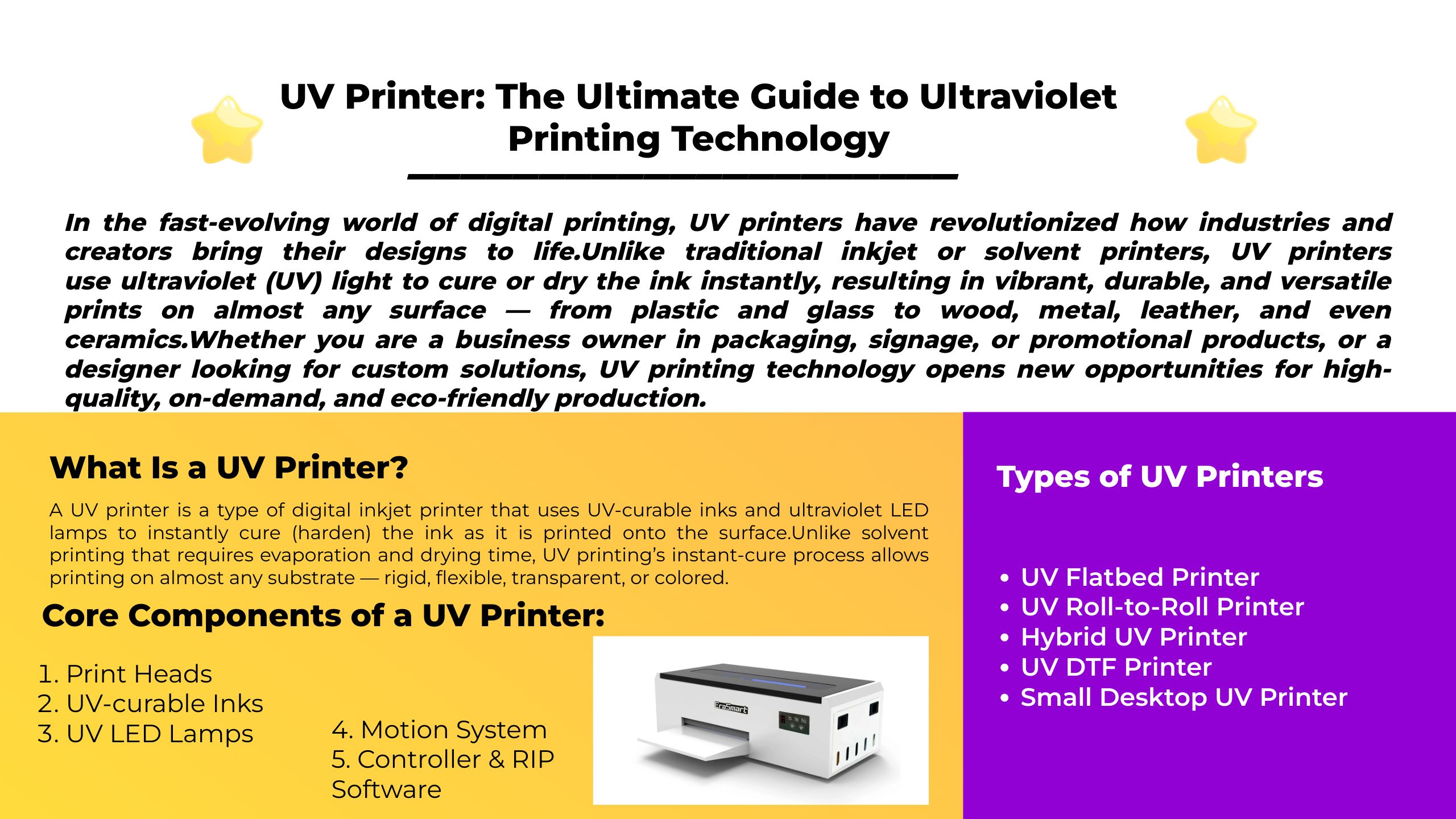
A UV printer is another specialized inkjet system. Instead of using standard paper ink, it uses UV-curable ink. The printer ejects ink onto the material surface, and UV light cures the ink almost immediately.

UV printing is suitable for many hard and semi-rigid materials, such as:

  • akrilik
  • bardak
  • maden
  • odun
  • plastik
  • ceramic
  • deri
  • telefon kılıfları
  • ambalaj örnekleri
  • promosyon ürünleri

The advantage of UV printing is direct-to-object customization. You can print full-color designs, white ink layers, and varnish effects on many product surfaces.

EraSmart'ın UV yazıcı category is designed for businesses that want to create custom gifts, signs, phone cases, packaging samples, acrylic products, and hard-surface promotional items. For material selection, see the UV Yazıcı Malzemeleri Kılavuzu.

Inkjet Printing in UV DTF Printers

UV DTF printing combines UV inkjet printing with a transfer workflow. The printer prints UV ink onto A film, laminates it with B film, and creates a transfer decal that can be applied to hard surfaces.

UV DTF is useful for:

  • çıkartmalar
  • decals
  • fincan sarar
  • bottle labels
  • kozmetik ambalaj etiketleri
  • gadget skins
  • cam dekorasyon
  • acrylic decals
  • metal etiketler
  • ürün markalaması

Unlike textile DTF, UV DTF is mainly for hard-surface transfers, not garments. It is a good choice for businesses that want to sell premium stickers, decals, labels, and cup wraps.

EraSmart'ın UV DTF yazıcı is suitable for hard-surface transfer applications, while the A/B Film for UV DTF Printing guide explains how the film system works in the transfer process.

Why Inkjet Technology Is Important for Custom Printing

Inkjet printing is important because it allows digital, flexible, short-run production. Unlike traditional methods that require screens, plates, or molds, inkjet printing can print directly from a digital file.

This creates major advantages for custom businesses:

  • lower setup barriers
  • faster design changes
  • easier personalization
  • full-color printing
  • short-run production
  • lower inventory pressure
  • product variety
  • print-on-demand flexibility

For example, a DTF apparel business can print different names, numbers, and graphics without preparing new screens. A UV printing business can print different logos on phone cases, acrylic signs, glass gifts, or packaging samples. A UV DTF business can produce custom decals and labels for many small brands.

This is why inkjet technology is no longer only about office printing. It is now a core technology for modern customization businesses.

Advantages of Inkjet Printing

1. Digital Flexibility

Inkjet printing works directly from digital files. This makes it easy to change designs, personalize products, and produce short runs.

2. Full-Color Output

Inkjet printers can reproduce complex color images, gradients, photos, and illustrations. This is useful for apparel graphics, product decoration, stickers, and packaging samples.

3. Short-Run Production

Inkjet does not require plates or screens, so it is suitable for low-MOQ custom orders and on-demand production.

4. Variable Data Printing

Each print can be different. This is useful for names, numbers, QR codes, serialized labels, personalized gifts, and custom designs.

5. Wide Application Range

Inkjet technology can be adapted to many surfaces and workflows, including paper, textiles, film, rigid materials, packaging, labels, and transfers.

6. Scalable Business Model

A business can start with small orders and upgrade equipment as demand grows. This is why inkjet-based DTF, UV, and UV DTF systems are attractive to startups and growing shops.

Limitations of Inkjet Printing

1. Printhead Maintenance Is Important

Inkjet printers need regular maintenance. If nozzles clog, print quality declines. This is especially important for white ink, UV ink, and other specialty ink systems.

2. Ink Compatibility Matters

Not every ink works with every printhead or material. Ink viscosity, pigment size, curing method, and surface compatibility all matter.

3. Material Preparation May Be Needed

Some surfaces need cleaning, primer, coating, or testing before printing. This is especially common in UV printing on glass, metal, plastic, and other hard materials.

4. Color Management Requires Testing

Screen colors and printed colors are not always identical. Professional results require color profiles, test prints, correct RIP settings, and stable consumables.

5. Production Speed Depends on Quality Settings

Higher resolution, more passes, white ink layers, and varnish effects may improve quality but increase printing time.

6. Workflow Control Matters

In DTF printing, powdering, curing, and heat pressing affect durability. In UV DTF, lamination and application affect transfer quality. In UV printing, curing and adhesion affect final product quality.

Common Inkjet Printer Problems

1. Clogged Nozzles

This is one of the most common inkjet problems. It can be caused by dried ink, settled pigment, poor maintenance, incompatible ink, or long idle time.

2. Banding

Banding appears as unwanted horizontal or vertical lines. It can be caused by clogged nozzles, incorrect feed settings, poor calibration, or unstable ink flow.

3. Color Difference

Colors may look different from the screen because of material surface, ink type, printer profile, white ink layer, or lighting conditions.

4. Poor Adhesion

In UV printing, poor adhesion can happen if the surface is oily, dusty, incompatible, or not treated correctly.

5. Weak White Ink

In DTF and UV printing, white ink must be managed carefully. Weak white ink can reduce color brightness, opacity, and dark-surface performance.

6. Ink Smearing or Poor Curing

If ink is not dried, cured, or transferred correctly, the final product may smear, peel, crack, or lose durability.

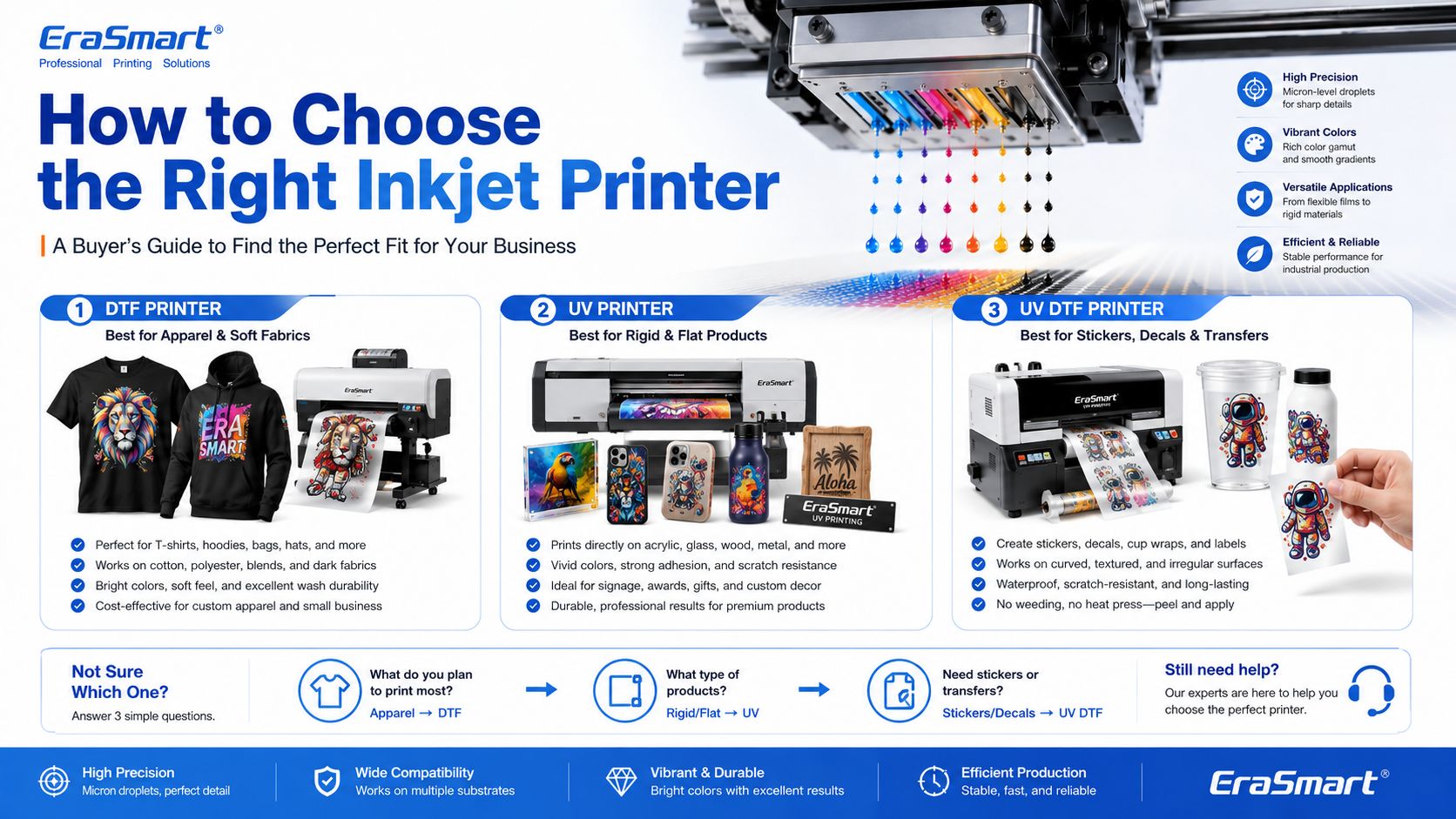
How to Choose the Right Inkjet Printer for Your Business

The right inkjet printer depends on what you want to sell.

Choose a DTF Printer If You Want to Print Apparel

Bir tane seçin DTF yazıcı if your business focuses on:

  • Tişörtler
  • kapüşonlular
  • bez çantalar
  • üniformalar
  • spor giyim
  • moda grafikleri
  • koyu giysiler
  • small-batch custom apparel
  • print-on-demand clothing

For machine selection, read EraSmart’s DTF Yazıcı Nasıl Seçilir Ve DTF Yazıcı Satın Alma Kontrol Listesi.

DIY ve Kişisel Stüdyo için

Giriş Seviyesi Kompakt Kurulum

• Küçük toplu özelleştirme
• Tasarım testi
• Düşük giriş yükü

Kendin Yap Hobileri ve Kişisel Stüdyolar için En İyisi

Amacınız küçükten başlamak, iş akışını test etmek ve kişisel özelleştirme veya hafif ticari kullanımı ele almaksa en pratik seçim, yönetilebilir maliyete ve basit günlük kullanıma sahip kompakt bir kurulumdur.

Bu tür makineler, daha büyük A3 veya A1 prodüksiyon ekipmanına çok erken geçmeden güvenilir bir giriş noktasına ihtiyaç duyan yaratıcılar, ilk kez satın alacaklar ve kişisel stüdyolar için iyi çalışır.

Küçük Stüdyolar ve Startup'lar İçin

Esnek A3 Girişli Ticari Kurulum

• Yerel özel siparişler
• Küçük partili giysiler
• Başlangıç ​​dostu iş akışı

Küçük Stüdyolar, Yeni Markalar ve Startup Mağazaları için En İyisi

Zaten bir iş fikriniz varsa, yerel özel siparişler alıyorsanız veya A4 girişli makinelerden daha fazla esnekliğe ihtiyaç duyan küçük bir stüdyo işletiyorsanız, A3 serisine geçmek genellikle daha pratik bir ticari iş akışı yaratır.

Bu modeller, doğrudan daha yüksek çıkışlı endüstriyel ekipmanlara geçmeden daha güçlü çıkış aralığı isteyen yeni kurulan markalara, stüdyo operatörlerine ve erken aşamadaki mağazalara daha uygundur.

E-ticaret ve Tasarımcılar için

Detay, Renk ve Hızlı Tasarım Döndürme

• Tasarım açısından zengin grafikler
• Sık sık yeni düşüşler
• Birinci sınıf görsel sunum

E-ticaret Girişimcileri ve Tasarımcı Stüdyoları için En İyisi

İşletmeniz sık sık tasarım değişikliklerine, zengin renkli sanat eserlerine, ayrıntılı görsellere ve daha hızlı çevrimiçi ürün testlerine bağlı olduğunda, daha güçlü görüntü sunumu ve daha sorunsuz ticari esneklik sunan modelleri seçmek mantıklı olacaktır.

Bu grup, çevrimiçi satıcılar, tasarımcı liderliğindeki markalar, yaratıcı ekipler ve görsel sunumun ve yeni tasarım lansmanlarının iş modelinin merkezinde yer aldığı mağazalar için güçlü bir seçimdir.

Küçük İşletmeler İçin

Sabit Günlük Ticari Üretim

• Günlük siparişler
• Daha iyi üretim ritmi
• Daha istikrarlı ticari çıktı

Küçük Giyim İşletmeleri ve Sabit Günlük Üretim için En İyisi

İşletmeniz ara sıra verilen siparişlerin ötesine geçip daha istikrarlı günlük üretime bağımlı olmaya başladığında, daha sorunsuz iş akışını, daha güçlü tutarlılığı ve daha iyi bir üretim ritmini destekleyen makineleri seçmek daha önemli hale gelir.

Bu seviye genellikle alıcıların yalnızca giriş fiyatı hakkında düşünmeyi bırakıp çıktı istikrarı, iş akışı verimliliği ve uzun vadeli işletim pratikliği hakkında daha ciddi düşünmeye başlamaları gereken seviyedir.

Otomasyon için

Daha Yüksek Verim ve İş Akışı Yükseltmesi

• Daha hızlı iş akışı
• Daha düşük manuel yük
• Daha iyi üretim sürekliliği

Daha Otomatik İş Akışına Geçiş Yapan Mağazalar İçin En İyisi

İşletmeniz temel manuel üretimin ötesine geçiyorsa ve daha sorunsuz, üretime daha hazır bir süreç istiyorsa, daha güçlü iş akışı entegrasyonunu ve daha yüksek üretim beklentilerini destekleyen modelleri düşünmek mantıklı olacaktır.

Bu yön özellikle halihazırda istikrarlı siparişleri olan ve üretimdeki sürtünmeyi azaltmak, tekrarlanabilirliği artırmak ve daha büyük günlük çalışma hacimlerine hazırlanmak isteyen mağazalar için geçerlidir.

Büyük Ölçekli Üretim İçin

Geniş Format Endüstriyel Yön

• Daha yüksek çıktı hedefi
• Daha geniş baskı genişliği
• Endüstriyel üretim ritmi

Büyük Ölçekli Üretim ve Daha Yüksek Üretim Ekipleri için En İyisi

İşletmenizin daha geniş baskı genişliğine, daha güçlü çıktı tavanına ve daha ciddi bir endüstriyel üretim yönüne ihtiyacı olduğunda A1 serisi değerlendirilecek doğru kategori haline gelir. Bu seviye, çıktı sürekliliği ve daha düşük kesinti maliyetinin önemli operasyonel öncelikler olduğu işletmeler için daha uygundur.

Üretim hedefinizin ne kadar agresif olduğuna ve daha güçlü üretkenliğe ne kadar değer verdiğinize bağlı olarak yazıcı kafası katmanını seçin.

Choose a UV Printer If You Want to Print Hard Products

Bir tane seçin UV yazıcı if your business focuses on:

  • telefon kılıfları
  • akrilik plaklar
  • cam hediyeler
  • metal işaretleri
  • wood products
  • seramik fayans
  • ambalaj örnekleri
  • promosyon ürünleri
  • product decoration

For material planning, read EraSmart’s UV Yazıcı Malzemeleri Kılavuzu Ve How to Choose a UV Printer.

Küçük Başlangıç ​​Projeleri

Küçük formatlı özel ürünler, numuneler, kompakt hediyeler ve UV baskıya daha küçük bir alanla başlamak isteyen kullanıcılar için uygundur.

Kompakt İş Kullanımı

Telefon kılıfları, aksesuarlar, küçük akrilik ürünler, kişiselleştirilmiş hediyeler ve küçük işletme üretimi için pratik bir seçenek.

A3 Ürün Esnekliği

Daha büyük bir platforma, daha fazla ürün kapsamına ve daha esnek küçük seri üretime ihtiyaç duyan kullanıcılar için daha güçlü bir seçim.

Daha Büyük Formatlı Üretim

Daha geniş bir baskı alanına ve daha güçlü ölçeklenebilirliğe ihtiyaç duyan daha büyük tabelalar, paneller, özel panolar ve üretim ekipleri için uygundur.

Telefon Kılıfı İşi

Daha odaklı bir uygulama yolu ile telefon kılıfının kişiselleştirilmesi ve hızlı kişiselleştirilmiş ürün üretimi için tasarlanmıştır.

Çıkartmalar ve Bardak Sargıları

UV DTF çıkartmaları, kristal etiketler, bardak ambalajları, şişeler ve sert yüzey transfer çıkartmaları için daha iyidir.

Choose a UV DTF Printer If You Want to Print Decals and Transfers

Bir tane seçin UV DTF yazıcı if your business focuses on:

  • çıkartmalar
  • decals
  • fincan sarar
  • labels
  • cosmetic packaging transfers
  • bottle decoration
  • gadget skins
  • hard-surface branding

To understand the film workflow, read EraSmart’s A/B Film for UV DTF Printing.

EraSmart Satın Alma Önerisi

Inkjet printing is not one single business model. It is a technology foundation. The right machine depends on your target products.

A simple buying direction looks like this:

İş HedefiRecommended EraSmart Direction
Custom T-shirts, hoodies, apparelDTF yazıcı
Acrylic, glass, metal, wood, phone casesUV yazıcı
Stickers, cup wraps, labels, decalsUV DTF yazıcı
Apparel startupA4 / A3 DTF Printer
Growing apparel shopA3 MAX DTF / shaker workflow
Custom product studioA4 / A3 UV Printer
Hard-surface transfer businessA3 UV DTF Yazıcı

If your business is apparel-first, start with EraSmart’s DTF yazıcı lineup. If your business is hard-product customization, compare the UV yazıcı range. If your business is stickers, decals, labels, and cup wraps, start with the UV DTF yazıcı.

Final Answer: What Is an Inkjet Printer?

An inkjet printer is a digital printer that creates images by ejecting tiny ink droplets through microscopic nozzles onto a surface.

In basic office printing, that surface is usually paper. In custom printing, the surface may be PET film, transfer film, acrylic, glass, metal, wood, plastic, packaging board, fabric, or product blanks.

The most important point is this: inkjet printing is not only for documents and photos. It is the core technology behind many modern custom printing systems, including DTF printers, UV printers, and UV DTF printers.

For small businesses, inkjet technology makes it possible to print full-color designs, personalize products, produce short runs, reduce setup cost, and build flexible custom printing workflows.

Need help choosing the right inkjet-based printing system for your business? Share your target products, material type, print size, expected daily order volume, and budget range with EraSmart.

Our team can help you choose the right DTF yazıcı- UV yazıcı, veya UV DTF yazıcı for your custom printing business.


Sen de gibi olabilirsin

  • Erasmart yazıcısı

    UV yazıcı
    DTF yazıcı
    DTG yazıcı
    Isı Pres Makinesi
    Reklam yazıcısı

  • Yazıcı Araçları

    DTF Fırını
    Sıcak Pres
    Oyma makinesi
    Kupa ısı transferi
    Laminasyon makinesi

  • Sarf malzemeleri

    Mürekkep Mürekkebi
    Cep telefonu kasası
    Cam ürün
    Temizlik sıvısı
    Pamuklu çubuk

  • Bize Ulaşın

    WhatsApp : +8618566233796
    Wechat : +8618566233796
    Mobil : +8618566233796
    Web :www.erasmart.com
    Mağaza:www.erasmartmall.com

  • Teklif isteyin

    Sadece birkaç ayrıntı sağlayın ve hızlı teklifler almanıza yardımcı olacağız!