Kích thước nhỏ nhà sản xuất máy in phun phẳng

86-18566233796 [email protected]

Blog Danh sách kiểm tra thiết bị thăng hoa và DTF cho người mới bắt đầu
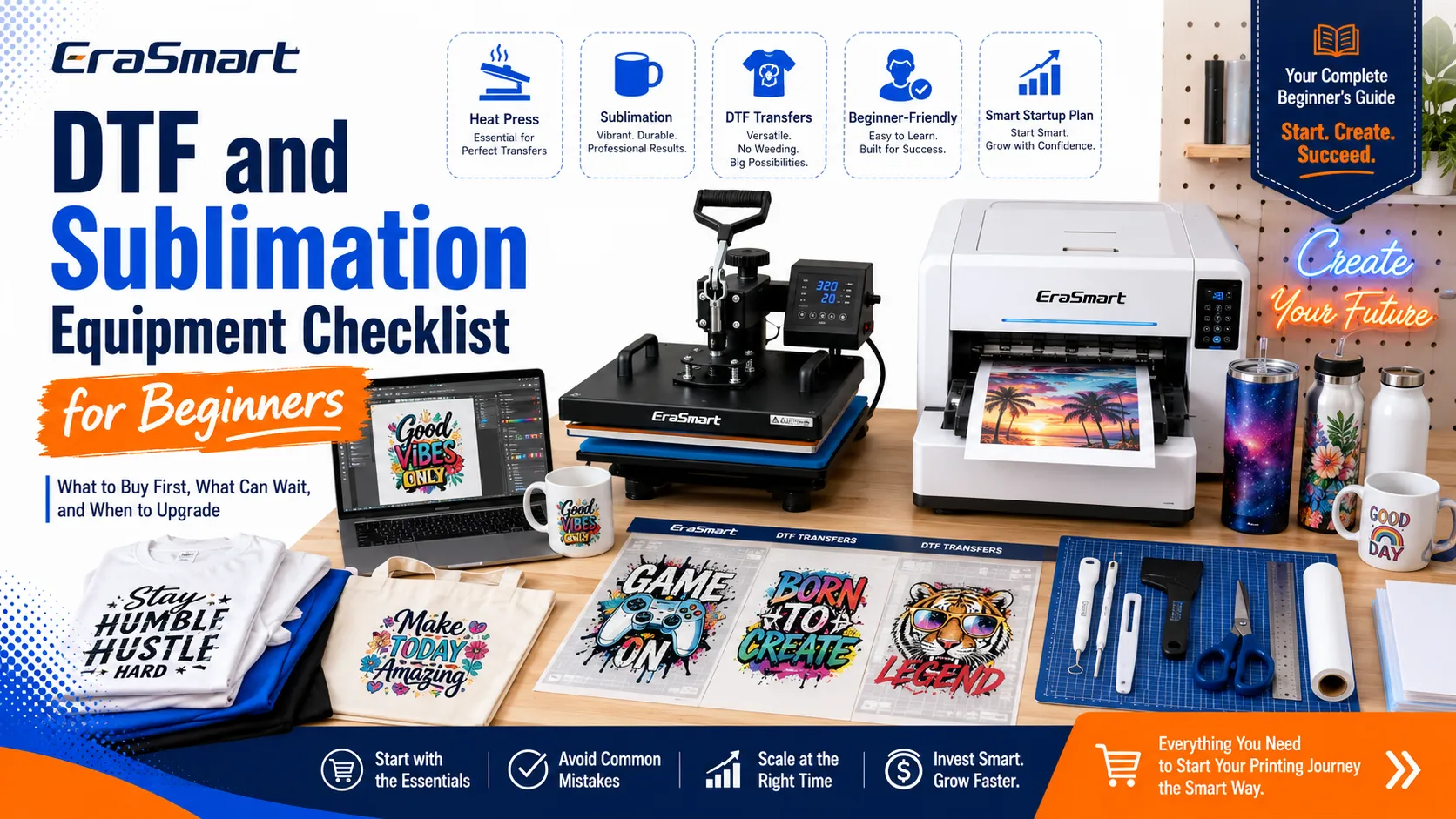
Danh sách kiểm tra thiết bị thăng hoa và DTF cho người mới bắt đầu

July 11, 2026 Blog

Starting a custom printing business can feel complicated because there are many machines, consumables, tools, and blank products available.

The good news is that beginners do not need to purchase everything immediately.

Your equipment list depends on how you plan to handle DTF production:

  1. Outsource DTF transfers and apply them with a heat press
  2. Print DTF transfers in-house with your own DTF printer

For many beginners, the first option is the safer starting point. You can order ready-to-press DTF transfers, focus on heat pressing, and use sublimation printing to produce mugs, mousepads, polyester apparel, and personalized gifts.

Once your order volume becomes stable, you can add your own DTF printer, powder curing equipment, RIP software, and a more complete production workflow.

This guide provides a complete DTF and sublimation equipment checklist, explains which items are essential, and shows which purchases can be delayed until the business grows.

DTF and Sublimation Equipment Checklist at a Glance

Here is the basic equipment structure for a beginner studio.

Equipment categoryEssential at startup?Used for
Máy ép nhiệt phẳngĐúngDTF apparel and flat sublimation products
Máy tínhĐúngDesign, order management and printing
Phần mềm thiết kếĐúngChuẩn bị tác phẩm nghệ thuật
Máy in thăng hoaYes for sublimationPrinting sublimation transfer paper
Mực thăng hoaYes for sublimationProducing sublimation prints
Giấy thăng hoaYes for sublimationCarrying the printed design
Chuyển DTF sẵn sàng để nhấnYes if outsourcing DTFCustom apparel production
Máy in DTFOptional at startupIn-house DTF transfer printing
mực DTFOnly with DTF printerCMYK and white printing
Phim chuyển thú cưngOnly with DTF printerCarrying the DTF design
Hot-melt powderOnly with DTF printerAdhesive layer
DTF curing equipmentOnly with DTF printerMelting and curing adhesive powder
Máy ép cốcKhông bắt buộcMugs and curved drinkware
Bấm nắpKhông bắt buộcHats and cap panels
Dụng cụ cắtĐúngTrimming paper and transfers
Vật tư đóng góiĐúngDelivery and order fulfillment

The exact checklist changes depending on whether you outsource DTF printing or produce transfers yourself.

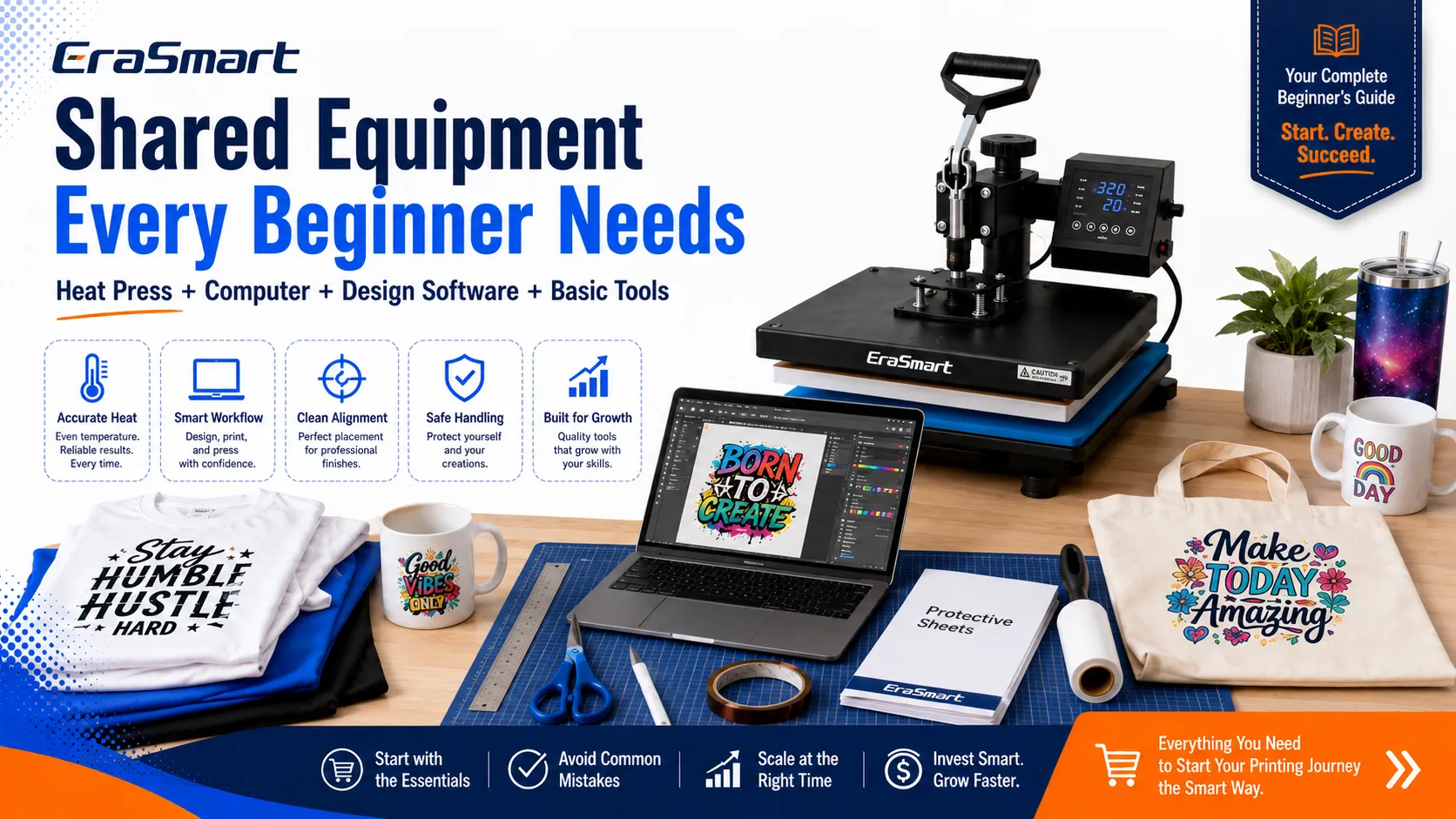
Part 1: Shared Equipment for DTF and Sublimation

Some equipment can be used for both production methods.

These shared tools should usually receive the highest purchasing priority.

1. Flat Heat Press

A flat heat press is the most important machine in a beginner DTF and sublimation studio.

It can be used for:

  • Áo phông DTF
  • Áo hoodie
  • Áo nỉ
  • Túi xách
  • Áo sơ mi polyester
  • Bàn di chuột
  • Vỏ gối
  • Đế lót ly
  • Tấm ảnh phẳng
  • Other flat sublimation blanks

Recommended heat press sizes

For most beginners:

  • 12 × 15 inches: suitable for small graphics and limited workspaces
  • 15 × 15 inches: a common beginner size
  • 16 × 20 inches: better for larger designs and commercial use

A 16 × 20-inch press provides more flexibility, but a reliable 15 × 15-inch press may be enough for a home-based startup.

What to check before buying

Hãy tìm:

  • Phân phối nhiệt đều
  • Kiểm soát nhiệt độ chính xác
  • Điều chỉnh áp suất
  • Stable timer
  • Strong frame
  • Replaceable heating components
  • Dễ dàng tải quần áo
  • Auto-open function when possible
  • Slide-out or swing-away platen when space allows

Uneven temperature can cause incomplete DTF adhesion or inconsistent sublimation color.

Pressure also matters. Too little pressure may reduce adhesion, while too much pressure can damage the garment, leave press marks, or affect the finish.

2. Máy tính hoặc Laptop

A computer is required for:

  • Chuẩn bị tác phẩm nghệ thuật
  • Resizing designs
  • Managing customer files
  • Printing sublimation designs
  • Preparing DTF gang sheets
  • Creating invoices
  • Managing online orders
  • Producing product mockups
  • Communicating with customers

You do not need the most expensive computer, but it should handle image files smoothly.

Useful file formats include:

  • PNG
  • PDF
  • PSD
  • trí tuệ nhân tạo
  • EPS
  • SVG
  • TIFF

Create an organized file structure from the beginning. A simple system may include folders for:

  • Khách hàng
  • Approved artwork
  • Print-ready files
  • Mô hình sản phẩm
  • Completed orders
  • Reorders

This reduces printing mistakes and makes repeat orders easier.

3. Phần mềm thiết kế

Your design software depends on your experience and product range.

Các tùy chọn phổ biến bao gồm:

  • canva
  • Adobe Photoshop
  • Adobe Illustrator
  • CorelDRAW
  • Nhà thiết kế mối quan hệ
  • Inkscape

canva

Suitable for:

  • Simple personalization
  • Text designs
  • Social media graphics
  • Basic product mockups

Photoshop

Suitable for:

  • Photo editing
  • Xóa nền
  • Raster artwork
  • Color adjustments
  • Sublimation photo products

Illustrator or CorelDRAW

Suitable for:

  • Vector logos
  • Scalable artwork
  • Văn bản đẹp
  • Business branding
  • Gang sheet preparation

Artwork resolution is important. Low-resolution customer files can produce blurry or pixelated results. EraSmart’s guide to dpi tốt nhất cho in ấn explains how image resolution affects final print quality.

4. Cutting and Measuring Tools

Basic hand tools improve accuracy and reduce waste.

Chuẩn bị:

  • Sharp scissors
  • Dao thủ công
  • Thảm cắt
  • Máy xén giấy
  • Thước kim loại
  • thước dây
  • Thước đo căn chỉnh hàng may mặc
  • Thước chữ T
  • Corner rounder for cards or gift products

A garment alignment ruler helps position chest graphics consistently across multiple shirt sizes.

For commercial orders, repeatable positioning is more important than visually estimating the design location every time.

5. Heat-Resistant Tape

Heat-resistant tape is useful for:

  • Securing sublimation paper
  • Preventing transfer movement
  • Reducing sublimation ghosting
  • Holding small transfers in place
  • Positioning artwork on curved blanks

Regular adhesive tape may melt or leave residue under heat. Use tape specifically designed for heat transfer applications.


6. Protective Paper and Finishing Sheets

Prepare several protective materials:

  • Giấy da
  • Giấy thịt
  • Copy paper
  • Silicone finishing sheet
  • tấm teflon
  • Giấy phát hành

These materials protect the heat press from:

  • Mực thăng hoa
  • Adhesive residue
  • DTF transfer contamination
  • Thiêu đốt
  • Direct contact with printed surfaces

Use clean protective paper when sublimation ink may transfer through the blank.

Reusing contaminated paper can transfer unwanted ink onto the next product.

7. Heat Press Pillows and Pads

Heat press pillows help create an even pressing surface around:

  • Dây kéo
  • Đường may
  • Túi
  • Nút
  • Vòng cổ
  • Thick garment edges

Useful accessories include:

  • Silicone pads
  • Foam pressing pads
  • Gối ép nhiệt
  • Small sleeve pressing pads

They are particularly useful for tote bags, hoodies, workwear, and garments with uneven surfaces.

8. Lint Roller

A lint roller is essential for both DTF and sublimation apparel.

It removes:

  • Bụi
  • Sợi vải
  • Tóc
  • Hạt rời

In sublimation printing, small fibers can absorb ink and leave colored marks on the garment.

In DTF production, debris under the transfer may affect the surface and adhesion.

9. Heat-Resistant Gloves

Heat-resistant gloves are recommended when handling:

  • Hot mugs
  • Tấm ảnh kim loại
  • cốc
  • Gạch men
  • Pressed garments
  • Recently cured DTF film

They improve safety and reduce the risk of burns.

10. Worktable and Storage

A stable worktable is necessary for the heat press.

Your workspace should include separate areas for:

  • Design and printing
  • Transfer preparation
  • Heat pressing
  • Cooling
  • Kiểm tra chất lượng
  • Bao bì
  • Blank product storage

Useful storage equipment includes:

  • Shelving
  • Plastic bins
  • Drawer organizers
  • Film racks
  • Paper storage trays
  • Garment racks
  • Mug and blank product shelves

Avoid storing sublimation paper or DTF film in damp, dusty, or extremely hot areas.

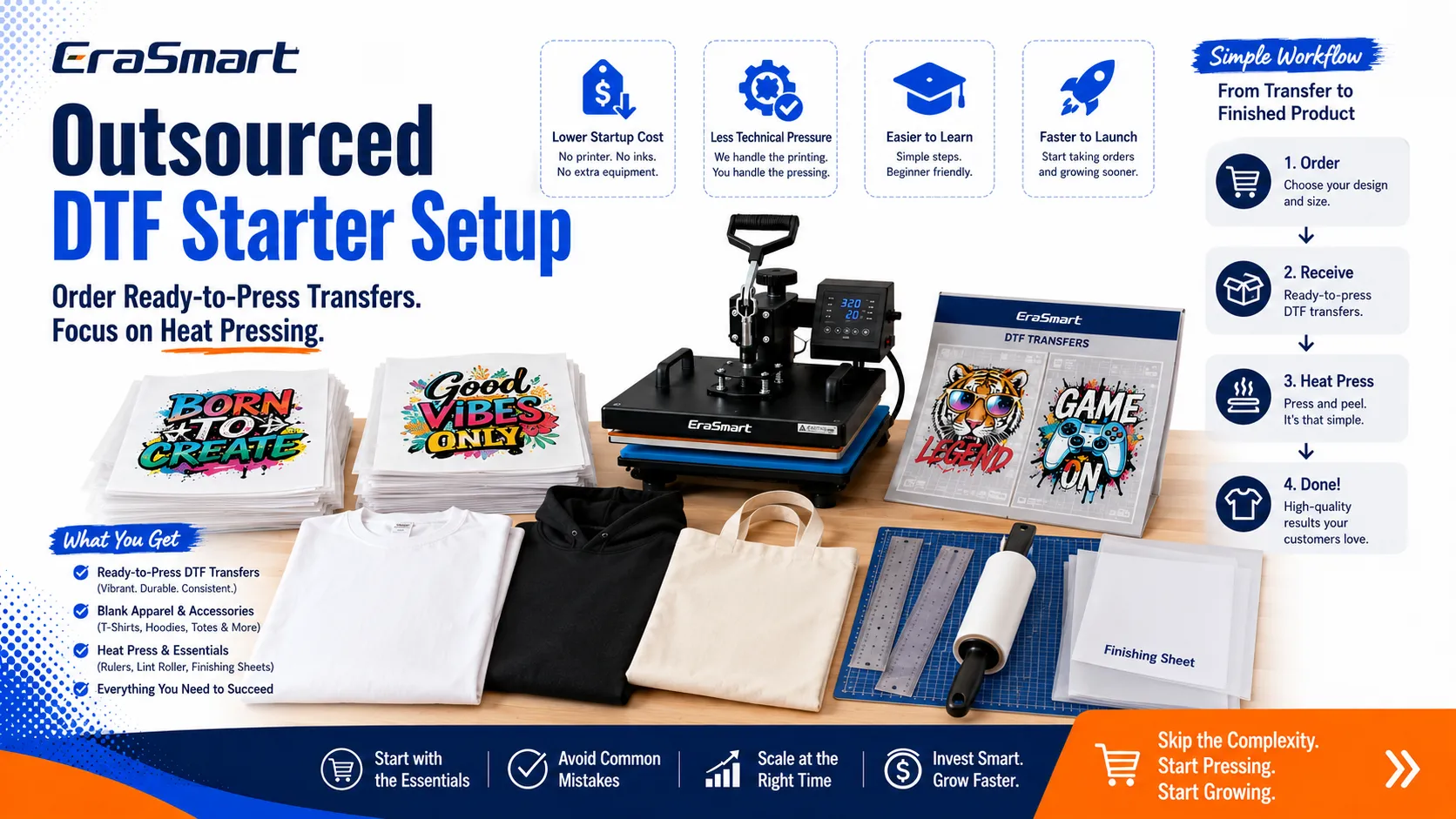
Part 2: DTF Equipment Checklist When Outsourcing Transfers

If you order ready-to-press DTF transfers, your startup equipment list is relatively simple.

You do not immediately need a DTF printer, DTF ink, adhesive powder, powder shaker, curing oven, or RIP software.


Essential Equipment

Bạn cần:

  • Máy ép nhiệt phẳng
  • Máy tính
  • Phần mềm thiết kế
  • Dụng cụ cắt
  • Thước đo căn chỉnh hàng may mặc
  • Con lăn xơ vải
  • Gối ép nhiệt
  • Finishing sheet
  • Băng chịu nhiệt
  • Găng tay chịu nhiệt
  • Blank apparel
  • Chuyển DTF sẵn sàng để nhấn

This model allows you to start selling custom clothing without operating a complete DTF production line.


Chuyển DTF sẵn sàng để nhấn

A ready-to-press transfer supplier handles:

  • In ấn
  • Mực trắng
  • Bột kết dính
  • Bảo dưỡng bột
  • Chuẩn bị phim

You receive a finished transfer that can be applied directly to the garment.

Before selecting a supplier, test:

  • Độ chính xác màu
  • Chi tiết đẹp
  • Độ mờ mực trắng
  • Chống căng
  • Độ bền giặt
  • Adhesive coverage
  • Hiệu suất bóc vỏ
  • Gang sheet quality
  • Delivery time

Ask the supplier whether the transfer is:

  • Vỏ nóng
  • Vỏ ấm
  • Vỏ lạnh

Follow the supplier’s pressing instructions instead of using one universal setting for every transfer.

Blank Apparel

Khoảng không quảng cáo đơn giản dành cho người mới bắt đầu có thể bao gồm:

  • White cotton T-shirts
  • Black cotton T-shirts
  • Gray blended T-shirts
  • Áo hoodie cơ bản
  • Túi xách cotton
  • Áo thể thao polyester
  • tạp dề

Avoid buying too many sizes and colors before you know which products customers prefer.

A better strategy is to:

  1. Keep several common sample blanks.
  2. Đặt hàng màu đặc biệt sau khi nhận được thanh toán.
  3. Record which styles and sizes sell most often.
  4. Increase inventory only for proven products.

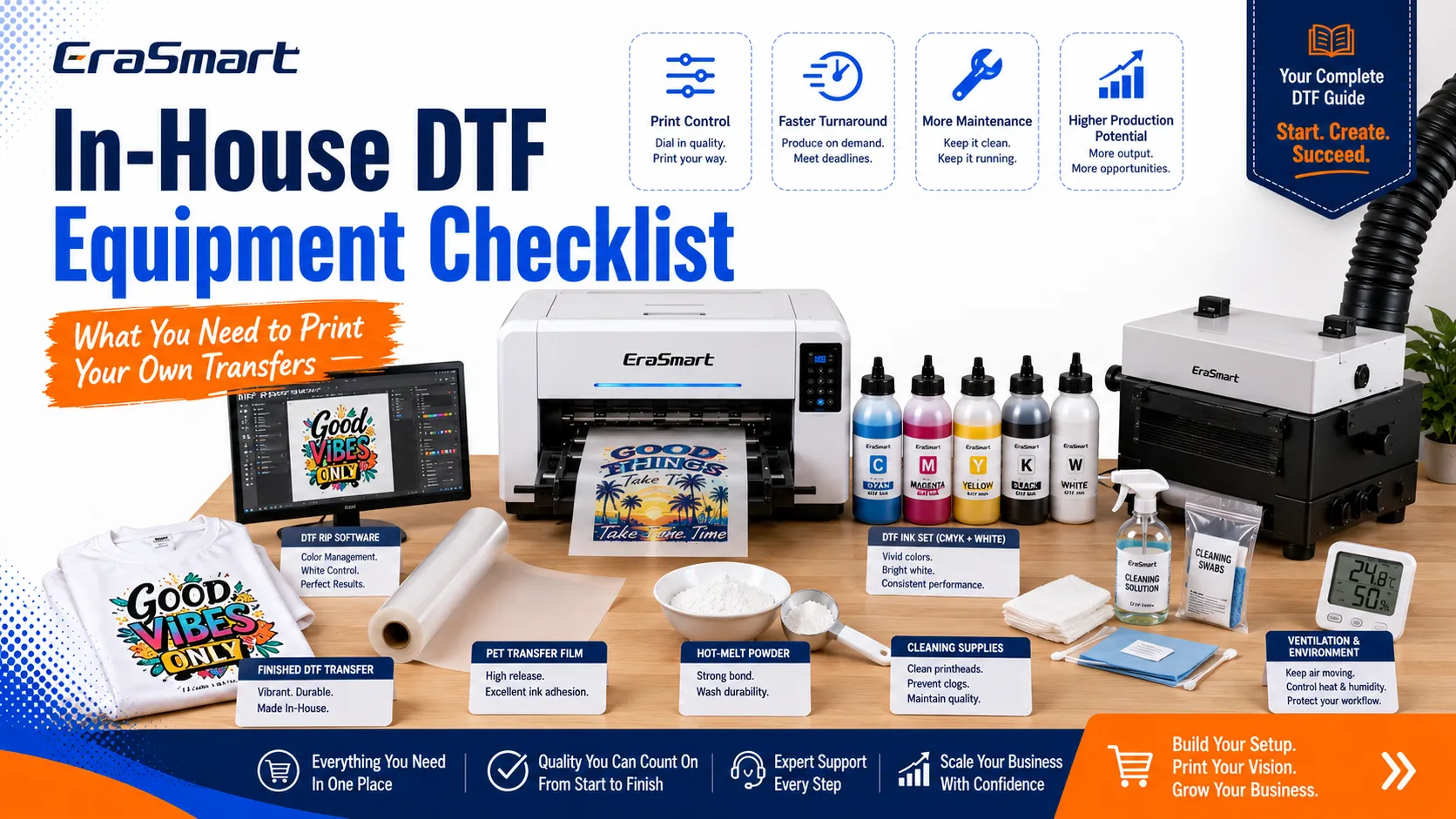
Part 3: Complete In-House DTF Equipment Checklist

When order volume becomes stable, you may decide to print your own DTF transfers.

This requires a more complete equipment system.

1. DTF Printer

The DTF printer is the center of the in-house workflow.

Common size categories include:

  • máy in A4 DTF
  • máy in DTF A3
  • A3+ DTF printer
  • 13-inch roll printer
  • 24-inch or A1 DTF printer

máy in A4 DTF

Suitable for:

  • Hobby use
  • Very small orders
  • Small graphics
  • Không gian làm việc hạn chế

máy in DTF A3

Suitable for:

  • Home studios
  • Doanh nghiệp nhỏ
  • Đồ họa áo phông
  • Hoạt động sản xuất ngắn
  • Custom orders

Larger roll-fed systems

Suitable for:

  • Higher order volume
  • Gang sheet production
  • Commercial apparel printing
  • Chuyển nhượng doanh số
  • Continuous workflow

Beginners can review the Danh sách kiểm tra mua máy in DTF before comparing machine sizes, printheads, production speed, and maintenance requirements.

2. DTF Ink

A standard DTF ink set includes:

  • Cyan
  • Magenta
  • Yellow
  • Đen
  • Trắng

White ink is necessary for:

  • Quần áo tối màu
  • Colored fabrics
  • Creating an opaque underbase

White ink requires regular circulation and maintenance because pigment can settle over time.

Do not mix unverified ink formulations. Ink compatibility affects:

  • Printhead performance
  • Color consistency
  • độ bám dính
  • Độ bền giặt
  • Nozzle condition

3. PET Transfer Film

DTF designs are printed onto PET transfer film.

Film options may differ in:

  • Thickness
  • Coating
  • Static behavior
  • Ink absorption
  • Peel temperature
  • Bề mặt hoàn thiện
  • Powder release
  • Sheet or roll format

Common peel types include:

  • Vỏ nóng
  • Vỏ ấm
  • Vỏ lạnh

Film, ink, powder, curing, and pressing settings should be tested as a complete system.

EraSmart's Hướng dẫn sử dụng vật tư tiêu hao DTF explains the relationship between ink, PET film, adhesive powder, and production quality.

4. Hot-Melt Adhesive Powder

DTF powder creates the adhesive layer between the printed design and the fabric.

Powder selection can affect:

  • độ bám dính
  • Cảm giác bề mặt
  • Chất lượng cạnh
  • Kéo dài
  • Khả năng chống rửa
  • Curing temperature
  • Cặn bột

Common powder categories include:

  • Fine powder
  • Medium powder
  • Coarse powder

The best option depends on the artwork, film, garment, and production system.

5. Powder Application Equipment

For very small production, powder may be applied manually.

Manual powdering requires:

  • Powder tray
  • Protective gloves
  • Controlled workspace
  • Careful removal of excess powder

For higher-volume production, use:

  • Automatic powder shaker
  • Powder recycling system
  • Integrated curing unit

An automatic shaker improves consistency and reduces manual labor.

6. DTF Curing Equipment

The powder must be melted and cured before the transfer is pressed onto fabric.

Curing options include:

  • DTF curing oven
  • Drawer oven
  • Conveyor dryer
  • Powder shaker with integrated dryer

Curing quality affects:

  • độ bám dính
  • Bề mặt hoàn thiện
  • Powder melting
  • Khả năng chống rửa
  • Transfer storage stability

Undercured powder may not bond correctly. Excessive heat may damage the ink, film, or adhesive.

7. RIP Software

RIP software controls important DTF printing functions such as:

  • White ink layers
  • Color ink output
  • White underbase
  • Ink limits
  • Độ phân giải in
  • Color profiles
  • Bố cục tấm băng đảng
  • Printer channels

Normal office printer software is generally not enough for a professional DTF workflow.

Confirm that the RIP software supports:

  • Your printer model
  • Your printhead
  • Your operating system
  • CMYK and white ink channels
  • Required print resolutions

8. White Ink Circulation System

A reliable DTF printer should include or support:

  • Tuần hoàn mực trắng
  • Khuấy mực trắng
  • Controlled ink delivery
  • Waste ink collection
  • Cleaning functions

These systems reduce settling but do not eliminate the need for regular maintenance.

9. Cleaning and Maintenance Supplies

Chuẩn bị:

  • Printhead cleaning solution
  • Cleaning swabs
  • Syringes
  • Tubing
  • Wipers
  • Dampers
  • Capping station supplies
  • Gloves
  • Lint-free cloths
  • Waste ink bottle
  • Maintenance log

DTF printing requires routine maintenance.

Review EraSmart’s DTF maintenance guide before leaving a printer unused or planning production around irregular working hours.


10. Ventilation and Workspace Protection

Powder handling and curing should take place in a controlled environment. Consider:
  • Thông gió
  • Local extraction
  • Air filtration
  • Powder containment
  • Heat-resistant work surfaces
  • Fire-safe equipment placement
  • Electrical capacity
Keep powder away from food, customer packaging, and unrelated work areas. Follow the safety information provided by the ink, powder, film, and equipment manufacturers.

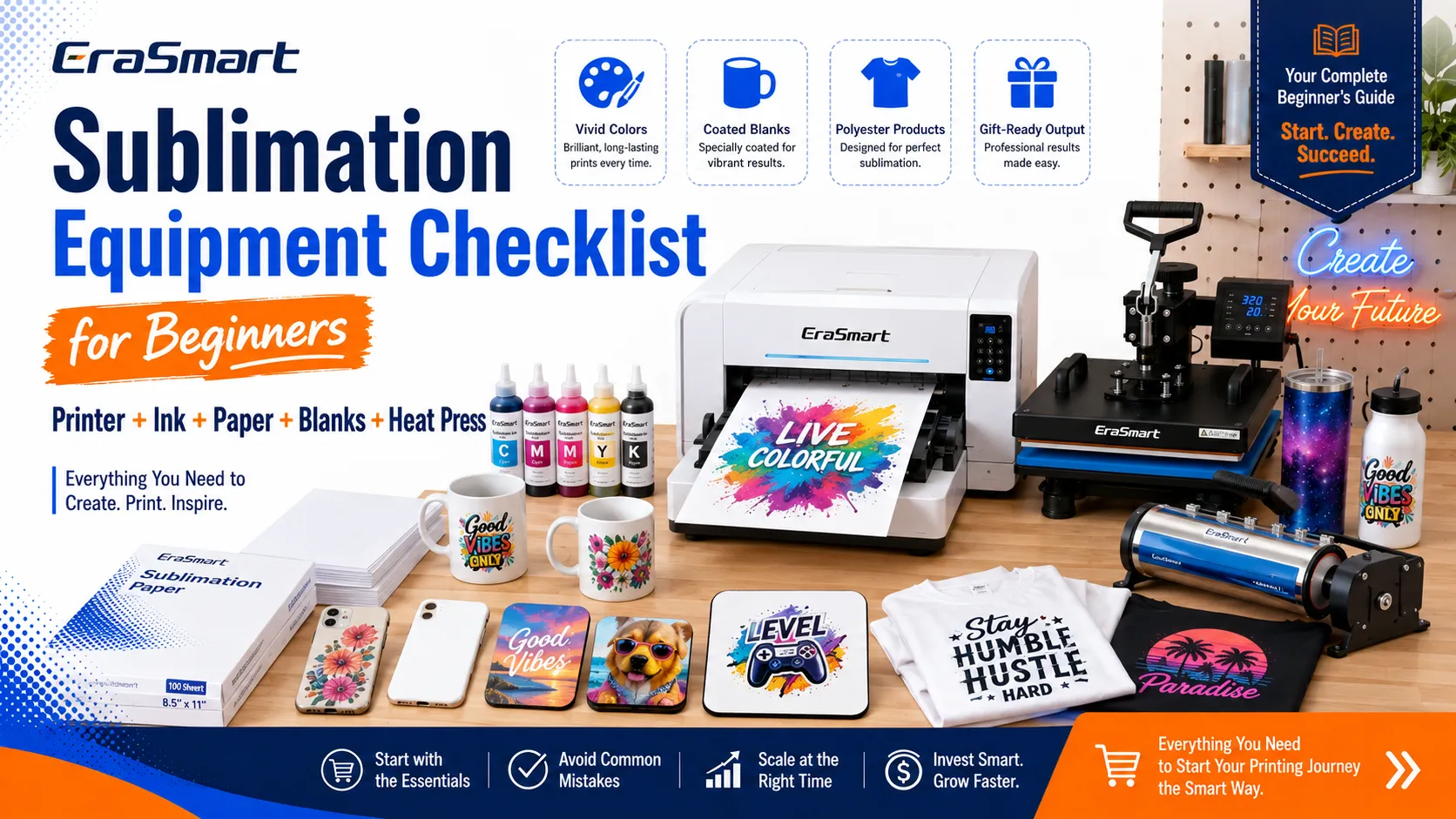
Part 4: Sublimation Equipment Checklist

Sublimation printing is generally easier to start in-house than DTF printing.

The basic workflow requires a printer, ink, paper, compatible blanks, and suitable heat press equipment.

1. Sublimation Printer

Common beginner sizes include:
  • A4
  • A3
  • A3+
  • Wide-format roll printer

Choose A4 if you mainly produce:

  • Cốc
  • Small keychains
  • Đế lót ly
  • Small phone case inserts
  • Small artwork

Choose A3 if you plan to produce:

  • Larger shirt graphics
  • Bàn di chuột
  • Vỏ gối
  • Larger photo products
  • Multiple designs on one sheet
An A3 printer usually provides more room for business growth.

2. Sublimation Ink

Use ink specifically designed for sublimation transfer. Ink quality affects:
  • Color density
  • Độ chính xác màu
  • Printhead reliability
  • Transfer performance
  • Long-term consistency
Do not mix ink brands or formulations unless compatibility has been verified. Keep records of:
  • Ink brand
  • Cài đặt máy in
  • Paper type
  • Hồ sơ ICC
  • Cài đặt ép nhiệt
  • Blank supplier
This helps reproduce successful results.

3. Sublimation Paper

Sublimation paper temporarily holds the printed image before heat transfer. Paper quality affects:
  • Drying time
  • Ink release
  • Color density
  • Chi tiết đẹp
  • Transfer efficiency
  • Ghosting risk
Store paper flat and dry. Moisture can affect printing and transfer performance.

4. ICC Color Profile

An ICC profile helps match the printer, ink, paper, and output settings. Without a suitable profile, you may experience:
  • Dull colors
  • Red or orange color shifts
  • Weak blacks
  • Incorrect skin tones
  • Oversaturated images
  • Inconsistent reproduction
Color management involves more than selecting a bright setting. EraSmart’s guide on cách in màu chính xác giải thích các nguyên nhân phổ biến gây ra hiện tượng không khớp màu.

5. Mug Press

A mug press is required for cylindrical ceramic mugs. Check:
  • Mug diameter range
  • Heating element coverage
  • Temperature accuracy
  • Pressure adjustment
  • Replacement heater availability
Use mugs with a coating designed for sublimation. Ordinary ceramic mugs generally do not accept sublimation ink correctly.

6. Tumbler Press

A tumbler press is useful for:

  • Straight tumblers
  • Travel cups
  • Sports bottles
  • Insulated drinkware

Check the size range before purchasing. One heater may not support every cup diameter or shape.

7. Sublimation Oven

A sublimation oven may be useful for:

  • Multiple tumblers
  • Irregular drinkware
  • Full-wrap products
  • Sản xuất hàng loạt

Additional supplies may include:

  • Co tay áo
  • Súng nhiệt
  • Silicone wraps
  • Găng tay chịu nhiệt

An oven is usually not essential for a beginner unless drinkware is a major product category.

8. Cap Press

A cap press may be used for:

  • Polyester caps
  • Sublimation hat patches
  • Curved heat-transfer applications

It is optional and should be purchased only when cap orders justify the equipment.

9. Sublimation Blanks

Khoảng trống thăng hoa phổ biến bao gồm:

  • White polyester shirts
  • Cốc
  • cốc
  • Bàn di chuột
  • Đế lót ly
  • Keychains
  • Vỏ điện thoại
  • Vỏ gối
  • Tấm ảnh kim loại
  • Gạch men
  • đồ trang trí MDF
  • Câu đố
  • Thẻ hành lý

Always confirm that a blank has a sublimation-compatible coating or polyester surface.

Part 5: Packaging and Order Fulfillment Checklist

Printing equipment alone is not enough to operate a professional business.

Prepare packaging materials from the beginning.

Apparel Packaging

Useful supplies include:

  • Túi đựng quần áo trong suốt
  • Nhiều bưu phẩm
  • Size stickers
  • Khăn giấy
  • Garment care cards
  • Thiệp cảm ơn
  • Nhãn dán logo

Mug and Gift Packaging

Chuẩn bị:

  • Hộp đựng cốc
  • Bọc bong bóng
  • Protective inserts
  • Hộp giấy kraft
  • băng
  • Fragile labels
  • Khăn giấy

Test packaging before shipping customer orders.

A mug box that looks strong may still fail during transport without internal protection.

Shipping and Labeling Equipment

Optional equipment includes:

  • Shipping label printer
  • Barcode printer
  • Digital scale
  • Tape dispenser
  • Thermal labels
  • Inventory labels

These tools become more valuable as order volume increases.

Part 6: Workspace and Safety Checklist

A beginner studio should also prepare for heat, electricity, ventilation, and storage.

Kiểm tra:

  • Stable electrical supply
  • Suitable outlets
  • No overloaded extension cords
  • Heat-resistant worktable
  • Thông gió
  • Fire extinguisher
  • Clear walkways
  • Safe cable management
  • Secure ink storage
  • Powder containment
  • Child and pet safety
  • Proper waste handling

Keep hot equipment away from:

  • Plastic bags
  • Paper stacks
  • Curtains
  • Cleaning chemicals
  • Flammable packaging

Allow heat press machines and ovens to cool before covering or storing them.

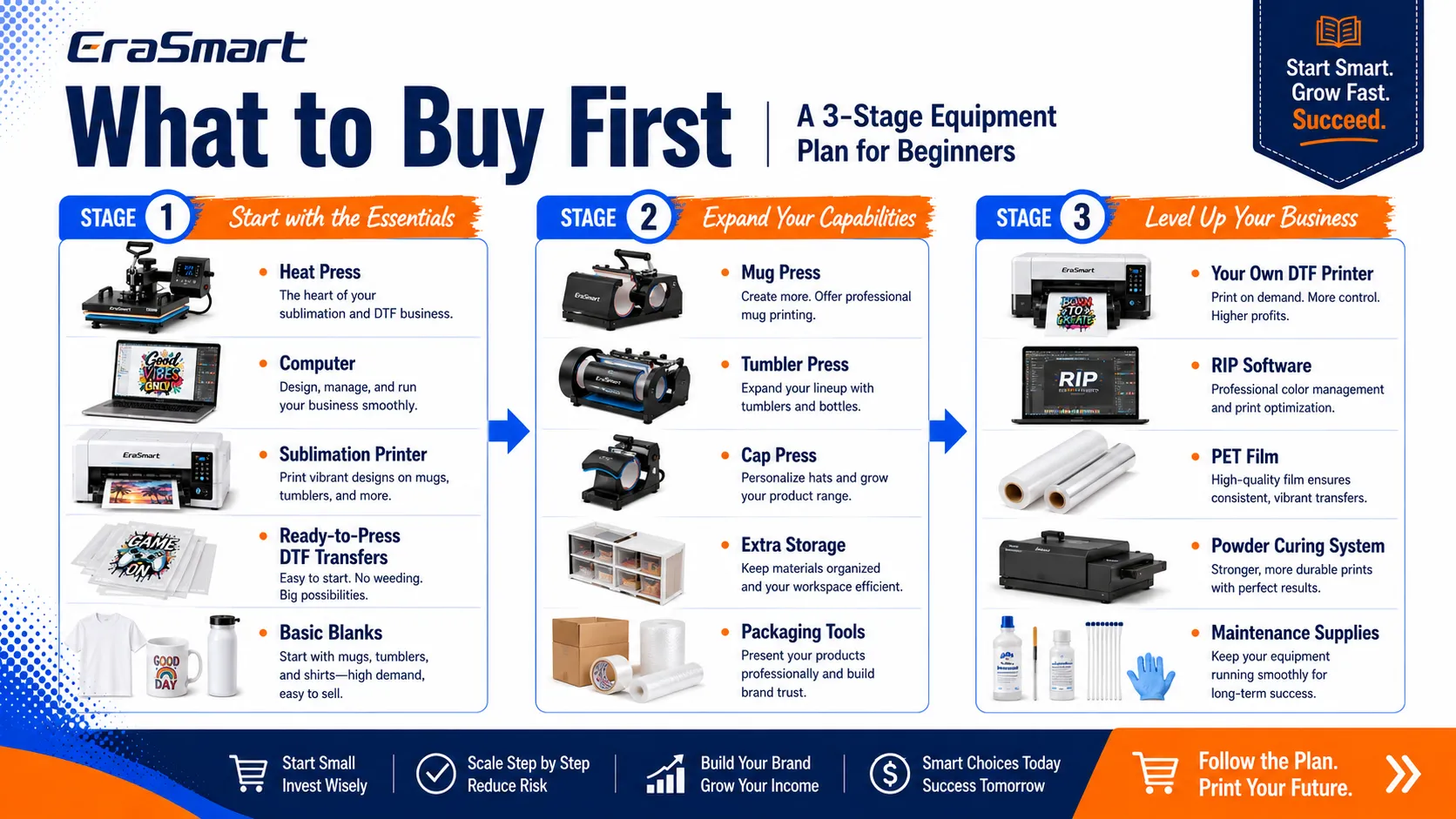
What to Buy First

Beginners should purchase equipment in stages.

Stage 1: Minimum Startup Setup

Buy first:

  • Máy ép nhiệt phẳng đáng tin cậy
  • Máy tính
  • Phần mềm thiết kế
  • Máy in thăng hoa
  • Mực thăng hoa
  • Giấy thăng hoa
  • Chuyển DTF sẵn sàng để nhấn
  • Áo phông trống
  • Several sublimation blanks
  • Scissors and cutting tools
  • Băng chịu nhiệt
  • Giấy bảo vệ
  • Con lăn xơ vải
  • Alignment ruler
  • Vật tư đóng gói cơ bản

This setup allows you to sell products before investing in a complete DTF printing system.

Stage 2: Product Expansion

Add after you have customer demand:

  • Máy ép cốc
  • Máy ép cốc
  • Bấm nắp
  • Máy ép nhiệt lớn hơn
  • Auto-open press
  • Product photography lighting
  • máy in nhãn
  • Thêm hàng tồn kho trống
  • Additional storage

Purchase equipment based on actual orders rather than predicted demand.

Stage 3: In-House DTF Production

Add when outsourced transfer volume becomes stable:

  • Máy in DTF
  • Phần mềm RIP
  • mực DTF
  • Phim thú cưng
  • Bột kết dính
  • Curing oven or powder shaker
  • Thông gió
  • Dụng cụ vệ sinh
  • Spare maintenance components

A compact DTF printer may be suitable for a home studio, while a larger roll-fed system is more appropriate for continuous commercial production.

Beginners comparing machine sizes can review EraSmart’s guide to the best DTF printer for beginners.

Equipment You Can Delay

These items are useful but not always necessary at the beginning:

  • Máy in DTF
  • Máy lắc bột
  • Conveyor dryer
  • Multiple heat presses
  • Lò thăng hoa
  • Bấm nắp
  • Large blank inventory
  • Professional color calibration device
  • Automatic folding equipment
  • Large-format printer
  • Commercial photography system

Delay an equipment purchase when:

  • The product has not been tested
  • There is no consistent demand
  • The machine does not solve an existing problem
  • Outsourcing is still cheaper
  • You do not have enough space
  • You cannot maintain the machine properly

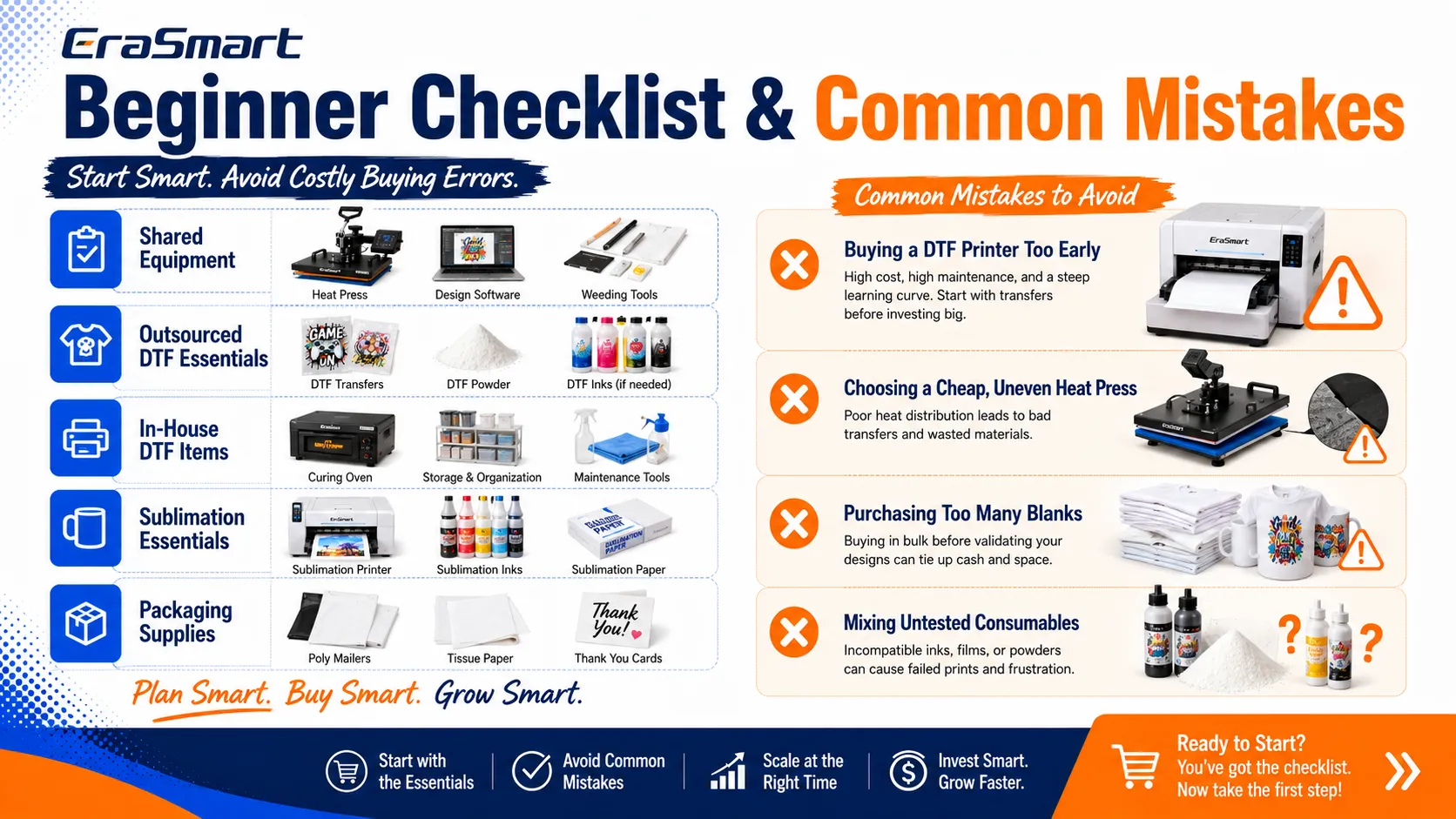
Beginner Equipment Checklist

Use this final checklist when planning your studio.

Shared equipment

  • Máy ép nhiệt phẳng
  • Computer or laptop
  • Phần mềm thiết kế
  • Kéo
  • Máy xén giấy
  • Dao thủ công
  • Thảm cắt
  • Cái thước kẻ
  • Thước đo căn chỉnh hàng may mặc
  • Băng chịu nhiệt
  • Giấy bảo vệ
  • Tấm silicon
  • Con lăn xơ vải
  • Găng tay chịu nhiệt
  • Gối ép nhiệt
  • Stable worktable
  • Kệ lưu trữ

Outsourced DTF workflow

  • Chuyển DTF sẵn sàng để nhấn
  • Áo phông trống
  • Áo hoodie
  • Túi xách
  • Thẻ hướng dẫn chăm sóc
  • Tested pressing settings

In-house DTF workflow

  • Máy in DTF
  • Phần mềm RIP
  • CMYK DTF ink
  • White DTF ink
  • Phim chuyển thú cưng
  • Hot-melt powder
  • Powder tray or shaker
  • Curing oven or dryer
  • Thông gió
  • Cleaning solution
  • Cleaning swabs
  • Waste ink system
  • Spare dampers and maintenance parts

Sublimation workflow

  • Máy in thăng hoa
  • Mực thăng hoa
  • Giấy thăng hoa
  • Hồ sơ ICC
  • Áo sơ mi polyester
  • Cốc thăng hoa
  • Bàn di chuột
  • Đế lót ly
  • Keychains
  • Phone case blanks
  • Máy ép cốc
  • Tumbler press if required
  • Shrink sleeves if required

Bao bì

  • Nhiều bưu phẩm
  • Túi đựng quần áo trong suốt
  • Hộp giấy kraft
  • Hộp đựng cốc
  • Bọc bong bóng
  • Khăn giấy
  • Thiệp cảm ơn
  • Care cards
  • Nhãn dán logo
  • Nhãn vận chuyển
  • Digital scale

Common Equipment-Buying Mistakes

Buying a DTF Printer Too Early

A DTF printer can improve control and profit, but it also introduces maintenance, ink, film, powder, curing, and software requirements.

Start with outsourced transfers if you are still testing demand.

Buying a Heat Press Based Only on Price

A low-cost press with uneven heat can waste transfers, garments, and sublimation blanks.

Heat consistency is more important than additional attachments.

Purchasing Too Many Blanks

Blank products consume storage space and cash.

Start with a small range of common products.

Buying a Multi-Function Press Without Checking Quality

A multi-function press may appear economical, but not every attachment provides reliable pressure or temperature.

Dedicated equipment is often better when a product category becomes important.

Ignoring Maintenance Supplies

A DTF printer should never be purchased without budgeting for cleaning supplies, spare parts, and regular maintenance.

Mixing Unverified Consumables

Do not assume every ink, film, powder, paper, or blank works equally well together.

Test the complete production system.

Common Equipment-Buying Mistakes

Buying a DTF Printer Too Early

A DTF printer can improve control and profit, but it also introduces maintenance, ink, film, powder, curing, and software requirements.

Start with outsourced transfers if you are still testing demand.

Buying a Heat Press Based Only on Price

A low-cost press with uneven heat can waste transfers, garments, and sublimation blanks.

Heat consistency is more important than additional attachments.

Purchasing Too Many Blanks

Blank products consume storage space and cash.

Start with a small range of common products.

Buying a Multi-Function Press Without Checking Quality

A multi-function press may appear economical, but not every attachment provides reliable pressure or temperature.

Dedicated equipment is often better when a product category becomes important.

Ignoring Maintenance Supplies

A DTF printer should never be purchased without budgeting for cleaning supplies, spare parts, and regular maintenance.

Mixing Unverified Consumables

Do not assume every ink, film, powder, paper, or blank works equally well together.

Test the complete production system.

Câu hỏi thường gặp

What equipment does a beginner need for DTF and sublimation?

At minimum, a beginner needs a heat press, computer, design software, sublimation printer, sublimation ink, sublimation paper, ready-to-press DTF transfers, blank products, cutting tools, and packaging supplies.

Do I need a DTF printer to start selling DTF shirts?

No. You can purchase ready-to-press DTF transfers and apply them with a heat press.

Can one heat press be used for both DTF and sublimation?

Yes. A flat heat press can be used for DTF apparel and flat sublimation products such as polyester shirts, mousepads, and pillow covers.

Do I need a mug press?

You need a mug press if you plan to produce ceramic mugs regularly. It can be delayed if your first products are shirts and flat blanks.

Is A4 or A3 better for sublimation?

A4 is suitable for small gifts and mugs. A3 provides more flexibility for apparel, mousepads, larger designs, and multiple products on one sheet.

Khi nào tôi nên mua máy in DTF của riêng mình?

Consider purchasing one when transfer orders are frequent, outsourcing affects your profit or delivery speed, and you are prepared to manage daily maintenance.

What is the most important equipment purchase?

The flat heat press is usually the most important first purchase because both DTF transfers and many sublimation products depend on consistent heat and pressure.


Có thể bạn cũng thích

  • Máy in Erasmart

    Máy in UV
    Máy in DTF
    Máy in DTG
    Máy ép nhiệt
    Máy in quảng cáo

  • Công cụ máy in

    Lò nướng DTF
    Báo chí nóng
    Máy chạm khắc
    Truyền nhiệt cốc
    Máy làm cán

  • Vật tư tiêu hao

    In mực in
    Vỏ điện thoại di động
    Sản phẩm thủy tinh
    Làm sạch chất lỏng
    Gạc bông

  • Liên hệ với chúng tôi

    WhatsApp, +8618566233796
    WeChat, +8618566233796
    Di động +8618566233796
    Web :www.erasmart.com
    Cửa hàng:www.erasmartmall.com

  • Cần giá máy in?

    Hãy cho chúng tôi biết nhu cầu in ấn của bạn. Nhóm của chúng tôi sẽ trả lời trong vòng 24 giờ.

    Yêu cầu báo giá

    Chỉ cần cung cấp một vài chi tiết và chúng tôi sẽ giúp bạn nhận được báo giá nhanh!