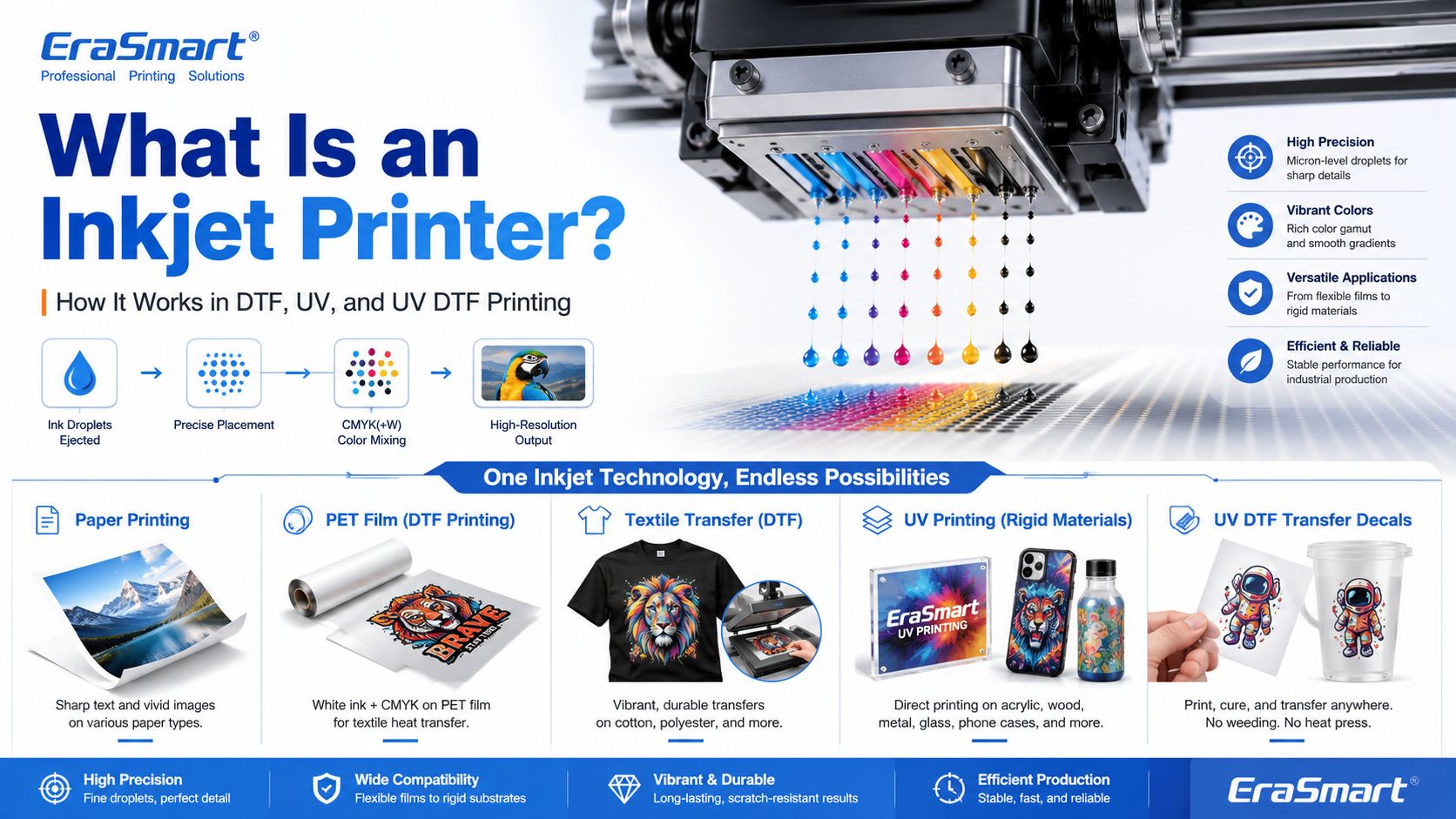
An inkjet printer is a digital printing device that creates images by ejecting tiny droplets of ink onto a surface. Instead of using plates, screens, or physical stencils, an inkjet printer receives digital image data and places controlled ink droplets in precise positions to form text, graphics, photos, labels, transfers, or product decoration.
Most people first know inkjet printers from office or home photo printing. But inkjet technology is much broader than desktop paper printing. Today, inkjet systems are used in DTF printing, UV flatbed printing, UV DTF transfers, packaging samples, product labels, signage, promotional products, textile decoration, industrial marking, and custom product manufacturing.
For EraSmart customers, this topic matters because many modern custom printing machines are built on inkjet principles. A Máy in DTF uses inkjet technology to print garment designs onto transfer film. A máy in tia cực tím uses inkjet technology to print UV-curable ink directly onto rigid materials. A Máy in UV DTF uses inkjet printing to create hard-surface decals and transfers on A/B film.
In simple terms, inkjet printing is the foundation. DTF, UV, and UV DTF are specialized business workflows built around that foundation.
An inkjet printer is a printer that sprays or ejects tiny droplets of liquid ink through microscopic nozzles to create a printed image.
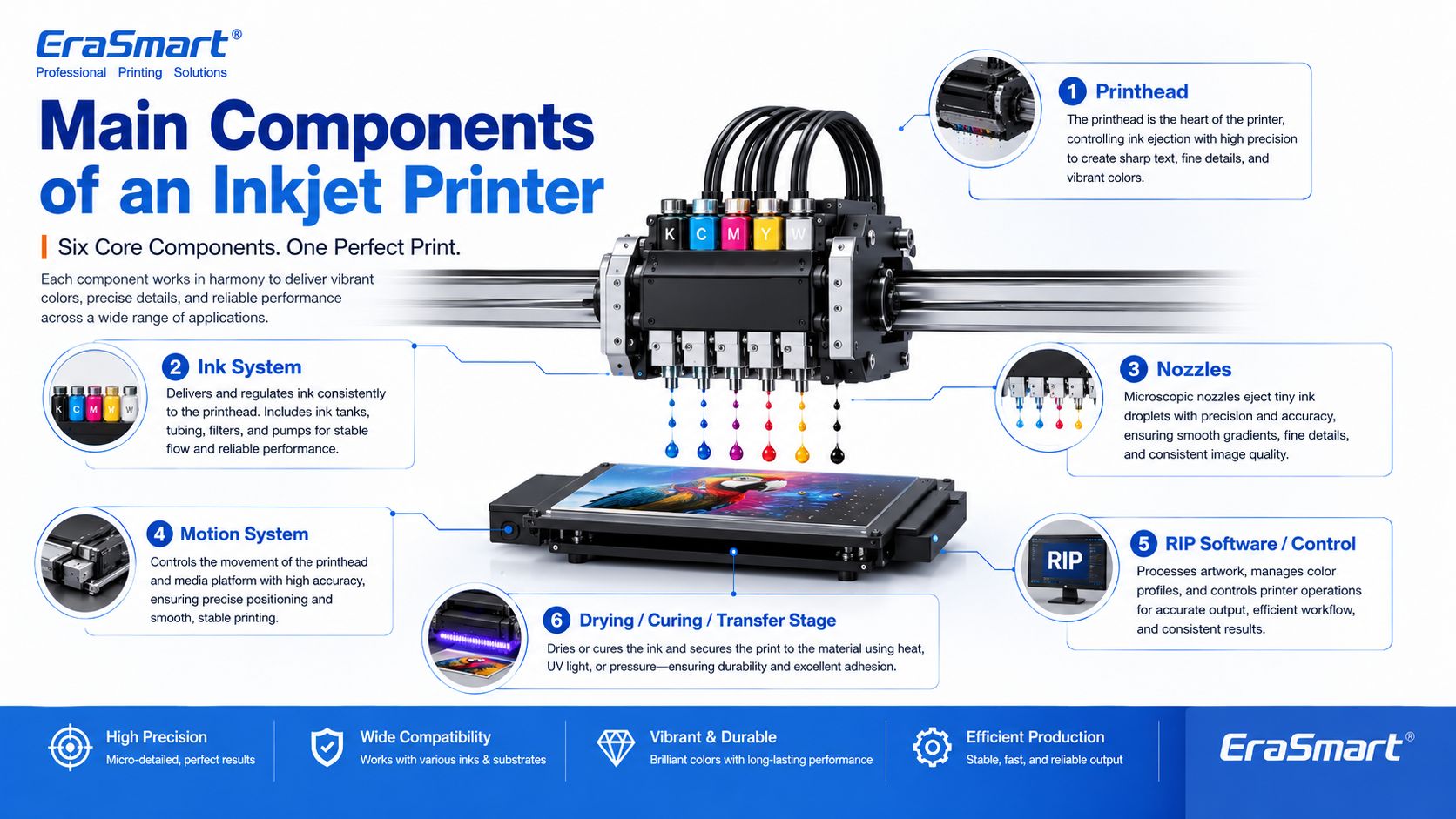
A basic inkjet printing system includes:
The printhead is the key component. It controls where ink droplets land, how much ink is ejected, and how accurately the image is formed.

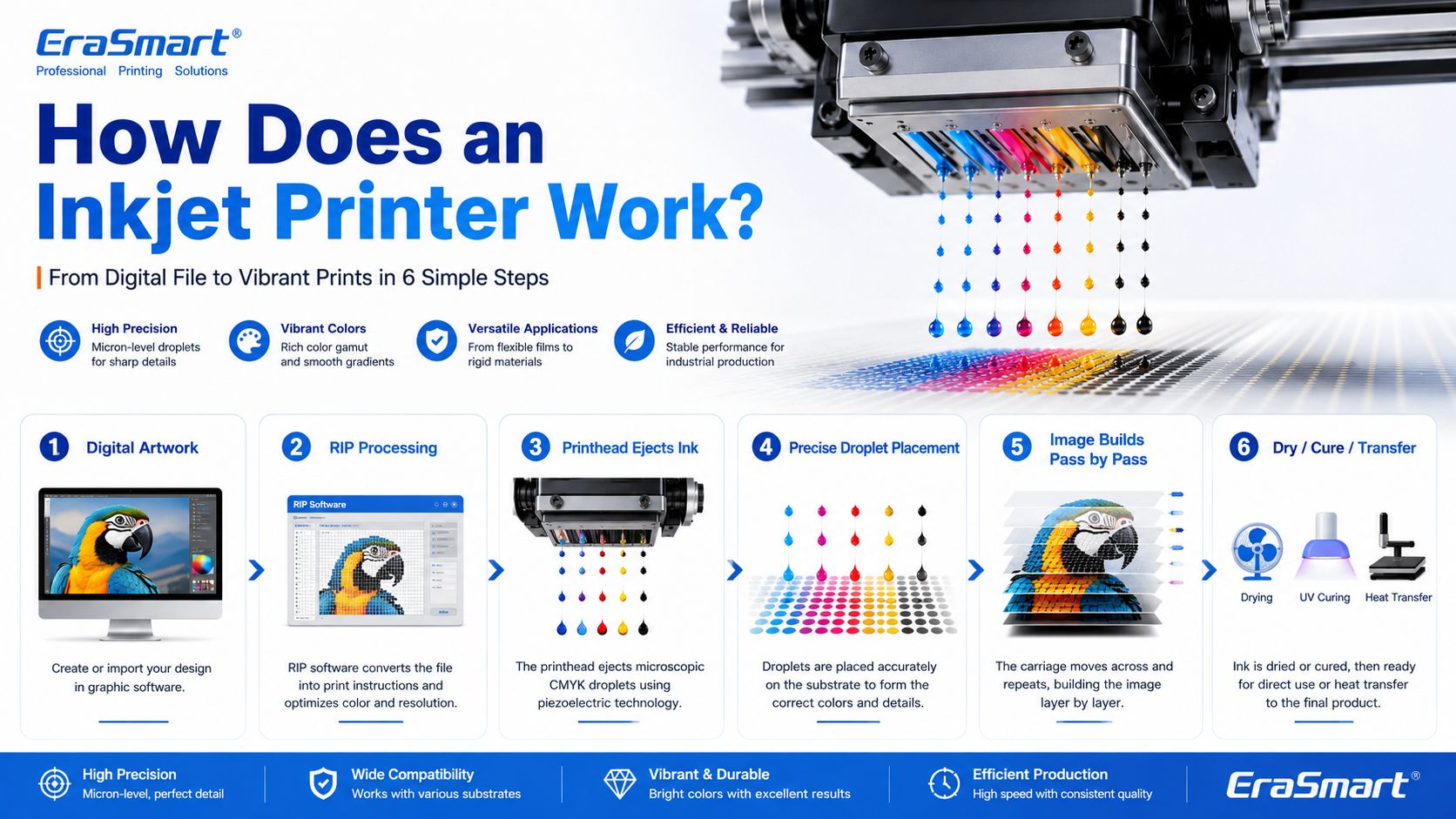
Inkjet printing may look simple from the outside, but inside the printer there is a precise digital control process.
A simplified workflow looks like this:
In an office inkjet printer, ink is usually printed onto paper and dries or absorbs into the paper surface. In an industrial or custom printing system, the process may be more specialized. For example, UV ink is cured by UV light, while DTF ink is printed onto PET film and later heat transferred onto fabric.

The printhead is the most important part of an inkjet printer. It contains many tiny nozzles that eject ink droplets. The printhead determines much of the printer’s resolution, droplet control, speed, and print quality.
In custom printing, printhead condition directly affects:
This is why printer maintenance is so important in DTF and UV printing. If the printhead nozzles are clogged or unstable, the final print may show banding, missing lines, weak colors, or poor detail.
For apparel printing users, EraSmart’s Hướng dẫn bảo trì máy in DTF is a useful resource for understanding why nozzle checks, cleaning, white ink circulation, and daily care matter.
The ink system stores and delivers ink to the printhead. Different inkjet printers use different types of ink depending on the application.
Common ink types include:
For EraSmart customers, the most relevant ink systems are DTF ink, UV ink, white ink, and varnish.
MỘT Máy in DTF commonly uses CMYK ink plus white ink. The white ink helps designs appear clearly on dark garments. A máy in tia cực tím may use CMYK, white ink, and varnish to print on hard surfaces such as acrylic, glass, metal, wood, plastic, leather, and packaging materials.
If you want to understand how CMYK, white ink, and varnish work together in product customization, see EraSmart’s UV Ink Guide: CMYK, White Ink, and Varnish.
Nozzles are microscopic openings in the printhead. They eject ink droplets in controlled patterns.
Nozzle performance affects:
Nozzles can become clogged if ink dries, settles, or becomes contaminated. This is especially important for white ink systems because white ink contains heavier pigment particles and needs proper circulation and maintenance.
Inkjet printers need accurate motion control. Either the printhead moves across the material, the material moves under the printhead, or both are coordinated.
The motion system affects:
In UV flatbed printing, the platform and printhead movement must be stable so the image lands accurately on rigid objects. In DTF printing, film feeding must be smooth so the transfer image remains consistent.
RIP software converts artwork into printer-ready instructions. It controls color output, resolution, ink layering, white ink channels, varnish layers, print passes, and other production settings.
For custom printing businesses, RIP setup is important because it affects:
A good printer is only part of the system. Correct artwork preparation and RIP settings are also necessary for professional results.

Inkjet printing is not finished when ink leaves the nozzle. The ink must also become stable on the final product.
Different workflows use different finishing methods:
| Inkjet Workflow | What Happens After Printing |
|---|---|
| Office inkjet | Ink dries or absorbs into paper |
| in DTF | Powder is applied, cured, then heat pressed onto fabric |
| in UV | UV light cures the ink almost instantly |
| In UV DTF | UV ink is printed on film, laminated, then applied as a transfer |
| Thăng hoa | Printed transfer is heat pressed into polyester or coated blanks |
This is why inkjet technology can support many industries. The core droplet technology is similar, but the finishing process changes based on the product.

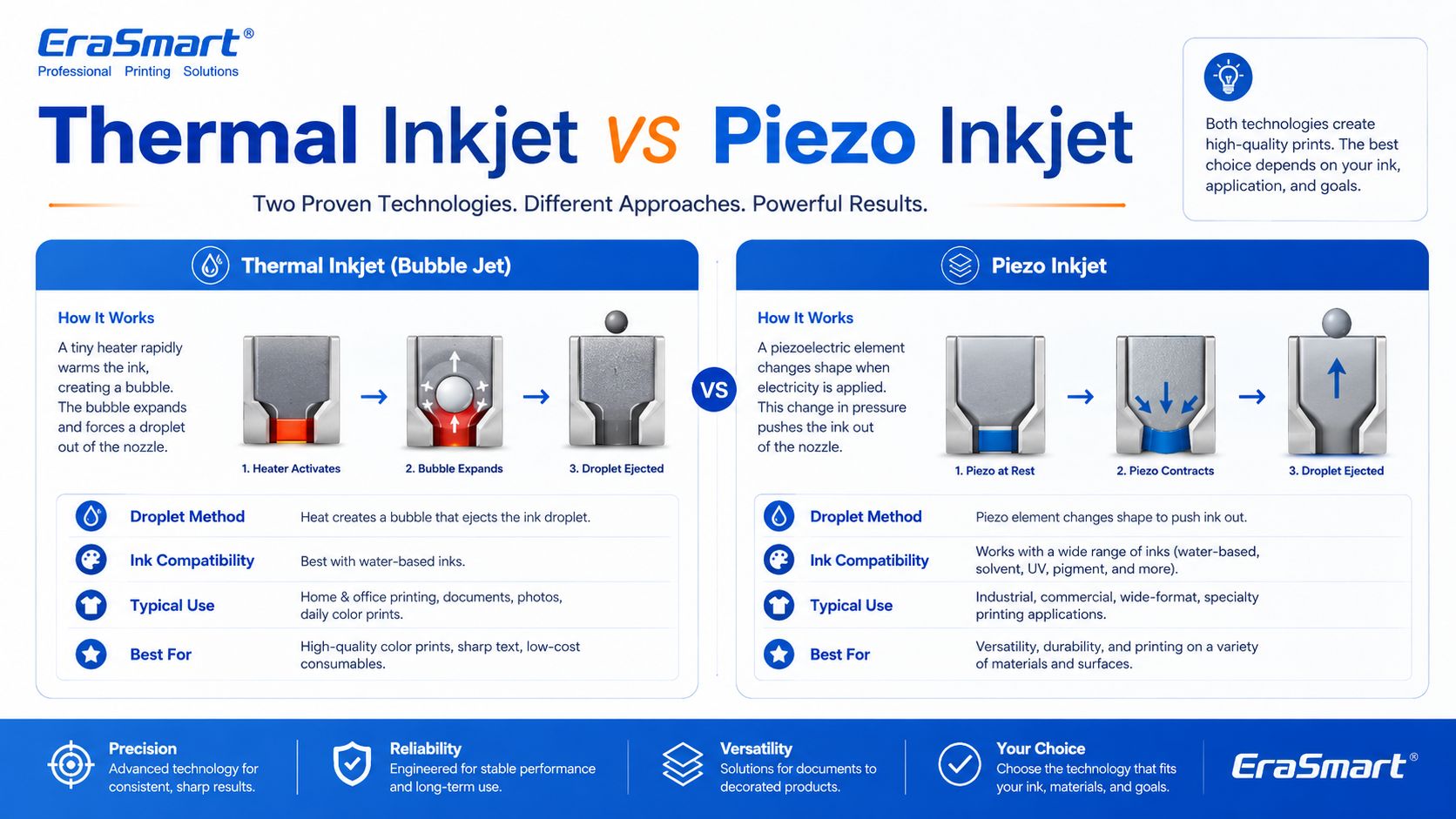
There are two major inkjet technologies: thermal inkjet and piezo inkjet.
Thermal inkjet uses heat to create a vapor bubble inside the ink chamber. The pressure from this bubble pushes a droplet of ink out of the nozzle.
Thermal inkjet is common in many desktop and office printers. It can produce high-quality prints on paper, but the ink must be compatible with heat-based ejection.
Piezo inkjet uses a piezoelectric element that changes shape when voltage is applied. This mechanical movement creates pressure and ejects ink droplets through the nozzle.
Piezo inkjet is widely used in many professional and industrial printing systems because it can work with a broader range of inks. Since the ink is not heated for ejection, piezo technology is suitable for inks that may not perform well in thermal systems, including many specialty inks used in industrial and custom printing.
For DTF, UV, and UV DTF applications, piezo-style inkjet technology is especially important because these workflows require precise ink control and compatibility with specialized ink types.
Inkjet printing can also be divided by how ink is delivered.
Drop-on-demand means ink droplets are ejected only when needed. This is common in many graphic and custom printing applications because it offers precise control and efficient ink use.
DTF, UV, and UV DTF printers generally operate around controlled digital droplet placement, which is why they can reproduce detailed designs and full-color artwork.
Continuous inkjet ejects a continuous stream of ink droplets. Some droplets are directed to the surface, while others may be recycled. This method is often used in industrial coding and marking, such as printing dates, batch codes, and product identification on packaging lines.
For EraSmart customers, drop-on-demand inkjet is the more relevant concept because custom apparel and product printing require accurate image reproduction rather than simple coding.
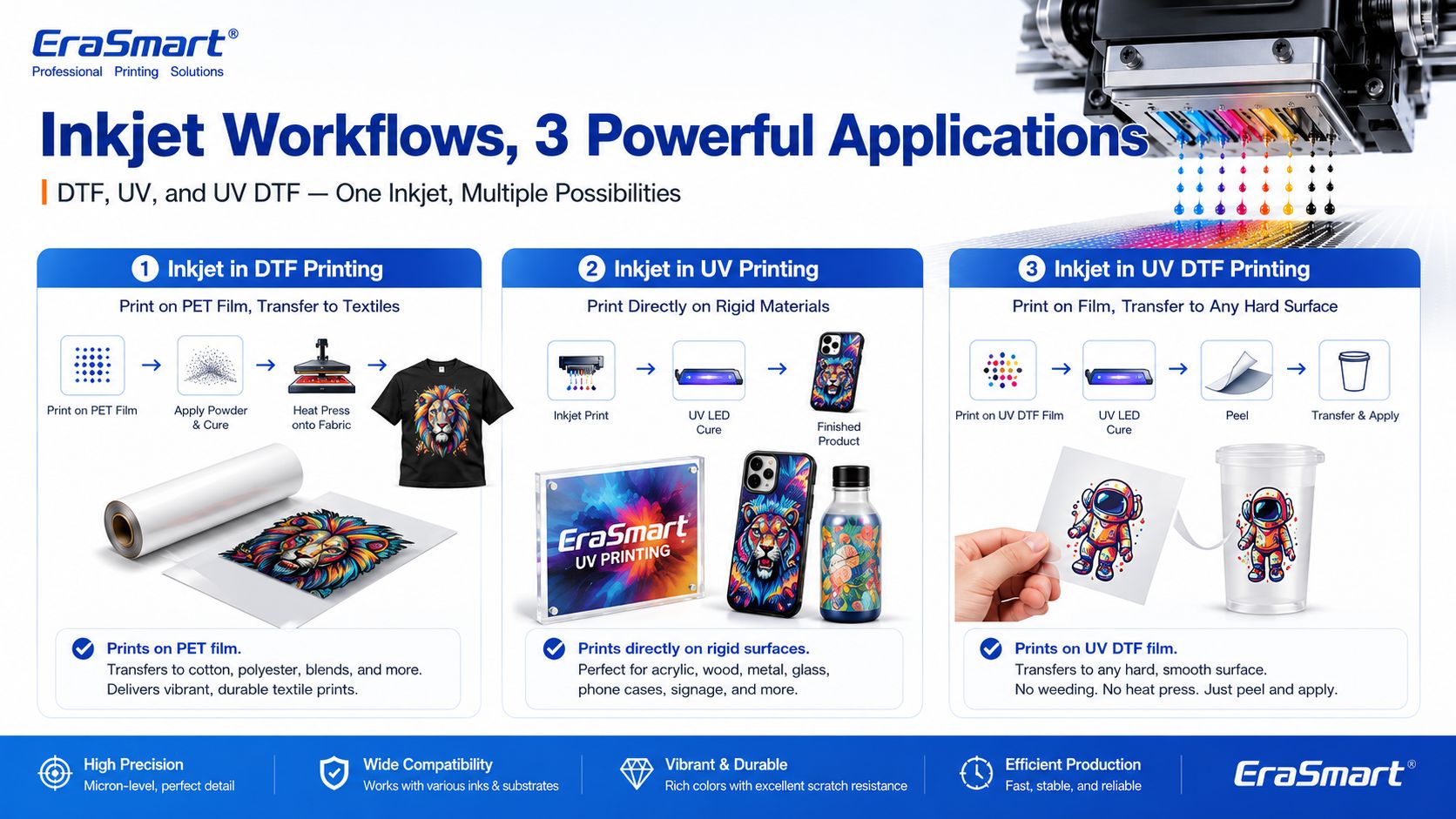
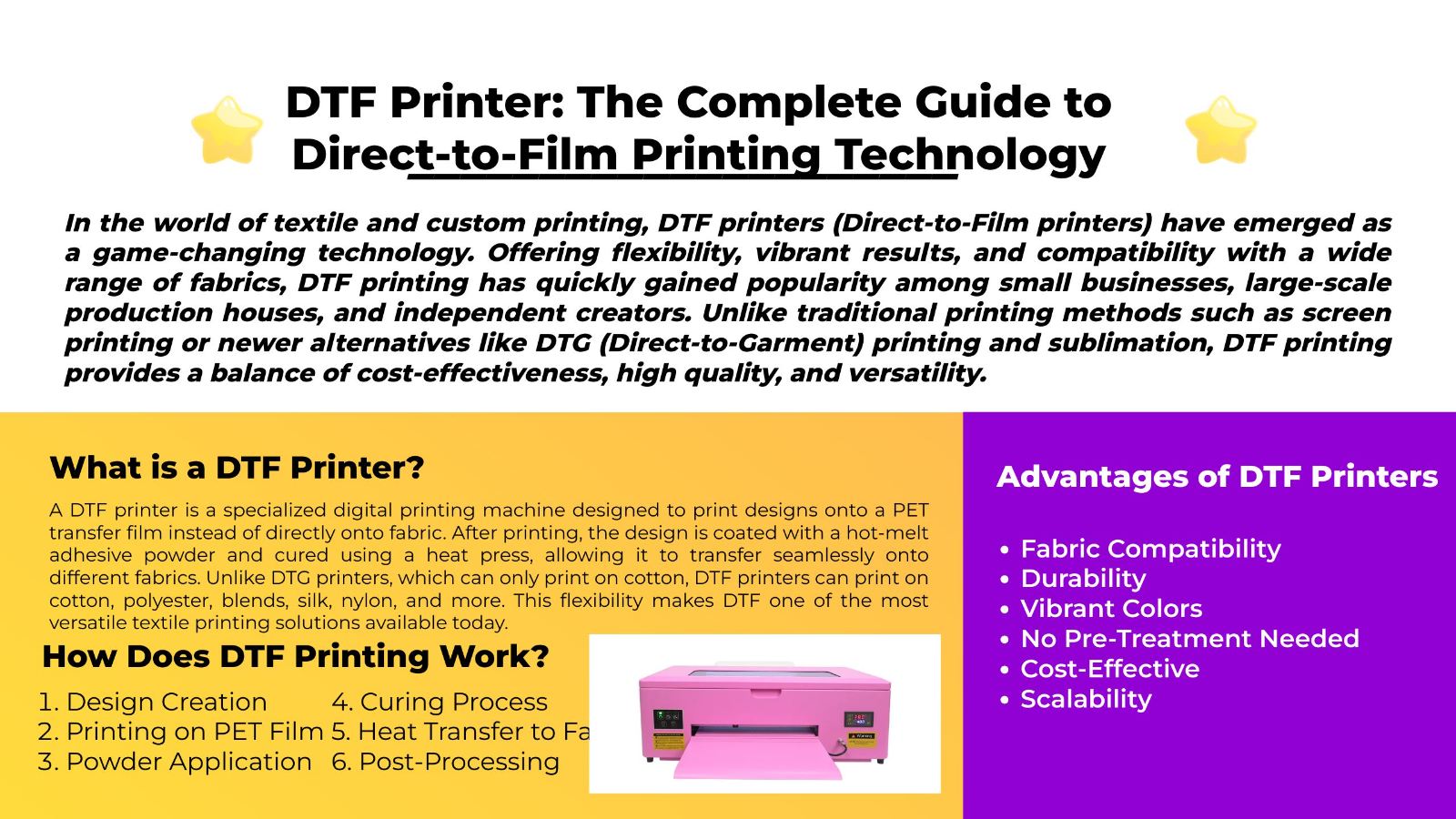
A DTF printer is a specialized inkjet printer for garment transfer production. Instead of printing directly onto a shirt, it prints the design onto PET transfer film.
The typical DTF process includes:
This process is useful for custom apparel because it supports:
If you are interested in building an apparel business, EraSmart’s Máy in DTF category includes different models for startups, small studios, growing shops, and higher-volume production. You can also read the Quy trình sản xuất DTF to understand the full process from artwork to finished garment.
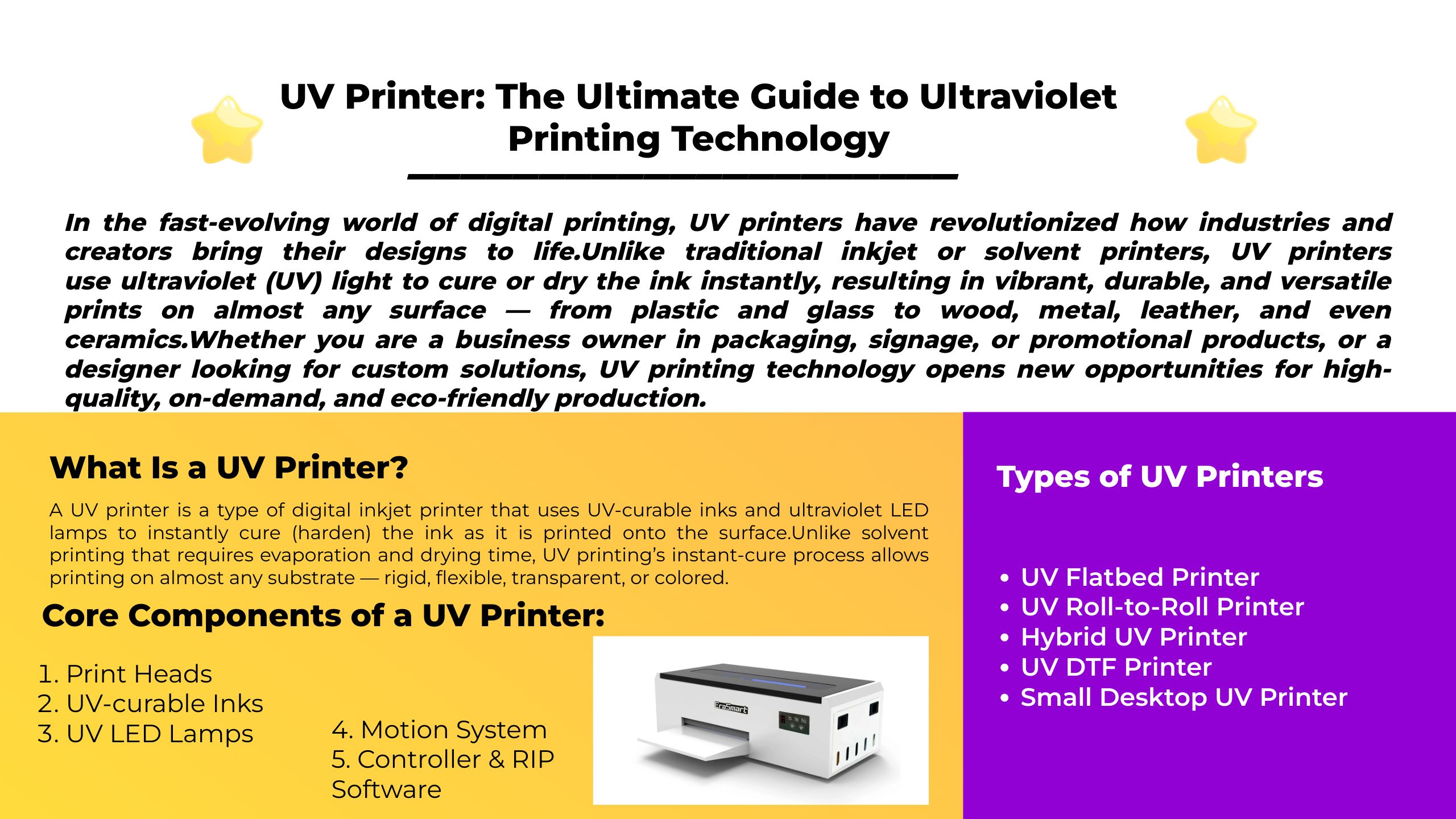
A UV printer is another specialized inkjet system. Instead of using standard paper ink, it uses UV-curable ink. The printer ejects ink onto the material surface, and UV light cures the ink almost immediately.
UV printing is suitable for many hard and semi-rigid materials, such as:
The advantage of UV printing is direct-to-object customization. You can print full-color designs, white ink layers, and varnish effects on many product surfaces.
EraSmart's Máy in UV category is designed for businesses that want to create custom gifts, signs, phone cases, packaging samples, acrylic products, and hard-surface promotional items. For material selection, see the Hướng dẫn sử dụng vật liệu máy in UV.
UV DTF printing combines UV inkjet printing with a transfer workflow. The printer prints UV ink onto A film, laminates it with B film, and creates a transfer decal that can be applied to hard surfaces.
UV DTF is useful for:
Unlike textile DTF, UV DTF is mainly for hard-surface transfers, not garments. It is a good choice for businesses that want to sell premium stickers, decals, labels, and cup wraps.
EraSmart's Máy in UV DTF is suitable for hard-surface transfer applications, while the A/B Film for UV DTF Printing guide explains how the film system works in the transfer process.
Inkjet printing is important because it allows digital, flexible, short-run production. Unlike traditional methods that require screens, plates, or molds, inkjet printing can print directly from a digital file.
This creates major advantages for custom businesses:
For example, a DTF apparel business can print different names, numbers, and graphics without preparing new screens. A UV printing business can print different logos on phone cases, acrylic signs, glass gifts, or packaging samples. A UV DTF business can produce custom decals and labels for many small brands.
This is why inkjet technology is no longer only about office printing. It is now a core technology for modern customization businesses.
Inkjet printing works directly from digital files. This makes it easy to change designs, personalize products, and produce short runs.
Inkjet printers can reproduce complex color images, gradients, photos, and illustrations. This is useful for apparel graphics, product decoration, stickers, and packaging samples.
Inkjet does not require plates or screens, so it is suitable for low-MOQ custom orders and on-demand production.
Each print can be different. This is useful for names, numbers, QR codes, serialized labels, personalized gifts, and custom designs.
Inkjet technology can be adapted to many surfaces and workflows, including paper, textiles, film, rigid materials, packaging, labels, and transfers.
A business can start with small orders and upgrade equipment as demand grows. This is why inkjet-based DTF, UV, and UV DTF systems are attractive to startups and growing shops.
Inkjet printers need regular maintenance. If nozzles clog, print quality declines. This is especially important for white ink, UV ink, and other specialty ink systems.
Not every ink works with every printhead or material. Ink viscosity, pigment size, curing method, and surface compatibility all matter.
Some surfaces need cleaning, primer, coating, or testing before printing. This is especially common in UV printing on glass, metal, plastic, and other hard materials.
Screen colors and printed colors are not always identical. Professional results require color profiles, test prints, correct RIP settings, and stable consumables.
Higher resolution, more passes, white ink layers, and varnish effects may improve quality but increase printing time.
In DTF printing, powdering, curing, and heat pressing affect durability. In UV DTF, lamination and application affect transfer quality. In UV printing, curing and adhesion affect final product quality.
This is one of the most common inkjet problems. It can be caused by dried ink, settled pigment, poor maintenance, incompatible ink, or long idle time.
Banding appears as unwanted horizontal or vertical lines. It can be caused by clogged nozzles, incorrect feed settings, poor calibration, or unstable ink flow.
Colors may look different from the screen because of material surface, ink type, printer profile, white ink layer, or lighting conditions.
In UV printing, poor adhesion can happen if the surface is oily, dusty, incompatible, or not treated correctly.
In DTF and UV printing, white ink must be managed carefully. Weak white ink can reduce color brightness, opacity, and dark-surface performance.
If ink is not dried, cured, or transferred correctly, the final product may smear, peel, crack, or lose durability.

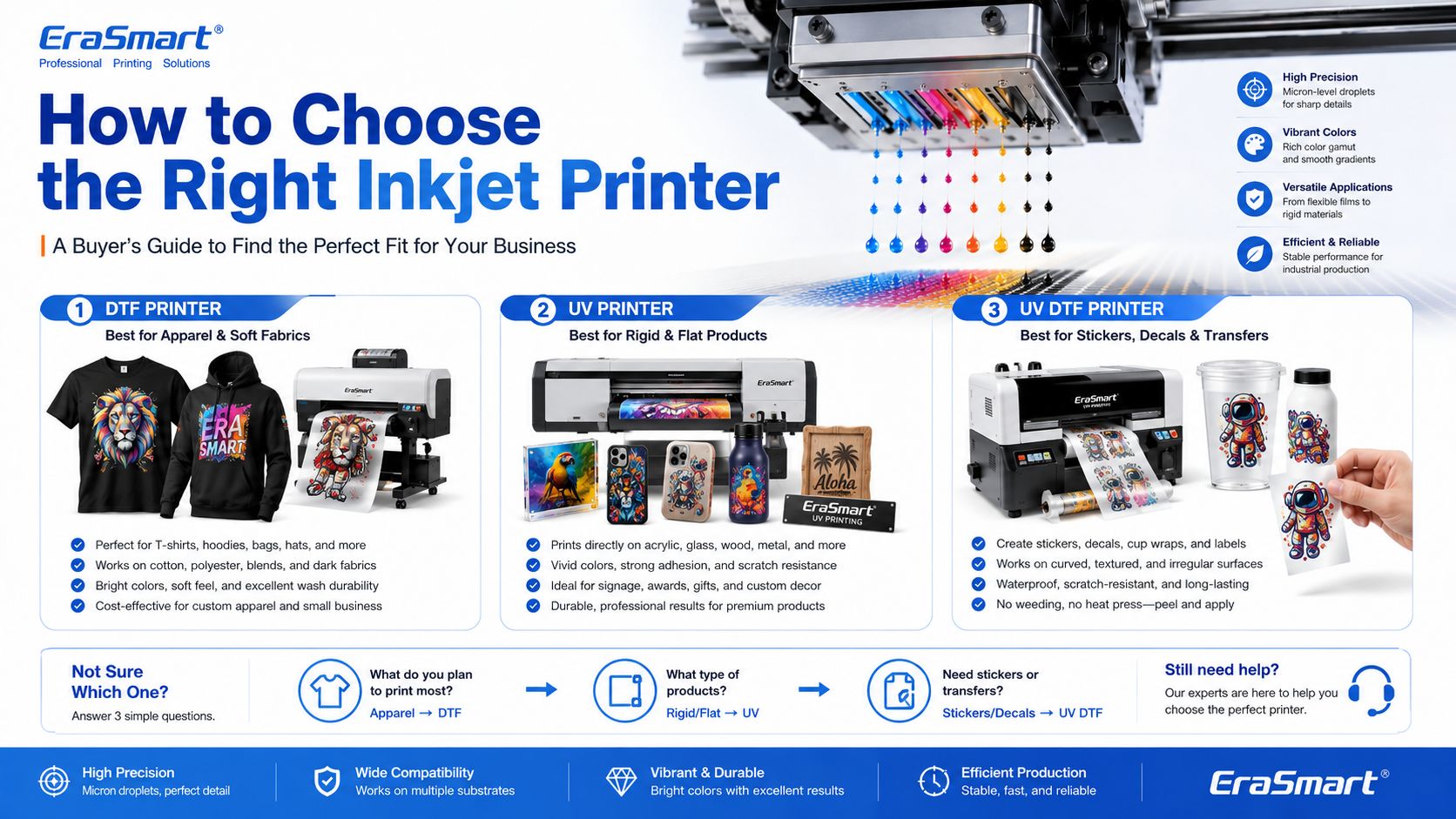
The right inkjet printer depends on what you want to sell.
Chọn một Máy in DTF if your business focuses on:
For machine selection, read EraSmart’s Cách chọn máy in DTF Và Danh sách kiểm tra mua máy in DTF.
• Tùy chỉnh hàng loạt nhỏ
• Thử nghiệm thiết kế
• Gánh nặng gia nhập thấp
Nếu mục tiêu của bạn là bắt đầu từ quy mô nhỏ, kiểm tra quy trình làm việc và xử lý việc tùy chỉnh cá nhân hoặc sử dụng thương mại nhẹ thì lựa chọn thiết thực nhất là thiết lập nhỏ gọn với chi phí có thể quản lý và hoạt động đơn giản hàng ngày.
Loại máy này hoạt động tốt cho người sáng tạo, người mua lần đầu và studio cá nhân cần một điểm đầu vào đáng tin cậy mà không cần chuyển sang thiết bị sản xuất A3 hoặc A1 lớn hơn quá sớm.
• Đơn đặt hàng tùy chỉnh địa phương
• Quần áo lô nhỏ
• Quy trình làm việc thân thiện với người khởi nghiệp
Nếu bạn đã có ý tưởng kinh doanh, nhận đơn đặt hàng tùy chỉnh tại địa phương hoặc điều hành một studio nhỏ cần linh hoạt hơn máy nhập A4, thì việc chuyển sang dòng máy A3 thường tạo ra quy trình làm việc thương mại thực tế hơn.
Những mô hình này phù hợp hơn với các thương hiệu khởi nghiệp, nhà điều hành studio và các cửa hàng ở giai đoạn đầu muốn có phạm vi sản lượng mạnh hơn mà không cần chuyển thẳng sang thiết bị công nghiệp có hiệu suất cao hơn.
• Đồ họa phong phú về thiết kế
• Những giọt mới thường xuyên
• Trình bày trực quan cao cấp
Khi doanh nghiệp của bạn phụ thuộc vào việc thay đổi thiết kế thường xuyên, tác phẩm nghệ thuật nhiều màu sắc, hình ảnh chi tiết và thử nghiệm sản phẩm trực tuyến nhanh hơn, bạn nên chọn những mô hình có khả năng trình bày hình ảnh mạnh mẽ hơn và tính linh hoạt thương mại mượt mà hơn.
Nhóm này rất phù hợp với những người bán hàng trực tuyến, thương hiệu do nhà thiết kế chỉ đạo, nhóm sáng tạo và cửa hàng nơi việc trình bày trực quan và ra mắt thiết kế mới là trọng tâm của mô hình kinh doanh.
• Đơn hàng hàng ngày
• Nhịp độ sản xuất tốt hơn
• Sản lượng thương mại ổn định hơn
Khi doanh nghiệp của bạn vượt ra ngoài các đơn đặt hàng không thường xuyên và bắt đầu phụ thuộc vào sản lượng ổn định hàng ngày, điều quan trọng hơn là chọn máy hỗ trợ quy trình làm việc mượt mà hơn, tính nhất quán mạnh mẽ hơn và nhịp độ sản xuất tốt hơn.
Mức này thường là nơi người mua không còn chỉ nghĩ đến giá đầu vào mà bắt đầu suy nghĩ nghiêm túc hơn về sự ổn định đầu ra, hiệu quả quy trình làm việc và tính thực tiễn vận hành lâu dài.
• Quy trình làm việc nhanh hơn
• Giảm gánh nặng thủ công
• Tính liên tục sản xuất tốt hơn
Nếu doanh nghiệp của bạn đang vượt ra ngoài phạm vi sản xuất thủ công cơ bản và muốn có một quy trình mượt mà hơn, sẵn sàng cho sản xuất hơn, thì bạn nên xem xét các mô hình hỗ trợ tích hợp quy trình làm việc mạnh mẽ hơn và kỳ vọng thông lượng cao hơn.
Hướng đi này đặc biệt phù hợp với những cửa hàng đã có đơn đặt hàng ổn định và muốn giảm bớt cản trở trong sản xuất, cải thiện khả năng lặp lại và chuẩn bị cho khối lượng hoạt động hàng ngày lớn hơn.
• Mục tiêu sản lượng cao hơn
• Chiều rộng in rộng hơn
• Nhịp điệu sản xuất công nghiệp
Khi doanh nghiệp của bạn cần chiều rộng in rộng hơn, trần sản lượng mạnh hơn và hướng sản xuất công nghiệp nghiêm túc hơn, dòng A1 sẽ trở thành danh mục phù hợp để đánh giá. Cấp độ này phù hợp hơn với các doanh nghiệp trong đó tính liên tục của đầu ra và chi phí gián đoạn thấp hơn là những ưu tiên vận hành quan trọng.
Chọn cấp độ đầu in dựa trên mục tiêu sản xuất của bạn mạnh mẽ đến mức nào và giá trị bạn đặt vào năng suất cao hơn.
Chọn một máy in tia cực tím if your business focuses on:
For material planning, read EraSmart’s Hướng dẫn sử dụng vật liệu máy in UV Và How to Choose a UV Printer.
Thích hợp cho các sản phẩm tùy chỉnh có định dạng nhỏ, hàng mẫu, quà tặng nhỏ gọn và người dùng muốn bắt đầu in UV với diện tích nhỏ hơn.
Một lựa chọn thiết thực cho ốp điện thoại, phụ kiện, sản phẩm acrylic nhỏ, quà tặng cá nhân và sản xuất kinh doanh nhỏ.
Sự lựa chọn mạnh mẽ hơn cho người dùng cần nền tảng lớn hơn, phạm vi sản phẩm nhiều hơn và sản xuất hàng loạt nhỏ linh hoạt hơn.
Thích hợp cho các bảng hiệu, bảng điều khiển, bảng tùy chỉnh lớn hơn và các nhóm sản xuất cần vùng in rộng hơn và khả năng mở rộng mạnh mẽ hơn.
Được thiết kế để tùy chỉnh vỏ điện thoại và sản xuất sản phẩm được cá nhân hóa nhanh chóng với lộ trình ứng dụng tập trung hơn.
Tốt hơn cho nhãn dán UV DTF, nhãn pha lê, giấy bọc cốc, chai và đề can chuyển bề mặt cứng.
Chọn một Máy in UV DTF if your business focuses on:
To understand the film workflow, read EraSmart’s A/B Film for UV DTF Printing.
Inkjet printing is not one single business model. It is a technology foundation. The right machine depends on your target products.
A simple buying direction looks like this:
| Mục tiêu kinh doanh | Recommended EraSmart Direction |
|---|---|
| Custom T-shirts, hoodies, apparel | Máy in DTF |
| Acrylic, glass, metal, wood, phone cases | Máy in UV |
| Stickers, cup wraps, labels, decals | Máy in UV DTF |
| Apparel startup | A4 / A3 DTF Printer |
| Growing apparel shop | A3 MAX DTF / shaker workflow |
| Custom product studio | A4 / A3 UV Printer |
| Hard-surface transfer business | Máy in DTF UV A3 |
If your business is apparel-first, start with EraSmart’s Máy in DTF lineup. If your business is hard-product customization, compare the Máy in UV range. If your business is stickers, decals, labels, and cup wraps, start with the Máy in UV DTF.
An inkjet printer is a digital printer that creates images by ejecting tiny ink droplets through microscopic nozzles onto a surface.
In basic office printing, that surface is usually paper. In custom printing, the surface may be PET film, transfer film, acrylic, glass, metal, wood, plastic, packaging board, fabric, or product blanks.
The most important point is this: inkjet printing is not only for documents and photos. It is the core technology behind many modern custom printing systems, including DTF printers, UV printers, and UV DTF printers.
For small businesses, inkjet technology makes it possible to print full-color designs, personalize products, produce short runs, reduce setup cost, and build flexible custom printing workflows.
Need help choosing the right inkjet-based printing system for your business? Share your target products, material type, print size, expected daily order volume, and budget range with EraSmart.
Our team can help you choose the right Máy in DTFThì máy in tia cực tím, hoặc Máy in UV DTF for your custom printing business.
Máy in UV
Máy in DTF
Máy in DTG
Máy ép nhiệt
Máy in quảng cáo
Lò nướng DTF
Báo chí nóng
Máy chạm khắc
Truyền nhiệt cốc
Máy làm cán
In mực in
Vỏ điện thoại di động
Sản phẩm thủy tinh
Làm sạch chất lỏng
Gạc bông
WhatsApp, +8618566233796
WeChat, +8618566233796
Di động +8618566233796
Web :www.erasmart.com
Cửa hàng:www.erasmartmall.com
WhatsApp chúng tôi
Chỉ cần cung cấp một vài chi tiết và chúng tôi sẽ giúp bạn nhận được báo giá nhanh!