小型平板噴墨打印機製造商
86-18566233796 [email protected]

部落格 冷(壓敏)層壓:工作原理、最佳用途、優點/缺點和技巧

冷(壓敏)層壓:工作原理、最佳用途、優點/缺點和技巧

2026 年 1 月 17 日 部落格

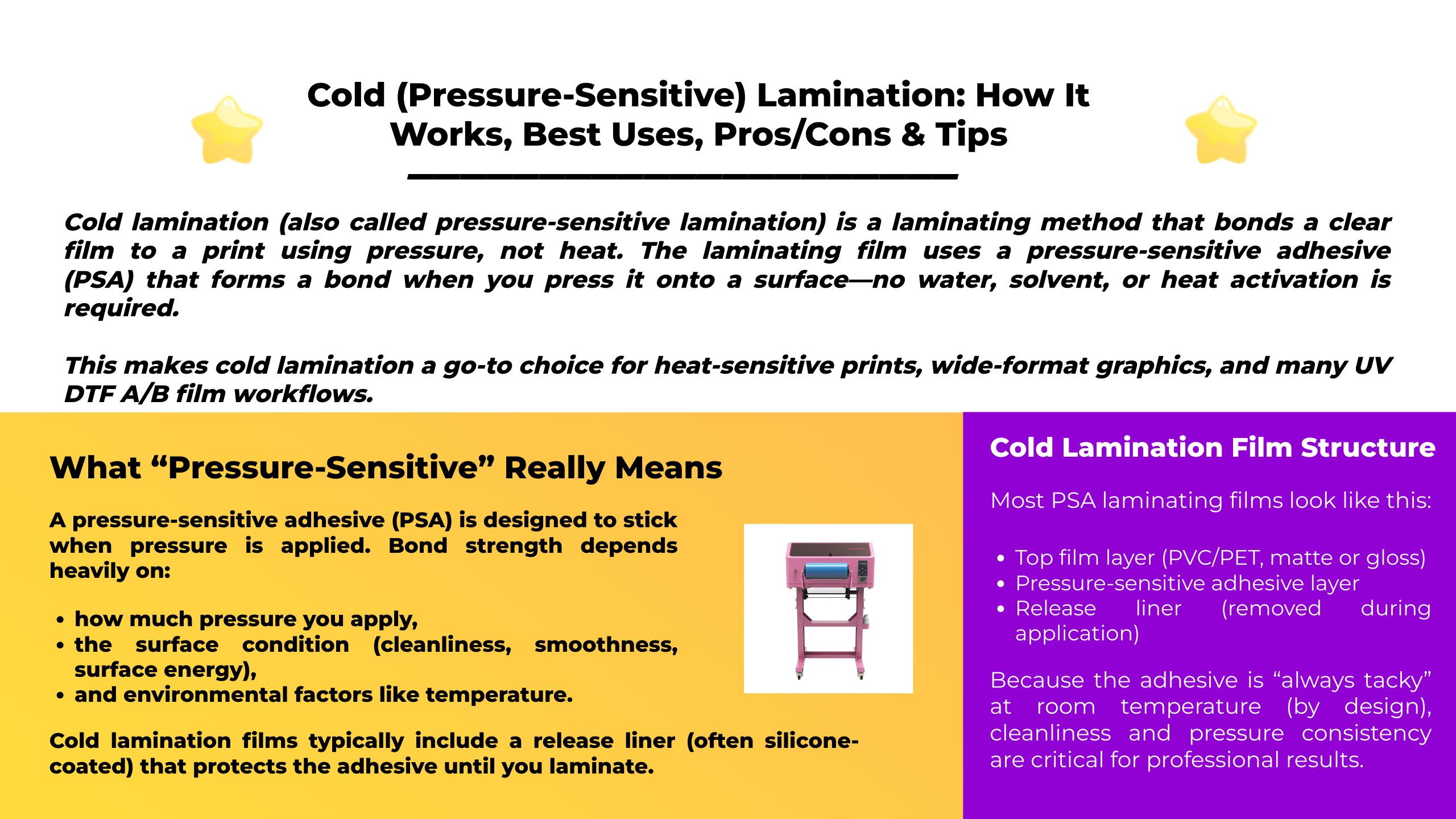
冷層壓 (also called pressure-sensitive lamination) is a laminating method that bonds a clear film to a print using 壓力, not heat. The laminating film uses a 壓敏膠(PSA) that forms a bond when you press it onto a surface—no water, solvent, or heat activation is required.

This makes cold lamination a go-to choice for heat-sensitive prints, wide-format graphics, and many 紫外DTF A/B膜 workflows.

What “Pressure-Sensitive” Really Means

一個 壓敏膠(PSA) is designed to stick when pressure is applied. Bond strength depends heavily on:

  • how much pressure you apply,
  • the surface condition (cleanliness, smoothness, surface energy),
  • and environmental factors like temperature.

Cold lamination films typically include a 離型紙 (often silicone-coated) that protects the adhesive until you laminate.

How Cold Lamination Works (Step-by-Step)

Method A: Cold roll laminator (most common for production)

  1. Load the laminate roll and align your print/media.
  2. Peel/introduce the adhesive film (depending on film type and machine setup).
  3. Feed the print through rollers.
  4. Rollers apply 壓力均勻 to bond the PSA film to the print.
  5. Trim edges and allow the laminate to “settle” if needed.

Cold lamination is commonly described as using rollers to apply pressure that bonds the adhesive-backed film—without heat.

Method B: Hand lamination (small jobs)

  • Peel the liner, tack one edge, then squeegee from center outward to push air out.
  • Works for short runs but is more operator-dependent.

Cold Lamination Film Structure

Most PSA laminating films look like this:

Because the adhesive is “always tacky” at room temperature (by design), cleanliness and pressure consistency are critical for professional results.

When to Use Cold Lamination

當熱量可能導致損壞或變形時,冷層壓特別有用,因為它不需要溫度來激活粘合劑。

常見應用

  • 照片和噴墨打印 (熱量可能會變形或影響墨水)
  • 乙烯基圖形 和大幅面海報
  • 貼花和標籤
  • UV DTF A/B 膜層壓 (在薄膜A上印刷,與薄膜B層壓)

Pros and Cons of Cold (Pressure-Sensitive) Lamination

優點

  • No heat needed (safer for heat-sensitive media)
  • Often simpler operation (no warm-up time, fewer temperature variables)
  • Great for wide-format and PSA workflows

缺點

  • More sensitive to dust and contamination (bubbles/silvering)
  • Tracking/alignment matters more (wrinkles/skew)
  • PSA films can behave differently across temperatures (tack changes with conditions)

Key Settings That Matter (Practical Checklist)

SettingWhat to aim forWhat happens if wrong
壓力Even, sufficient roller pressureLow pressure = weak bonding / bubbles
速度Start slow, increase after stable resultsToo fast = trapped air, wrinkles
AlignmentFilm and media must feed squareSkew = creases and waste
CleanlinessDust-free path + clean mediaDust = bubbles / “silvering”

Cold lamination performance depends strongly on pressure and surface conditions—PSA bonding is not “forgiving” of dirt/oil.

Troubleshooting Cold Lamination Problems

1) Bubbles / “silvering”

原因: dust, uneven pressure, too high speed
使固定: clean rollers/media, slow down, increase pressure slightly, squeegee from center outward.

2) Wrinkles or skew tracking

原因: roll tension issues, misalignment
使固定: reload rolls square, use side guides, reduce speed until tracking is stable.

3) Edge lifting / poor adhesion

原因: contaminated surface (oil), insufficient pressure, low surface energy substrate
使固定: clean substrate properly, apply firmer pressure, consider higher-tack laminate for difficult surfaces (film options vary by supplier).

Cold Lamination for UV DTF (AB Film) — Why It’s Popular

In many UV DTF workflows, you print on Film A and then laminate with 電影B to create a transferable decal. This lamination step is typically pressure-based, making cold lamination a natural fit.

Shop advantage: You can produce consistent transfers without managing temperature profiles that might affect films or adhesives.

常問問題

Is cold lamination the same as “self-adhesive” lamination?

They’re closely related. Cold lamination commonly uses pressure-sensitive adhesive films (PSA) that bond under pressure, usually protected by a release liner.

Does cold lamination need electricity?

Some cold laminators are manual, and many sources note cold lamination can be run without heating (no warm-up/cool-down). However, production roll laminators may still be motorized for speed and consistency.

Why does cold lamination fail in winter?

PSA tack can drop at low temperatures, and overall adhesive behavior changes with temperature. Keeping materials at stable room conditions often improves results.

Takeaway

冷(壓敏)層壓 is the best choice when you want lamination without heat, using PSA film plus roller pressure to bond cleanly—especially for heat-sensitive prints, vinyl graphics, and UV DTF AB film workflows

If you tell me your application (UV DTF AB film vs posters/vinyl) and your laminator width (A3/30cm/60cm), I can give you a tighter “best settings + SOP” section for a product/guide page.

你可能會喜歡

特色型號 — A3 UV DTF 打印機

用於貼花、標籤和杯膜的專業級 UV DTF 生產。佔地面積緊湊、輸出穩定、冷轉印工作流程輕鬆。

A3 UV DTF Printer

主要規格

範圍 價值
最大介質寬度A3/350毫米
渠道CMYK+白+光油
解決高達 1440 dpi
工作流程A/B UV DTF 薄膜 · 冷層壓
最佳使用貼紙、標籤、杯包裝、小工具皮膚
安息吧Riin / EraRip / Photoprint(支持 ICC)

也許你也喜歡

  • Erasmart打印機

    UV打印機
    DTF打印機
    DTG打印機
    熱壓機
    廣告打印機

  • 打印機工具

    DTF烤箱
    熱壓
    雕刻機
    杯傳熱
    層壓機

  • 消耗品

    打印墨水
    手機案例
    玻璃產品
    清潔液
    棉籤

  • 聯繫我們

    WhatsApp:+8618566233796
    微信:+8618566233796
    手機:+8618566233796
    網絡:www.erasmart.com
    店鋪:www.erasmartmall.com

  • 請求報價

    只需提供一些細節,我們將幫助您獲得快速報價!