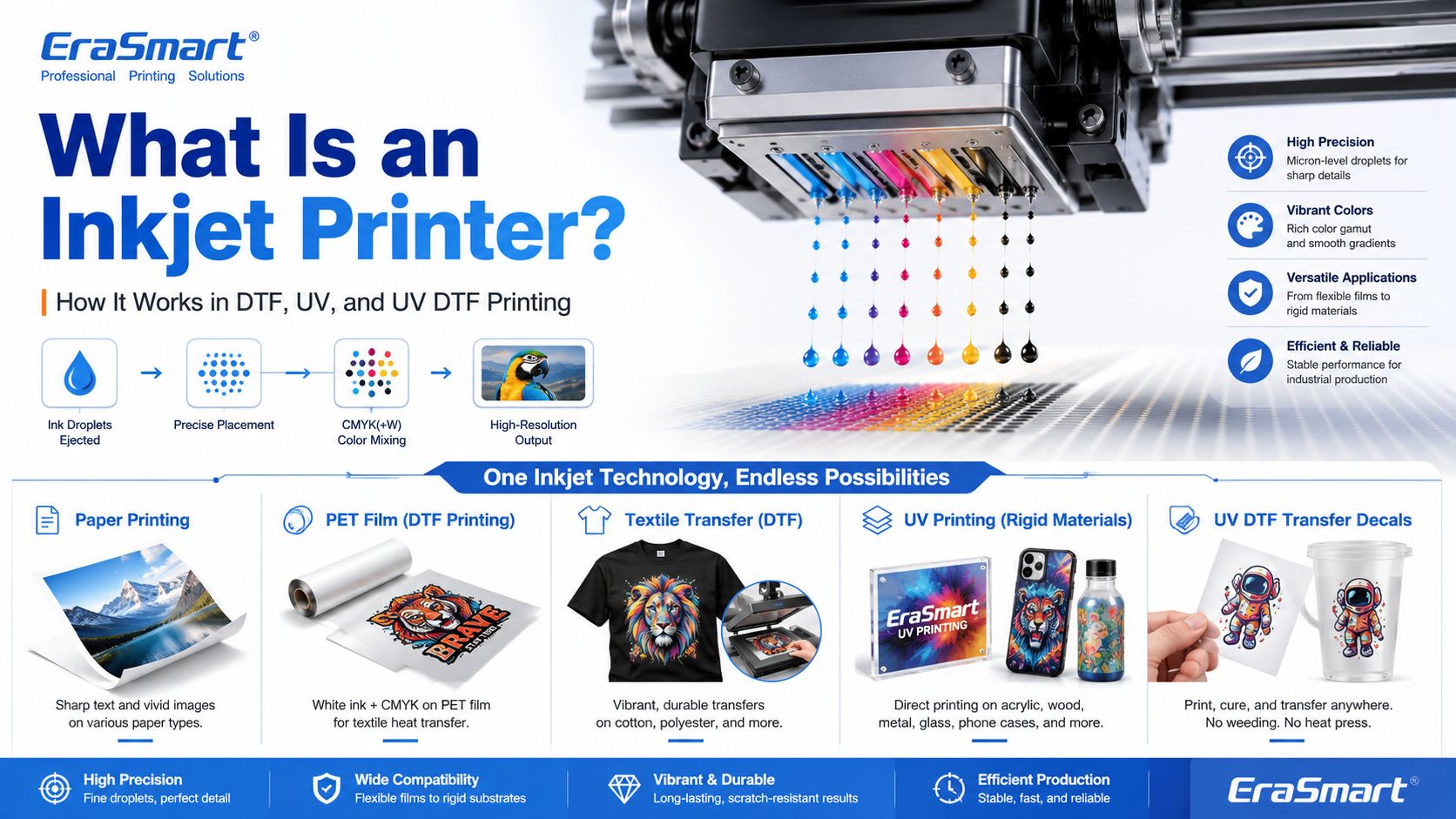
An inkjet printer is a digital printing device that creates images by ejecting tiny droplets of ink onto a surface. Instead of using plates, screens, or physical stencils, an inkjet printer receives digital image data and places controlled ink droplets in precise positions to form text, graphics, photos, labels, transfers, or product decoration.
Most people first know inkjet printers from office or home photo printing. But inkjet technology is much broader than desktop paper printing. Today, inkjet systems are used in DTF printing, UV flatbed printing, UV DTF transfers, packaging samples, product labels, signage, promotional products, textile decoration, industrial marking, and custom product manufacturing.
For EraSmart customers, this topic matters because many modern custom printing machines are built on inkjet principles. A DTF打印機 uses inkjet technology to print garment designs onto transfer film. A UV打印機 uses inkjet technology to print UV-curable ink directly onto rigid materials. A UV DTF打印機 uses inkjet printing to create hard-surface decals and transfers on A/B film.
In simple terms, inkjet printing is the foundation. DTF, UV, and UV DTF are specialized business workflows built around that foundation.
An inkjet printer is a printer that sprays or ejects tiny droplets of liquid ink through microscopic nozzles to create a printed image.
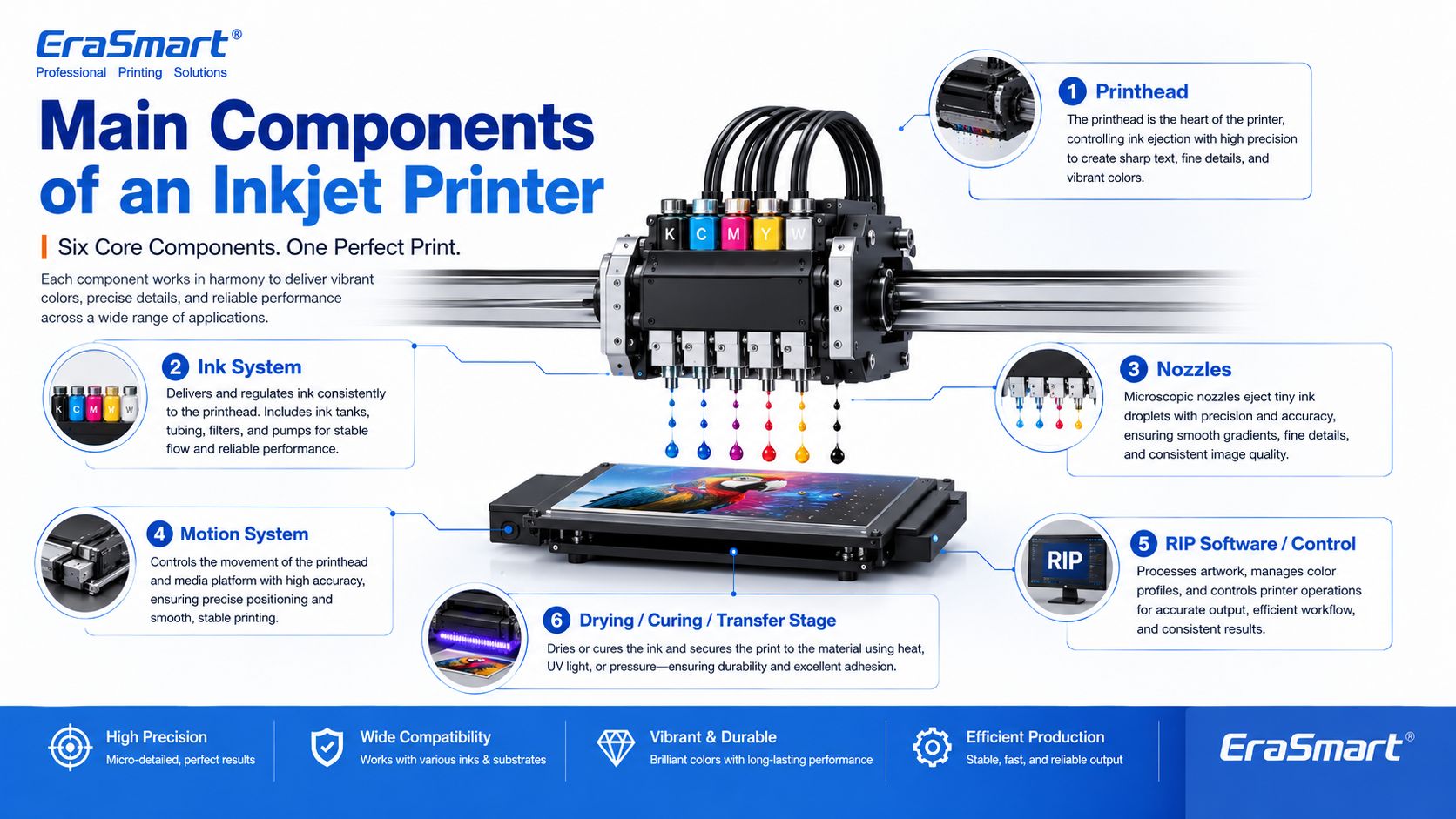
A basic inkjet printing system includes:
The printhead is the key component. It controls where ink droplets land, how much ink is ejected, and how accurately the image is formed.

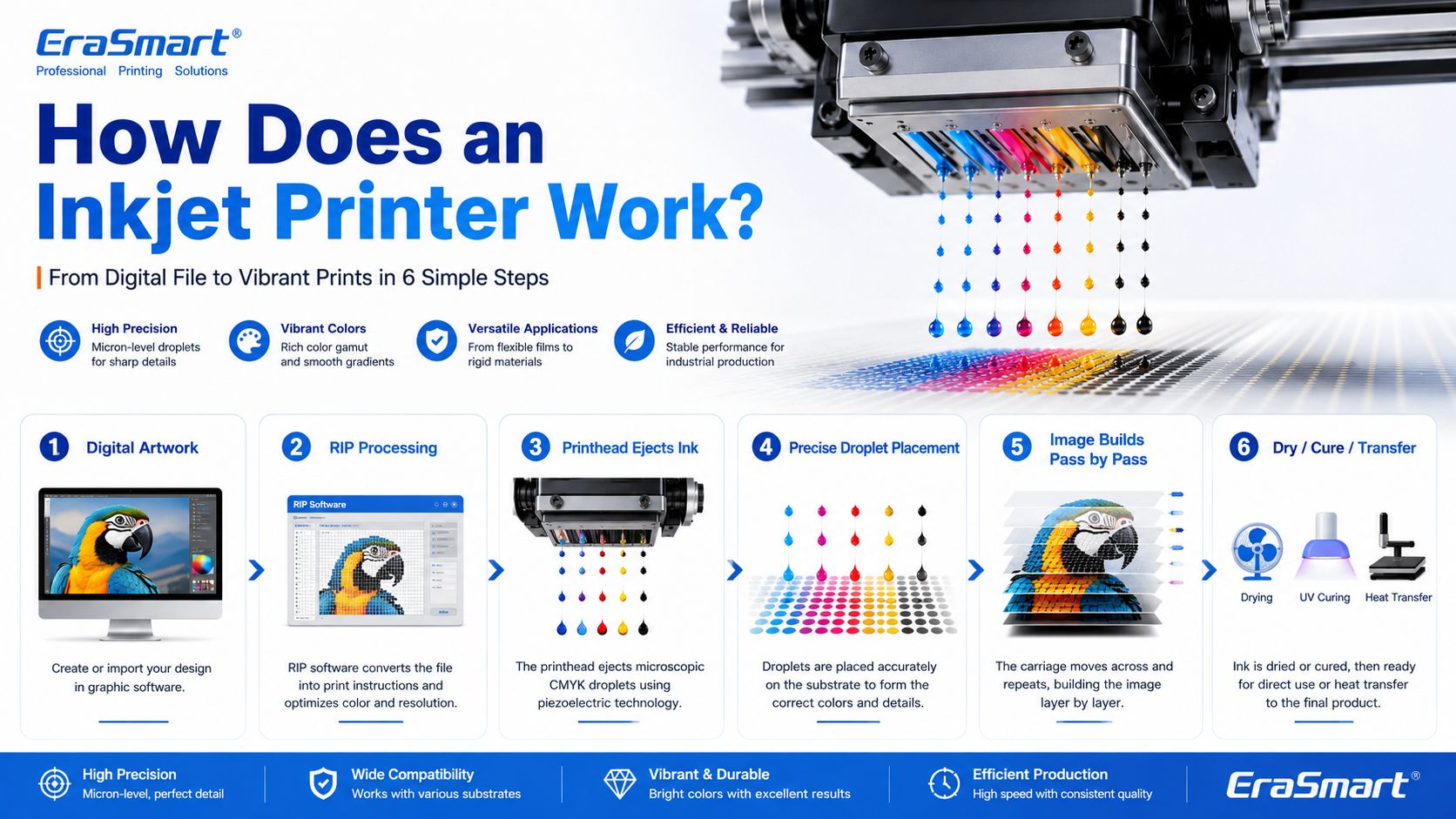
Inkjet printing may look simple from the outside, but inside the printer there is a precise digital control process.
A simplified workflow looks like this:
In an office inkjet printer, ink is usually printed onto paper and dries or absorbs into the paper surface. In an industrial or custom printing system, the process may be more specialized. For example, UV ink is cured by UV light, while DTF ink is printed onto PET film and later heat transferred onto fabric.

The printhead is the most important part of an inkjet printer. It contains many tiny nozzles that eject ink droplets. The printhead determines much of the printer’s resolution, droplet control, speed, and print quality.
In custom printing, printhead condition directly affects:
This is why printer maintenance is so important in DTF and UV printing. If the printhead nozzles are clogged or unstable, the final print may show banding, missing lines, weak colors, or poor detail.
For apparel printing users, EraSmart’s DTF 印表機維護指南 is a useful resource for understanding why nozzle checks, cleaning, white ink circulation, and daily care matter.
The ink system stores and delivers ink to the printhead. Different inkjet printers use different types of ink depending on the application.
Common ink types include:
For EraSmart customers, the most relevant ink systems are DTF ink, UV ink, white ink, and varnish.
一個 DTF打印機 commonly uses CMYK ink plus white ink. The white ink helps designs appear clearly on dark garments. A UV打印機 may use CMYK, white ink, and varnish to print on hard surfaces such as acrylic, glass, metal, wood, plastic, leather, and packaging materials.
If you want to understand how CMYK, white ink, and varnish work together in product customization, see EraSmart’s UV Ink Guide: CMYK, White Ink, and Varnish。
Nozzles are microscopic openings in the printhead. They eject ink droplets in controlled patterns.
Nozzle performance affects:
Nozzles can become clogged if ink dries, settles, or becomes contaminated. This is especially important for white ink systems because white ink contains heavier pigment particles and needs proper circulation and maintenance.
Inkjet printers need accurate motion control. Either the printhead moves across the material, the material moves under the printhead, or both are coordinated.
The motion system affects:
In UV flatbed printing, the platform and printhead movement must be stable so the image lands accurately on rigid objects. In DTF printing, film feeding must be smooth so the transfer image remains consistent.
RIP software converts artwork into printer-ready instructions. It controls color output, resolution, ink layering, white ink channels, varnish layers, print passes, and other production settings.
For custom printing businesses, RIP setup is important because it affects:
A good printer is only part of the system. Correct artwork preparation and RIP settings are also necessary for professional results.

Inkjet printing is not finished when ink leaves the nozzle. The ink must also become stable on the final product.
Different workflows use different finishing methods:
| Inkjet Workflow | What Happens After Printing |
|---|---|
| Office inkjet | Ink dries or absorbs into paper |
| DTF打印 | Powder is applied, cured, then heat pressed onto fabric |
| 紫外線打印 | UV light cures the ink almost instantly |
| UV DTF打印 | UV ink is printed on film, laminated, then applied as a transfer |
| 昇華 | Printed transfer is heat pressed into polyester or coated blanks |
This is why inkjet technology can support many industries. The core droplet technology is similar, but the finishing process changes based on the product.

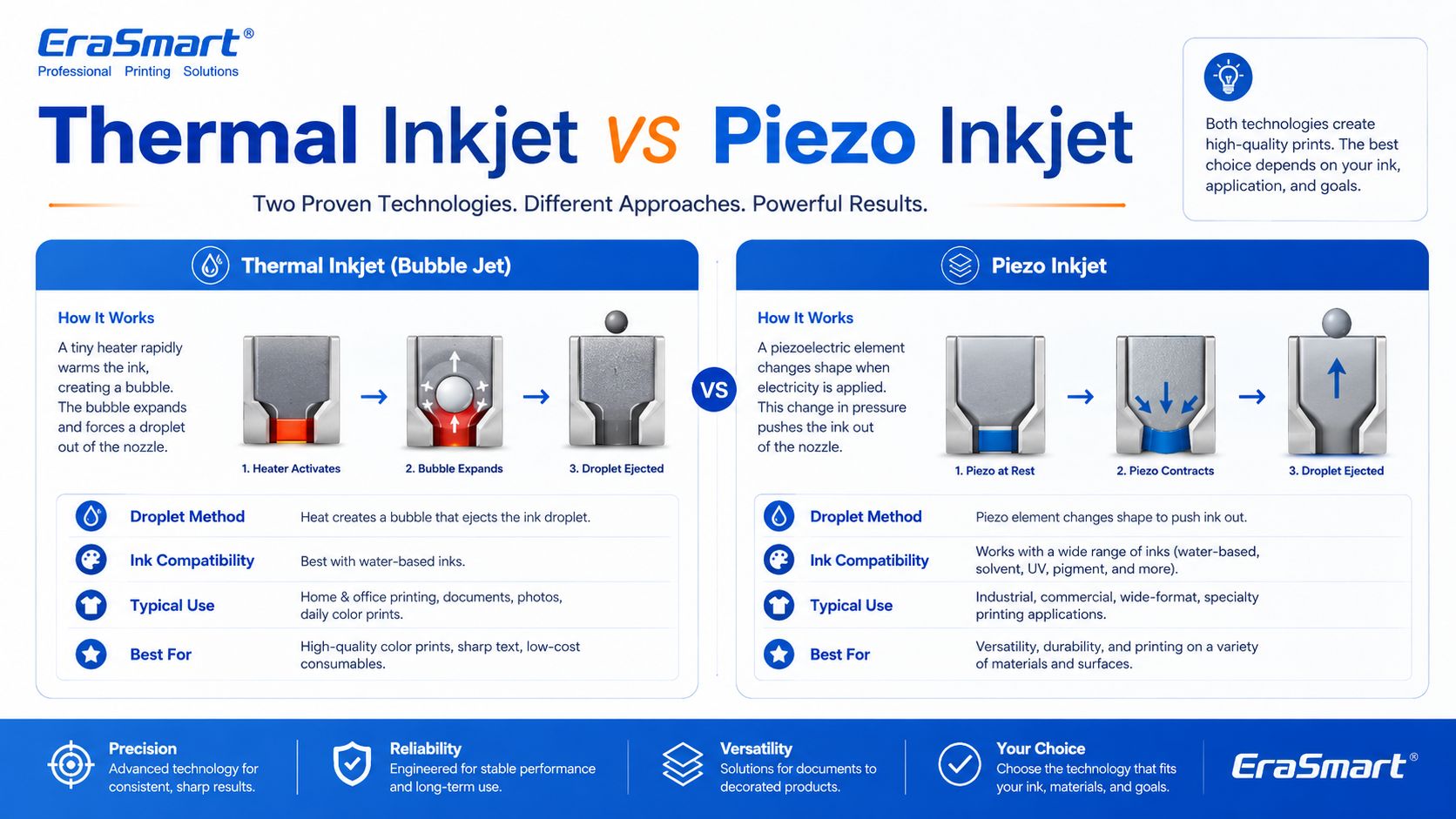
There are two major inkjet technologies: thermal inkjet and piezo inkjet.
Thermal inkjet uses heat to create a vapor bubble inside the ink chamber. The pressure from this bubble pushes a droplet of ink out of the nozzle.
Thermal inkjet is common in many desktop and office printers. It can produce high-quality prints on paper, but the ink must be compatible with heat-based ejection.
Piezo inkjet uses a piezoelectric element that changes shape when voltage is applied. This mechanical movement creates pressure and ejects ink droplets through the nozzle.
Piezo inkjet is widely used in many professional and industrial printing systems because it can work with a broader range of inks. Since the ink is not heated for ejection, piezo technology is suitable for inks that may not perform well in thermal systems, including many specialty inks used in industrial and custom printing.
For DTF, UV, and UV DTF applications, piezo-style inkjet technology is especially important because these workflows require precise ink control and compatibility with specialized ink types.
Inkjet printing can also be divided by how ink is delivered.
Drop-on-demand means ink droplets are ejected only when needed. This is common in many graphic and custom printing applications because it offers precise control and efficient ink use.
DTF, UV, and UV DTF printers generally operate around controlled digital droplet placement, which is why they can reproduce detailed designs and full-color artwork.
Continuous inkjet ejects a continuous stream of ink droplets. Some droplets are directed to the surface, while others may be recycled. This method is often used in industrial coding and marking, such as printing dates, batch codes, and product identification on packaging lines.
For EraSmart customers, drop-on-demand inkjet is the more relevant concept because custom apparel and product printing require accurate image reproduction rather than simple coding.
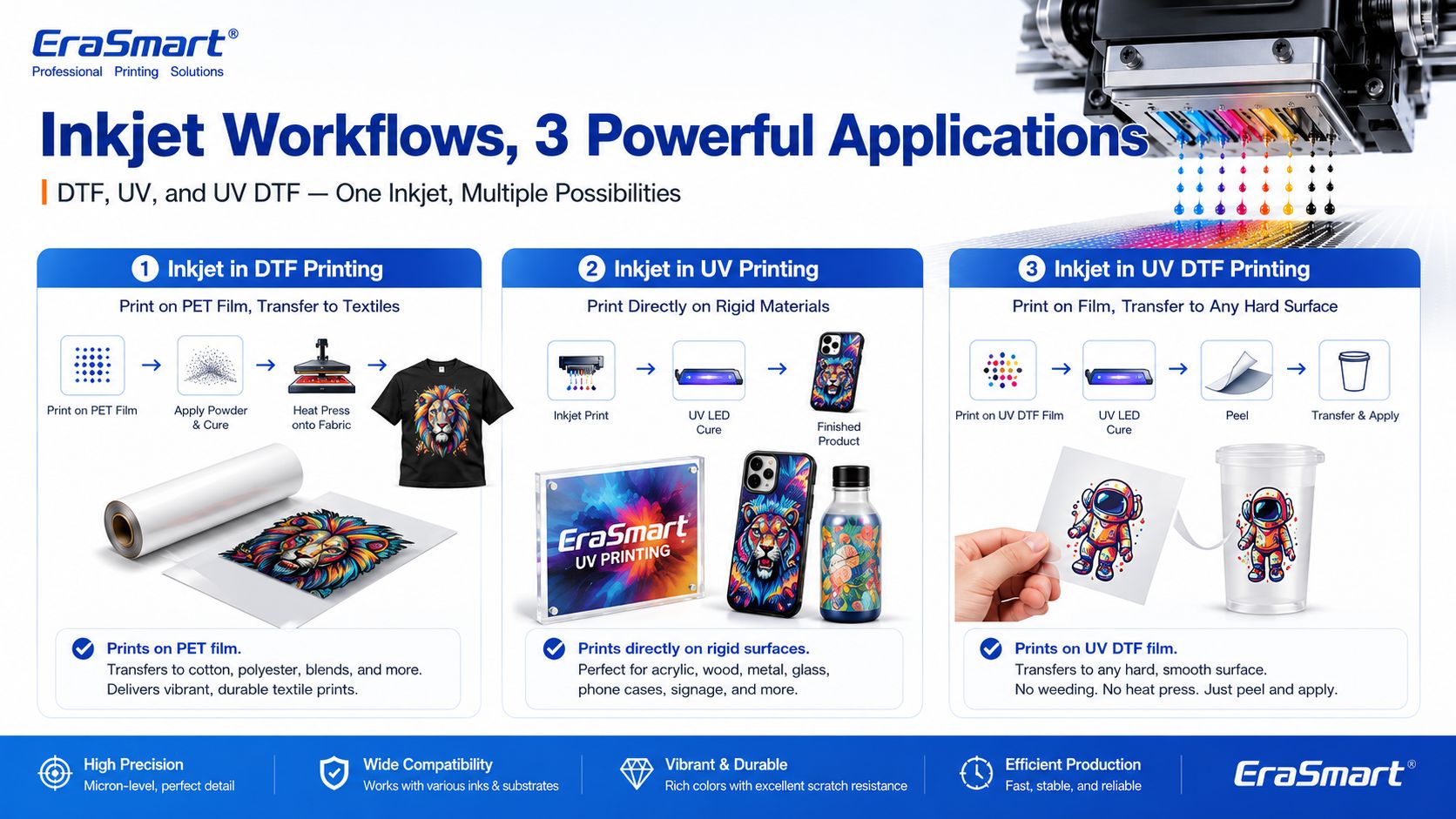
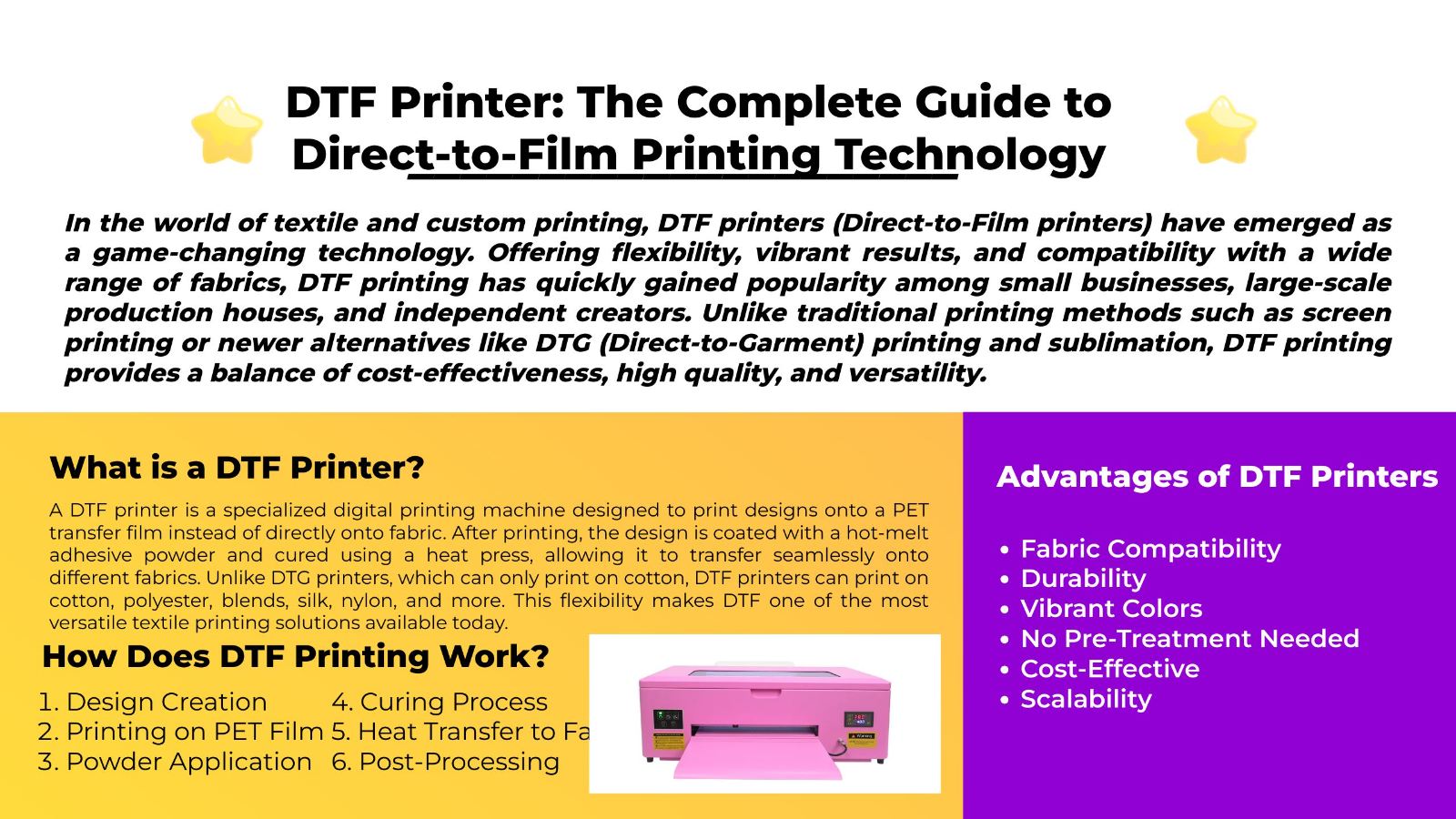
A DTF printer is a specialized inkjet printer for garment transfer production. Instead of printing directly onto a shirt, it prints the design onto PET transfer film.
The typical DTF process includes:
This process is useful for custom apparel because it supports:
If you are interested in building an apparel business, EraSmart’s DTF打印機 category includes different models for startups, small studios, growing shops, and higher-volume production. You can also read the DTF 製作流程 to understand the full process from artwork to finished garment.
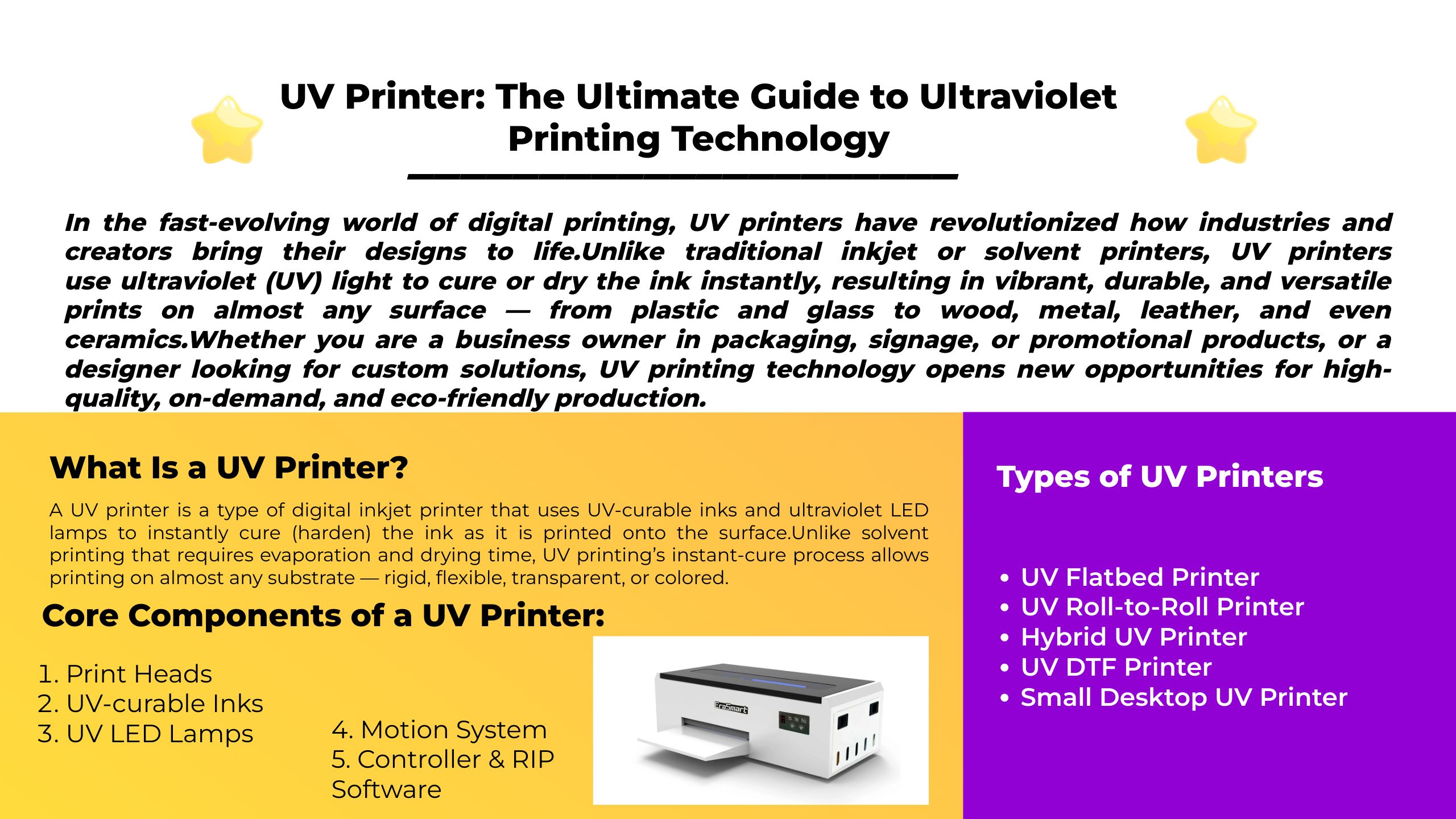
A UV printer is another specialized inkjet system. Instead of using standard paper ink, it uses UV-curable ink. The printer ejects ink onto the material surface, and UV light cures the ink almost immediately.
UV printing is suitable for many hard and semi-rigid materials, such as:
The advantage of UV printing is direct-to-object customization. You can print full-color designs, white ink layers, and varnish effects on many product surfaces.
時代智能的 UV打印機 category is designed for businesses that want to create custom gifts, signs, phone cases, packaging samples, acrylic products, and hard-surface promotional items. For material selection, see the UV印表機材料指南。
UV DTF printing combines UV inkjet printing with a transfer workflow. The printer prints UV ink onto A film, laminates it with B film, and creates a transfer decal that can be applied to hard surfaces.
UV DTF is useful for:
Unlike textile DTF, UV DTF is mainly for hard-surface transfers, not garments. It is a good choice for businesses that want to sell premium stickers, decals, labels, and cup wraps.
時代智能的 UV DTF打印機 is suitable for hard-surface transfer applications, while the A/B Film for UV DTF Printing guide explains how the film system works in the transfer process.
Inkjet printing is important because it allows digital, flexible, short-run production. Unlike traditional methods that require screens, plates, or molds, inkjet printing can print directly from a digital file.
This creates major advantages for custom businesses:
For example, a DTF apparel business can print different names, numbers, and graphics without preparing new screens. A UV printing business can print different logos on phone cases, acrylic signs, glass gifts, or packaging samples. A UV DTF business can produce custom decals and labels for many small brands.
This is why inkjet technology is no longer only about office printing. It is now a core technology for modern customization businesses.
Inkjet printing works directly from digital files. This makes it easy to change designs, personalize products, and produce short runs.
Inkjet printers can reproduce complex color images, gradients, photos, and illustrations. This is useful for apparel graphics, product decoration, stickers, and packaging samples.
Inkjet does not require plates or screens, so it is suitable for low-MOQ custom orders and on-demand production.
Each print can be different. This is useful for names, numbers, QR codes, serialized labels, personalized gifts, and custom designs.
Inkjet technology can be adapted to many surfaces and workflows, including paper, textiles, film, rigid materials, packaging, labels, and transfers.
A business can start with small orders and upgrade equipment as demand grows. This is why inkjet-based DTF, UV, and UV DTF systems are attractive to startups and growing shops.
Inkjet printers need regular maintenance. If nozzles clog, print quality declines. This is especially important for white ink, UV ink, and other specialty ink systems.
Not every ink works with every printhead or material. Ink viscosity, pigment size, curing method, and surface compatibility all matter.
Some surfaces need cleaning, primer, coating, or testing before printing. This is especially common in UV printing on glass, metal, plastic, and other hard materials.
Screen colors and printed colors are not always identical. Professional results require color profiles, test prints, correct RIP settings, and stable consumables.
Higher resolution, more passes, white ink layers, and varnish effects may improve quality but increase printing time.
In DTF printing, powdering, curing, and heat pressing affect durability. In UV DTF, lamination and application affect transfer quality. In UV printing, curing and adhesion affect final product quality.
This is one of the most common inkjet problems. It can be caused by dried ink, settled pigment, poor maintenance, incompatible ink, or long idle time.
Banding appears as unwanted horizontal or vertical lines. It can be caused by clogged nozzles, incorrect feed settings, poor calibration, or unstable ink flow.
Colors may look different from the screen because of material surface, ink type, printer profile, white ink layer, or lighting conditions.
In UV printing, poor adhesion can happen if the surface is oily, dusty, incompatible, or not treated correctly.
In DTF and UV printing, white ink must be managed carefully. Weak white ink can reduce color brightness, opacity, and dark-surface performance.
If ink is not dried, cured, or transferred correctly, the final product may smear, peel, crack, or lose durability.

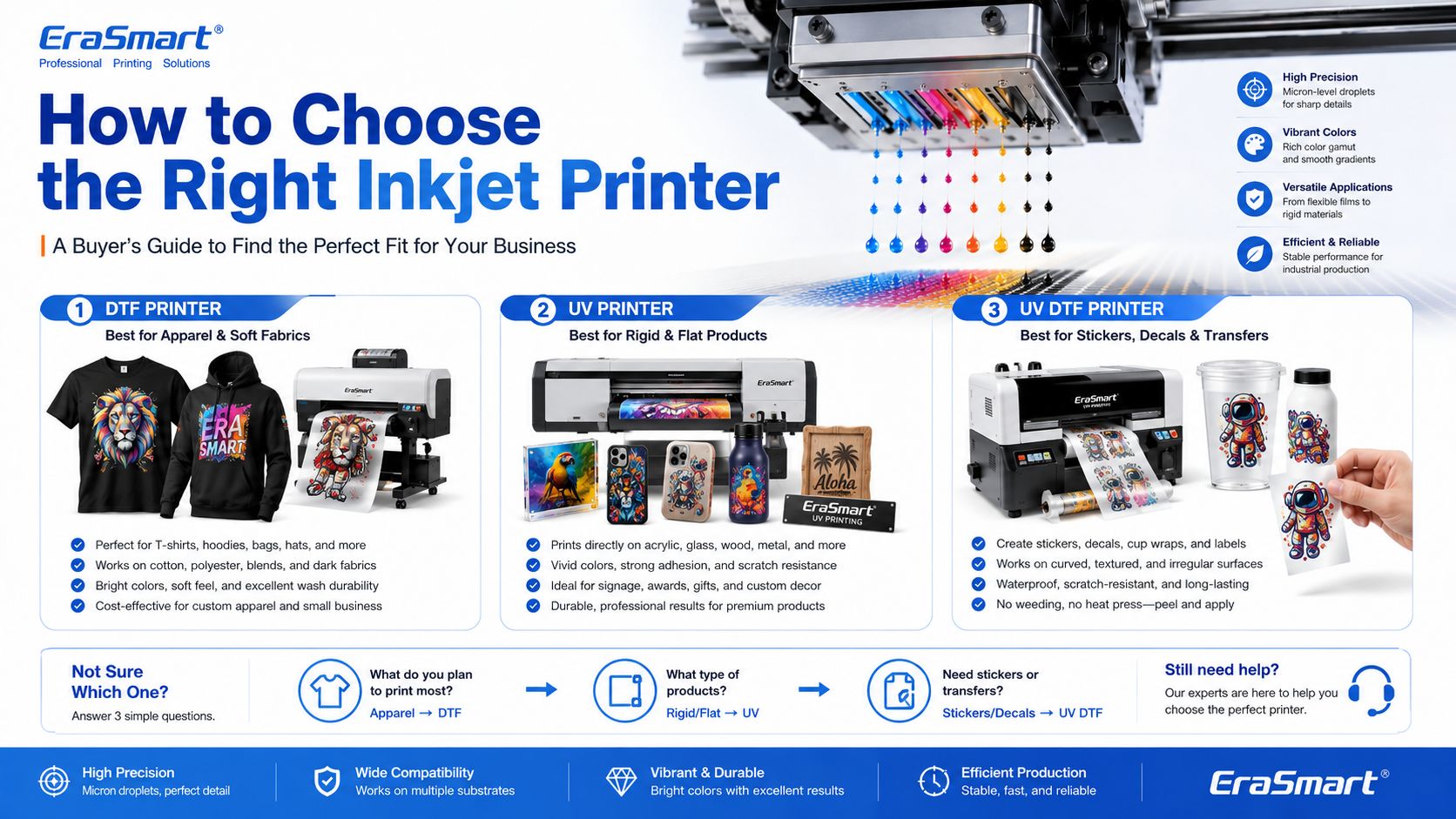
The right inkjet printer depends on what you want to sell.
選擇一個 DTF打印機 if your business focuses on:
For machine selection, read EraSmart’s 如何選擇 DTF 印表機 和 DTF 印表機購買清單。
• 小批量客製化
• 設計測試
• 低進入負擔
如果您的目標是從小規模開始,測試工作流程並處理個人定製或輕度商業用途,那麼最實用的選擇是成本可控且日常操作簡單的緊湊設定。
這種類型的機器非常適合創作者、首次購買者和個人工作室,他們需要一個可靠的切入點,而不必過早使用大型 A3 或 A1 製作設備。
• 本地客製訂單
• 小批量服裝
• 啟動友善的工作流程
如果您已經有了商業想法,接受本地客製訂單,或者經營一個需要比 A4 入門機更大靈活性的小型工作室,那麼遷移到 A3 系列通常會創建更實用的商業工作流程。
這些型號更適合新創品牌、工作室營運商和早期商店,他們想要更大的輸出範圍,而不是直接轉向更高輸出的工業設備。
• 設計豐富的圖形
• 頻繁推出新品
• 優質的視覺呈現
當您的業務依賴頻繁的設計變更、色彩豐富的圖稿、詳細的圖像和更快的線上產品測試時,選擇提供更強的圖像呈現和更流暢的商業靈活性的型號是有意義的。
該群體非常適合線上賣家、設計師主導的品牌、創意團隊和商店,在這些商店中,視覺呈現和新設計發布是商業模式的核心。
• 每日訂單
• 更好的生產節奏
• 商業產出更加穩定
一旦您的業務超越了偶爾的訂單並開始依賴更穩定的日常產量,選擇支援更流暢的工作流程、更強的一致性和更好的生產節奏的機器就變得更加重要。
在這個水準上,買家通常應該停止只考慮入門價格,並開始更認真地考慮產量穩定性、工作流程效率和長期營運實用性。
• 更快的工作流程
• 減輕人工負擔
• 更好的生產連續性
如果您的企業正在超越基本的手動生產,並希望有一個更流暢、更易於生產的流程,那麼考慮支援更強大的工作流程整合和更高吞吐量期望的模型是有意義的。
對於已經有穩定訂單並希望減少生產摩擦、提高可重複性並為更大的日常營運量做好準備的商店來說,這一方向尤其重要。
• 更高的產出目標
• 更寬的列印寬度
• 工業生產節奏
當您的企業需要更寬的列印寬度、更強的輸出上限以及更嚴肅的工業生產方向時,A1系列就成為合適評估的類別。此等級更適合以輸出連續性和降低中斷成本為重要營運優先事項的企業。
根據您的生產目標的積極程度以及您對提高生產力的重視程度來選擇列印頭層。
選擇一個 UV打印機 if your business focuses on:
For material planning, read EraSmart’s UV印表機材料指南 和 How to Choose a UV Printer。
選擇一個 UV DTF打印機 if your business focuses on:
To understand the film workflow, read EraSmart’s A/B Film for UV DTF Printing。
Inkjet printing is not one single business model. It is a technology foundation. The right machine depends on your target products.
A simple buying direction looks like this:
| 經營目標 | Recommended EraSmart Direction |
|---|---|
| Custom T-shirts, hoodies, apparel | DTF打印機 |
| Acrylic, glass, metal, wood, phone cases | UV打印機 |
| Stickers, cup wraps, labels, decals | UV DTF打印機 |
| Apparel startup | A4 / A3 DTF Printer |
| Growing apparel shop | A3 MAX DTF / shaker workflow |
| Custom product studio | A4 / A3 UV Printer |
| Hard-surface transfer business | A3 UV DTF 打印機 |
If your business is apparel-first, start with EraSmart’s DTF打印機 lineup. If your business is hard-product customization, compare the UV打印機 range. If your business is stickers, decals, labels, and cup wraps, start with the UV DTF打印機。
An inkjet printer is a digital printer that creates images by ejecting tiny ink droplets through microscopic nozzles onto a surface.
In basic office printing, that surface is usually paper. In custom printing, the surface may be PET film, transfer film, acrylic, glass, metal, wood, plastic, packaging board, fabric, or product blanks.
The most important point is this: inkjet printing is not only for documents and photos. It is the core technology behind many modern custom printing systems, including DTF printers, UV printers, and UV DTF printers.
For small businesses, inkjet technology makes it possible to print full-color designs, personalize products, produce short runs, reduce setup cost, and build flexible custom printing workflows.
DTF烤箱
熱壓
雕刻機
杯傳熱
層壓機
打印墨水
手機案例
玻璃產品
清潔液
棉籤
WhatsApp:+8618566233796
微信:+8618566233796
手機:+8618566233796
網絡:www.erasmart.com
店鋪:www.erasmartmall.com
WhatsApp我們
只需提供一些細節,我們將幫助您獲得快速報價!