Si elige entre una impresora DTF y una impresora UV DTF, la pregunta más importante no es qué tecnología es "mejor".
La mejor pregunta es:
¿Qué productos quieres vender?
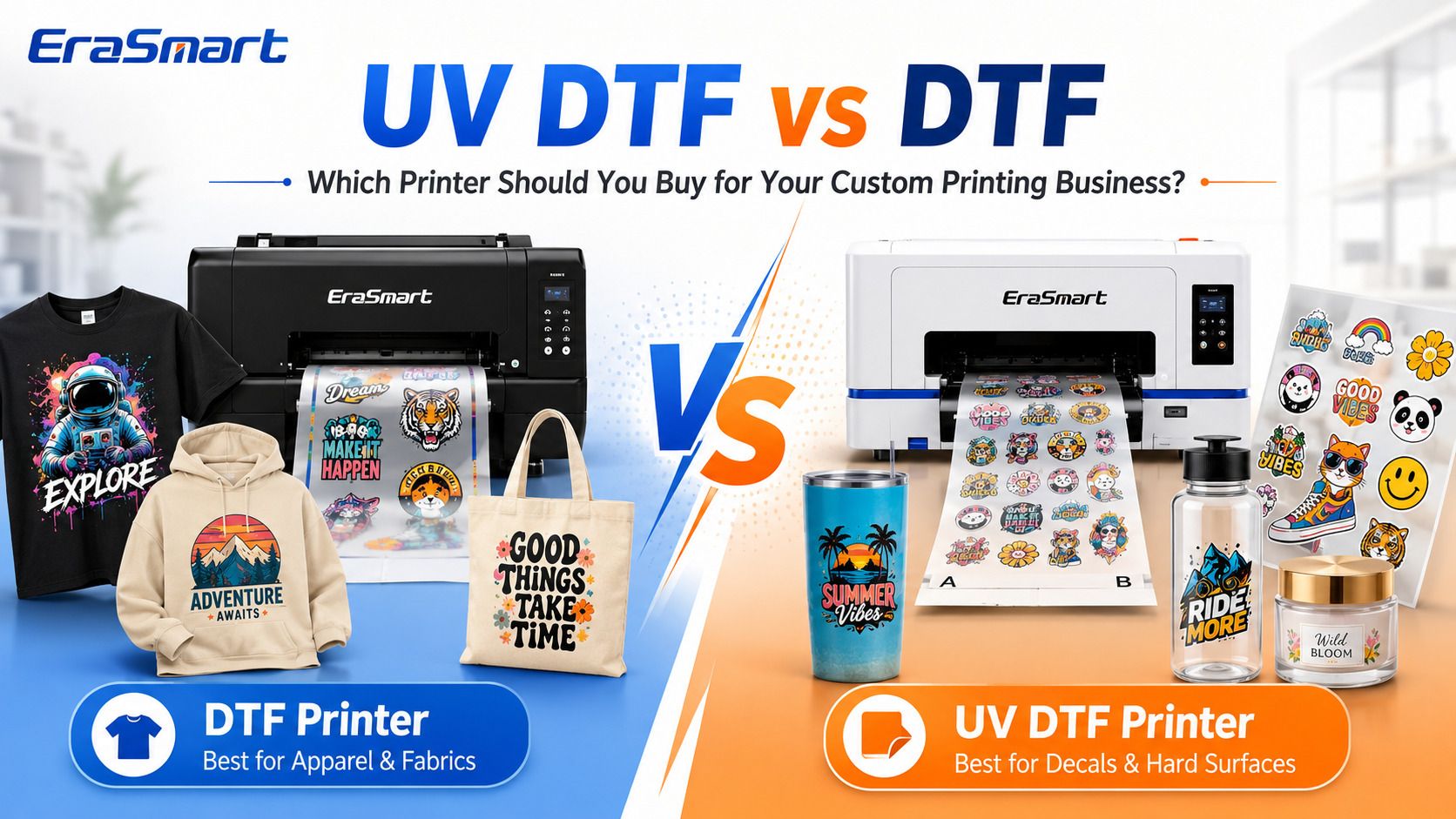
Si sus productos principales son camisetas, sudaderas con capucha, uniformes, ropa deportiva, bolsos de mano, ropa de trabajo y otros productos textiles, a Impresora DTF suele ser la dirección correcta.
Si sus productos principales son calcomanías, envoltorios para tazas, calcomanías para botellas, etiquetas de cosméticos, marcas de tarros de velas, calcomanías para empaques, gráficos para carcasas de teléfonos y otras aplicaciones de superficies duras, un Impresora UV DTF suele ser la que mejor se adapta.
Y si su objetivo a largo plazo es construir un negocio de personalización más amplio que atienda tanto a prendas de vestir como a bienes duraderos, las dos tecnologías pueden complementarse entre sí en lugar de competir entre sí.
Esta guía va más allá de una definición básica de DTF y UV DTF. En lugar de ello, compararemos los dos sistemas desde un punto de vista perspectiva de compra y negocio: productos, materiales, flujo de trabajo, equipos, consumibles, mantenimiento, tipos de clientes, estructura de pedidos y potencial de expansión.
Si primero necesita una comparación técnica más amplia entre UV DTF, DTF textil e impresión UV directa, lea EraSmart. UV DTF frente a Textil DTF frente a UV de cama plana guía.
Respuesta rápida: ¿Debería comprar una impresora DTF o UV DTF?
Aquí tienes la forma más sencilla de decidir.
| Si tu negocio principal es... | Mejor punto de partida |
|---|
| Camisetas personalizadas | Impresora DTF |
| Sudaderas con capucha y streetwear | Impresora DTF |
| Ropa deportiva y uniformes. | Impresora DTF |
| Bolsas de mano y productos de tela. | Impresora DTF |
| Ropa impresa bajo demanda | Impresora DTF |
| Venta de transferencia DTF | Impresora DTF |
| Pegatinas y calcomanías premium | Impresora UV DTF |
| Envoltorios para tazas y calcomanías para vasos | Impresora UV DTF |
| Marca de botellas y frascos | Impresora UV DTF |
| Etiquetas para cosméticos y velas. | Impresora UV DTF |
| Calcomanías de embalaje | Impresora UV DTF |
| Vinilos para gadgets y fundas de teléfonos | Impresora UV DTF |
| Personalización tanto de prendas como de superficies duras. | Considere ambos |
La regla básica es:
Tejidos y prendas de vestir → DTF
Calcomanías y superficies duras → UV DTF
No elijas sólo por el precio de la impresora, la resolución máxima o el número de cabezales de impresión que tiene una máquina. Compre de acuerdo con los productos que sus clientes realmente van a pedir.
DTF y UV DTF suenan similares, pero son sistemas de producción diferentes
Los nombres pueden resultar confusos porque ambas tecnologías incluyen “DTF”, que significa Direct to Film.
Ambos imprimen un diseño en una película primero y lo transfieren después.
Pero ahí es donde termina en gran medida la similitud.
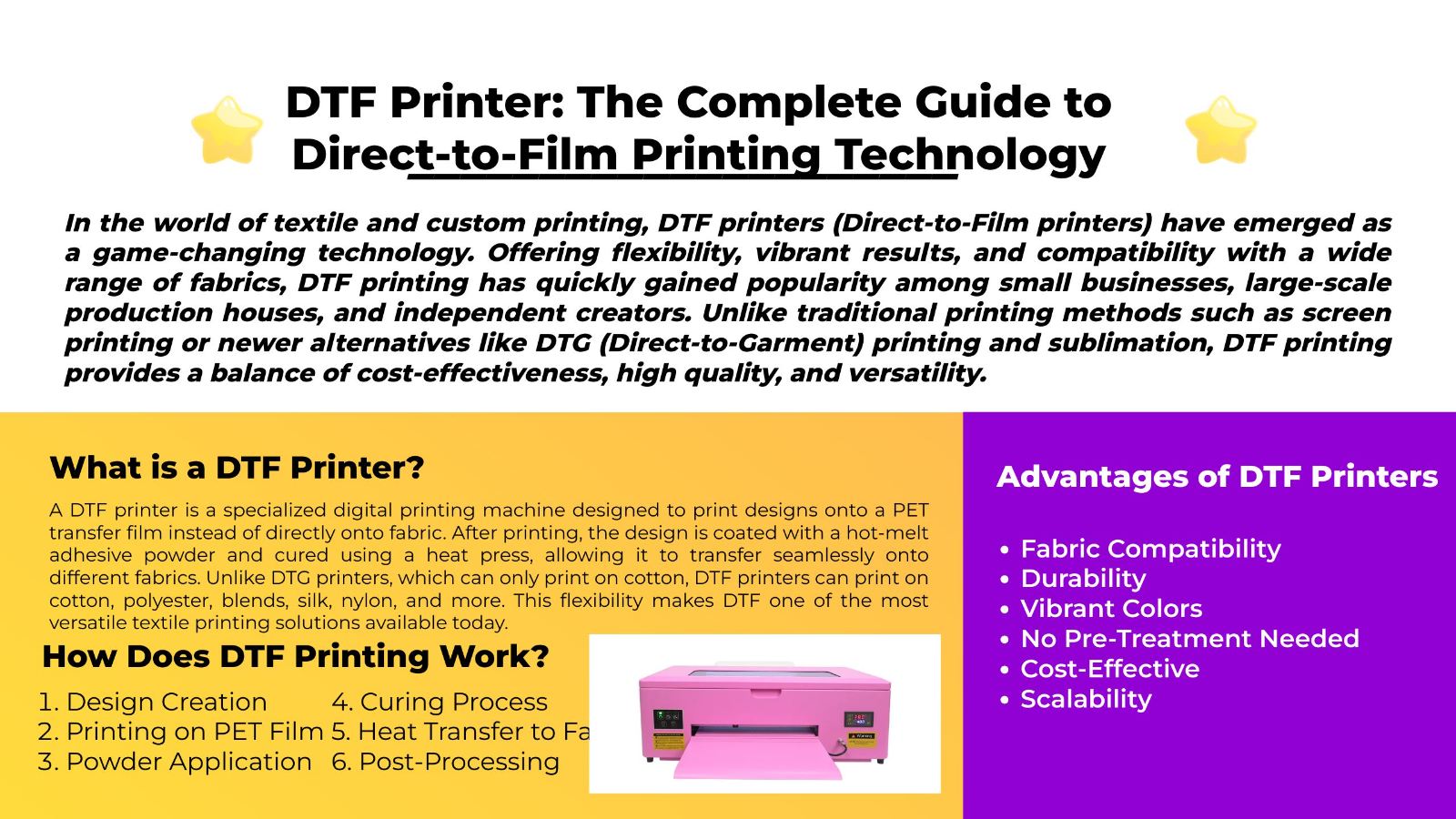
Un flujo de trabajo DTF textil estándar utiliza:
- Tinta pigmentada DTF
- CMYK + tinta blanca
- Película de transferencia de mascotas
- polvo adhesivo termofusible
- curado en polvo
- prensado en caliente
- productos textiles
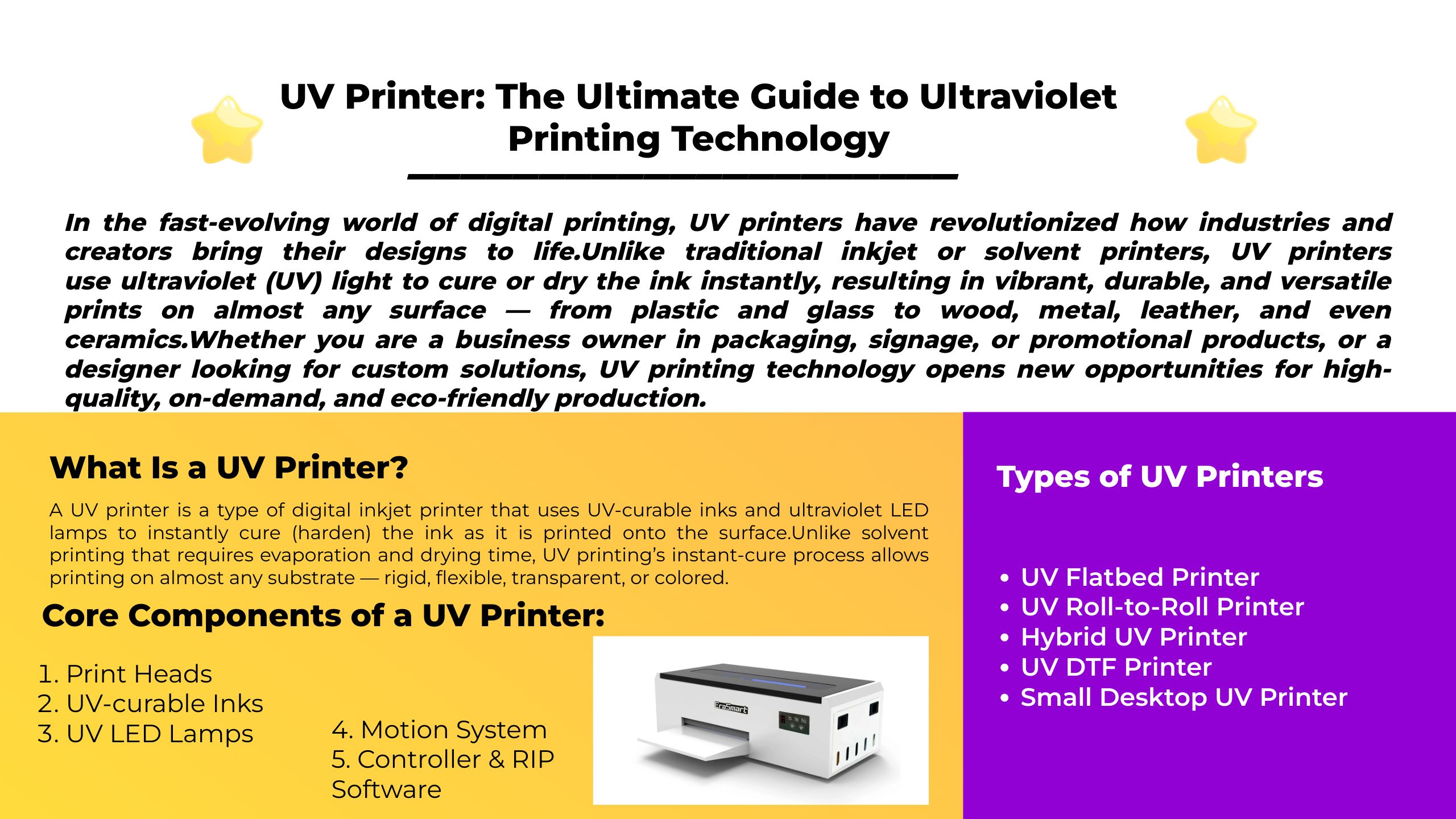
Un flujo de trabajo UV DTF utiliza:
- Tinta curable por UV
- CMYK + blanco + barniz
- la pelicula
- película B
- Curado LED UV
- laminación
- transferencia/aplicación en frío
- productos de superficie dura
Utilizan diferentes químicas de tinta, diferentes películas, diferentes sistemas adhesivos y diferentes métodos de aplicación final.
Eso significa que una impresora DTF no se puede convertir simplemente en una impresora UV DTF cambiando la película, y no se debe comprar una impresora UV DTF para imprimir camisetas.
Flujo de trabajo DTF vs UV DTF: donde comienza la verdadera diferencia
El flujo de trabajo es una de las diferencias más importantes para el propietario de un negocio porque determina qué equipo necesita, cuánto trabajo del operador implica y cómo se mueven los pedidos por su tienda.
Flujo de trabajo DTF
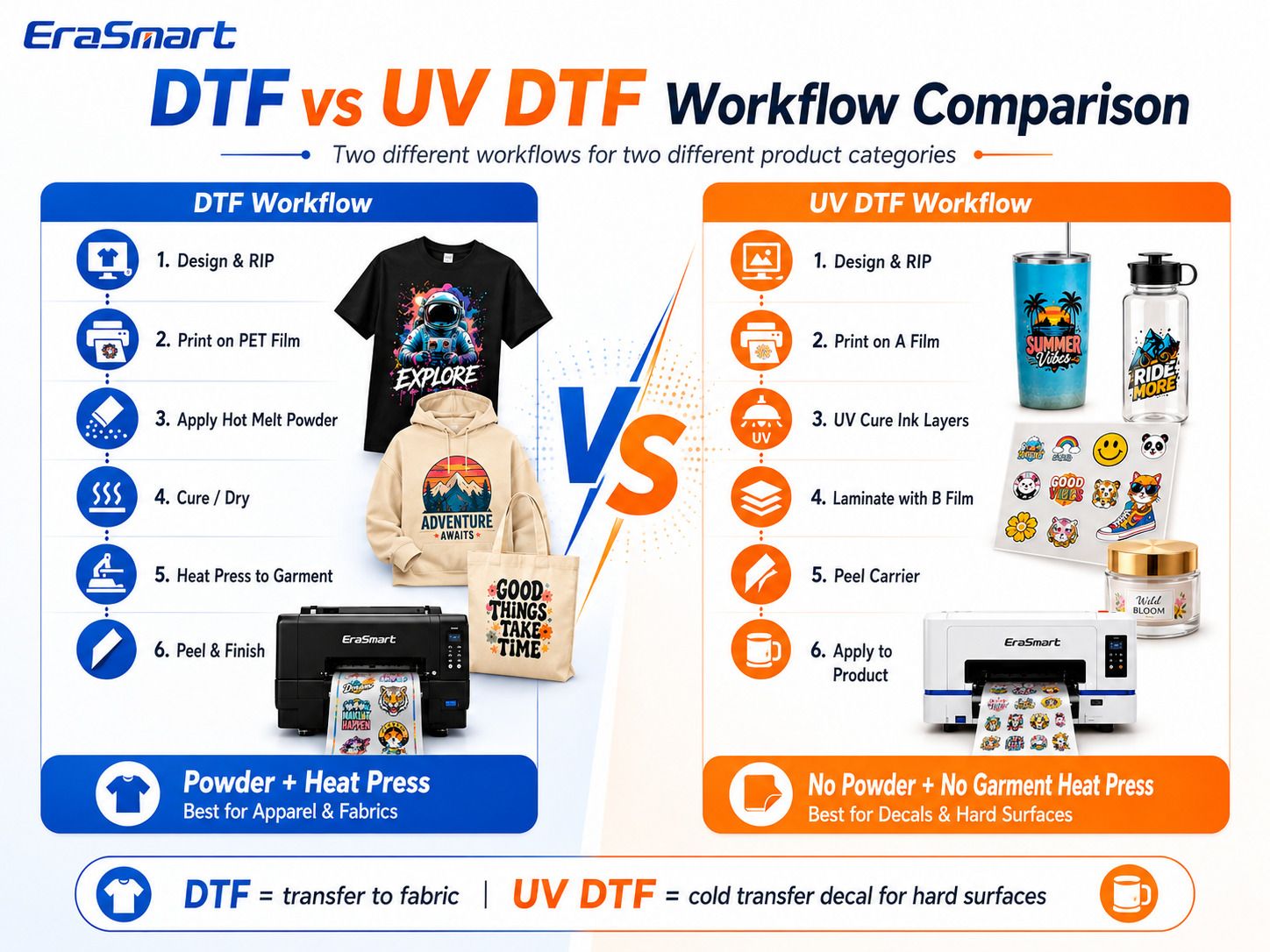
Un flujo de trabajo típico de DTF textil se ve así:
- Preparar obras de arte.
- Procesar ilustraciones en software RIP.
- Imprima CMYK y tinta blanca en película de PET.
- Aplicar adhesivo termofusible en polvo.
- Cura o derrite el polvo adhesivo.
- Colocar el transfer sobre la prenda.
- Presione con calor la transferencia.
- Pele la película.
- Termine de presionar si es necesario.
- Inspeccionar la prenda final.
La impresora crea la transferencia, pero la prenda no está terminada hasta que la transferencia se presiona con calor.
Para obtener una explicación más detallada de la producción, consulte el artículo de EraSmart. Flujo de trabajo de producción DTF.
Flujo de trabajo UVDTF
Un flujo de trabajo típico de UV DTF se ve así:
- Preparar obras de arte.
- Procese capas CMYK, blanco y barniz en el software RIP.
- Imprimir en una película.
- Los LED UV curan la tinta durante la impresión.
- Laminado con film B.
- Corta o recorta la transferencia terminada si es necesario.
- Retire la capa portadora adecuada.
- Coloque la calcomanía en el producto.
- Pulir o presionar sobre la superficie.
- Retire el transportador.
No hay polvo termofusible y normalmente no hay prensa térmica para prendas.
Esa diferencia hace que UV DTF sea especialmente útil cuando los clientes traen muchos productos duros diferentes que de otro modo requerirían accesorios o posicionamiento de impresión directa.
¿Qué productos desea realmente vender?
Esta debería ser la primera decisión de compra.
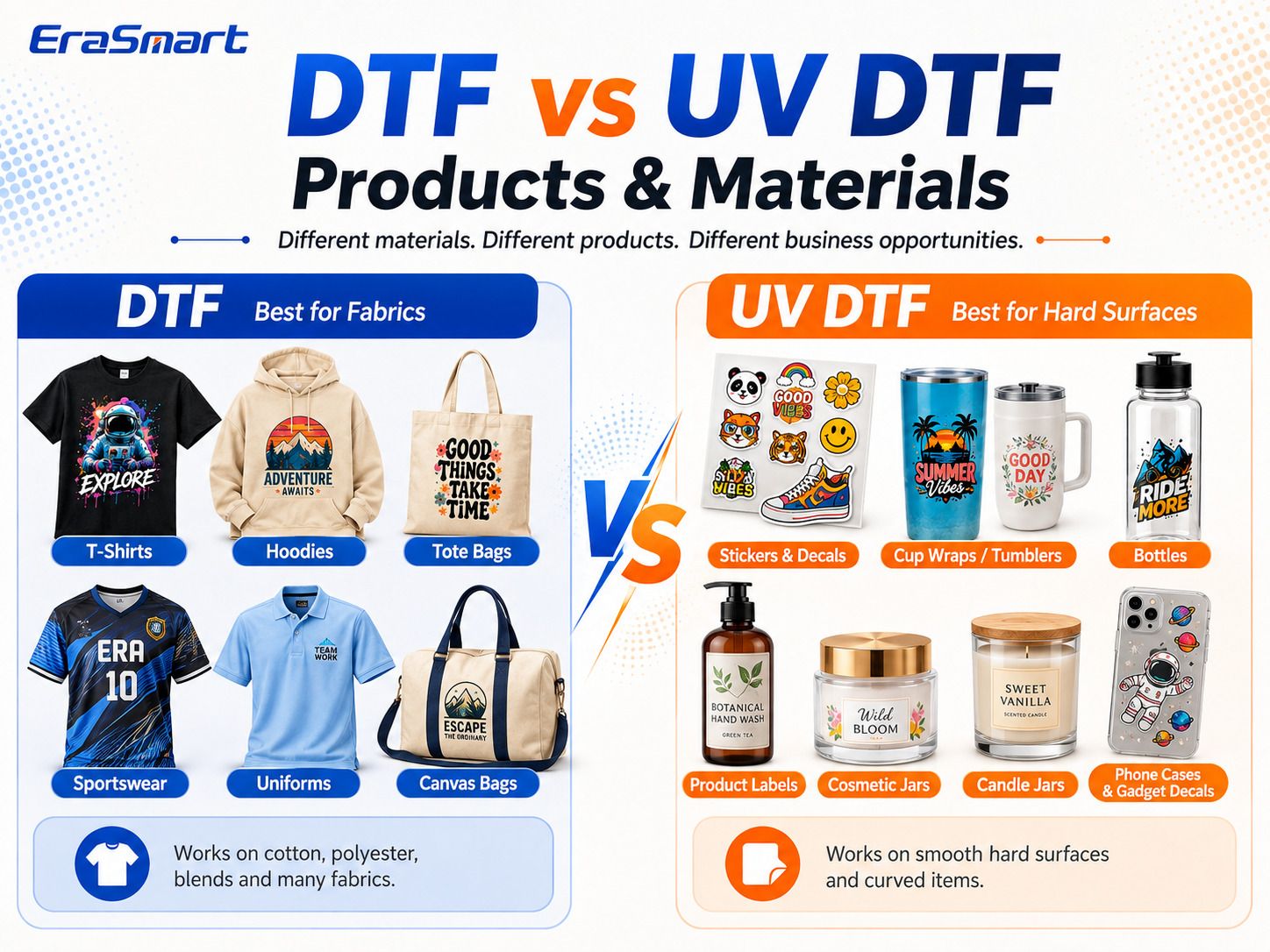
Elija DTF para prendas y tejidos
DTF está diseñado en torno a la decoración textil.
Los productos comunes incluyen:
- camisetas
- sudaderas con capucha
- sudaderas
- camisetas deportivas
- uniformes
- ropa de trabajo
- bolsas de mano
- bolsas de lona
- ropa del equipo
- mercancía de marca
- camisetas de eventos
- ropa de escuela y club
- prendas personalizadas
- ropa impresa bajo demanda
DTF es particularmente útil cuando una tienda maneja diferentes colores de prendas y cantidades de pedidos mixtas.
La tinta blanca crea una base opaca, lo que permite transferir obras de arte coloridas tanto a prendas oscuras como a telas de colores claros.
Una tienda DTF también puede vender las transferencias en lugar de vender únicamente prendas terminadas. Esto crea otro modelo de negocio potencial: imprimir hojas colectivas o transferencias para empresas locales de ropa, vendedores de artesanías, escuelas u otros decoradores de ropa.
Explora el completo Impresora EraSmart DTF rango si la ropa es su dirección principal.
Elija UV DTF para adhesivos, etiquetas y productos de superficie dura
UV DTF está diseñado alrededor de calcomanías UV transferibles.
Los productos típicos incluyen:
- pegatinas premium
- calcomanías de logotipo
- envolturas de taza
- vasos
- botellas de agua
- marca de cristalería
- etiquetas de tarros de velas
- etiquetas de botellas de cosméticos
- embalaje del producto
- calcomanías de caja de regalo
- calcomanías de la caja del teléfono
- pieles de gadgets
- Etiquetas de código QR
- marca de producto promocional
- etiquetas para pequeñas empresas
En lugar de colocar el objeto dentro de la impresora, primero se produce la calcomanía en una película y luego se aplica.
Esto es útil para empresas de productos con muchas formas y SKU.
Por ejemplo, la misma transferencia del logotipo se puede aplicar a una botella, frasco, caja de regalo, artículo acrílico u otra superficie lisa compatible después de realizar pruebas de adhesión adecuadas.
Explora EraSmart Impresora UV DTF alinee si su mercado principal son las calcomanías y los productos duros.
Compatibilidad de materiales: tela frente a superficies duras
Un error de compra común es asumir que el DTF UV es simplemente “mejor DTF” porque agrega tinta y barniz UV.
No lo es.
Resuelven diferentes problemas materiales.
DTF está diseñado para textiles compatibles con prensa térmica
Las aplicaciones típicas de DTF incluyen algodón, poliéster, mezclas, lonas y muchos materiales de prendas comunes.
Sin embargo, los operadores aún deben probar nuevas telas, recubrimientos, comportamiento de estiramiento, temperatura de prensado y adhesión antes de aceptar una orden de producción.
UV DTF está diseñado para superficies duras compatibles
UV DTF se utiliza generalmente en superficies duras, limpias y lisas, como:
- vidrio
- acrílico
- metal
- contenedores recubiertos
- productos de plastico
- embalaje
- botellas
- paso
- superficies de madera seleccionadas
- aparatos y accesorios
La textura de la superficie y la energía de la superficie son importantes.
Una calcomanía UV DTF que se adhiere muy bien al vidrio liso puede comportarse de manera diferente en un plástico aceitoso, madera en bruto, material similar a la silicona, una superficie con mucha textura o un producto flexible.
Siempre se recomienda probar el blanco real antes de la producción en volumen.
Apariencia de impresión y experiencia del cliente
DTF y UV DTF también crean productos terminados muy diferentes.
DTF: Gráficos de ropa flexibles
Una buena transferencia DTF puede proporcionar:
- ilustraciones vibrantes a todo color
- base blanca para prendas oscuras
- fino detalle gráfico
- personalización de lotes pequeños
- decoración de prendas flexibles
La sensación final depende de la cobertura de la obra de arte, la densidad de la tinta, el polvo adhesivo, el curado, el prensado y la prenda misma.
Un gráfico grande y sólido naturalmente se sentirá diferente de un logotipo pequeño en el pecho con más espacio negativo.
UV DTF: calcomanía premium y efectos elevados
UV DTF puede utilizar:
CMYK + Blanco + Barniz
El barniz permite efectos como:
- brillo
- brillo puntual
- detalles en relieve
- efectos de logotipo premium
- acentos decorativos texturizados
Esto hace que UV DTF sea atractivo para etiquetas de marcas, bebidas, envases, productos de regalo y gráficos decorativos de primera calidad.
Todavía se debe considerar como una capa de calcomanía transferida en lugar de imprimirla directamente en el sustrato.
Equipos y consumibles: ¿qué es lo que realmente necesita?
La impresora es sólo una parte de la inversión.
Debe comparar el sistema de producción completo.
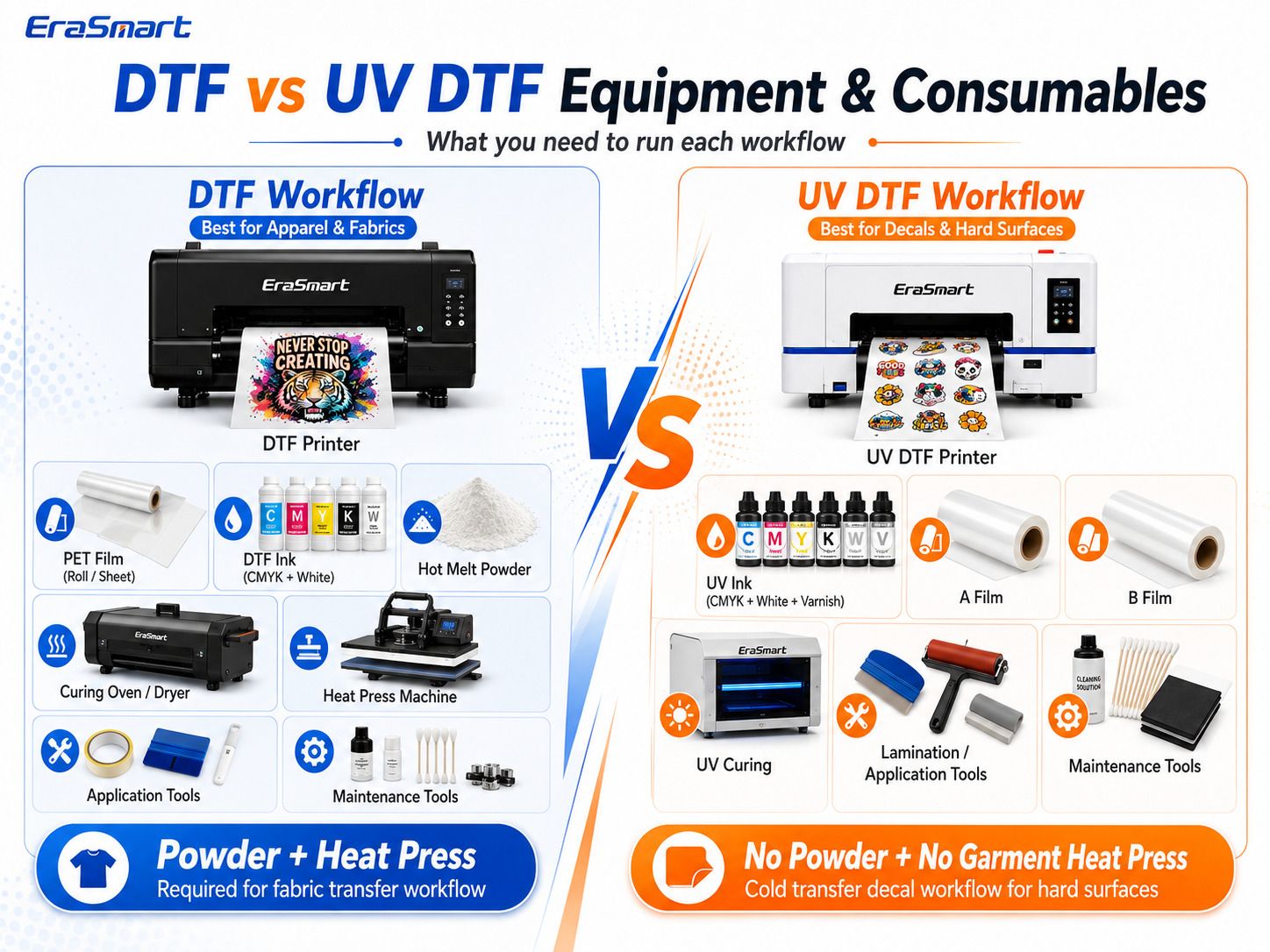
Sistema de producción DTF
Un flujo de trabajo DTF completo puede requerir:
- Impresora DTF
- CMYK + tinta blanca DTF
- Película de transferencia de mascotas
- polvo adhesivo termofusible
- sistema de aplicación de polvo
- horno de curado o secadora
- prensa de calor
- Software
- solución limpiadora
- herramientas de mantenimiento
- ropa en blanco
Los talleres pequeños pueden aplicar el polvo manualmente y utilizar equipos de curado independientes.
A medida que aumenta la producción, un agitador y secador de polvo automáticos pueden reducir el trabajo manual y mejorar la consistencia.
Para los compradores que estén considerando esa actualización, EraSmart también ofrece la Impresora DTF A3 MAX XP600 con agitador de polvo.
Sistema de producción UV DTF
Un flujo de trabajo UV DTF generalmente necesita:
- Impresora UV DTF
- Tinta UV CMYK
- tinta ultravioleta blanca
- barniz
- la pelicula
- película B
- Sistema de curado UV
- sistema de laminación
- Software
- herramientas de recorte/aplicación
- suministros de limpieza y mantenimiento
El flujo de trabajo EraSmart UV DTF no utiliza polvo y no requiere una prensa térmica para prendas para la aplicación de calcomanías estándar.
Esto hace que la estructura de producción sea muy diferente de la DTF textil.
¿Qué flujo de trabajo tiene más pasos?
Depende de lo que cuentes.
DTF necesita pasos adicionales de producción de prendas después de imprimir la transferencia:
polvo → curar → prensa de calor → pelar
El DTF UV necesita:
Curado UV durante la impresión → laminado → recortar → aplicar → pelar
Entonces la pregunta no debería ser "¿Cuál tiene menos pasos?"
La mejor pregunta es:
¿Qué flujo de trabajo se adapta a los productos que desea vender repetidamente?
Si el 90% de tus pedidos son camisetas, un flujo de trabajo DTF te resultará natural.
Si el 90% de sus pedidos son envoltorios para tazas y calcomanías para empaques, un flujo de trabajo UV DTF tendrá mucho más sentido.
Mantenimiento: ¿Qué impresora es más fácil de adquirir?
Ninguno de los sistemas debe considerarse libre de mantenimiento.
Tanto las impresoras DTF como las UV DTF contienen cabezales de impresión de inyección de tinta y sistemas de tinta blanca que necesitan rutinas operativas adecuadas.
Prioridades de mantenimiento de DTF
Los operadores de DTF deben gestionar:
- circulación de tinta blanca
- controles de boquillas
- condición del cabezal de impresión
- estación de taponado
- limpiaparabrisas
- lineas de tinta
- contaminación del polvo
- almacenamiento de película
- temperatura y humedad ambiente
- rutinas de tiempo muerto
La tinta blanca contiene pigmentos más pesados y es una de las principales razones por las que la operación y el mantenimiento regulares del DTF son importantes.
EraSmart Guía de mantenimiento DTF proporciona orientación de mantenimiento adicional.
Prioridades de mantenimiento de UV DTF
Los operadores de UV DTF también deben gestionar:
- condición del cabezal de impresión
- sistema de tinta blanca
- Tinta UV
- canal de barniz
- controles de boquillas
- tapado y limpieza
- Almacenamiento de películas A/B
- calidad de laminación
- Sistema de curado UV
- polvo y contaminación
UV DTF elimina el polvo termofusible del flujo de trabajo, pero eso no significa que la impresora en sí pueda dejarse sin uso indefinidamente sin cuidados.
Para cualquiera de los sistemas, la disciplina operativa diaria es más importante que frases de marketing como "fácil mantenimiento".
¿Cuál es más fácil para un principiante?
No existe una respuesta universal.
La impresora más sencilla para un principiante suele ser la impresora que coincide con la primera categoría de producto del principiante.
DTF es más fácil de entender si ya desea vender ropa
Si tu idea de negocio es:
"Quiero vender camisetas y sudaderas con capucha personalizadas".
DTF tiene un camino claro:
diseño → transferencia → prensa de calor → prenda.
Tus principales áreas de aprendizaje serán:
- preparación de obras de arte
- configuración de RIP
- gestión de tinta blanca
- curado en polvo
- prensado
- prueba de prendas
UV DTF es más fácil de entender si desea vender calcomanías y productos duros personalizados
Si tu idea de negocio es:
"Quiero vender envoltorios para vasos, etiquetas y calcomanías de productos personalizados".
UV DTF le ofrece un flujo de trabajo que se adapta naturalmente a esos productos.
Tus principales áreas de aprendizaje serán:
- Configuración CMYK/blanco/barniz
- película A/B
- laminación
- posicionamiento de la calcomanía
- técnica de aplicación
- prueba de adherencia del sustrato
Comprar el sistema incorrecto crea una experiencia para principiantes mucho más difícil que elegir cualquiera de las tecnologías correctamente.
Modelos de negocio DTF vs UV DTF
La diferencia se vuelve aún más clara cuando dejas de pensar en las imprentas y empiezas a pensar en los clientes.
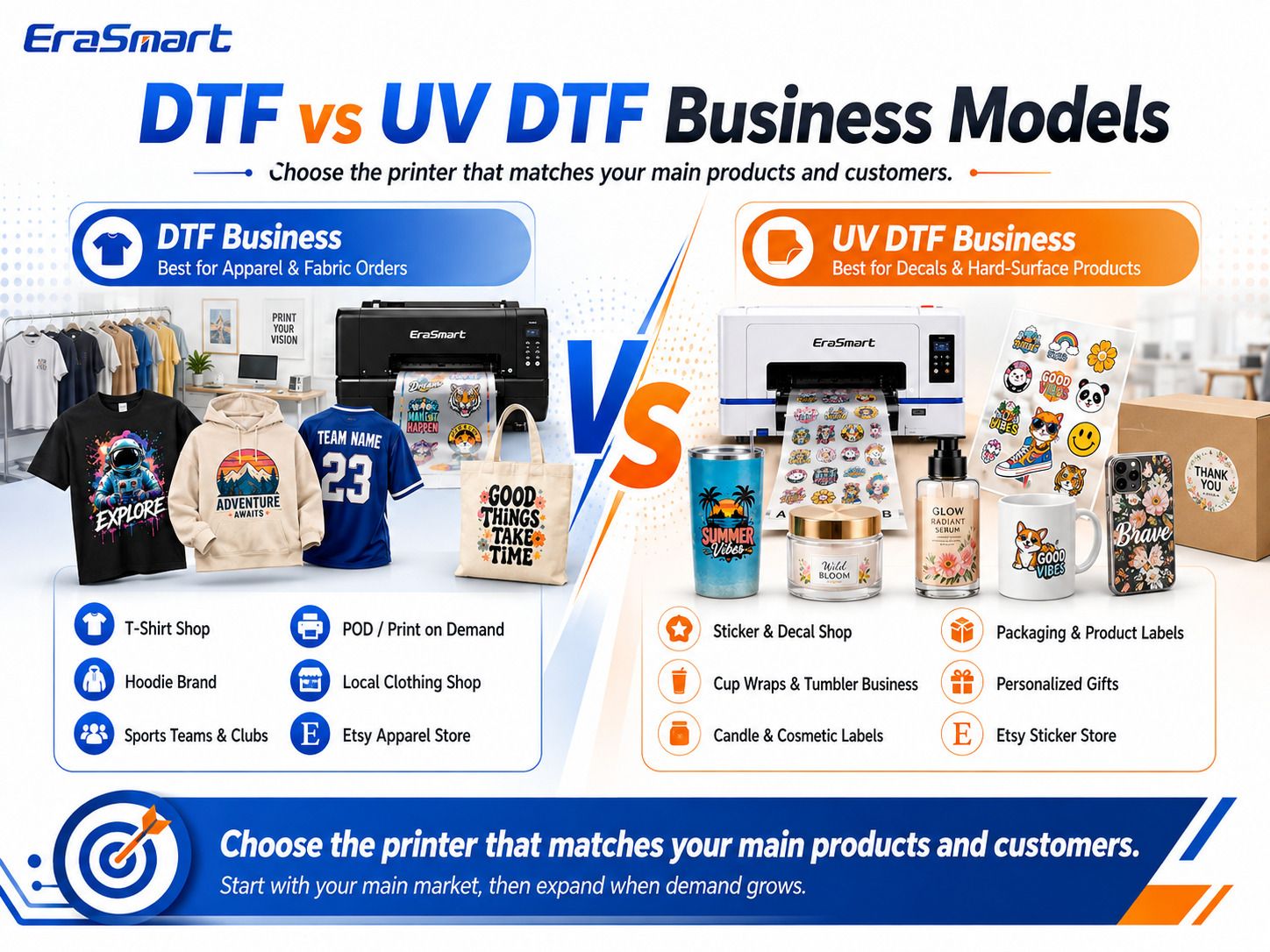
Modelos de negocio DTF
DTF es ideal para:
Tienda de camisetas personalizadas
Los clientes envían diseños y piden camisas en cantidades pequeñas o medianas.
Ropa de impresión bajo demanda
Se pueden preparar y producir múltiples diseños a medida que llegan los pedidos.
Marcas de ropa y streetwear
Las marcas pueden lanzar pequeñas colecciones sin preparar pantallas para cada diseño.
Ropa para la escuela, el equipo y el club
Los nombres, números, logotipos y diseños cambiantes se adaptan a la producción de transferencia digital.
Mercancía corporativa
Las camisas para el personal, la indumentaria para eventos, la ropa de trabajo y las prendas de marca pueden generar negocios recurrentes.
Proveedor de transferencia DTF
En lugar de planchar las prendas tú mismo, puedes vender transferencias terminadas a otros decoradores.
Modelos de negocio UV DTF
UV DTF es ideal para:
Tienda de pegatinas y calcomanías
Produzca transferencias premium sobre superficies duras para consumidores y empresas.
negocio de envoltura de tazas
Cree obras de arte para vasos, copas de vidrio, botellas y artículos para beber.
Etiquetas de embalaje y productos
Atienda a marcas pequeñas que desean etiquetas y calcomanías atractivas en tiradas cortas.
Marca de velas y cosméticos
Cree marcas decorativas para frascos y contenedores compatibles.
Negocio de regalos personalizados
Utilice calcomanías para personalizar diferentes productos de regalo sin imprimir directamente cada artículo.
Proveedor de marca B2B
Atendemos cafeterías, salones de belleza, tiendas de regalos, marcas de productos locales, empresas de eventos y empresas de productos promocionales.
¿Cuál es mejor para Etsy y las tiendas online?
Ambos pueden funcionar bien, pero conducen a tiendas diferentes.
Tienda en línea DTF
Posibles productos:
- camisetas gráficas
- sudaderas personalizadas
- ropa deportiva personalizada
- camisetas de eventos
- bolsas de mano
- mercancía del creador
- transferencias de ropa
Este modelo se adapta a vendedores cuya identidad visual se basa en la ropa.
Tienda en línea UV DTF
Posibles productos:
- hojas de pegatinas
- envolturas de taza
- calcomanías de vaso
- etiquetas de botellas
- colecciones de calcomanías de temporada
- etiquetas personalizadas
- paquetes de marca para pequeñas empresas
Las transferencias UV DTF también se pueden vender sin el espacio en blanco terminado, lo que reduce la necesidad de almacenar todos los diseños posibles de tazas, frascos o botellas.
¿Qué es mejor para las imprentas locales?
Esto depende de su base de clientes local.
DTF es atractivo si recibe regularmente:
- Pedidos de camisetas para el personal del restaurante.
- ropa de equipo deportivo
- camisas escolares
- pedidos de construcción/ropa de trabajo
- mercancía del club
- ropa para eventos
- uniformes corporativos
UV DTF es atractivo si sus clientes necesitan:
- etiquetas de embalaje
- marca de botella
- calcomanías de productos
- personalización del vaso
- Calcomanías de códigos QR
- regalos promocionales
- etiquetas de cosméticos/velas
- marca de tiradas pequeñas
Es posible que una imprenta local eventualmente tenga demanda para ambos.
¿Cuál tiene mayor potencial de crecimiento?
Ninguna tecnología genera automáticamente más dinero.
El beneficio depende de:
- demanda local
- precio de venta
- costo de materiales
- desperdiciar
- utilización de la máquina
- mano de obra
- posicionamiento del producto
- marketing
- retención de clientes
- repetir pedidos
DTF le ofrece un camino de crecimiento dentro del sector textil.
Puedes moverte desde:
pequeños pedidos personalizados → trabajo de marca de ropa → hojas colectivas → venta por transferencia → sistemas de producción más grandes.
UV DTF le brinda una vía de crecimiento dentro de la decoración de superficies duras.
Puedes moverte desde:
pegatinas → vasos → etiquetas de embalaje → marca B2B → productos promocionales → mayor producción de calcomanías.
La mejor plataforma de crecimiento es la que está conectada a la base de clientes que puedes construir de manera realista.
¿Se pueden ejecutar DTF y UV DTF juntos?
Sí. De hecho, los dos sistemas pueden ser complementarios porque se dirigen a categorías de productos diferentes.
Imagine que el cliente de una cafetería quiere un paquete completo de productos de marca.
Con DTF podrías producir:
- camisetas del personal
- sudaderas promocionales
- camisetas de eventos
- bolsas de mano
Con UV DTF podrías producir:
- calcomanías del logotipo de la taza
- marca de botella
- pegatinas de códigos qr
- etiquetas de embalaje
- marca de caja de regalo
Por lo tanto, un cliente puede generar pedidos para varios tipos de productos.
Esta es la razón por la que un taller de personalización maduro puede eventualmente operar ambos sistemas.
Pero eso no no significa que un principiante debería comprar ambos automáticamente el primer día.
Comience con el sistema que coincida con su mejor oportunidad de producto. Añade el segundo flujo de trabajo cuando la demanda del cliente lo justifique.
Impresora EraSmart A3 MAX DTF frente a A3 UV DTF
Para ver un ejemplo de compra más práctico, considere dos sistemas EraSmart clase A3.
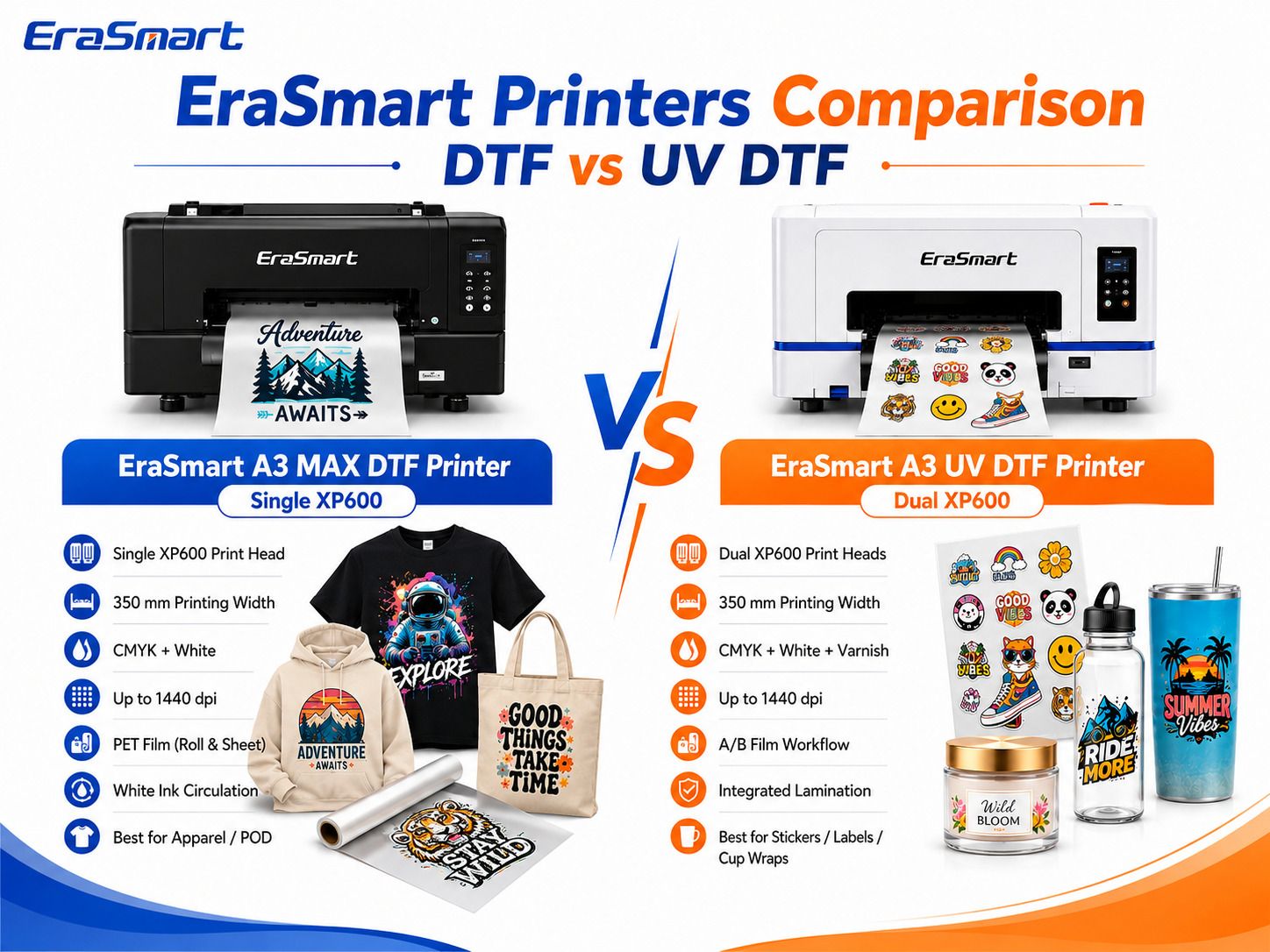
| Especificación | Impresora EraSmart A3 MAX DTF | Impresora EraSmart A3 UV DTF |
|---|
| Aplicación principal | Transferencias de ropa | Calcomanías para superficies duras |
| cabezal de impresión | XP600 único | Doble XP600 |
| Ancho máximo de impresión | 350 milímetros | 350 milímetros |
| Sistema de colores | CMYK + blanco | CMYK + Blanco + Barniz |
| Resolución | Hasta 1440 ppp | Hasta 1440 ppp |
| Película | Película, rollo y lámina de PET | Película A/B UV DTF |
| Flujo de trabajo adhesivo | Polvo termofusible | Sistema adhesivo de película A/B |
| Curación | Se requiere curado en polvo | Curado LED UV |
| Laminación | No forma parte del flujo de trabajo de transferencia DTF estándar | Flujo de trabajo de laminación en frío/integrado |
| Prensa de calor | Requerido para aplicar a la prenda. | Sin prensa térmica para prendas para la aplicación de calcomanías estándar |
| Gestión de tinta blanca | Circulación de tinta blanca | Gestión de tinta blanca/tinta UV |
| Mejor ajuste | Ropa, POD, textiles | Calcomanías, etiquetas, envoltorios para tazas, calcomanías |
Impresora EraSmart A3 MAX DTF: única XP600
los Impresora EraSmart A3 MAX DTF: única XP600 es una impresora de transferencia textil de clase A3 diseñada en torno a un flujo de trabajo de película PET de 350 mm.
Las características clave incluyen:
- Cabezal de impresión XP600 único
- hasta 350 mm de ancho de impresión
- CMYK + blanco
- Soporte para rollos y láminas de film PET
- hasta 1440 ppp
- circulación de tinta blanca
- Flujo de trabajo Riin/EraRip
- Diseñado para prendas personalizadas y aplicaciones POD.
Es una dirección práctica para las tiendas que desean producir sus propias prendas transferidas internamente sin pasar inmediatamente a una plataforma de producción A1 más amplia.
Impresora EraSmart A3 UV DTF: doble XP600
los Impresora EraSmart A3 UV DTF está diseñado en torno al flujo de trabajo de calcomanías de películas A/B.
Su configuración principal incluye:
- Cabezales de impresión dobles XP600
- hasta 350 mm de ancho de material
- CMYK + blanco + barniz
- hasta 1440 ppp
- Flujo de trabajo de película A/B
- curado ultravioleta
- flujo de trabajo de laminación en frío/integrado
- sin polvo termofusible
- Sin prensa térmica para prendas para aplicación de calcomanías estándar.
- Diseñado para adhesivos, etiquetas, envoltorios para vasos y transferencias a superficies duras.
La diferencia importante no es que una máquina tenga un cabezal de impresión y la otra tenga dos.
La diferencia importante es que Las máquinas están diseñadas para dos negocios diferentes..
No compare el número de cabezales de impresión sin comparar el flujo de trabajo
Esto merece una atención especial.
Un comprador puede ver:
- XP600 único en una impresora
- Doble XP600 en otra impresora
e inmediatamente asumir que la máquina de doble cabezal es simplemente "mejor".
Esa no es una comparación útil.
Los cabezales de impresión se configuran según el sistema de tinta, el ancho, los requisitos de capa y el flujo de trabajo previsto de la máquina.
Es posible que una impresora UV DTF deba gestionar los requisitos de CMYK, blanco, barniz y curado/laminación.
Una impresora textil DTF está optimizada para la producción de transferencia de blanco CMYK +.
Por lo tanto:
No elija DTF frente a UV DTF basándose únicamente en el número de cabezales de impresión.
Elige según lo que necesites hacer.
Costo: ¿Cuál es más barato de ejecutar?
No existe una respuesta universal responsable porque los costos varían según el mercado, el proveedor, el tamaño del producto, la cobertura de tinta, los residuos, la mano de obra y el tipo de pedido.
En su lugar, compare la estructura de costos.
Estructura de costos DTF
Incluir:
- tinta DTF
- Película de PET
- polvo termofusible
- energía curativa
- prensa de calor
- prendas en blanco
- suministros de limpieza
- transferencias fallidas
- mantenimiento
- mano de obra
Estructura de costos UV DTF
Incluir:
- Tinta UV
- tinta blanca
- barniz
- la pelicula
- película B
- laminación
- suministros de limpieza
- calcomanías fallidas
- mano de obra de aplicación
- mantenimiento
- productos en blanco si vende productos terminados
El coste por metro cuadrado más barato no necesariamente produce el mejor negocio.
Una calcomanía de taza premium o una etiqueta de cosmético pueden venderse de manera muy diferente a un gráfico de camiseta grande.
Siempre calcule el costo basándose en el producto terminado que vendes, no sólo la tinta o la película.
Requisitos de espacio
Ambos sistemas A3 pueden adaptarse a entornos de impresión personalizados relativamente compactos, pero sus flujos de trabajo circundantes difieren.
Espacio de trabajo DTF
Planificar espacio para:
- Erasmart phone case impresora en la nube para funda móvil
- Película de PET
- polvo
- sistema de curado
- prensa de calor
- preparación de prendas
- transferencias completadas
- contención de polvo
- ventilación
Si agrega un agitador de polvo automático, la huella de producción aumenta pero el flujo de trabajo se vuelve más automatizado.
Espacio de trabajo UV DTF
Planificar espacio para:
- Impresora UV DTF
- Almacenamiento de películas A/B
- laminación
- cortar/recortar
- aplicación de calcomanía
- almacenamiento de productos duros
- suministros de limpieza
Es posible que una empresa de DTF UV no necesite una prensa térmica para prendas, pero puede requerir mucho más almacenamiento si vende muchos productos duros en blanco diferentes.
¿Qué sistema es mejor para pedidos pequeños de gran variedad?
Aquí es donde ambas tecnologías funcionan bien, pero en mercados diferentes.
DTF es fuerte cuando el pedido de un cliente contiene:
- cinco diseños de camisetas
- varios colores de prendas
- diferentes nombres
- numeros de equipo
- cantidades bajas por diseño
UV DTF es fuerte cuando un pedido contiene:
- múltiples calcomanías con logotipos
- varios tamaños de botella
- envolturas de taza
- etiquetas de embalaje
- diferentes nombres personalizados
Ambos flujos de trabajo ayudan a las pequeñas empresas a evitar los altos requisitos de configuración tradicionales.
La diferencia es la categoría del producto.
¿Qué sistema debería comprar primero?
Utilice la siguiente guía de decisión.
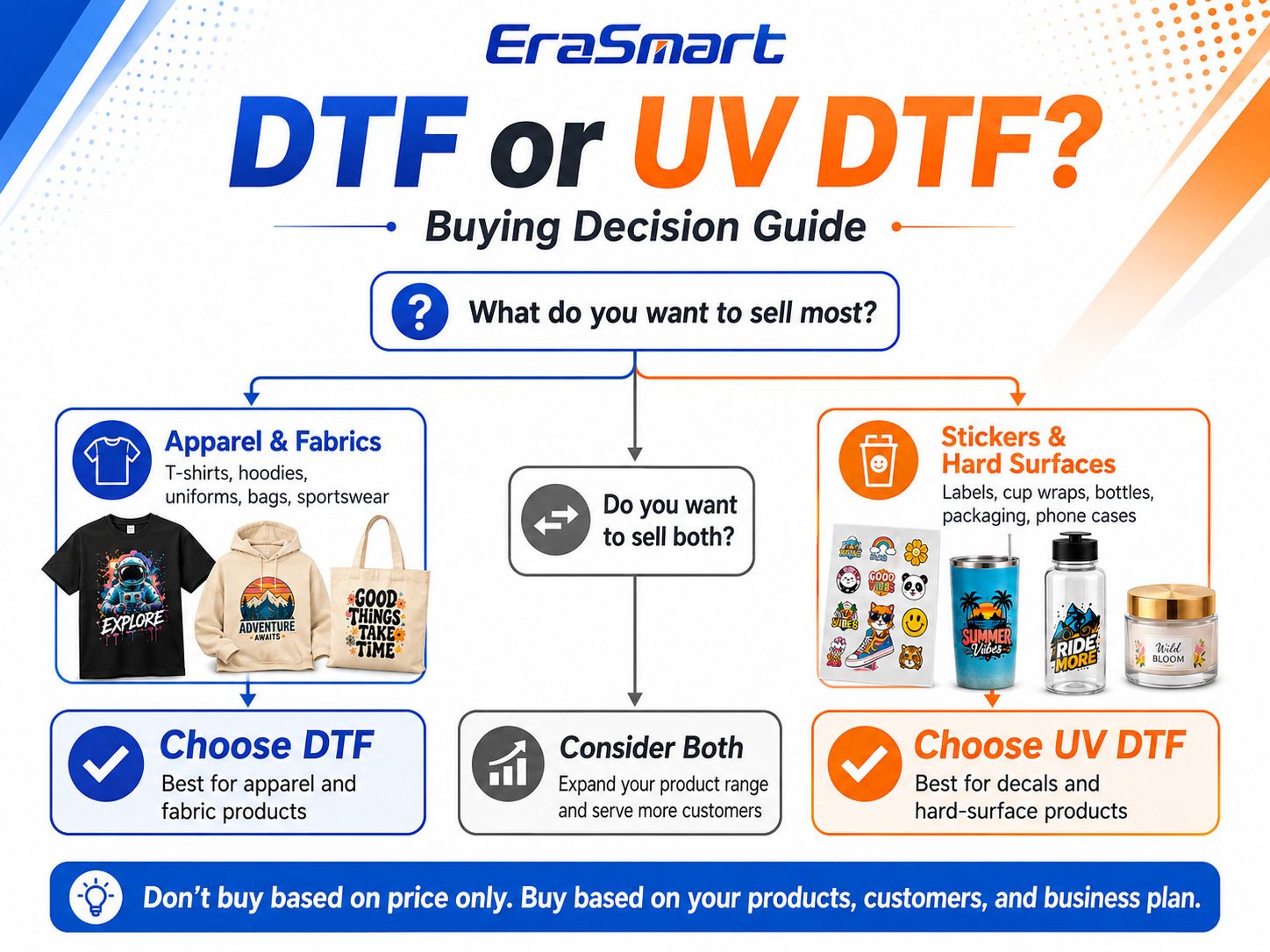
Elija DTF si:
- la mayoría de sus productos son prendas
- Los clientes quieren camisetas y sudaderas.
- quieres construir una marca de ropa
- Quieres servir a equipos y escuelas.
- planeas vender transferencias DTF
- necesitas impresión a todo color en prendas oscuras
- La ropa POD es tu negocio principal
Comience con el Impresora EraSmart DTF rango.
Elija UV DTF si:
- Las pegatinas y calcomanías son sus productos principales.
- quieres vender envoltorios para tazas
- sirves marcas de velas o cosméticos
- Las etiquetas de embalaje son un mercado importante.
- Los clientes traen botellas, tarros o productos de regalo.
- quieres efectos de barniz puntual
- Quieres un negocio de transferencia de superficies duras
Comience con el Impresora UV DTF EraSmart rango.
Considere ambos si:
- Ya tiene clientes que solicitan tanto ropa como productos duraderos de marca.
- Quieres ofrecer paquetes completos de mercancías.
- sus clientes actuales de DTF quieren etiquetas y envoltorios para vasos
- tus clientes actuales de calcomanías quieren ropa
- el volumen de su pedido puede admitir dos flujos de trabajo separados
- Tiene suficiente espacio de trabajo y personal para mantener ambos sistemas.
No compre dos máquinas simplemente porque quiere “más posibilidades”.
Compre el segundo sistema después de que la demanda del cliente demuestre que esas posibilidades son reales.
DTF vs UV DTF: Comparación final
| Categoría | DTF | UVDTF |
|---|
| Mercado Primario | Vestir | Calcomanías para superficies duras |
| Productos típicos | Camisetas, sudaderas, uniformes, bolsos. | Pegatinas, vasos, botellas, etiquetas, embalajes. |
| Tinta | Tinta pigmentada DTF | Tinta curable por UV |
| Configuración de colores | CMYK + blanco | CMYK + Blanco + Barniz |
| Película | MASCOTA | película A/B |
| Adhesivo | Polvo termofusible | Adhesivo de película A/B |
| Curación | Curado en polvo | LED ultravioleta |
| Transferencia final | prensa de calor | Aplicación en frío |
| Prensa de calor | sí | normalmente no |
| Polvo | sí | No |
| Efectos de barniz | Sin capa de barniz estándar | sí |
| Enfoque principal de mantenimiento | Tinta blanca, cabezal de impresión, flujo de trabajo en polvo. | Tinta blanca, tinta UV, barniz, cabezal de impresión, película/laminación |
| Mejor principiante | Principiante centrado en la ropa | Principiante centrado en calcomanías/bienes duraderos |
| Mejor Dirección de Negocios | POD, indumentaria, traslados | Calcomanías, etiquetas, marcas de regalos/productos |
Respuesta final: UV DTF o DTF: ¿qué impresora debería comprar?
Si su negocio se basa en Camisetas, sudaderas con capucha, uniformes, ropa deportiva, bolsos de mano y mercancías textiles., compra un Impresora DTF.
Si su negocio se basa en calcomanías, etiquetas, envoltorios para tazas, botellas, frascos, embalajes, dispositivos y calcomanías para superficies duras, compra un Impresora UV DTF.
Si sus clientes necesitan constantemente marcas de ropa y de productos, considere operar ambos sistemas una vez que el volumen de su pedido justifique la inversión.
El mayor error de compra es elegir según las especificaciones antes de elegir tu producto.
No empieces con:
¿Qué impresora tiene más cabezales de impresión?
No empieces con:
¿Qué impresora tiene el DPI más alto?
Y no empieces con:
¿Qué impresora es más barata?
Comience con:
¿Qué voy a vender y quién lo va a comprar?
Una vez que la respuesta sea clara, la elección entre DTF y UV DTF se vuelve mucho más fácil.
Preguntas frecuentes
¿Es UV DTF mejor que DTF?
No. UV DTF y DTF están diseñados para diferentes aplicaciones. DTF se adapta mejor a transferencias de textiles y prendas de vestir, mientras que UV DTF está diseñado para calcomanías que se aplican a superficies duras compatibles.
¿Puede una impresora UV DTF imprimir camisetas?
El DTF UV no debe tratarse como un reemplazo del DTF textil. Para camisetas, sudaderas con capucha, uniformes y productos textiles, utilice un textil Impresora DTF.
¿Puede una impresora DTF hacer envoltorios para tazas?
Las transferencias textiles DTF estándar están diseñadas para textiles compatibles con prensado en caliente. Para envoltorios de tazas, botellas, etiquetas y calcomanías de superficies duras, utilice un Impresora UV DTF.
¿UV DTF requiere una prensa térmica?
Las calcomanías UV DTF estándar utilizan un flujo de trabajo de película A/B de transferencia en frío y normalmente no requieren una prensa térmica para prendas para su aplicación.
¿DTF requiere polvo?
Sí. La producción textil estándar de DTF utiliza polvo adhesivo termofusible que se aplica a la transferencia impresa y se cura antes del prensado térmico.
¿UV DTF usa polvo?
No. UV DTF utiliza tinta curable por UV y un sistema de transferencia de película A/B en lugar de polvo DTF termofusible.
¿Cuál es la diferencia entre la película DTF y la película UV DTF?
Textile DTF comúnmente utiliza una película de transferencia de PET que transporta tinta DTF y polvo adhesivo termofusible antes del prensado térmico.
UV DTF normalmente utiliza un sistema de película A/B. La imagen se imprime y se cura con luz UV en una película A, luego se lamina y se transfiere con una película B.
¿Qué es mejor para una pequeña empresa?
Si la empresa vende principalmente ropa, DTF suele ser el mejor sistema de inicio. Si la empresa vende principalmente adhesivos, etiquetas, envoltorios para vasos y productos duros, UV DTF suele ser el mejor sistema de inicio.
¿Cuál es más fácil de mantener?
Ambos requieren un mantenimiento rutinario de la impresora de inyección de tinta. DTF requiere una gestión cuidadosa del flujo de trabajo con tinta blanca y polvo. UV DTF también requiere cabezal de impresión, tinta blanca, barniz, tinta UV y gestión de películas/laminación. Ninguno de los dos debe considerarse libre de mantenimiento.
¿Puedo comenzar con DTF y agregar UV DTF más tarde?
Sí. Este es un camino de expansión práctico para una empresa de indumentaria que comienza a recibir solicitudes de calcomanías, vasos, etiquetas de embalaje y otros productos de superficie dura.
¿Puedo comenzar con UV DTF y agregar DTF más tarde?
Sí. Las empresas de calcomanías, regalos y marcas de productos pueden agregar DTF más adelante cuando los clientes comiencen a solicitar camisetas, sudaderas con capucha, uniformes para el personal y prendas de vestir.
¿No está seguro de si DTF o UV DTF se adapta a su negocio?
Dígale a EraSmart:
- qué productos quieres vender
- ¿Qué materiales personalizarás?
- la cantidad típica de su pedido
- su producción diaria esperada
- tu espacio de trabajo
- ya sea que esté comenzando desde casa o operando una imprenta
- su futuro plan de expansión de productos
Nuestro equipo puede ayudarle a comparar el derecho Impresora DTF y Impresora UV DTF flujo de trabajo basado en sus productos reales en lugar de recomendar una máquina solo por especificaciones.