تولید کننده چاپگر جوهر افشان به اندازه کوچک

Why Is DTF Powder Clumping? Causes, Fixes & Storage Guide
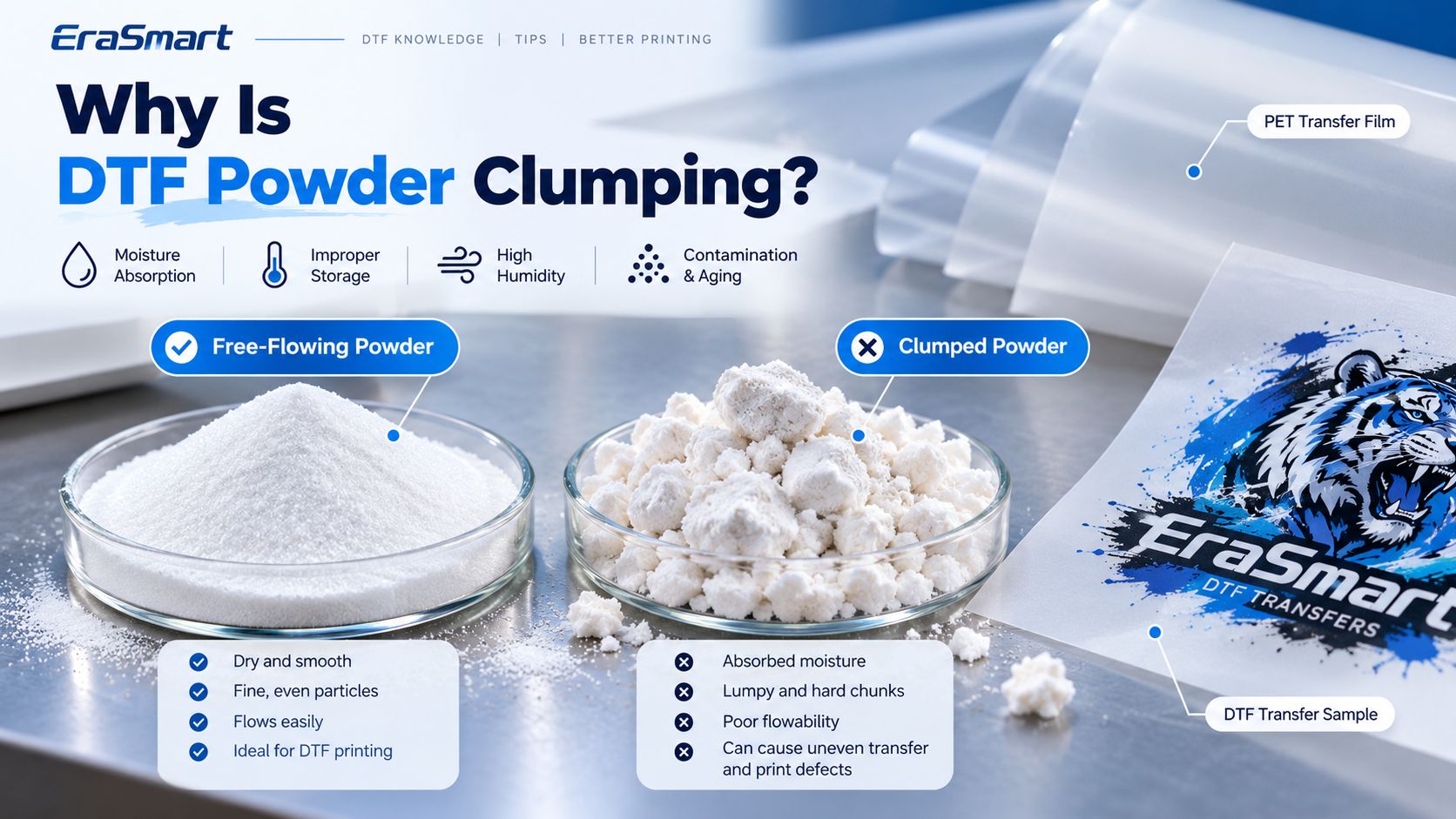
DTF adhesive powder should normally be dry, free-flowing and easy to distribute evenly over freshly printed ink.
If the powder begins forming lumps, sticking together or refusing to flow normally, something in the storage or production environment may have changed.
Humidity is one of the first things to check, but it is not the only possible cause.
Other factors can include:
- open packaging
- temperature fluctuations
- آلودگی
- dirty tools
- recovered powder
- poor storage practices
- unsuitable production conditions
The better troubleshooting workflow is:
Identify the symptom → Check storage → Check the environment → Inspect the powder → Run a test → Correct the cause → Approve production
Do not simply break up the lumps and immediately continue with a customer order.
Quick Answer: Why Does DTF Powder Clump?
Common causes include:
- excessive humidity
- قرار گرفتن در معرض رطوبت
- leaving the powder bag open
- storing powder in an unsealed container
- rapid temperature changes
- آلودگی
- dirty powder trays or scoops
- improper recycling of recovered powder
- prolonged or unsuitable storage
DTF powder is part of the adhesive system that bonds the printed transfer to the garment.
Its condition can therefore affect:
- powder distribution
- درمان
- transfer consistency
- چسبندگی
- final garment quality
However, not every powder-related symptom means the powder is wet.
به عنوان مثال:
Powder sticking outside the printed area
may be related to static electricity.
و:
Powder remaining grainy after heating
is more likely related to curing.
Correct diagnosis matters.
What Should Good DTF Powder Look Like?
Before identifying damaged powder, it helps to establish what normal powder should look and behave like.
Good DTF powder should generally be:
- خشک
- loose
- free-flowing
- relatively uniform
- easy to distribute
- free from obvious hard lumps
- free from visible contamination
When the container is gently tilted, the powder should move relatively freely rather than staying together as a solid mass.
Different DTF powders can still have different:
- particle sizes
- رنگ ها
- textures
- melting characteristics
- نرمی
So the goal is not to compare every powder visually.
The more important question is whether your powder is behaving consistently compared with its normal condition.
For more information about matching ink, film and powder, see the راهنمای مواد مصرفی DTFبشر
How Can You Tell If DTF Powder Has Absorbed Moisture?
Several visible and practical signs can indicate excessive moisture exposure.
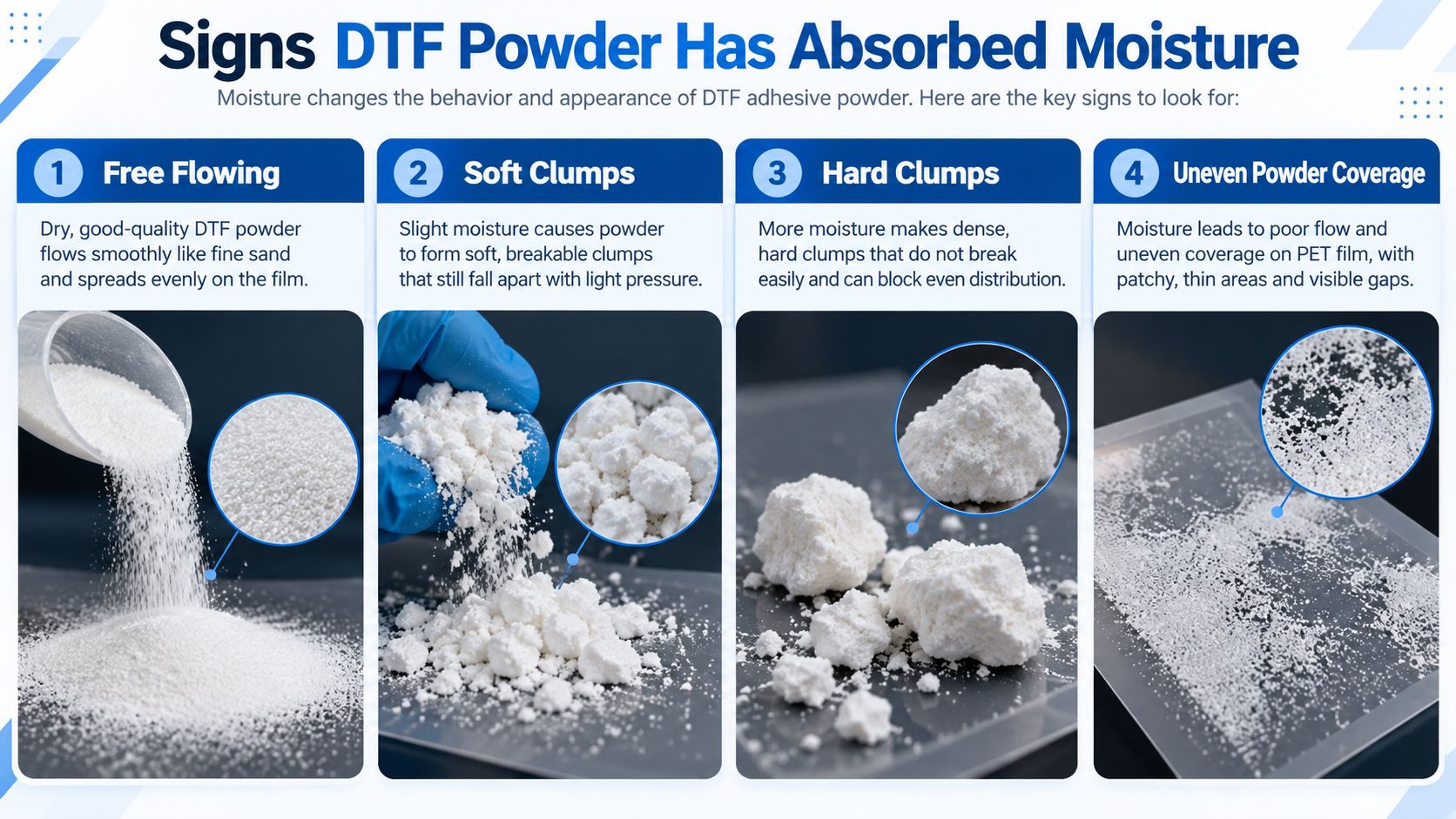
1. Soft Clumps Begin to Form
Early moisture exposure may create small, soft lumps.
They may:
- break apart under light pressure
- reduce powder flow
- distribute less evenly
Soft clumps do not automatically mean the entire container must be discarded.
But they should trigger a storage and production check.
2. Hard Clumps Appear
Hard, compacted lumps are more concerning.
The powder may:
- resist gentle breakup
- fall in chunks
- stop flowing evenly
- create inconsistent coating
Do not feed severely clumped powder directly into normal production without testing it first.
3. Powder No Longer Flows Freely
Fresh powder should normally move relatively freely when the container is gently tilted.
Moisture-affected powder may:
- bridge
- cake
- remain stuck together
- move in irregular chunks
A clear change in flow behavior is one of the easiest practical warning signs.
4. Powder Coverage Becomes Uneven
Clumps can make it difficult to create an even adhesive layer.
علائم احتمالی عبارتند از:
- thick powder areas
- thin areas
- bare spots
- irregular edges
- isolated chunks
However, uneven coverage can also result from:
- shaker settings
- manual powdering technique
- film condition
- wet ink coverage
- static electricity
Do not diagnose moisture from coverage alone.
5. Powder Looks or Feels Damp
If the powder has obvious moisture or its texture has changed significantly after exposure to a humid environment, stop and investigate before using it for production.
Avoid mixing questionable powder into fresh stock.
What Causes DTF Powder to Clump?
Clumping usually starts before the heat press stage.
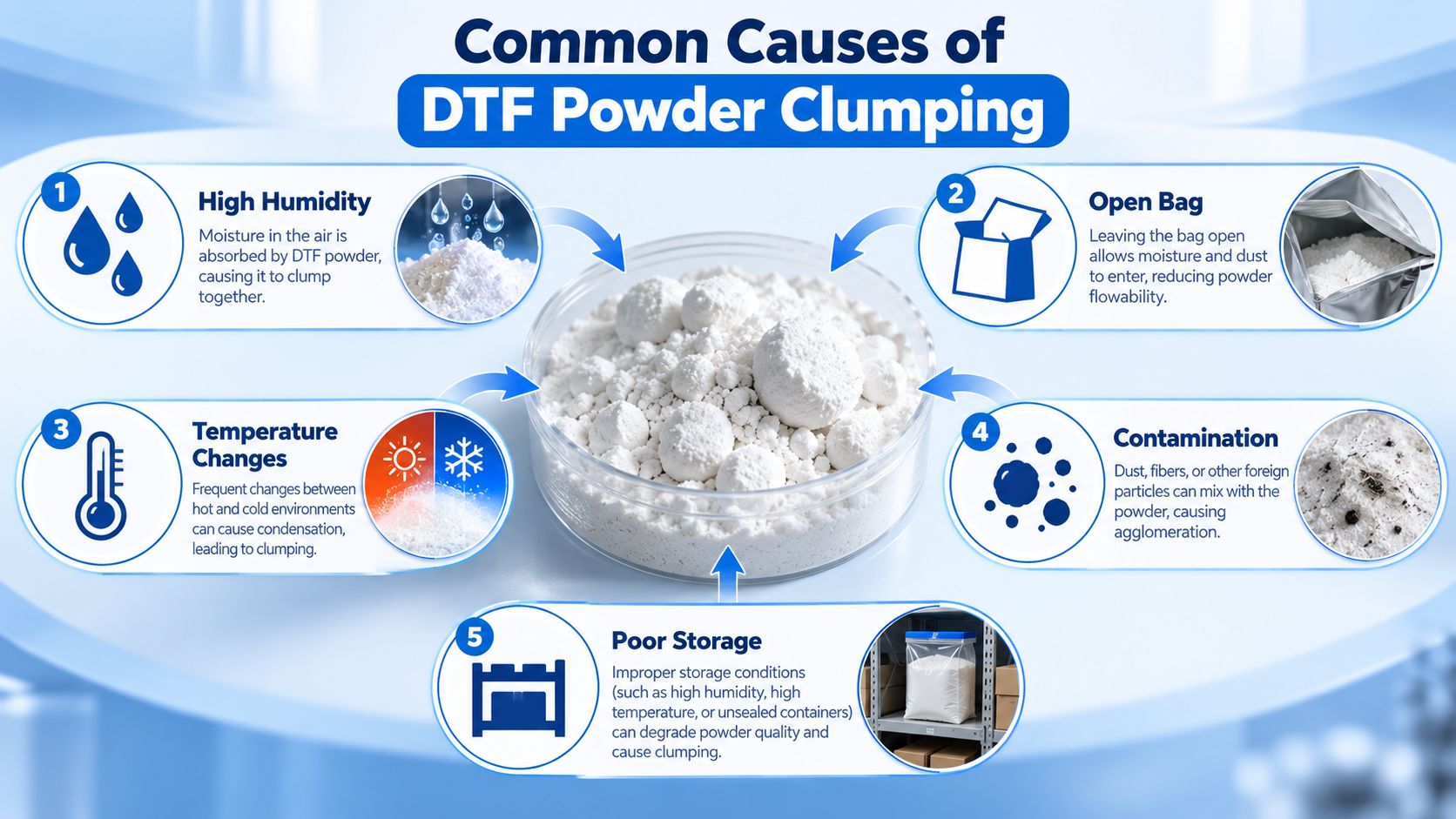
Cause 1: High Humidity
High relative humidity increases the chance that powder will be exposed to moisture.
اثرات احتمالی عبارتند از:
- soft clumping
- hard clumping
- reduced flowability
- inconsistent powder application
EraSmart DTF printers commonly specify a working environment around 40-60٪ RH, depending on model.
For the complete environmental guide, see:
How Temperature and Humidity Affect DTF Printing
Cause 2: Leaving the Bag Open
A powder bag left open for long periods is continuously exposed to ambient air.
Common situations include:
- bag left open for an entire shift
- powder tray left exposed overnight
- loose lid
- repeatedly opening the main storage container
A better production method is:
bulk storage → small working quantity → reseal bulk storage
Cause 3: Temperature Fluctuations
Temperature changes can also affect storage conditions.
به عنوان مثال:
cold storage → warm humid production room
can expose the powder and packaging to a sudden environmental change.
Stable storage is preferable to repeatedly moving powder between extreme conditions.
Cause 4: Contamination
Powder may become contaminated by:
- گرد و غبار
- الیاف
- dried ink
- partially processed powder
- dirty scoops
- dirty trays
- workshop debris
Use clean and completely dry tools whenever handling adhesive powder.
Cause 5: Poor Storage
Avoid storing powder:
- in open containers
- near water
- in damp rooms
- next to open windows
- beside heaters
- in direct sunlight
- directly on a damp floor
Storage conditions are part of production quality control.
Cause 6: Recycled Powder Contamination
Some automatic shaker systems recover unused powder.
Recovered powder may also collect:
- الیاف
- گرد و غبار
- partially processed particles
- environmental moisture
- other contaminants
Follow the powder shaker and consumable workflow rather than automatically returning every recovered particle to fresh stock.
Fresh DTF Powder vs Moisture-Damaged Powder
The difference is often easier to understand visually.
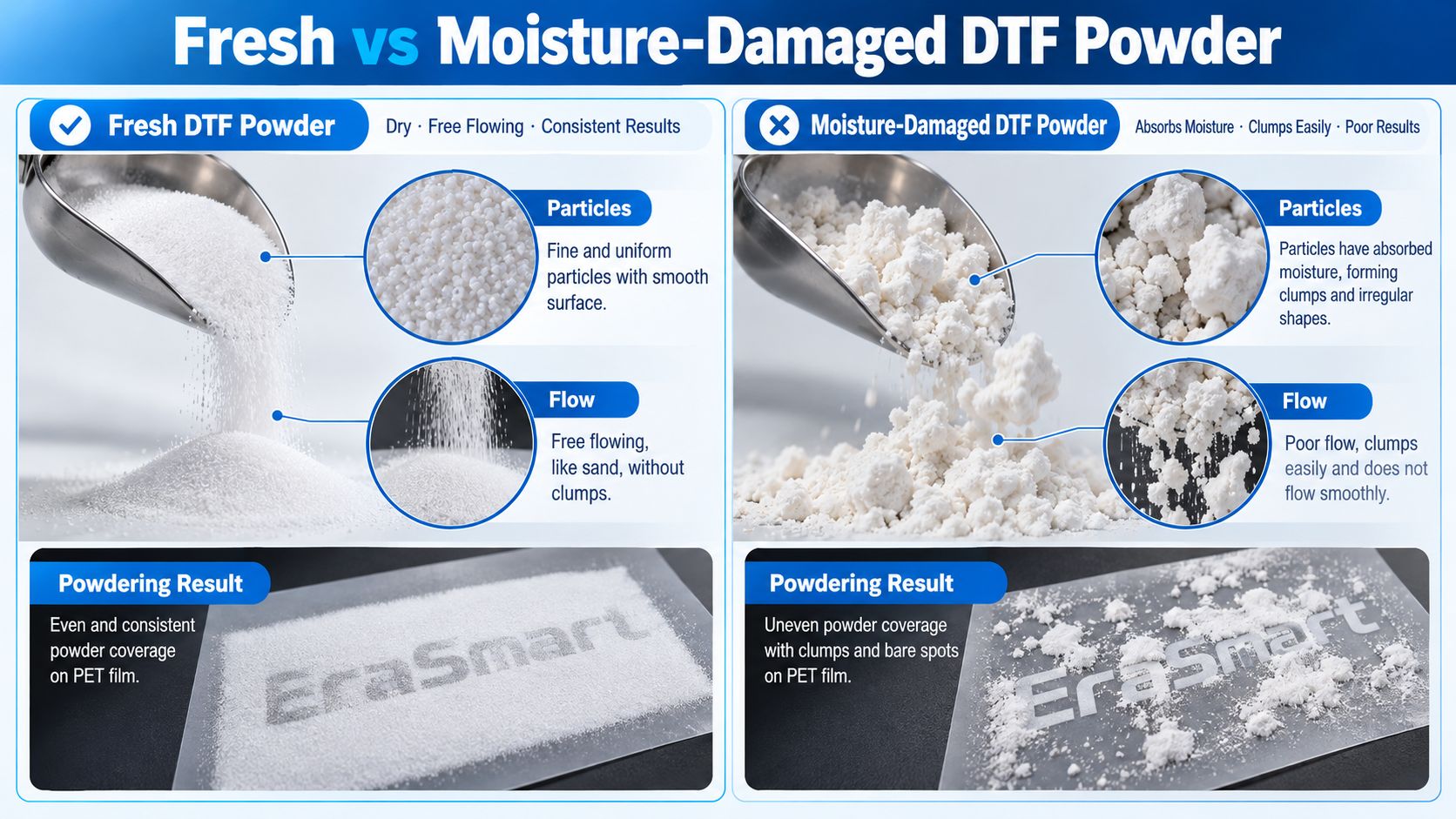
| Fresh / Stable Powder | Moisture-Affected Powder |
|---|---|
| Free-flowing | Clumped |
| Easier to distribute | Irregular flow |
| No obvious hard lumps | Soft or hard lumps |
| More predictable coating | Patchy application |
| Known storage condition | Possible moisture exposure |
Do not judge powder only by color.
Instead, look at:
- flow
- clumping
- آلودگی
- application behavior
- درمان
- transfer test results
Is Clumped DTF Powder Still Usable?
It depends on the severity and the cause.
There is no universal rule that:
All clumped powder must immediately be discarded.
But there is also no safe rule that:
Breaking up the clumps makes the powder as good as new.
Slight Soft Clumping
If you only see minor soft clumps:
- Check the storage condition.
- Check room humidity.
- Inspect for contamination.
- Follow the powder supplier’s handling instructions.
- Test the powder on scrap material.
- Inspect powder coverage and curing.
- Test the final transfer.
Do not move directly to full production.
Severe Hard Clumping
Persistent hard clumps are more concerning.
Questionable powder can potentially contribute to:
- uneven coating
- missing adhesive areas
- inconsistent melting
- transfer failure
- فیلم هدر رفته
- garment rework
For commercial orders, replacing questionable powder can be less expensive than repeating an entire batch.
Contaminated Powder
If the powder contains:
- الیاف
- dirt
- foreign particles
- ink contamination
- unknown debris
do not simply mix it with fresh powder.
Can You Dry Wet DTF Powder and Reuse It?
Do not assume that heating moisture-damaged DTF powder will restore it to its original production condition.
DTF powder is a formulated hot-melt adhesive consumable.
Uncontrolled heating may affect:
- particle behavior
- melting characteristics
- powder distribution
- آلودگی
- later curing
- transfer performance
Unless your specific powder supplier provides a validated reconditioning procedure, do not make:
“oven-dry the powder and reuse it”
a standard production process.
For clearly damp or severely clumped material, replacement is usually the safer production choice.
How Humidity Affects DTF Powder
Humidity can cause different problems at opposite extremes.
High Humidity
نتیجه احتمالی:
Moisture exposure → clumping → poor flow
Low Humidity
نتیجه احتمالی:
Dry air → static electricity → powder sticks where it should not
That distinction is important.
If powder appears outside the intended image area, the problem may not be excessive moisture at all.
It may be static.
For more detail, read:
How Temperature and Humidity Affect DTF Printing
How to Store DTF Powder Properly
Preventing clumping is easier than trying to recover damaged powder.
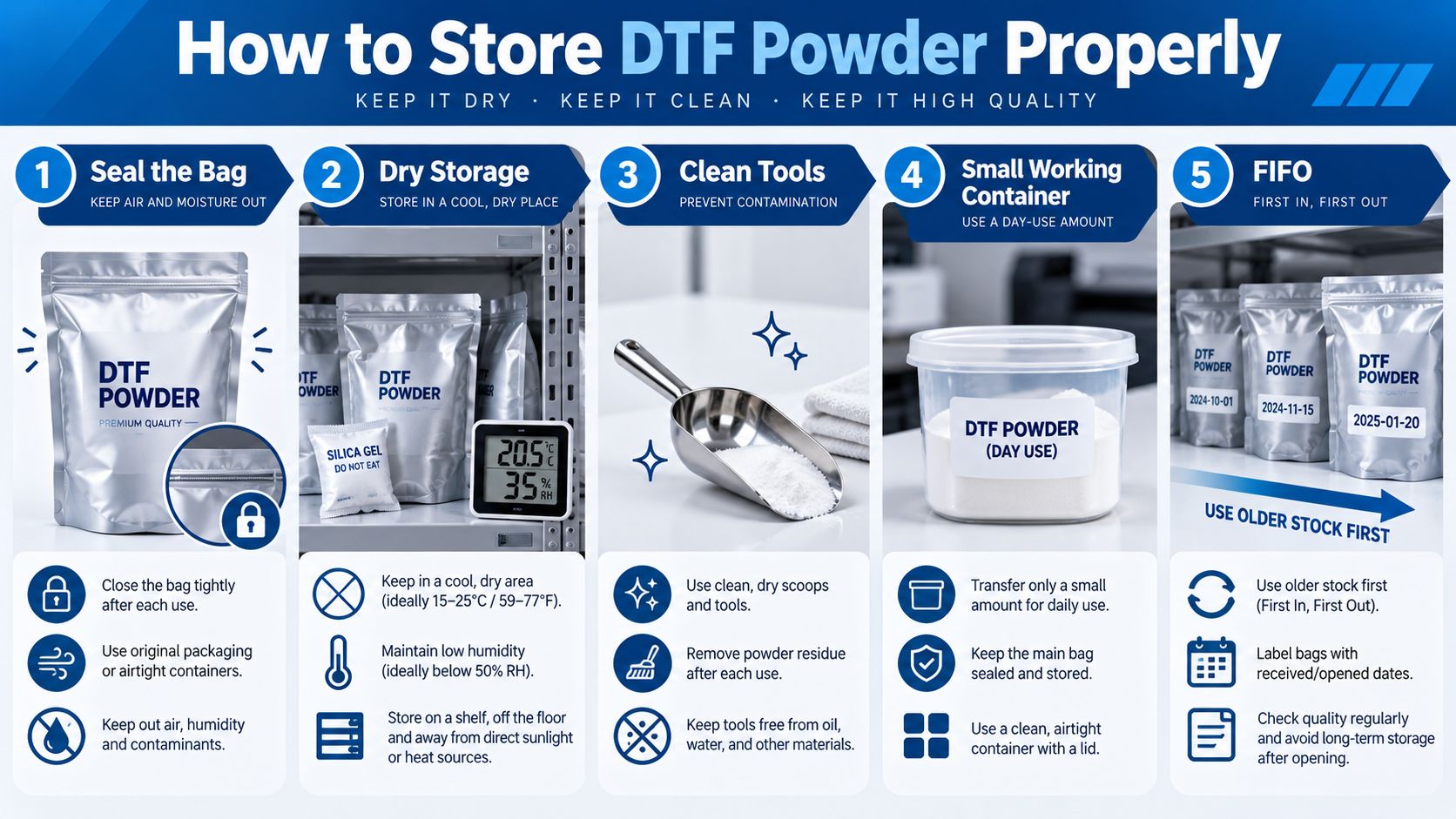
1. Reseal the Package After Use
Do not leave the main powder supply exposed throughout production.
After taking out the required amount:
reseal the package
2. Keep Powder in a Dry Storage Area
اجتناب کنید:
- damp storage rooms
- wet work areas
- high-humidity locations
- direct exposure to outdoor air during rainy weather
Always follow the storage requirements supplied with the actual DTF powder you are using.
3. Avoid Extreme Temperature Changes
Stable storage conditions are preferable to moving powder repeatedly between very cold and very hot areas.
4. Use Clean, Dry Tools
Scoops and working containers should be:
- تمیز کردن
- خشک
- عاری از روغن
- free from water
- free from fibers
Never return powder using a damp or dirty scoop.
5. Use a Small Working Container
A practical production workflow is:
Main sealed package → small daily-use container → powder station
This reduces how often the main stock is exposed.
6. Label Opened Stock
Useful information can include:
- batch number
- received date
- opened date
7. Use FIFO
First In, First Out
Use suitable older stock before opening newer stock.
This helps avoid forgotten powder remaining in storage for long periods.
Should You Use Desiccant Packs?
A sealed desiccant pack can be useful as an additional moisture-control measure in appropriate storage conditions.
But it should not replace:
- proper sealing
- room humidity control
- clean handling
Do not mix loose desiccant directly into the adhesive powder.
Fresh Powder vs Recovered Powder
Automatic powder systems can improve production efficiency, but recovered powder should be managed carefully.
Fresh Powder
مزایا عبارتند از:
- known storage history
- lower contamination risk
- predictable condition
Recovered Powder
May contain:
- الیاف
- گرد و غبار
- partially processed material
- environmental contamination
Do not automatically create an endless recycling loop.
Use the powder according to the recommended shaker and consumable workflow.
How Does Clumped Powder Affect the Final Transfer?
Powder clumping can affect how the adhesive is distributed over wet ink.
اثرات احتمالی عبارتند از:
- uneven coating
- excessive powder in some areas
- insufficient powder in others
- rough adhesive layer
- inconsistent melting
- reduced transfer consistency
However:
A weak transfer does not automatically mean the powder was clumped.
Also check:
- پوشش جوهر
- فیلم
- درمان
- تنظیمات پرس حرارتی
- فشار
- پارچه
- powder compatibility
DTF Powder Clumping vs Curing Problems
These problems occur at different stages.
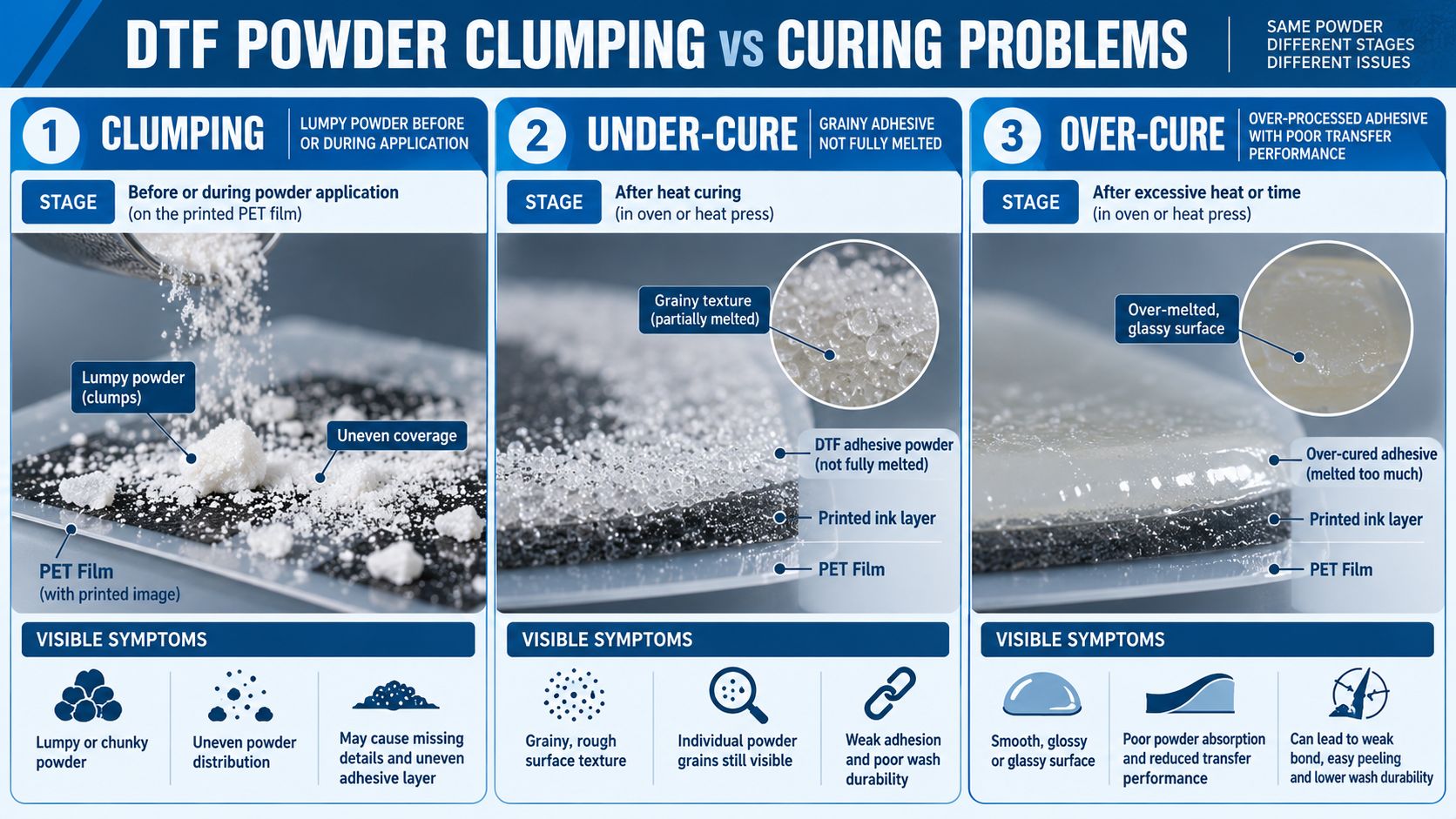
Powder Clumping
Occurs:
before or during powder application
Typical signs include:
- lumps in the container
- poor flow
- uneven powdering
علل احتمالی عبارتند از:
- رطوبت
- poor storage
- آلودگی
Under-Curing
Occurs:
after powder has already been applied
The adhesive has not melted sufficiently according to the required production workflow.
Possible signs include:
- clearly grainy adhesive
- visible powder particles
- incomplete melt
- weak bonding later
The correct curing settings depend on:
- پودر
- فیلم
- equipment
- سرعت تولید
Use the consumable and equipment specifications rather than copying one universal temperature.
Over-Curing
Over-curing occurs when the transfer receives more heat or time than required by the particular film and powder system.
Possible effects can include changes in:
- adhesive behavior
- film condition
- transfer performance
More heat is not automatically better.
The Key Difference
Clumping = powder condition/application problem
Under-curing / over-curing = heat-process problem
A perfectly dry powder can still be under-cured.
Why Does Powder Stick Outside the Printed Image?
علل احتمالی عبارتند از:
- static electricity
- low humidity
- film condition
- excessive powder
- fine powder behavior
- آلودگی
This is why:
background powder ≠ automatically wet powder
Check the complete environment and powdering workflow.
Why Is the Powder Layer Uneven?
علل احتمالی عبارتند از:
- clumped powder
- inconsistent manual powdering
- shaker adjustment
- static
- uneven ink coverage
- film condition
For an automatic shaker, also inspect:
- vibration
- recycling path
- film tracking
- powder movement
- آلودگی
Why Are There Bare Spots with No Powder?
Remember that DTF powder attaches to wet printed ink.
Bare spots may be caused by:
- insufficient wet ink
- مشکلات نازل
- poor powder distribution
- powder flow
- timing
Run a nozzle check and inspect the printed film before deciding the powder itself is defective.
Why Does Powder Remain Grainy After Heating?
This points more directly to curing.
بررسی کنید:
- دمای پخت
- زمان درمان
- heat distribution
- equipment setup
- powder/film combination
Use the validated parameters for your actual consumables.
Do not simply continue increasing heat until the surface looks different.
Why Does the DTF Transfer Peel After Pressing?
Several parts of the workflow may cause peeling:
- insufficient powder
- uneven adhesive coverage
- under-curing
- heat-press temperature
- فشار
- pressing time
- فیلم
- لباس
- روش لایه برداری
This is why DTF production should be treated as a complete system:
Ink + PET Film + Powder + Curing + Heat Press
rather than independent consumables.
For more information, see the راهنمای مواد مصرفی DTFبشر
DTF Powder Troubleshooting Chart
Use visible symptoms to decide what to investigate first.
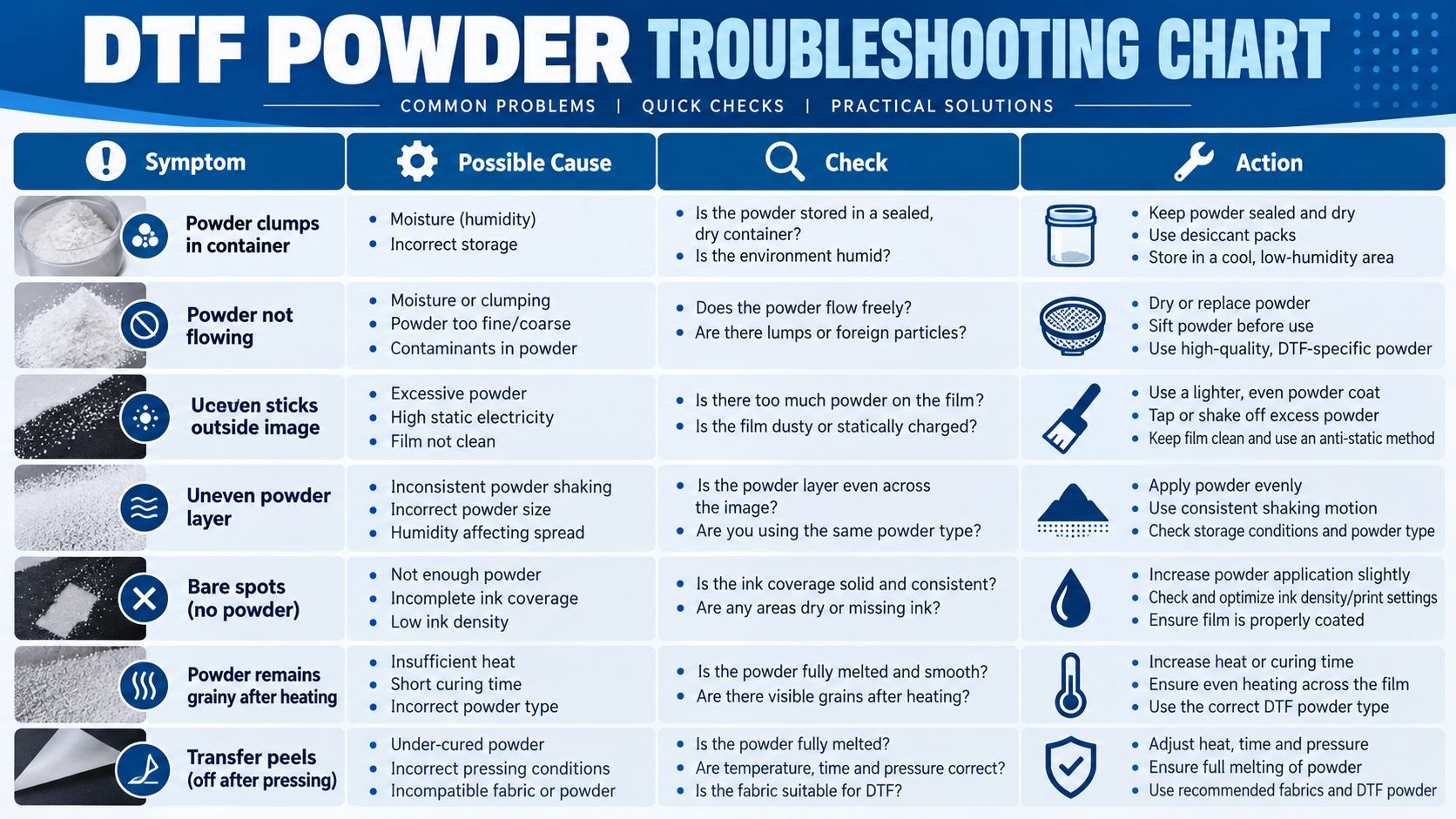
| علامت | علت احتمالی | ابتدا بررسی کنید | Direction |
|---|---|---|---|
| Powder clumps in container | Moisture / storage | Packaging + environment | Keep sealed and dry |
| Powder does not flow | Clumps / contamination | Powder condition | Isolate questionable stock |
| Powder outside artwork | Static / film / excess powder | RH + film | Reduce static and inspect process |
| Powder layer uneven | Clumps / shaker / application | Distribution | Stabilize powdering |
| Bare areas | Ink or powder coverage | Wet print | Check print before powder |
| Powder grainy after curing | Under-curing | Curing stage | Follow validated settings |
| Transfer peels | Multiple variables | Powder + cure + press | Test complete workflow |
Use this as:
a diagnostic starting point
not proof of one specific cause.
When Should You Replace DTF Powder?
Consider replacing powder when you see:
- obvious dampness
- persistent hard clumps
- severe contamination
- unknown storage history
- repeated poor flow
- repeated failed transfer tests
- major change from normal powder behavior
For commercial printing, consistency is usually more valuable than trying to save a small amount of questionable consumable.
A Better DTF Powder Handling Workflow
A simple standardized workflow is:
- Receive the powder.
- Record the batch.
- Keep bulk stock sealed.
- Move only a working quantity into a clean container.
- Keep tools clean and dry.
- Monitor room temperature and humidity.
- Keep recovered powder controlled.
- Seal the main stock after use.
- Record unusual powder behavior.
- Test questionable material before customer production.
This turns consumable handling into a repeatable production process.
Where Powder Fits in the Complete DTF Workflow
DTF production can be viewed as:
Artwork → Ink → PET Film → Powder → Curing → Heat Press → Garment
A failure in one stage can appear as a problem somewhere else.
به عنوان مثال:
Uneven Powder
The actual issue may be:
- clumped powder
- missing ink
- static
- shaker adjustment
Transfer Peeling
The actual issue may be:
- adhesive coverage
- درمان
- پرس حرارتی
- fabric compatibility
Avoid changing several variables at the same time.
Troubleshoot one stage at a time.
Final Answer: Why Is My DTF Powder Clumping?
DTF powder usually begins clumping after exposure to moisture or unsuitable storage, but contamination, repeated air exposure and handling conditions can also contribute.
به دنبال:
Normal Powder
- خشک
- free-flowing
- relatively uniform
- easy to distribute
Questionable Powder
- soft lumps
- hard lumps
- reduced flow
- آلودگی
- uneven application
The recommended response is:
Check Storage → Check Humidity → Inspect Powder → Isolate Questionable Stock → Test → Replace If Necessary
And remember:
Clumping is not the same as under-curing.
Clumping happens before or during powder application.
Curing problems happen after the powder is already applied to the printed film.
For overall environmental control:
How Temperature and Humidity Affect DTF Printing
For consumable matching:
For printer selection:
سوالات متداول
Why is my DTF powder clumping?
Moisture exposure is one of the first things to check. Also inspect storage, packaging, contamination, temperature changes and recovered-powder handling.
How do I know if DTF powder has absorbed moisture?
Possible signs include soft clumps, hard lumps, poor flow, changed texture and uneven powder distribution.
Can DTF powder absorb moisture?
DTF adhesive powder should be protected from excessive humidity and stored according to the supplier’s storage instructions.
Can I use clumped DTF powder?
Minor soft clumping should be investigated and tested before production. Severely damp, contaminated or hard-clumped powder should not be used directly for commercial orders.
Can I dry DTF powder in an oven?
Do not use uncontrolled heating as a universal recovery procedure. Only use a reconditioning method if it is specifically approved for the powder you are using.
Should DTF powder be stored in a sealed container?
Yes. After opening, reducing exposure to air and moisture helps maintain more stable storage conditions.
Can I use desiccant packs?
Contained desiccant may be useful as an additional moisture-control measure, but it does not replace correct storage. Do not mix loose desiccant with the powder.
Why does powder stick outside the print?
Static electricity, film condition, excessive powder and environmental conditions can all contribute. The powder is not necessarily wet.
Does low humidity affect DTF powder?
Low humidity can increase static electricity, which can affect powder and PET film behavior.
Does high humidity affect DTF powder?
High humidity increases moisture exposure and may contribute to clumping and poor powder flow.
Can DTF powder go bad?
Powder condition can deteriorate because of moisture, contamination or unsuitable storage. Follow the actual manufacturer’s shelf-life and storage requirements.
Why does powder stay grainy after heating?
That is more likely related to curing than to storage clumping. Check your powder, film and curing process.
Is clumped powder the same as under-cured powder?
خیر
Clumped powder: powder-condition problem before/during application.
Under-cured powder: heating problem after powder has been applied.
Can I reuse powder from a powder shaker?
Follow the powder-shaker and consumable supplier’s reuse procedure. Recovered powder should be checked for contamination and condition.
Should I mix questionable old powder with fresh powder?
No. Keep questionable powder isolated until you know whether it remains suitable for production.
Build a More Stable DTF Production Workflow
If you regularly experience:
- کلوخه شدن پودر
- uneven adhesive coverage
- background powder
- curing instability
- transfer peeling
- seasonal production changes
do not look at the powder alone.
Evaluate the entire process:
Environment + Ink + Film + Powder + Curing + Heat Press
Explore the چاپگر DTF EraSmart range and راهنمای مواد مصرفی DTF to build a more repeatable production workflow.
Keep it dry. Keep it clean. Test questionable powder. Protect the entire production batch.
ممکن است شما هم باشید

کپی رایت 2020 © Erasmart. | نقشه سایت