Fabricant d'imprimantes à jet d'encre à plat de petite taille

Poudre grossière ou poudre fine : quelle poudre DTF choisir ?
16 avril 2026 Blog
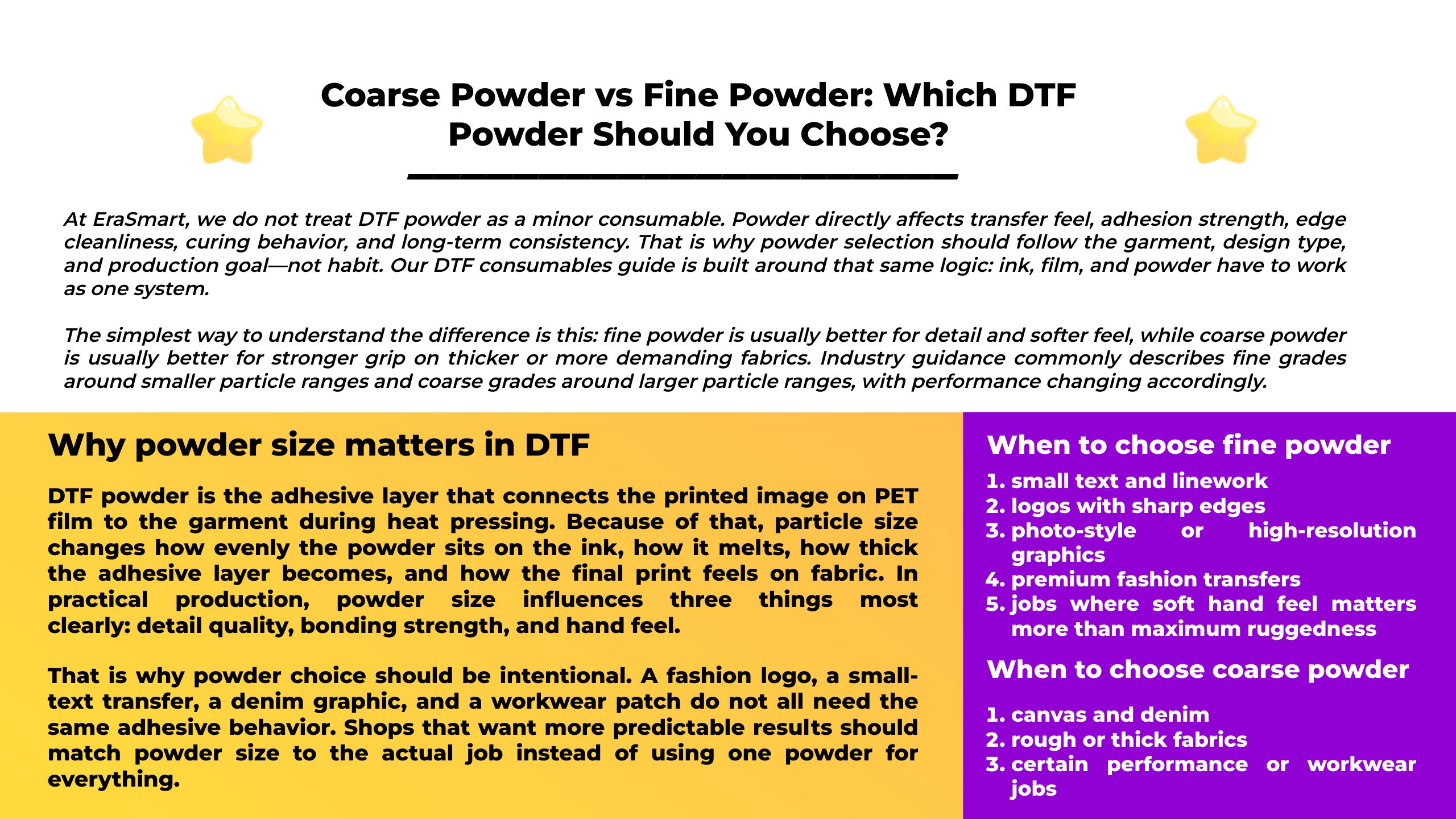
Chez EraSmart, nous ne considérons pas la poudre DTF comme un consommable mineur. La poudre affecte directement la sensation de transfert, la force d’adhérence, la propreté des bords, le comportement au durcissement et la consistance à long terme. C'est pourquoi la sélection de poudre doit suivre le vêtement, le type de conception et l'objectif de production, et non l'habitude. Notre Guide des consommables DTF est construit autour de la même logique : l’encre, le film et la poudre doivent fonctionner comme un seul système.
La façon la plus simple de comprendre la différence est la suivante : la poudre fine est généralement meilleure pour les détails et un toucher plus doux, tandis que la poudre grossière est généralement meilleure pour une meilleure adhérence sur les tissus plus épais ou plus exigeants. Les directives de l'industrie décrivent généralement des qualités fines autour de gammes de particules plus petites et des qualités grossières autour de gammes de particules plus larges, les performances évoluant en conséquence.
Lecture connexe : https://www.erasmart.com/how-to-choose-a-dtf-powder-shaker-and-dryer/
Pourquoi la taille de la poudre est importante dans le DTF
La poudre DTF est la couche adhésive qui relie l'image imprimée sur le film PET au vêtement lors du pressage à chaud. Pour cette raison, la taille des particules modifie la façon dont la poudre repose uniformément sur l'encre, la façon dont elle fond, l'épaisseur de la couche adhésive et la sensation de l'impression finale sur le tissu. Dans la production pratique, la taille de la poudre influence plus clairement trois choses : qualité des détails, force de liaison et sensation au toucher.
C'est pourquoi le choix de la poudre doit être intentionnel. Un logo de mode, un transfert en petit texte, un graphisme en denim et un patch sur un vêtement de travail n'ont pas tous besoin du même comportement adhésif. Les ateliers qui souhaitent des résultats plus prévisibles devraient adapter la taille de la poudre au travail réel au lieu d'utiliser une seule poudre pour tout.
Quelle poudre fine fait le mieux
La poudre fine est généralement le meilleur choix lorsque le design comprend petit texte, lignes fines, bords étroits, dégradés ou détails en gros plan. Étant donné que les particules sont plus petites, la poudre a tendance à recouvrir plus uniformément les zones imprimées complexes et à laisser une finition plus nette autour des formes détaillées. En production réelle, cela signifie souvent des logos plus nets, une couverture plus lisse et une apparence plus haut de gamme.
La poudre fine a également tendance à produire un sensation de main plus douce et plus lisse car la couche adhésive est généralement moins volumineuse après durcissement et transfert. Cela le rend particulièrement utile pour les graphiques de style commerce de détail, les applications de mode et les marques haut de gamme où l'apparence compte plus que la robustesse maximale.
Pour la plupart des utilisateurs d'EraSmart, la poudre fine est la plus logique lorsque la priorité est la qualité visuelle : une définition des bords plus nette, une meilleure présentation et un résultat plus doux sur les vêtements finis.
Quelle poudre grossière fait le mieux
La poudre grossière est généralement l'option la plus résistante lorsque le tissu est plus épais, plus rugueux, plus texturé ou plus exigeant dans l'utilisation quotidienne. Les particules plus grosses créent une couche adhésive plus importante, ce qui peut améliorer l'adhérence sur des matériaux plus résistants et aider les transferts à mieux tenir là où une adhérence plus forte est importante.
Cela fait de la poudre grossière un choix pratique pour des travaux tels que toile, denim, vêtements de travail, textiles plus lourds et certaines applications à forte usure où le raffinement ultime des carres est moins important qu’une tenue fiable. Les ateliers qui constatent des décollements ou une faible adhérence sur des tissus exigeants obtiennent souvent de meilleurs résultats en testant une poudre plus grossière plutôt que d'imposer une poudre axée sur les détails dans chaque flux de travail.
Le compromis est la sensation et la finition. La couche adhésive étant plus lourde, une poudre grossière peut laisser un transfert plus épais et moins raffiné autour de très petits éléments de conception.
Le véritable compromis : détail contre adhérence
La plupart des décisions de sélection de poudre se résument à un compromis pratique : la poudre fine favorise l'apparence et la précision, tandis que la poudre grossière favorise l'adhérence et la tolérance sur les substrats plus durs. Ni l’un ni l’autre n’est automatiquement meilleur. Chacun résout un problème de production différent.
C’est également la raison pour laquelle de nombreux magasins finissent par utiliser plus d’une stratégie de poudre au fil du temps. Si l’entreprise imprime des graphiques de mode, des vêtements d’équipe, des vêtements de travail et des vêtements promotionnels, il n’est peut-être pas logique de s’attendre à ce qu’une seule taille de particule soit aussi efficace dans chaque catégorie.
Quand choisir la poudre fine
Chez EraSmart, le bon moment pour choisir une poudre fine est lorsque la qualité d'impression doit être supérieure à courte distance. La poudre fine est généralement la meilleure solution pour :
petit texte et dessin au trait
logos aux bords nets
graphiques de style photo ou haute résolution
transferts de mode premium
travaux où la douceur du toucher compte plus que la robustesse maximale
La poudre fine est également utile lorsque l’objectif est de réduire les résidus visibles et de garder la surface de transfert propre. Les directives actuelles sur la poudre fine indiquent qu'elle a tendance à laisser une finition plus lisse, moins granuleuse et des zones sans image plus propres lorsqu'elle est manipulée correctement.
Quand choisir la poudre grossière
La poudre grossière devient le meilleur choix lorsque la surface du vêtement ou du tissu est plus exigeante. C’est généralement la meilleure solution pour :
toile et jean
tissus rugueux ou épais
certains travaux de performance ou de vêtements de travail
des graphiques plus grands où l'adhésion compte plus que les micro-détails
les transferts devraient subir davantage d'usure et d'abrasion
Si l'atelier continue de constater des soulèvements de bords, une adhérence faible ou une tenue peu fiable sur des matériaux plus résistants, la poudre grossière mérite souvent d'être testée avant de modifier l'ensemble du flux de travail. Il en va de même lorsque la conception n’est pas soucieuse des détails et que la priorité est simplement une fixation plus solide et plus durable.
Guérir compte toujours
Le choix de la poudre ne peut être séparé du durcissement. Un changement dans la taille de la poudre modifie la façon dont l'adhésif fond et le comportement du transfert final. La poudre fine réagit généralement plus rapidement à la chaleur, tandis que la poudre plus grossière a généralement besoin de suffisamment de chaleur et de temps pour fondre uniformément à travers la couche de particules plus épaisse. Les magasins qui changent de qualité de poudre devraient toujours retester les performances de durcissement, de sensation et de lavage au lieu de supposer que les réglages précédents seront toujours idéaux.
C’est également là qu’un flux de travail stable avec un agitateur et un séchoir à poudre devient important. À mesure que les ateliers passent du poudrage manuel à une production en plus grand volume, la cohérence du durcissement est plus importante, pas moins. C'est l'une des raisons pour lesquelles nos conseils pour les agitateurs de poudre se concentrent sur l'adaptation de la largeur, du débit et de la stabilité du chauffage au flux de travail DTF réel.
Notre recommandation pratique
Chez EraSmart, le plus simple pour choisir est de démarrer depuis l’application :
Utiliser poudre fine lorsque la commande est sensible aux détails, à la marque ou à la mode.
Utiliser poudre grossière lorsque la commande est sensible au tissu, axée sur la durabilité ou construite autour de matériaux plus résistants.
Utilisez un flux de travail quotidien équilibré lorsque l'atelier gère des tâches mixtes et souhaite d'abord une configuration générale.
Cette décision devient beaucoup plus facile lorsque l'ensemble du flux de travail est correctement adapté : de l'imprimante au film en passant par la poudre, l'agitateur et le séchoir. Notre Catégorie DTF, le guide des consommables et les ressources sur les shakers sont conçus pour aider les acheteurs à construire ce système complet au lieu de choisir des pièces isolément.
Conclusion
La poudre grossière contre la poudre fine n’est pas un concours de qualité. Il s’agit d’une décision qui correspond au processus. La poudre fine est généralement le meilleur outil pour précision, finition plus lisse et sensation de main plus douce. La poudre grossière est généralement le meilleur outil pour adhérence plus forte, tissus plus résistants et travaux à usure plus élevée. Le meilleur résultat de production consiste à adapter la poudre au vêtement et au flux de travail au lieu de forcer une seule poudre à gérer chaque application.
Peut-être que tu as aussi

Imprimante EraSmart
imprimante uv
imprimante DTF
Imprimante DTG
Presse à chaud
Imprimeur publicitaire
Outils d'impression
four DTF
Presse à chaud
Machine à découper
Tasse transfert de chaleur
Machine de laminage
Consommables
Encre à imprimer
Cas de téléphone portable
Produit en verre
Liquide nettoyant
Coton-tige
Contactez-nous
WhatsApp: +8618566233796
WeChat: +8618566233796
Mobile: +8618566233796
Web :www.erasmart.com
Boutique:www.erasmartmall.com
Copyright 2020 © Erasmart. | Plan du site
WhatsApp nous
Besoin du prix d’une imprimante ?
Faites-nous part de vos besoins en impression. Notre équipe vous répondra dans les 24 heures.
Demander un devis
Fournissez simplement quelques détails et nous vous aiderons à obtenir des citations rapides!