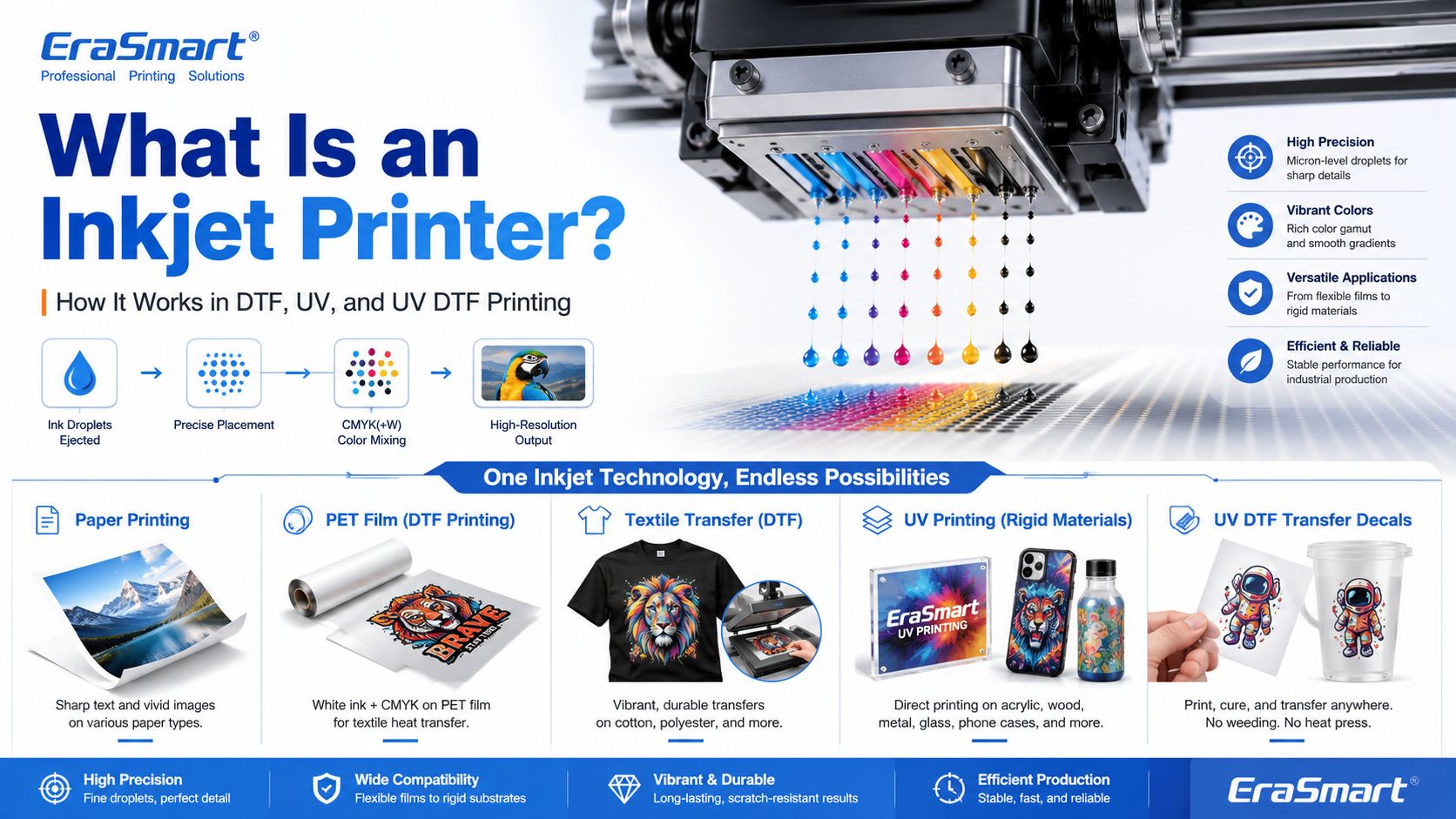
An inkjet printer is a digital printing device that creates images by ejecting tiny droplets of ink onto a surface. Instead of using plates, screens, or physical stencils, an inkjet printer receives digital image data and places controlled ink droplets in precise positions to form text, graphics, photos, labels, transfers, or product decoration.
Most people first know inkjet printers from office or home photo printing. But inkjet technology is much broader than desktop paper printing. Today, inkjet systems are used in DTF printing, UV flatbed printing, UV DTF transfers, packaging samples, product labels, signage, promotional products, textile decoration, industrial marking, and custom product manufacturing.
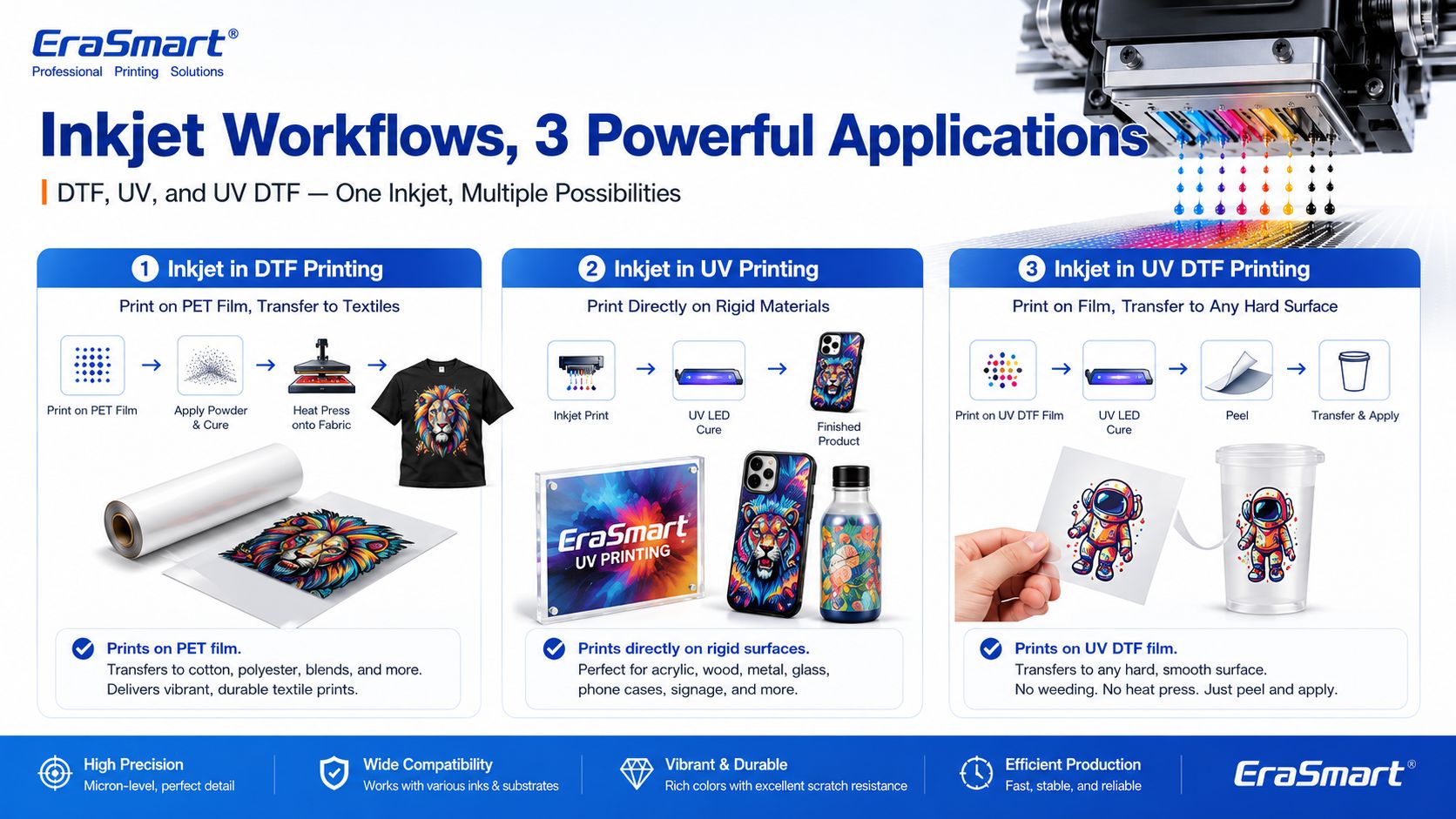
For EraSmart customers, this topic matters because many modern custom printing machines are built on inkjet principles. A Printer DTF uses inkjet technology to print garment designs onto transfer film. A pencetak UV uses inkjet technology to print UV-curable ink directly onto rigid materials. A Printer UV DTF uses inkjet printing to create hard-surface decals and transfers on A/B film.
In simple terms, inkjet printing is the foundation. DTF, UV, and UV DTF are specialized business workflows built around that foundation.
An inkjet printer is a printer that sprays or ejects tiny droplets of liquid ink through microscopic nozzles to create a printed image.
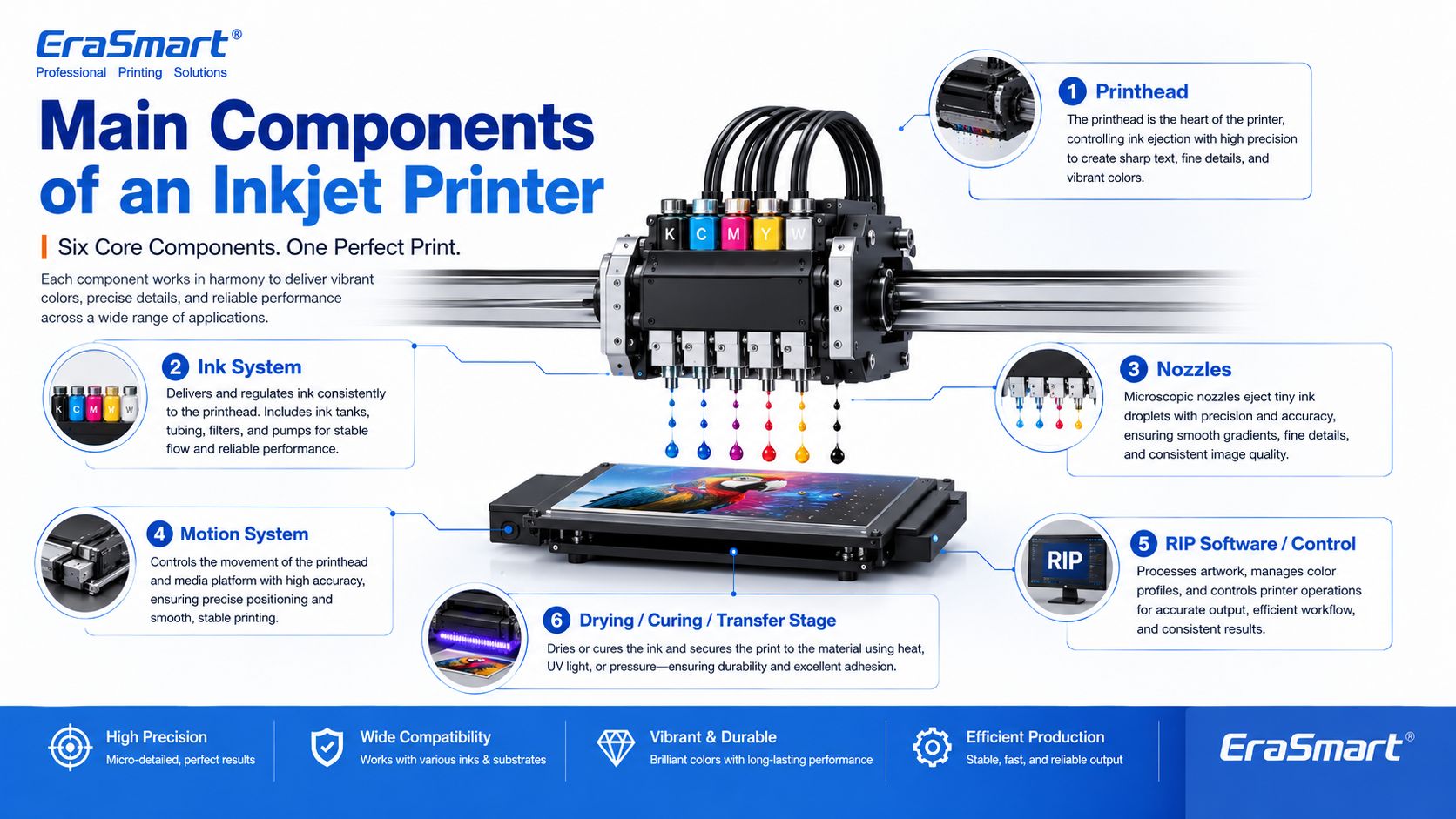
A basic inkjet printing system includes:
The printhead is the key component. It controls where ink droplets land, how much ink is ejected, and how accurately the image is formed.

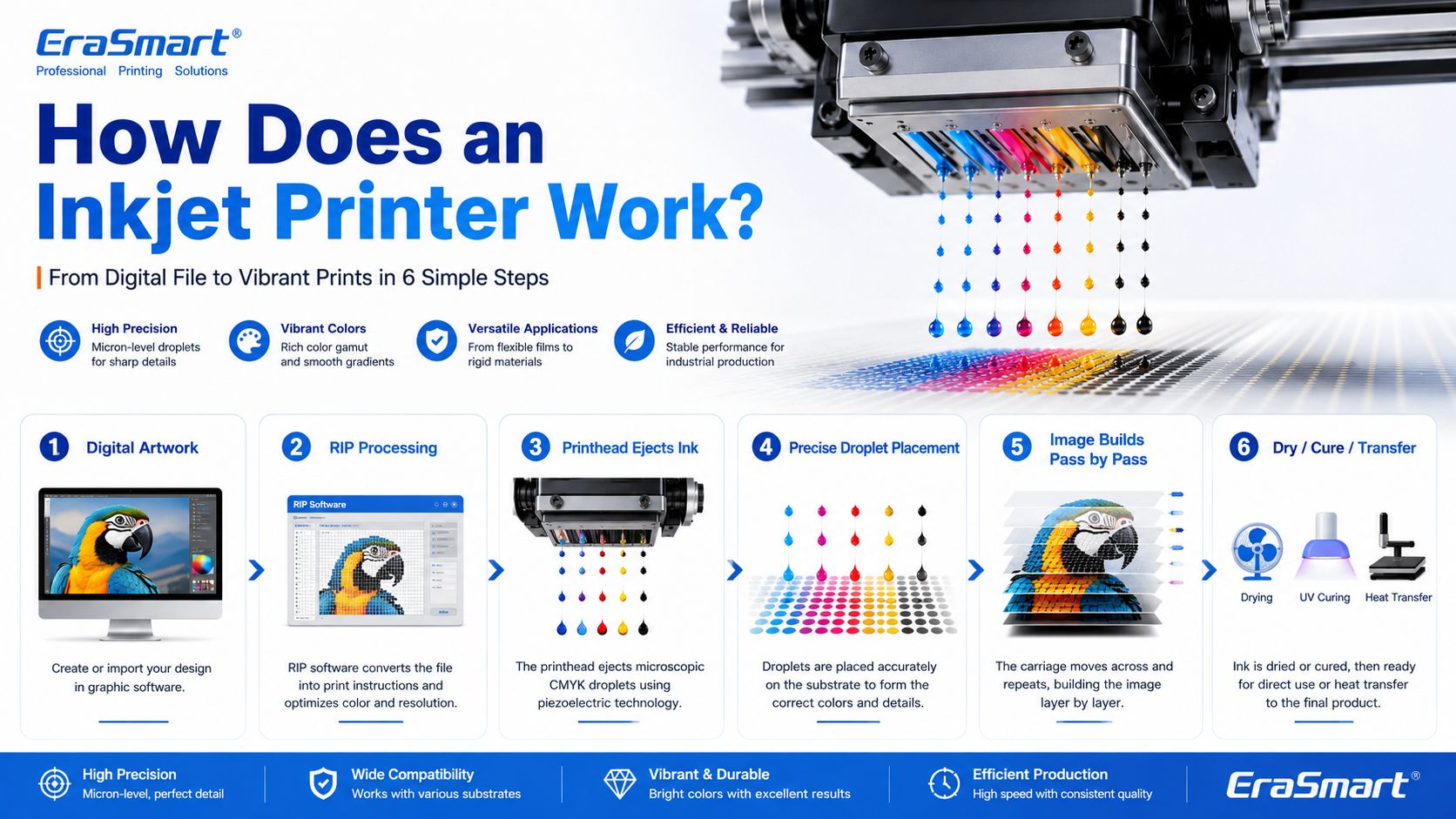
Inkjet printing may look simple from the outside, but inside the printer there is a precise digital control process.
A simplified workflow looks like this:
In an office inkjet printer, ink is usually printed onto paper and dries or absorbs into the paper surface. In an industrial or custom printing system, the process may be more specialized. For example, UV ink is cured by UV light, while DTF ink is printed onto PET film and later heat transferred onto fabric.

The printhead is the most important part of an inkjet printer. It contains many tiny nozzles that eject ink droplets. The printhead determines much of the printer’s resolution, droplet control, speed, and print quality.
In custom printing, printhead condition directly affects:
This is why printer maintenance is so important in DTF and UV printing. If the printhead nozzles are clogged or unstable, the final print may show banding, missing lines, weak colors, or poor detail.
For apparel printing users, EraSmart’s Panduan Perawatan Printer DTF is a useful resource for understanding why nozzle checks, cleaning, white ink circulation, and daily care matter.
The ink system stores and delivers ink to the printhead. Different inkjet printers use different types of ink depending on the application.
Common ink types include:
For EraSmart customers, the most relevant ink systems are DTF ink, UV ink, white ink, and varnish.
A Printer DTF commonly uses CMYK ink plus white ink. The white ink helps designs appear clearly on dark garments. A pencetak UV may use CMYK, white ink, and varnish to print on hard surfaces such as acrylic, glass, metal, wood, plastic, leather, and packaging materials.
If you want to understand how CMYK, white ink, and varnish work together in product customization, see EraSmart’s UV Ink Guide: CMYK, White Ink, and Varnish.
Nozzles are microscopic openings in the printhead. They eject ink droplets in controlled patterns.
Nozzle performance affects:
Nozzles can become clogged if ink dries, settles, or becomes contaminated. This is especially important for white ink systems because white ink contains heavier pigment particles and needs proper circulation and maintenance.
Inkjet printers need accurate motion control. Either the printhead moves across the material, the material moves under the printhead, or both are coordinated.
The motion system affects:
In UV flatbed printing, the platform and printhead movement must be stable so the image lands accurately on rigid objects. In DTF printing, film feeding must be smooth so the transfer image remains consistent.
RIP software converts artwork into printer-ready instructions. It controls color output, resolution, ink layering, white ink channels, varnish layers, print passes, and other production settings.
For custom printing businesses, RIP setup is important because it affects:
A good printer is only part of the system. Correct artwork preparation and RIP settings are also necessary for professional results.

Inkjet printing is not finished when ink leaves the nozzle. The ink must also become stable on the final product.
Different workflows use different finishing methods:
| Inkjet Workflow | What Happens After Printing |
|---|---|
| Office inkjet | Ink dries or absorbs into paper |
| Pencetakan DTF | Powder is applied, cured, then heat pressed onto fabric |
| Pencetakan UV | UV light cures the ink almost instantly |
| Pencetakan UV-DTF | UV ink is printed on film, laminated, then applied as a transfer |
| Sublimasi | Printed transfer is heat pressed into polyester or coated blanks |
This is why inkjet technology can support many industries. The core droplet technology is similar, but the finishing process changes based on the product.

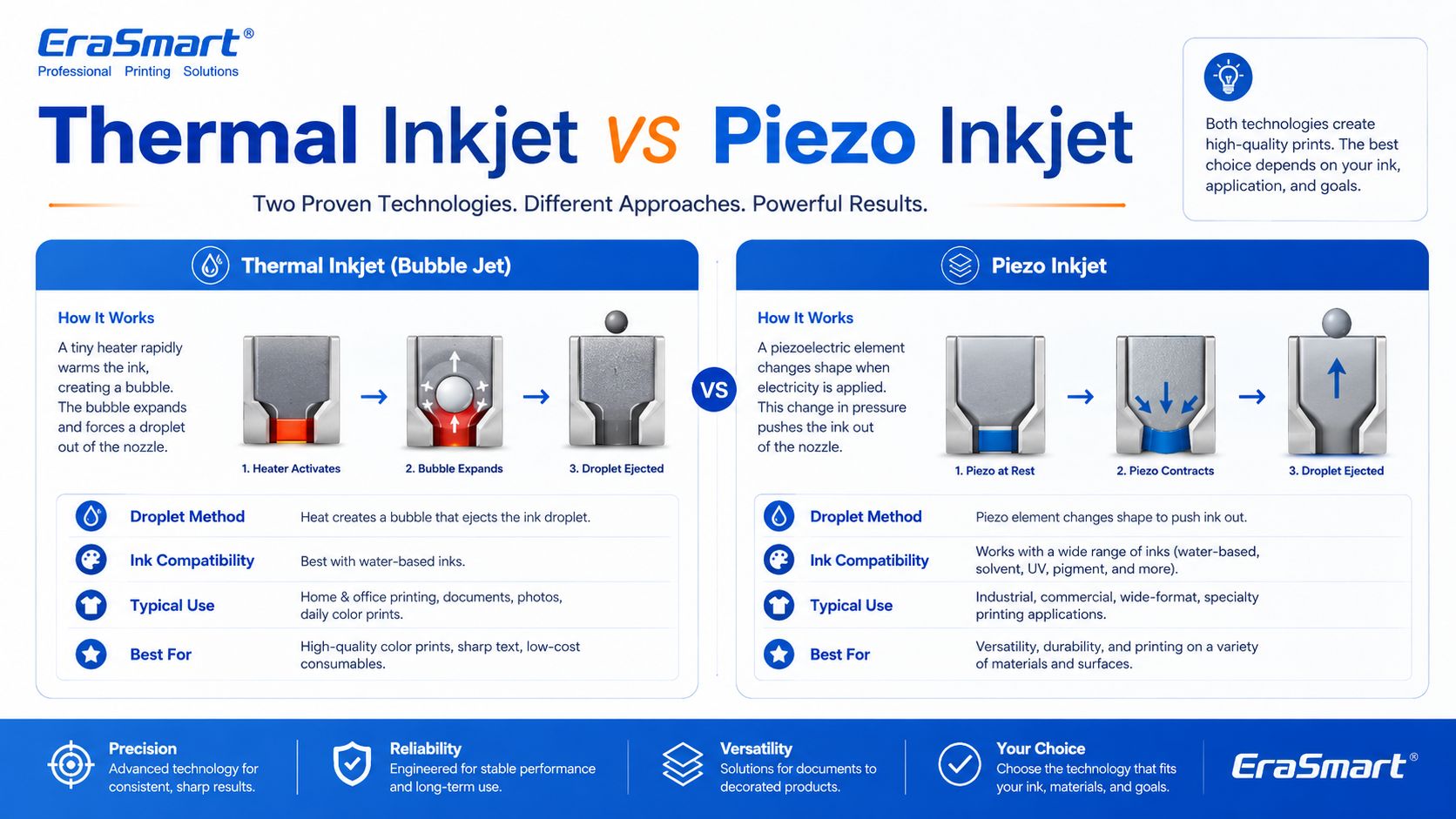
There are two major inkjet technologies: thermal inkjet and piezo inkjet.
Thermal inkjet uses heat to create a vapor bubble inside the ink chamber. The pressure from this bubble pushes a droplet of ink out of the nozzle.
Thermal inkjet is common in many desktop and office printers. It can produce high-quality prints on paper, but the ink must be compatible with heat-based ejection.
Piezo inkjet uses a piezoelectric element that changes shape when voltage is applied. This mechanical movement creates pressure and ejects ink droplets through the nozzle.
Piezo inkjet is widely used in many professional and industrial printing systems because it can work with a broader range of inks. Since the ink is not heated for ejection, piezo technology is suitable for inks that may not perform well in thermal systems, including many specialty inks used in industrial and custom printing.
For DTF, UV, and UV DTF applications, piezo-style inkjet technology is especially important because these workflows require precise ink control and compatibility with specialized ink types.
Inkjet printing can also be divided by how ink is delivered.
Drop-on-demand means ink droplets are ejected only when needed. This is common in many graphic and custom printing applications because it offers precise control and efficient ink use.
DTF, UV, and UV DTF printers generally operate around controlled digital droplet placement, which is why they can reproduce detailed designs and full-color artwork.
Continuous inkjet ejects a continuous stream of ink droplets. Some droplets are directed to the surface, while others may be recycled. This method is often used in industrial coding and marking, such as printing dates, batch codes, and product identification on packaging lines.
For EraSmart customers, drop-on-demand inkjet is the more relevant concept because custom apparel and product printing require accurate image reproduction rather than simple coding.
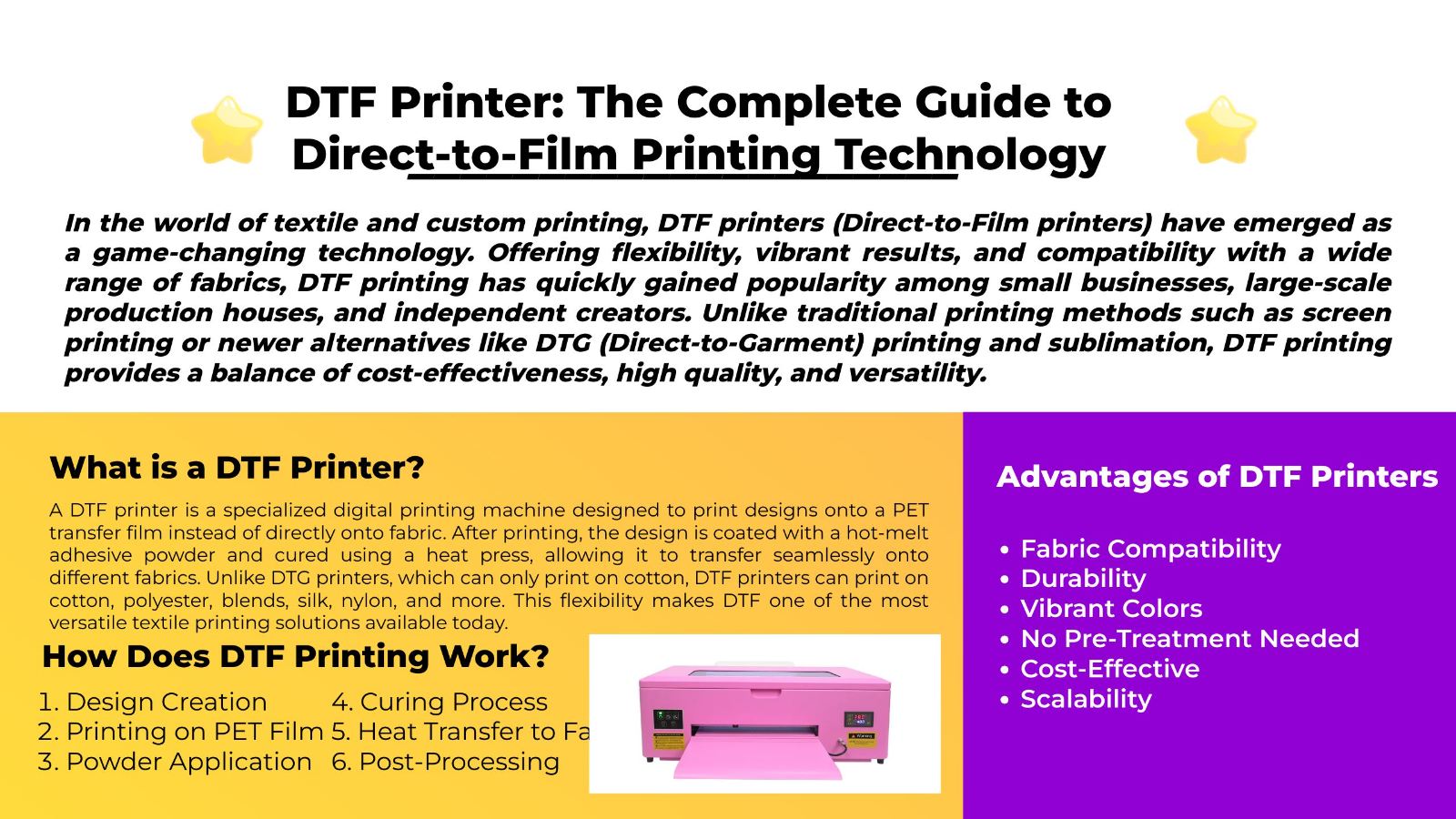
A DTF printer is a specialized inkjet printer for garment transfer production. Instead of printing directly onto a shirt, it prints the design onto PET transfer film.
The typical DTF process includes:
This process is useful for custom apparel because it supports:
If you are interested in building an apparel business, EraSmart’s Printer DTF category includes different models for startups, small studios, growing shops, and higher-volume production. You can also read the Alur Kerja Produksi DTF to understand the full process from artwork to finished garment.
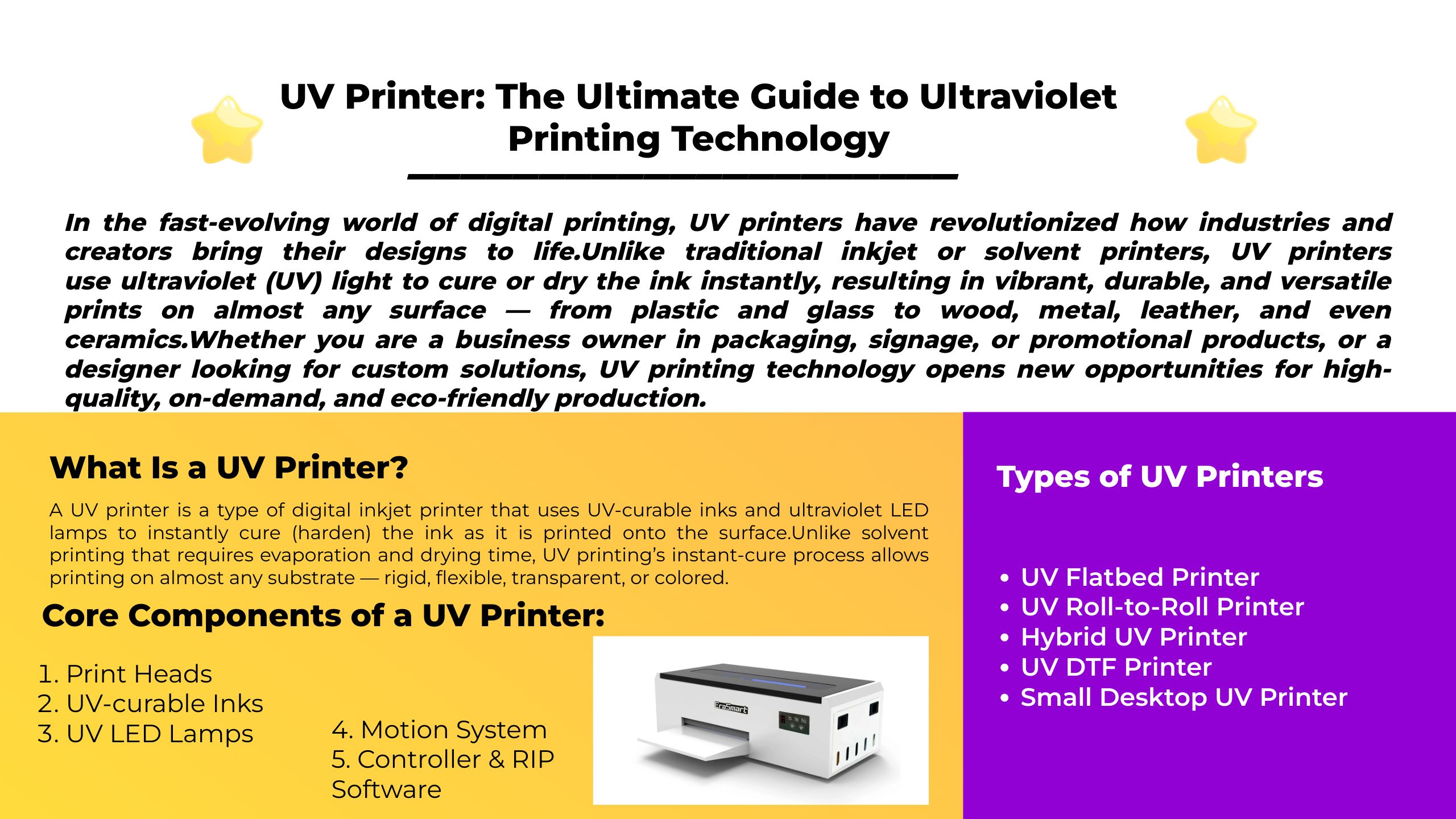
A UV printer is another specialized inkjet system. Instead of using standard paper ink, it uses UV-curable ink. The printer ejects ink onto the material surface, and UV light cures the ink almost immediately.
UV printing is suitable for many hard and semi-rigid materials, such as:
The advantage of UV printing is direct-to-object customization. You can print full-color designs, white ink layers, and varnish effects on many product surfaces.
EraSmart Printer UV category is designed for businesses that want to create custom gifts, signs, phone cases, packaging samples, acrylic products, and hard-surface promotional items. For material selection, see the Panduan Bahan Printer UV.
UV DTF printing combines UV inkjet printing with a transfer workflow. The printer prints UV ink onto A film, laminates it with B film, and creates a transfer decal that can be applied to hard surfaces.
UV DTF is useful for:
Unlike textile DTF, UV DTF is mainly for hard-surface transfers, not garments. It is a good choice for businesses that want to sell premium stickers, decals, labels, and cup wraps.
EraSmart Printer UV DTF is suitable for hard-surface transfer applications, while the A/B Film for UV DTF Printing guide explains how the film system works in the transfer process.
Inkjet printing is important because it allows digital, flexible, short-run production. Unlike traditional methods that require screens, plates, or molds, inkjet printing can print directly from a digital file.
This creates major advantages for custom businesses:
For example, a DTF apparel business can print different names, numbers, and graphics without preparing new screens. A UV printing business can print different logos on phone cases, acrylic signs, glass gifts, or packaging samples. A UV DTF business can produce custom decals and labels for many small brands.
This is why inkjet technology is no longer only about office printing. It is now a core technology for modern customization businesses.
Inkjet printing works directly from digital files. This makes it easy to change designs, personalize products, and produce short runs.
Inkjet printers can reproduce complex color images, gradients, photos, and illustrations. This is useful for apparel graphics, product decoration, stickers, and packaging samples.
Inkjet does not require plates or screens, so it is suitable for low-MOQ custom orders and on-demand production.
Each print can be different. This is useful for names, numbers, QR codes, serialized labels, personalized gifts, and custom designs.
Inkjet technology can be adapted to many surfaces and workflows, including paper, textiles, film, rigid materials, packaging, labels, and transfers.
A business can start with small orders and upgrade equipment as demand grows. This is why inkjet-based DTF, UV, and UV DTF systems are attractive to startups and growing shops.
Inkjet printers need regular maintenance. If nozzles clog, print quality declines. This is especially important for white ink, UV ink, and other specialty ink systems.
Not every ink works with every printhead or material. Ink viscosity, pigment size, curing method, and surface compatibility all matter.
Some surfaces need cleaning, primer, coating, or testing before printing. This is especially common in UV printing on glass, metal, plastic, and other hard materials.
Screen colors and printed colors are not always identical. Professional results require color profiles, test prints, correct RIP settings, and stable consumables.
Higher resolution, more passes, white ink layers, and varnish effects may improve quality but increase printing time.
In DTF printing, powdering, curing, and heat pressing affect durability. In UV DTF, lamination and application affect transfer quality. In UV printing, curing and adhesion affect final product quality.
This is one of the most common inkjet problems. It can be caused by dried ink, settled pigment, poor maintenance, incompatible ink, or long idle time.
Banding appears as unwanted horizontal or vertical lines. It can be caused by clogged nozzles, incorrect feed settings, poor calibration, or unstable ink flow.
Colors may look different from the screen because of material surface, ink type, printer profile, white ink layer, or lighting conditions.
In UV printing, poor adhesion can happen if the surface is oily, dusty, incompatible, or not treated correctly.
In DTF and UV printing, white ink must be managed carefully. Weak white ink can reduce color brightness, opacity, and dark-surface performance.
If ink is not dried, cured, or transferred correctly, the final product may smear, peel, crack, or lose durability.

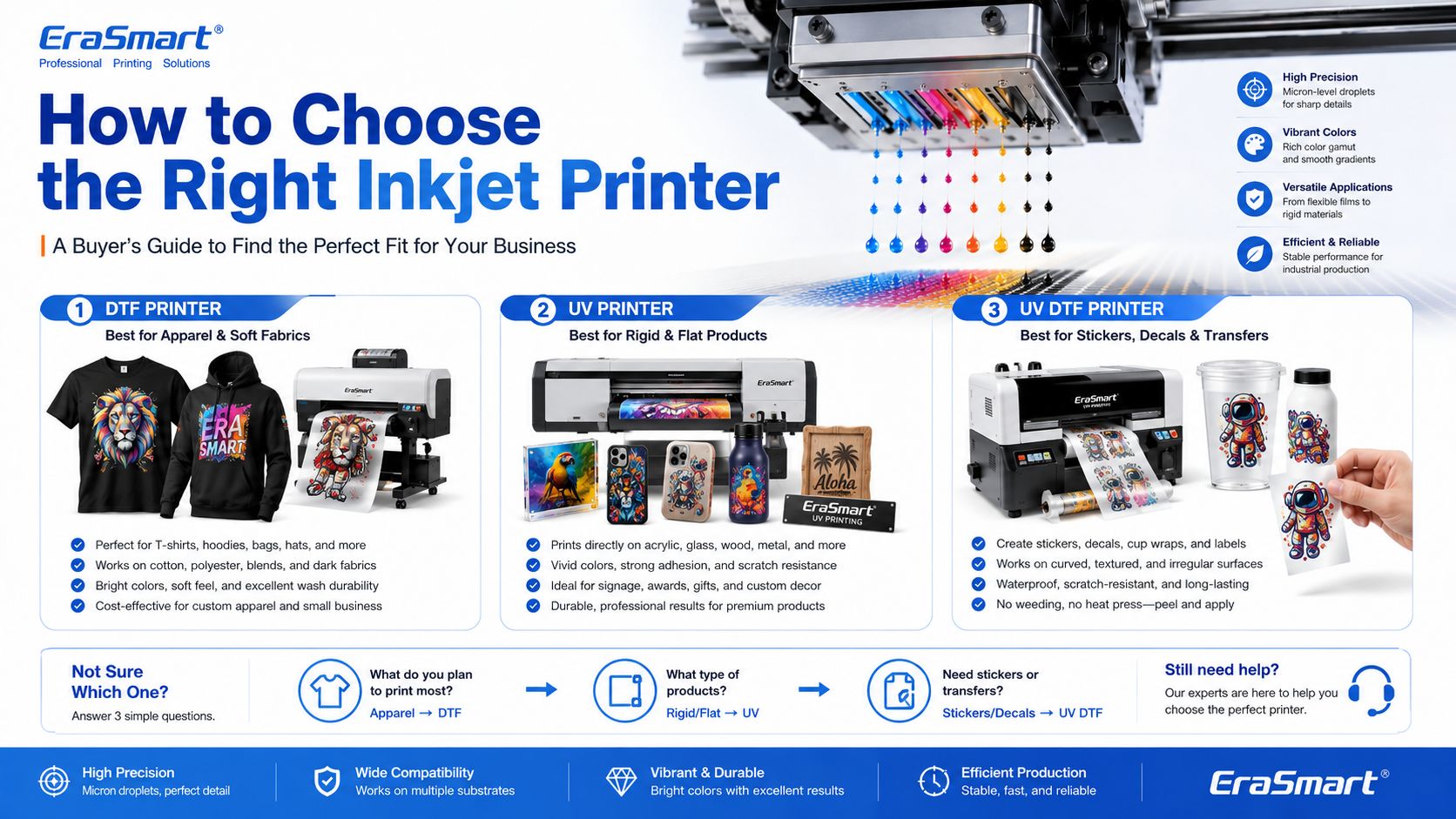
The right inkjet printer depends on what you want to sell.
Pilih A Printer DTF if your business focuses on:
For machine selection, read EraSmart’s Cara Memilih Printer DTF Dan Daftar Periksa Pembelian Printer DTF.
• Kustomisasi batch kecil
• Pengujian desain
• Beban masuk yang rendah
Jika tujuan Anda adalah memulai dari yang kecil, menguji alur kerja, dan menangani penyesuaian pribadi atau penggunaan komersial ringan, pilihan paling praktis adalah pengaturan ringkas dengan biaya terjangkau dan pengoperasian sehari-hari yang sederhana.
Mesin jenis ini cocok untuk kreator, pembeli pertama kali, dan studio pribadi yang membutuhkan titik masuk yang andal tanpa terlalu dini beralih ke peralatan produksi A3 atau A1 yang lebih besar.
• Pesanan khusus lokal
• Pakaian dalam jumlah kecil
• Alur kerja yang ramah startup
Jika Anda sudah memiliki ide bisnis, menerima pesanan khusus lokal, atau menjalankan studio kecil yang memerlukan lebih banyak fleksibilitas daripada mesin entry-level A4, berpindah ke jajaran A3 biasanya menciptakan alur kerja komersial yang lebih praktis.
Model ini lebih cocok untuk merek startup, operator studio, dan toko tahap awal yang menginginkan jangkauan output yang lebih kuat tanpa berpindah langsung ke peralatan industri dengan output lebih tinggi.
• Grafis yang kaya desain
• Penurunan baru yang sering terjadi
• Presentasi visual premium
Ketika bisnis Anda bergantung pada perubahan desain yang sering terjadi, karya seni yang kaya warna, gambar yang detail, dan pengujian produk online yang lebih cepat, masuk akal untuk memilih model yang menawarkan presentasi gambar yang lebih kuat dan fleksibilitas komersial yang lebih lancar.
Grup ini sangat cocok untuk penjual online, merek yang dipimpin oleh desainer, tim kreatif, dan toko di mana presentasi visual dan peluncuran desain baru merupakan inti dari model bisnisnya.
• Pesanan harian
• Ritme produksi yang lebih baik
• Output komersial lebih stabil
Ketika bisnis Anda melampaui pesanan sesekali dan mulai bergantung pada output harian yang lebih stabil, memilih mesin yang mendukung alur kerja yang lebih lancar, konsistensi yang lebih kuat, dan ritme produksi yang lebih baik menjadi lebih penting.
Pada level ini biasanya pembeli harus berhenti hanya memikirkan harga masuk dan mulai berpikir lebih serius mengenai stabilitas output, efisiensi alur kerja, dan kepraktisan pengoperasian jangka panjang.
• Alur kerja lebih cepat
• Menurunkan beban manual
• Kontinuitas produksi yang lebih baik
Jika bisnis Anda bergerak melampaui produksi manual dasar dan menginginkan proses yang lebih lancar dan siap produksi, masuk akal untuk mempertimbangkan model yang mendukung integrasi alur kerja yang lebih kuat dan ekspektasi hasil yang lebih tinggi.
Arahan ini sangat relevan bagi toko-toko yang sudah memiliki pesanan tetap dan ingin mengurangi hambatan produksi, meningkatkan kemampuan pengulangan, dan mempersiapkan volume operasi harian yang lebih besar.
• Sasaran keluaran yang lebih tinggi
• Lebar pencetakan lebih lebar
• Irama produksi industri
Ketika bisnis Anda membutuhkan lebar cetak yang lebih lebar, batas keluaran yang lebih kuat, dan arah produksi industri yang lebih serius, seri A1 menjadi kategori yang tepat untuk dievaluasi. Tingkat ini lebih cocok untuk bisnis di mana kontinuitas keluaran dan biaya interupsi yang lebih rendah merupakan prioritas operasional yang penting.
Pilih tingkat kepala cetak berdasarkan seberapa agresif target produksi Anda dan seberapa besar nilai yang Anda berikan pada produktivitas yang lebih kuat.
Pilih A pencetak UV if your business focuses on:
For material planning, read EraSmart’s Panduan Bahan Printer UV Dan How to Choose a UV Printer.
Cocok untuk produk kustom format kecil, sampel, hadiah ringkas, dan pengguna yang ingin memulai pencetakan UV dengan tapak yang lebih kecil.
Pilihan praktis untuk casing ponsel, aksesori, produk akrilik kecil, hadiah pribadi, dan produksi usaha kecil.
Pilihan yang lebih tepat bagi pengguna yang membutuhkan platform yang lebih besar, cakupan produk yang lebih luas, dan produksi skala kecil yang lebih fleksibel.
Cocok untuk papan tanda, panel, papan khusus, dan tim produksi yang lebih besar yang membutuhkan area pencetakan lebih luas dan skalabilitas yang lebih kuat.
Dirancang untuk kustomisasi casing ponsel dan produksi produk yang dipersonalisasi secara cepat dengan jalur aplikasi yang lebih fokus.
Lebih baik untuk stiker UV DTF, label kristal, pembungkus cangkir, botol, dan stiker transfer permukaan keras.
Pilih A Printer UV DTF if your business focuses on:
To understand the film workflow, read EraSmart’s A/B Film for UV DTF Printing.
Inkjet printing is not one single business model. It is a technology foundation. The right machine depends on your target products.
A simple buying direction looks like this:
| Tujuan Bisnis | Recommended EraSmart Direction |
|---|---|
| Custom T-shirts, hoodies, apparel | Printer DTF |
| Acrylic, glass, metal, wood, phone cases | Printer UV |
| Stickers, cup wraps, labels, decals | Printer UV DTF |
| Apparel startup | A4 / A3 DTF Printer |
| Growing apparel shop | A3 MAX DTF / shaker workflow |
| Custom product studio | A4 / A3 UV Printer |
| Hard-surface transfer business | A3 UV DTF Printer |
If your business is apparel-first, start with EraSmart’s Printer DTF lineup. If your business is hard-product customization, compare the Printer UV range. If your business is stickers, decals, labels, and cup wraps, start with the Printer UV DTF.
An inkjet printer is a digital printer that creates images by ejecting tiny ink droplets through microscopic nozzles onto a surface.
In basic office printing, that surface is usually paper. In custom printing, the surface may be PET film, transfer film, acrylic, glass, metal, wood, plastic, packaging board, fabric, or product blanks.
The most important point is this: inkjet printing is not only for documents and photos. It is the core technology behind many modern custom printing systems, including DTF printers, UV printers, and UV DTF printers.
For small businesses, inkjet technology makes it possible to print full-color designs, personalize products, produce short runs, reduce setup cost, and build flexible custom printing workflows.
Need help choosing the right inkjet-based printing system for your business? Share your target products, material type, print size, expected daily order volume, and budget range with EraSmart.
Our team can help you choose the right Printer DTF, pencetak UV, atau Printer UV DTF for your custom printing business.
printer UV
Printer DTF
Printer DTG
Mesin Press Panas
Printer iklan
Oven dtf
Pers panas
Mesin ukiran
Transfer panas mug
Mesin laminasi
Tinta cetak
Kasing ponsel
Produk kaca
Cairan pembersih
Kapas
Whatsapp : +8618566233796
WeChat : +8618566233796
Mobile : +8618566233796
Web :www.erasmart.com
Toko:www.erasmartmall.com
WhatsApp kami
Cukup berikan beberapa detail dan kami akan membantu Anda mendapatkan kutipan cepat!