작은 크기의 플랫 베드 잉크젯 프린터 제조업체

86-18566233796 [email protected]

블로그 UV Printing vs DTF Printing vs UV DTF Printing: Which Printer Should You Buy?

UV Printing vs DTF Printing vs UV DTF Printing: Which Printer Should You Buy?

May 24, 2026 블로그

UV printing, textile DTF printing, and UV DTF printing are often mentioned together, but they are not the same workflow. Each technology is designed for different materials, products, production steps, and business models. Choosing the wrong one can lead to poor product fit, wasted consumables, slow production, or a machine that does not match your real customer orders.

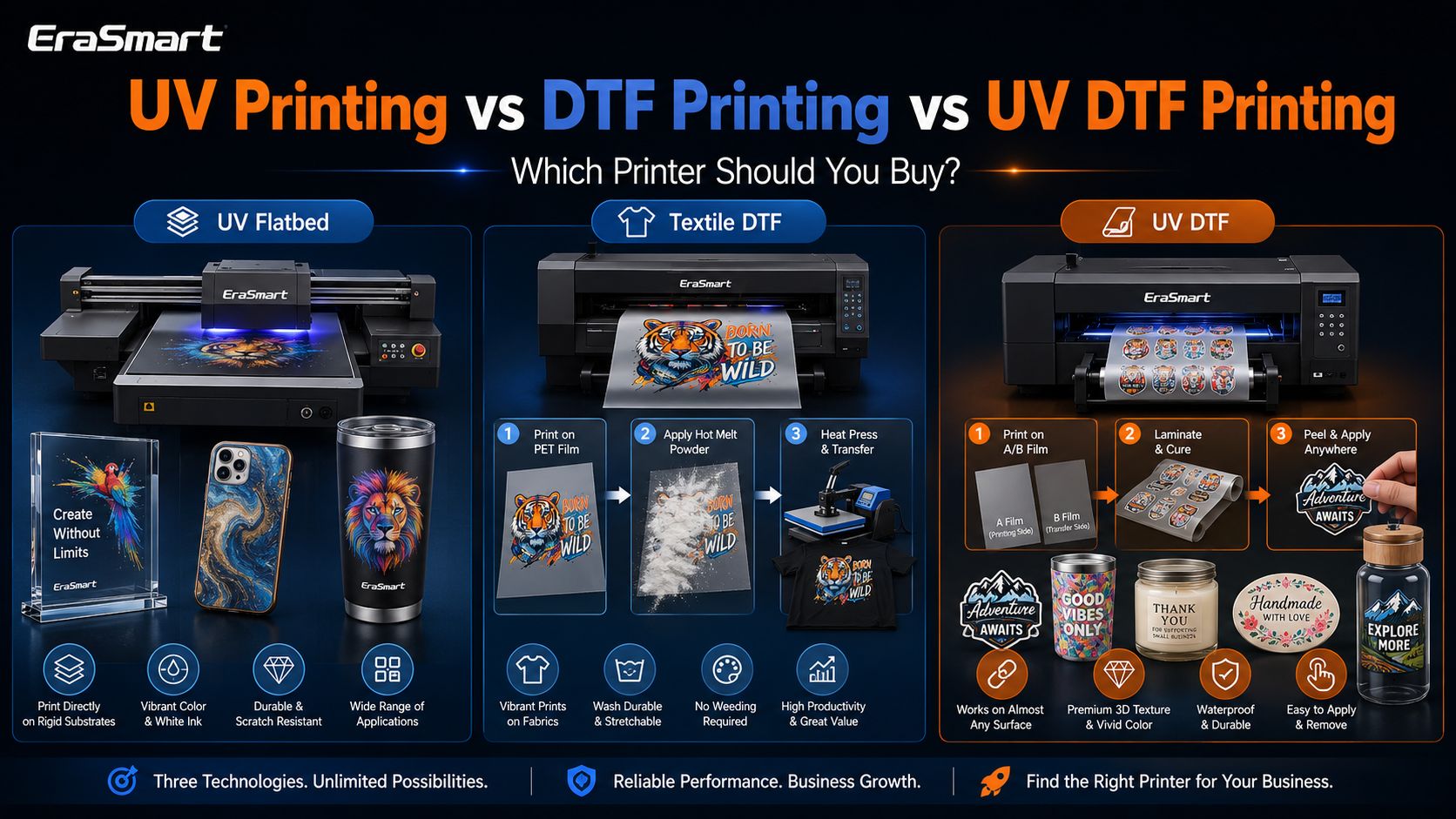
For EraSmart customers, the easiest way to understand the difference is this: UV flatbed printing is for direct printing on rigid products, textile DTF is for garments and fabric transfers, and UV DTF is for hard-surface decals, stickers, cup wraps, labels, and small custom goods. EraSmart’s own guide center separates these three workflows because each one serves a different production direction: DTF for apparel, UV flatbed for rigid and specialty materials, and UV DTF for hard-surface transfer applications.

Quick Answer: Which One Should You Choose?

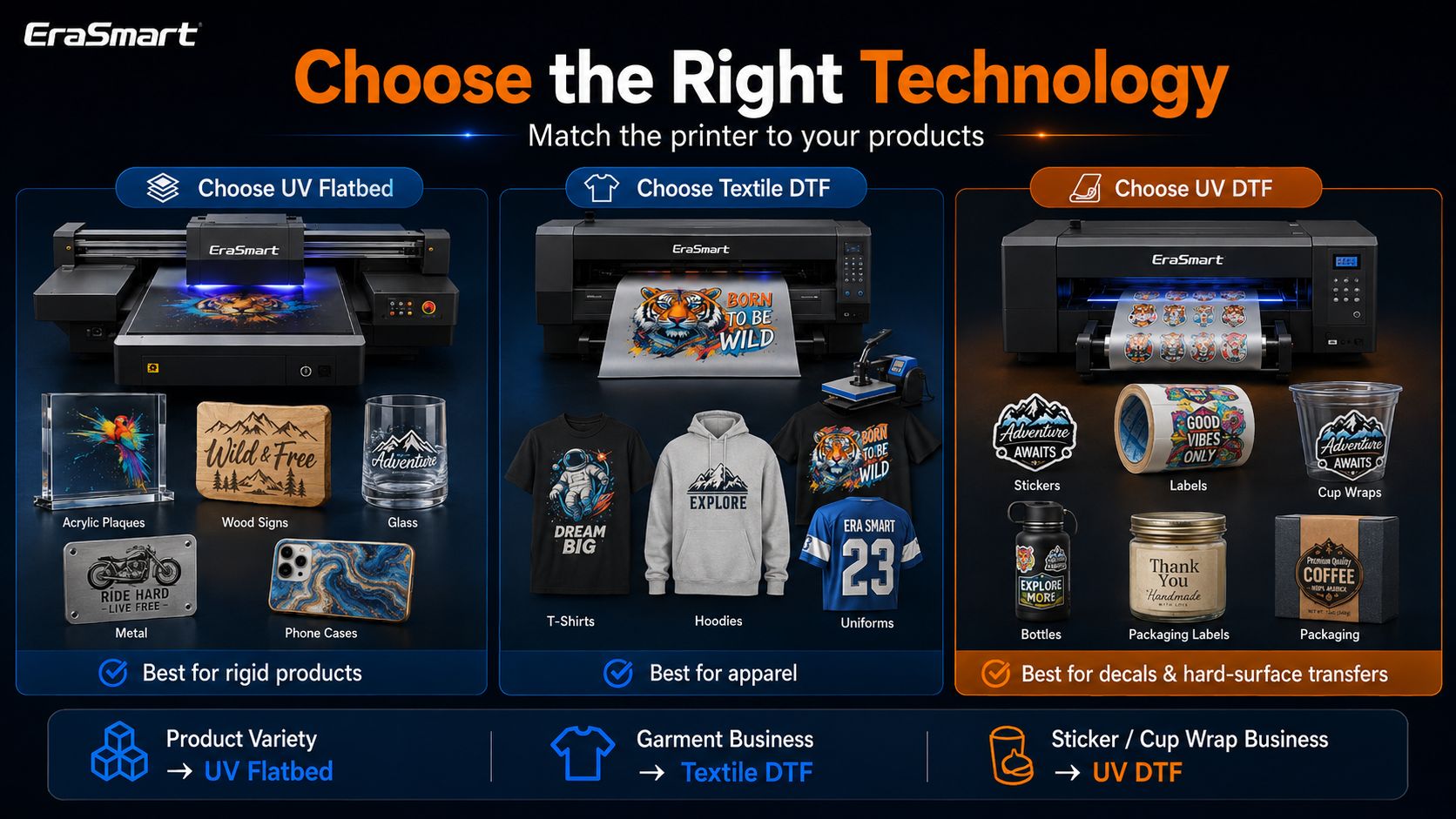
사업목표Best Technology
T-shirts, hoodies, uniforms, sportswear, cotton/polyester/blendsTextile DTF Printing
Acrylic, wood, glass, metal, phone cases, signs, packaging samplesUV Flatbed Printing
Stickers, labels, cup wraps, gadget skins, cosmetic packaging, hard-surface decalsUV DTF 인쇄
Direct printing onto flat or slightly raised rigid productsUV Flatbed Printing
Transfer printing onto garmentsTextile DTF Printing
Cold-transfer decals for hard productsUV DTF 인쇄
Premium gloss, spot varnish, raised label-style effectsUV DTF or UV Flatbed Printing
Apparel-focused startupTextile DTF Printing
Gift and product customization startupUV DTF or UV Flatbed Printing

The most important point is that UV DTF is not the same as textile DTF. UV DTF is mainly for hard-surface transfers, while textile DTF is the standard choice for garments such as T-shirts, hoodies, uniforms, and mixed-fabric apparel.

UV 인쇄란 무엇입니까?

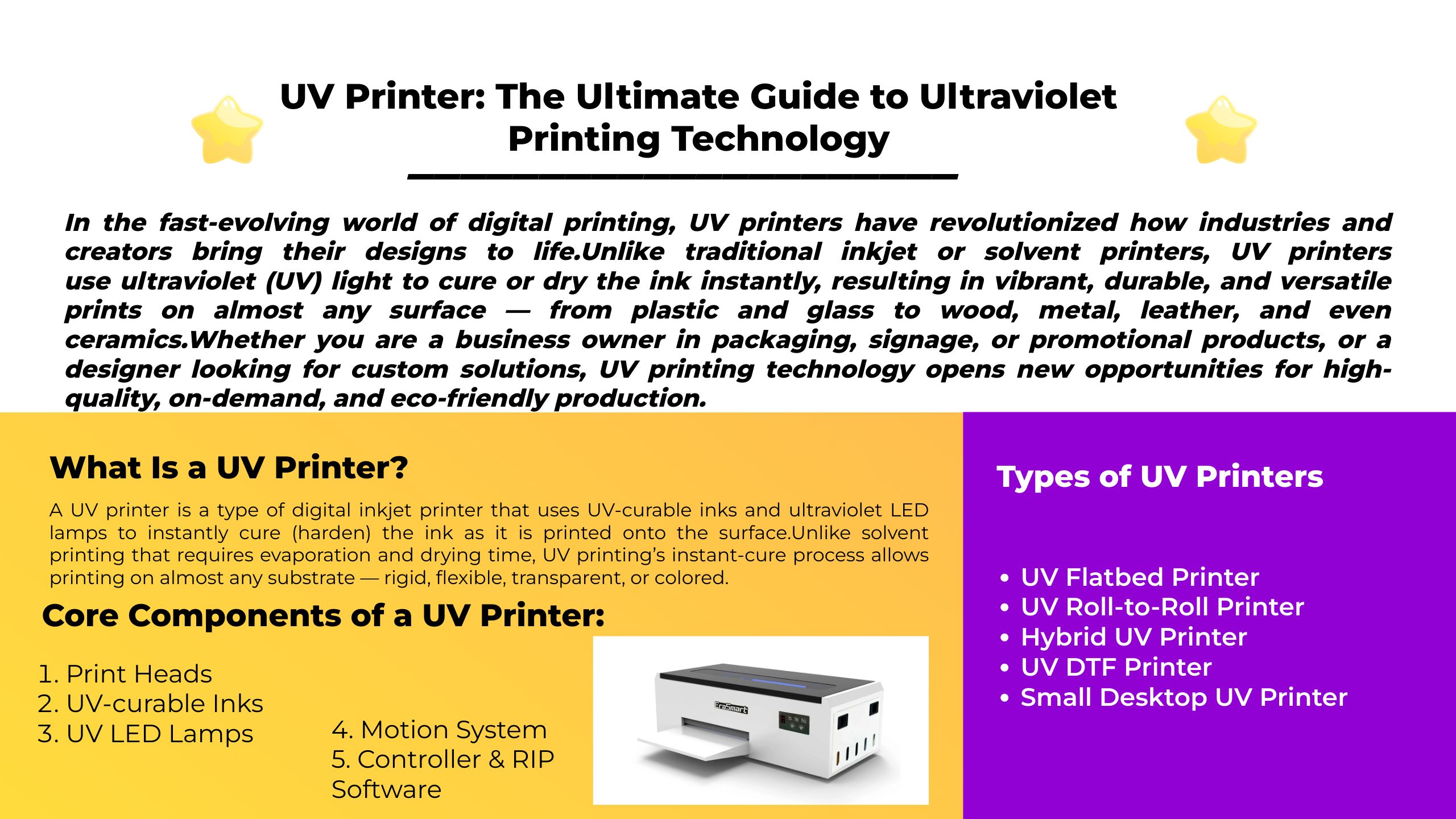
UV printing usually refers to UV flatbed printing. A UV printer applies UV-curable ink directly onto the product surface, and UV light cures the ink almost immediately. This makes it suitable for rigid and specialty materials such as acrylic, glass, metal, wood, plastic, leather, ceramic, phone cases, signs, and promotional products.

The main advantage of UV flatbed printing is direct-to-object production. You place the item on the printer bed, position the design, print directly onto the product, and the ink cures during the printing process. EraSmart’s buyer-focused UV printer guide explains that UV and DTF both support short-run customization and fast turnaround, but they differ in ink chemistry, compatible materials, workflow, durability, hand-feel, and total cost of ownership.

관련 읽기: https://www.erasmart.com/uv-printer-vs-dtf-printer/

What Is Textile DTF Printing?

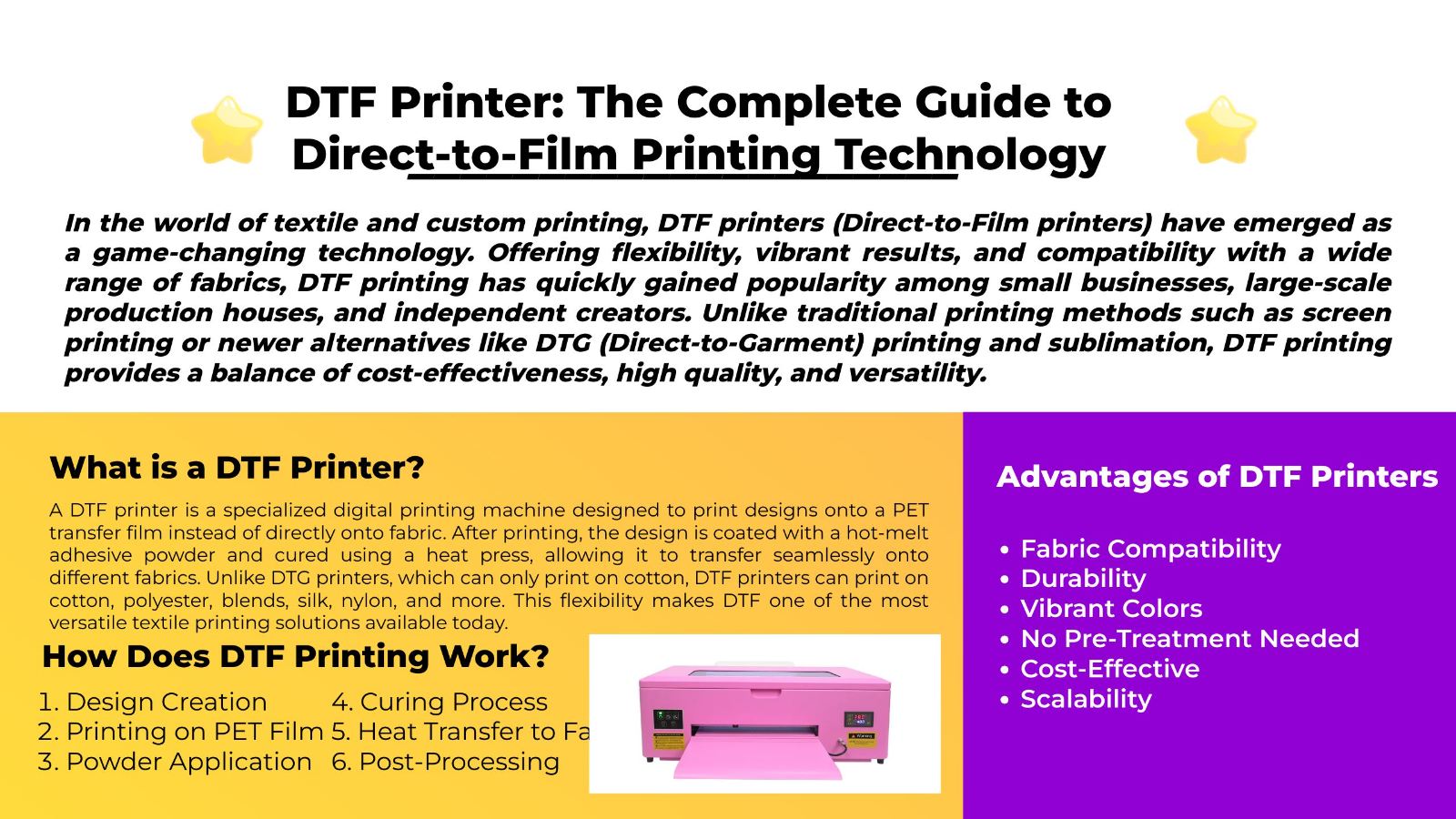
Textile DTF printing is the DTF process used for garments and fabrics. The printer prints the design onto PET transfer film, applies hot-melt adhesive powder, cures the powder, and then transfers the design onto fabric with a heat press. EraSmart’s workflow explanation describes textile DTF as film printing, powder application, curing, and heat press transfer.

Textile DTF is best for:

  • T-shirts

  • hoodies

  • uniforms

  • sportswear

  • cotton garments

  • polyester garments

  • blended fabrics

  • short-run apparel orders

  • custom brand merchandise

  • local team and event apparel

The business advantage is simple: textile DTF gives apparel businesses one flexible workflow for many garment types. It is especially useful when customers need small batches, mixed sizes, full-color artwork, dark garments, or personalized designs.

What Is UV DTF Printing?

UV DTF printing is a transfer process for hard surfaces. It uses UV ink, A/B film, and lamination to create decals that can be applied to smooth hard products. Instead of printing directly onto the object, the printer creates a transfer first, and the finished decal is applied later.

EraSmart’s UV DTF printer page describes the A3 UV DTF model as a solution for decals, labels, and cup wraps, with A3 / 350 mm width, CMYK + White + Varnish, up to 1440 dpi, powderless A/B film workflow, and cold lamination.

UV DTF is best for:

  • cup wraps

  • stickers

  • product labels

  • cosmetic packaging labels

  • glass decals

  • acrylic labels

  • metal tags

  • phone and laptop skins

  • water bottle decoration

  • short-run brand stickers

  • premium gift customization

EraSmart’s A/B film guide explains the typical UV DTF workflow clearly: print on A film, laminate with B film, cut the transfer, apply it to the substrate, press or squeegee out air, and peel the carrier layer according to the film instructions.

UV Printing vs Textile DTF vs UV DTF: Main Differences

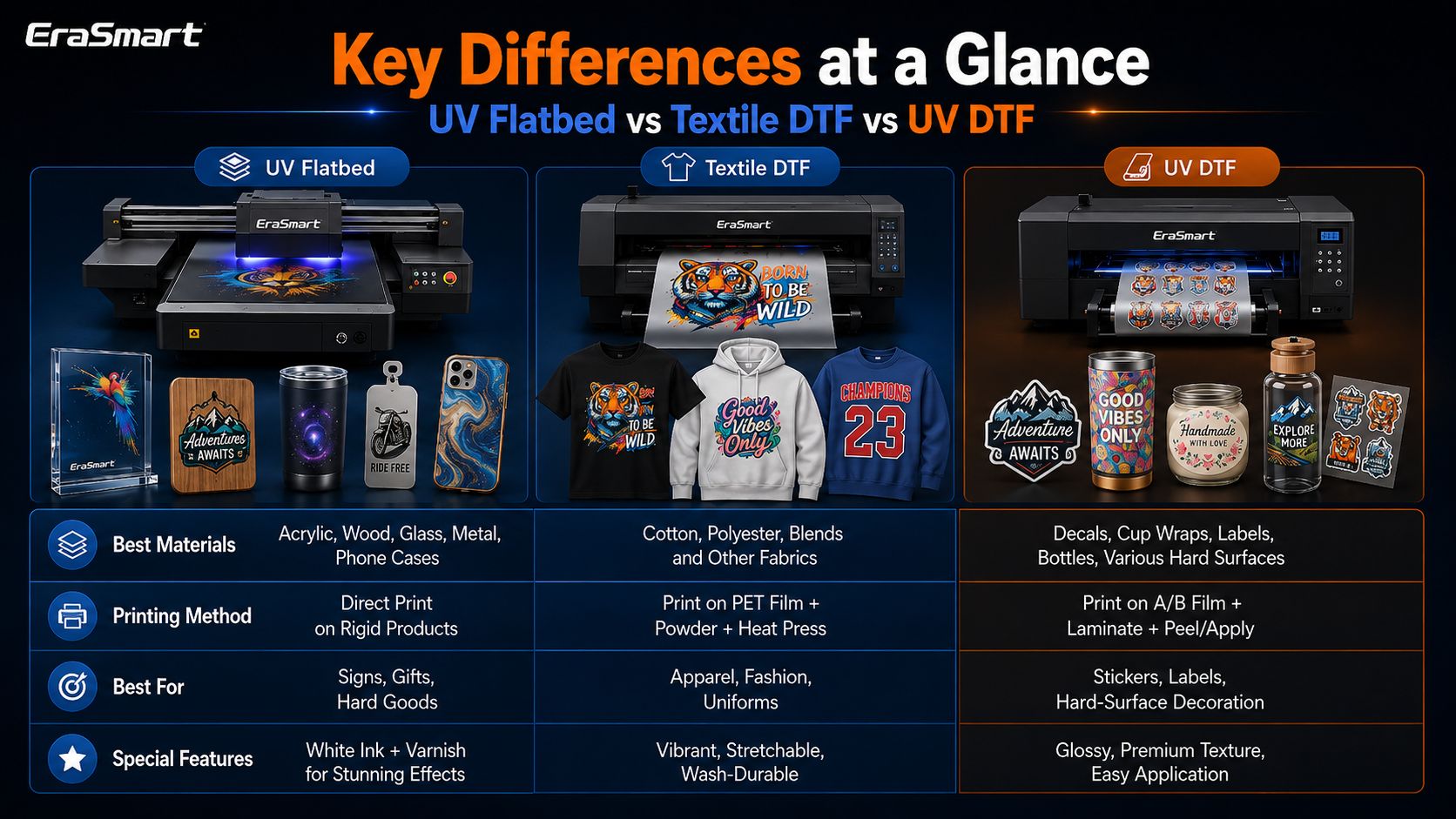
FactorUV Flatbed PrintingTextile DTF PrintingUV DTF 인쇄
Main purposeDirect printing on hard productsTransfer printing for garments딱딱한 표면용 데칼 전사
Ink typeUV 경화형 잉크Textile DTF inkUV 경화형 잉크
Transfer film아니요PET DTF filmA/B UV DTF film
가루아니요Yes, hot-melt powder아니요
열프레스Usually noUsually no heat press for standard decal application
최고의 제품Acrylic, wood, glass, metal, phone cases, signsT-shirts, hoodies, sportswear, uniforms스티커, 라벨, 컵랩, 가젯 스킨
White inkYes, often importantYes, important for dark garmentsYes, important for opacity and premium effects
광택Yes, depending on setupNo standard varnish layerYes, often used for gloss / raised effect
곡선형 아이템고정 장치에 따라 다름적합하지 않음Good for many decal-style curved applications
ApparelNot the right primary method최선의 선택권장되지 않음
Business fitHard product customizationApparel productionHard-surface transfer products

Workflow Comparison

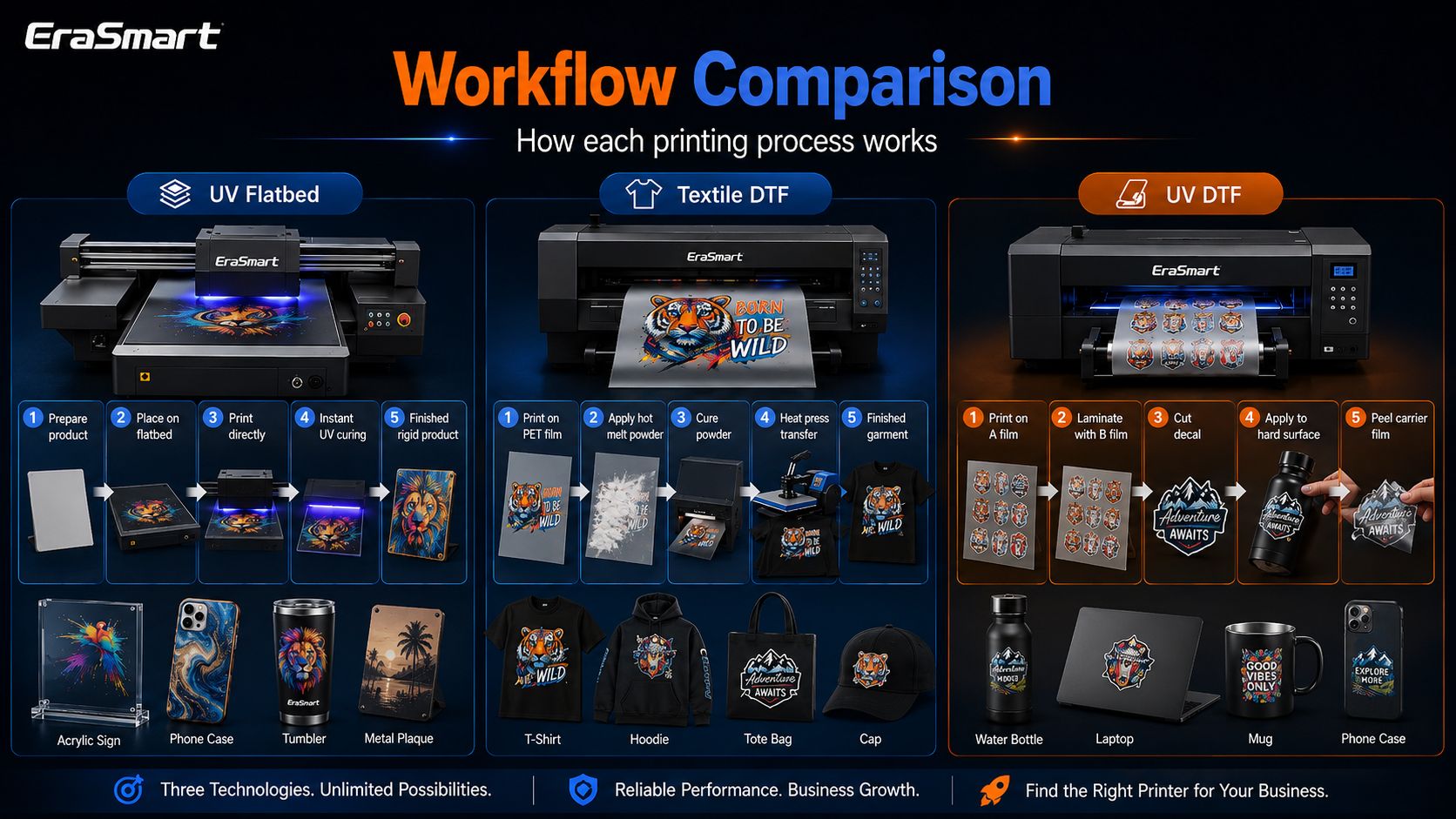
UV Flatbed Printing Workflow

UV flatbed printing is usually the most direct workflow:

  1. Prepare the material surface

  2. Place the product on the flatbed

  3. Align the artwork

  4. Print directly onto the product

  5. UV light cures the ink during printing

  6. Remove the finished product

This workflow is efficient for flat rigid products, especially when the item shape is easy to position. However, irregular objects may require jigs, fixtures, or surface testing.

Textile DTF Printing Workflow

Textile DTF has more steps, but it is very practical for apparel:

  1. Print the design onto PET film

  2. Apply hot-melt adhesive powder

  3. Cure the powder

  4. 전사물을 의류에 열압착합니다.

  5. Peel according to film type

  6. Final press if needed

This process is scalable when paired with a shaker, dryer, and standardized heat press settings. EraSmart’s guide notes that textile DTF repeatability depends on powder coverage, curing, and consistent press parameters.

UV DTF Printing Workflow

UV DTF is a decal workflow:

  1. Print the design on A film with UV ink

  2. Laminate with B film

  3. 전송을 중단하세요

  4. Apply the transfer onto a clean hard surface

  5. Press or squeegee out air

  6. Peel the carrier film

UV DTF repeatability depends heavily on film pairing, lamination quality, surface preparation, and correct application technique. EraSmart’s A/B film guide also notes that dust, poor lamination pressure, oily surfaces, humidity, and wrong peel technique can all affect the final transfer.

Which Technology Is Best for T-Shirts?

For T-shirts, hoodies, uniforms, sportswear, and mixed fabric apparel, textile DTF is the right choice.

UV DTF should not be promoted as a T-shirt printing method. It is designed for hard-surface transfers. EraSmart’s UV DTF small business guide clearly states that if your business focuses on shirts, hoodies, or other fabric products, textile DTF is the better process.

실제 읽기: https://www.erasmart.com/best-uv-dtf-printer-for-small-business/

Which Technology Is Best for Stickers and Cup Wraps?

For stickers, labels, cup wraps, bottle decals, cosmetic packaging labels, and hard-surface branding, UV DTF is usually the better choice.

UV DTF allows businesses to create premium-looking decals without printing directly onto every product. This is useful for small businesses that want to sell finished decals, apply branding to many product types, or produce short-run custom packaging and gift decoration. EraSmart’s UV DTF page positions the A3 UV DTF printer for decals, labels, cup wraps, gadget skins, glass, tile, metal, leather, wood gifts, and seasonal short-run branding.

Which Technology Is Best for Phone Cases?

For phone cases, both UV 평판 그리고 UV DTF can be useful, but they serve different workflows.

선택하다 UV 평판 if you want to print directly onto the phone case and control the full print position on the product. Choose UV DTF if you want to create transfer decals that can be applied to phone cases and other hard goods later. For small businesses with many SKU variations, UV DTF can reduce fixturing pressure because the decal is produced first and applied afterward.

Which Technology Is Best for Acrylic, Wood, Glass, and Metal?

For flat acrylic, wood, glass, metal, ceramic tiles, plaques, signs, and panels, UV flatbed printing is often the best primary method. It prints directly onto the object and is suitable for premium custom hard goods.

UV DTF can also be useful for smooth hard surfaces, especially when you want decal-style decoration or when direct printing and fixturing would be slower. EraSmart’s UV DTF vs Textile DTF vs UV Flatbed guide explains that UV flatbed prints directly onto the item, while UV DTF produces decals that can be applied later; they can complement each other rather than fully replace each other.

Common Buying Mistakes

Mistake 1: Thinking UV DTF is for T-shirts

UV DTF is not the correct primary method for apparel. It is for hard-surface decals. For garments, choose textile DTF.

Mistake 2: Thinking UV flatbed and UV DTF are the same

Both use UV ink, but the workflow is different. UV flatbed prints directly onto the product. UV DTF prints onto film and creates a transfer decal. The right choice depends on whether you want direct printing or transfer application.

Mistake 3: Buying based only on machine price

The machine is only one part of the production system. You should also consider consumables, maintenance, film compatibility, surface preparation, labor steps, operator skill, after-sales support, and the product categories you want to sell.

Mistake 4: Ignoring surface preparation

UV printing and UV DTF both depend on surface compatibility. Smooth, clean, stable surfaces usually perform better. Oily, dusty, textured, or low-surface-energy materials may require testing or preparation.

Mistake 5: Choosing one printer for every product

No single printer is perfect for every market. A serious custom printing business may eventually use textile DTF for apparel, UV DTF for decals and cup wraps, and UV flatbed printing for rigid product decoration.

EraSmart Buying Recommendation

If your business is mainly apparel, start with an EraSmart DTF printer. Textile DTF is the better choice for T-shirts, hoodies, uniforms, sportswear, and mixed fabric orders.

If your business is mainly stickers, labels, cup wraps, cosmetic labels, gadget skins, or hard-surface decals, start with an EraSmart UV DTF printer. The A3 UV DTF system is especially suitable for businesses that want a compact workflow for premium decals and hard-surface customization.

If your business is mainly acrylic signs, phone cases, wood gifts, glass products, metal plates, packaging samples, or direct-to-object printing, choose an EraSmart UV printer.

If your business wants to cover multiple markets, choose by priority:

  1. Apparel first → Textile DTF

  2. Stickers and cup wraps first → UV DTF

  3. Rigid products and direct printing first → UV flatbed

  4. Apparel + hard goods → combine DTF with UV DTF or UV flatbed

  5. Labels + acrylic + packaging + gifts → combine UV DTF and UV flatbed

Final Answer: Which Printer Should You Buy?

선택하다 textile DTF printing if your business is built around apparel.

선택하다 UV flatbed printing if your business is built around direct printing on rigid products.

선택하다 UV DTF 인쇄 if your business is built around decals, stickers, labels, cup wraps, and hard-surface transfers.

The best purchase is not the machine with the most features. It is the machine that matches your product catalog, material type, workflow, and growth plan. EraSmart supports all three categories—DTF printers, UV printers, and UV DTF printers—so the smarter buying decision is to start from your target products first, then choose the technology that fits that product path.

Need help choosing between DTF, UV flatbed, and UV DTF? Share your target products, material type, print size, expected daily order volume, and budget range with EraSmart. Our team can help you match the right machine, workflow, consumables, and upgrade path for your business.


당신도 좋아할 수도 있습니다

  • 에라스마르트 프린터

    UV 프린터
    DTF 프린터
    DTG 프린터
    열 프레스 머신
    광고 프린터

  • 프린터 도구

    DTF 오븐
    핫 프레스
    조각 기계
    머그잔 열전달
    라미네이팅 머신

  • 소모품

    인쇄 잉크
    핸드폰 케이스
    유리 제품
    청소 유체
    면봉

  • 저희에게 연락하십시오

    whatsapp : +8618566233796
    WeChat : +8618566233796
    모바일 : +8618566233796
    편물:www.erasmart.com
    가게:www.erasmartmall.com

  • 견적을 요청하십시오

    몇 가지 세부 정보 만 제공하면 빠른 인용문을 얻을 수 있도록 도와 드리겠습니다!