Fabricante de impressoras de jato de tinta pequeno de tamanho pequeno

UV DTF vs DTF: Qual impressora você deve comprar para o seu negócio?
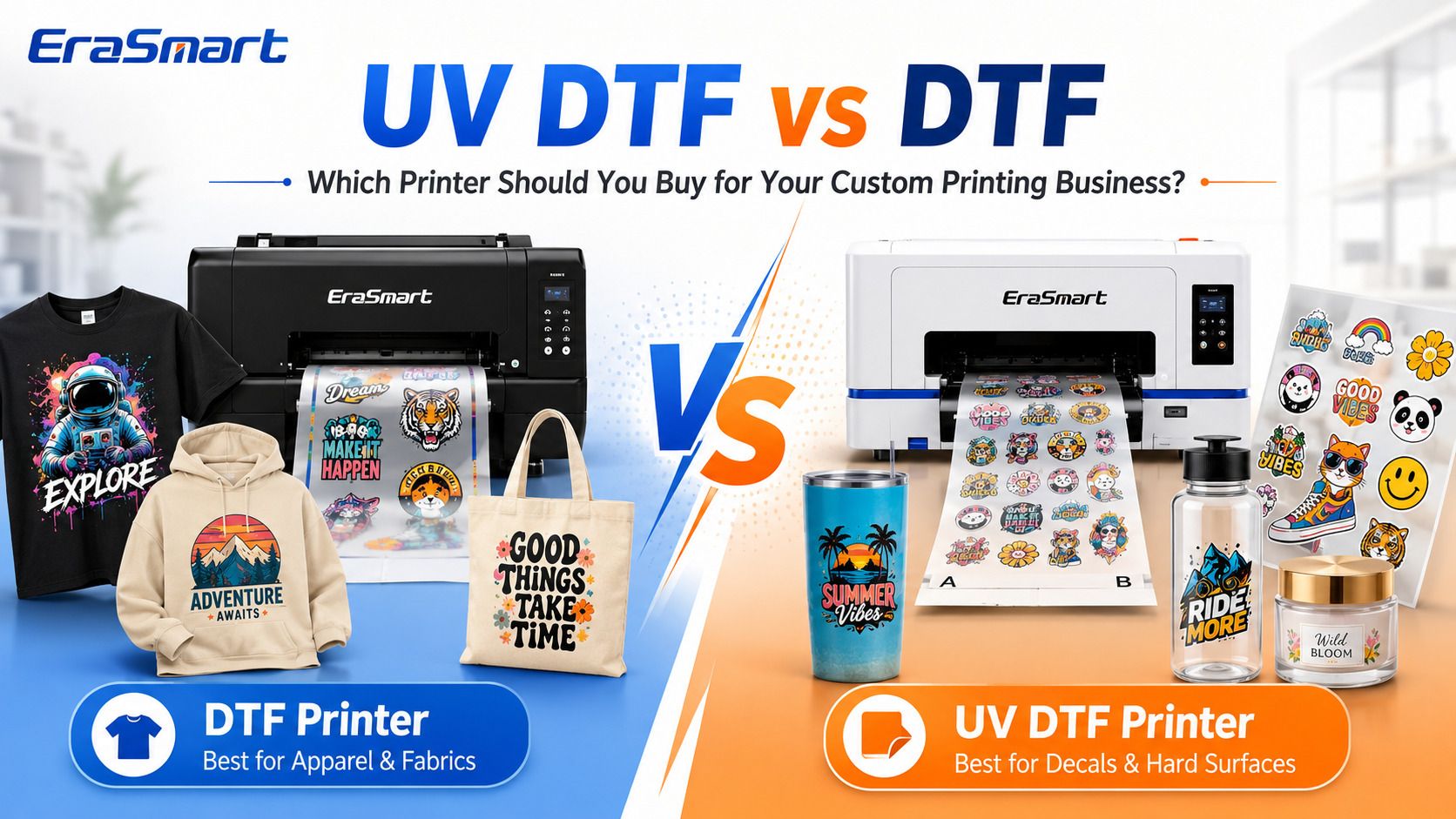
Se você estiver escolhendo entre uma impressora DTF e uma impressora UV DTF, a questão mais importante não é qual tecnologia é “melhor”.
A melhor pergunta é:
Quais produtos você deseja vender?
Se seus principais produtos são camisetas, moletons, uniformes, roupas esportivas, sacolas, roupas de trabalho e outros produtos têxteis, um Impressora DTF geralmente é a direção certa.
Se seus principais produtos são adesivos, embalagens para copos, decalques para garrafas, rótulos de cosméticos, marcas de potes de velas, decalques para embalagens, gráficos para capas de telefone e outras aplicações em superfícies duras, um Impressora UV DTF geralmente é o melhor ajuste.
E se o seu objetivo a longo prazo é construir um negócio de personalização mais amplo, servindo tanto vestuário como bens duráveis, as duas tecnologias podem complementar-se, em vez de competir entre si.
Este guia vai além de uma definição básica de DTF e UV DTF. Em vez disso, compararemos os dois sistemas a partir de uma perspectiva de compra e negócios: produtos, materiais, fluxo de trabalho, equipamentos, consumíveis, manutenção, tipos de clientes, estrutura de pedidos e potencial de expansão.
Se você primeiro precisar de uma comparação técnica mais ampla entre DTF UV, DTF têxtil e impressão UV direta, leia o artigo da EraSmart UV DTF vs Têxtil DTF vs UV Flatbed guia.
Resposta rápida: Você deve comprar uma impressora DTF ou UV DTF?
Aqui está a maneira mais simples de decidir.
| Se o seu negócio principal é… | Melhor ponto de partida |
|---|---|
| Camisetas personalizadas | Impressora DTF |
| Moletons e streetwear | Impressora DTF |
| Roupas esportivas e uniformes | Impressora DTF |
| Sacolas e mercadorias de tecido | Impressora DTF |
| Roupas impressas sob demanda | Impressora DTF |
| Venda de transferência DTF | Impressora DTF |
| Adesivos e decalques premium | Impressora UV DTF |
| Envoltórios para copos e decalques para copos | Impressora UV DTF |
| Marca de garrafas e potes | Impressora UV DTF |
| Rótulos de cosméticos e velas | Impressora UV DTF |
| Decalques de embalagem | Impressora UV DTF |
| Decalques para gadgets e capas de telefone | Impressora UV DTF |
| Personalização de roupas e superfícies duras | Considere ambos |
A regra básica é:
Tecidos e vestuário → DTF
Decalques e superfícies duras → UV DTF
Não escolha apenas pelo preço da impressora, resolução máxima ou quantos cabeçotes de impressão uma máquina possui. Compre de acordo com os produtos que seus clientes realmente vão encomendar.
DTF e UV DTF parecem semelhantes, mas são sistemas de produção diferentes
Os nomes podem ser confusos porque ambas as tecnologias incluem “DTF”, que significa Direct to Film.
Ambos imprimem primeiro um desenho no filme e depois o transferem.
Mas é aí que a semelhança termina em grande parte.
Um fluxo de trabalho DTF têxtil padrão usa:
- Tinta pigmentada DTF
- CMYK + tinta branca
- Filme de transferência de animais de estimação
- adesivo em pó termofusível
- cura em pó
- prensagem térmica
- produtos têxteis
Um fluxo de trabalho UV DTF usa:
- Tinta curável por UV
- CMYK + branco + verniz
- O filme
- Filme B
- Cura UV LED
- laminação
- transferência/aplicação a frio
- produtos de superfície dura
Eles usam diferentes químicas de tinta, diferentes filmes, diferentes sistemas adesivos e diferentes métodos de aplicação final.
Isso significa que uma impressora DTF não pode simplesmente ser convertida em uma impressora UV DTF trocando o filme, e uma impressora UV DTF não deve ser adquirida para imprimir camisetas.
Fluxo de trabalho DTF vs UV DTF: onde começa a verdadeira diferença
O fluxo de trabalho é uma das diferenças mais importantes para o proprietário de uma empresa porque determina quais equipamentos você precisa, quanto trabalho do operador está envolvido e como os pedidos passam pela sua loja.
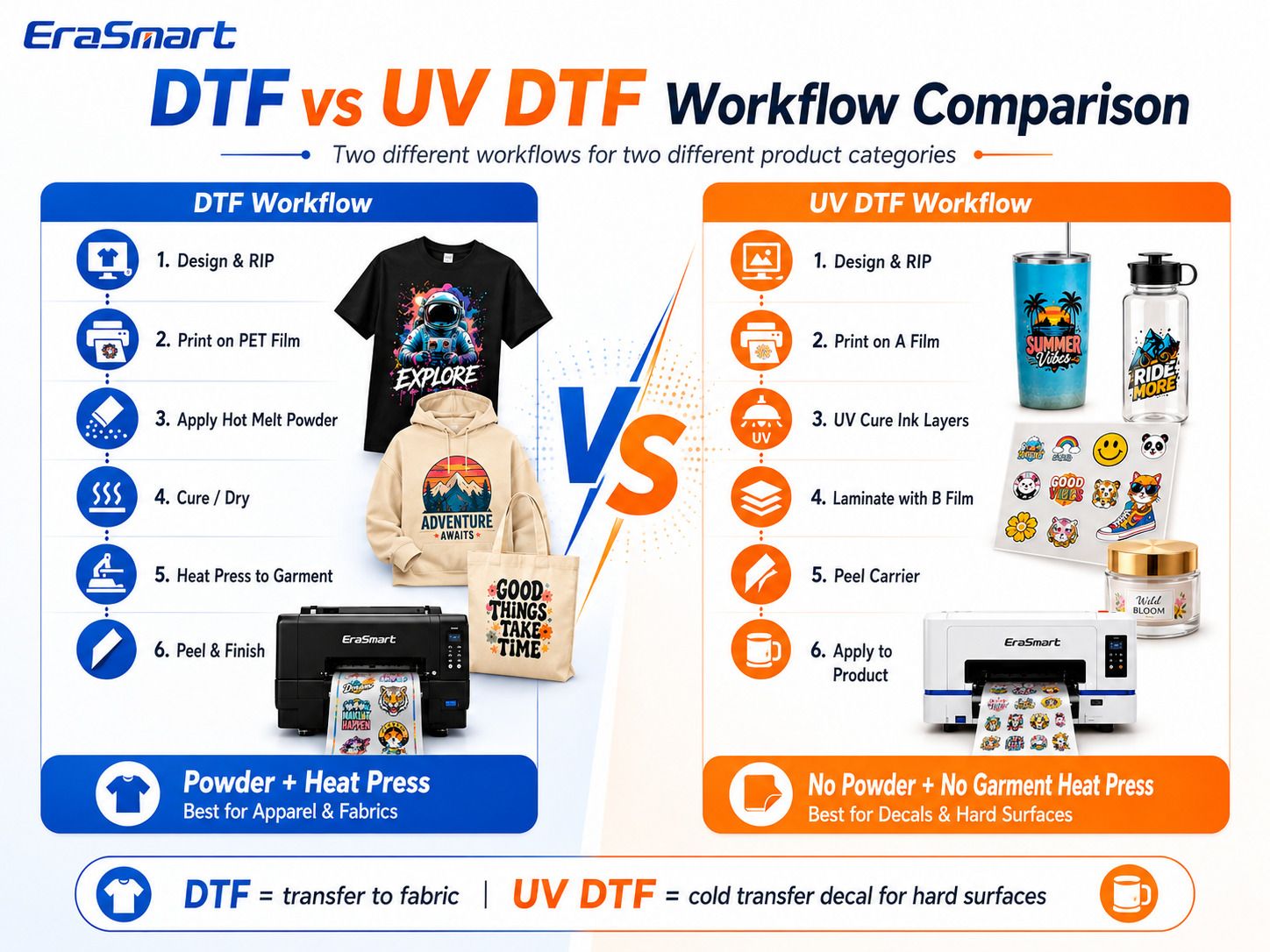
Fluxo de trabalho DTF
Um fluxo de trabalho típico de DTF têxtil é assim:
- Prepare obras de arte.
- Processe a arte final no software RIP.
- Imprima CMYK e tinta branca em filme PET.
- Aplique pó adesivo termofusível.
- Cure ou derreta o pó adesivo.
- Posicione o transfer na roupa.
- Pressione a transferência com calor.
- Descasque o filme.
- Conclua a imprensa, se necessário.
- Inspecione a roupa final.
A impressora cria a transferência, mas a peça não fica pronta até que a transferência seja prensada a quente.
Para uma explicação mais detalhada da produção, consulte EraSmart's Fluxo de trabalho de produção DTF.
Fluxo de trabalho DTF UV
Um fluxo de trabalho típico de UV DTF é assim:
- Prepare obras de arte.
- Processe camadas CMYK, brancas e de verniz no software RIP.
- Imprima em um filme.
- Os LEDs UV curam a tinta durante a impressão.
- Laminado com filme B.
- Corte ou apare a transferência finalizada, se necessário.
- Retire a camada transportadora apropriada.
- Posicione o decalque no produto.
- Dê polimento ou pressione-o na superfície.
- Remova a transportadora.
Não há pó termofusível e normalmente não há prensa térmica para roupas.
Essa diferença torna o UV DTF especialmente útil quando os clientes trazem muitos produtos duros diferentes que, de outra forma, exigiriam acessórios ou posicionamento de impressão direta.
Quais produtos você realmente deseja vender?
Esta deve ser a primeira decisão de compra.
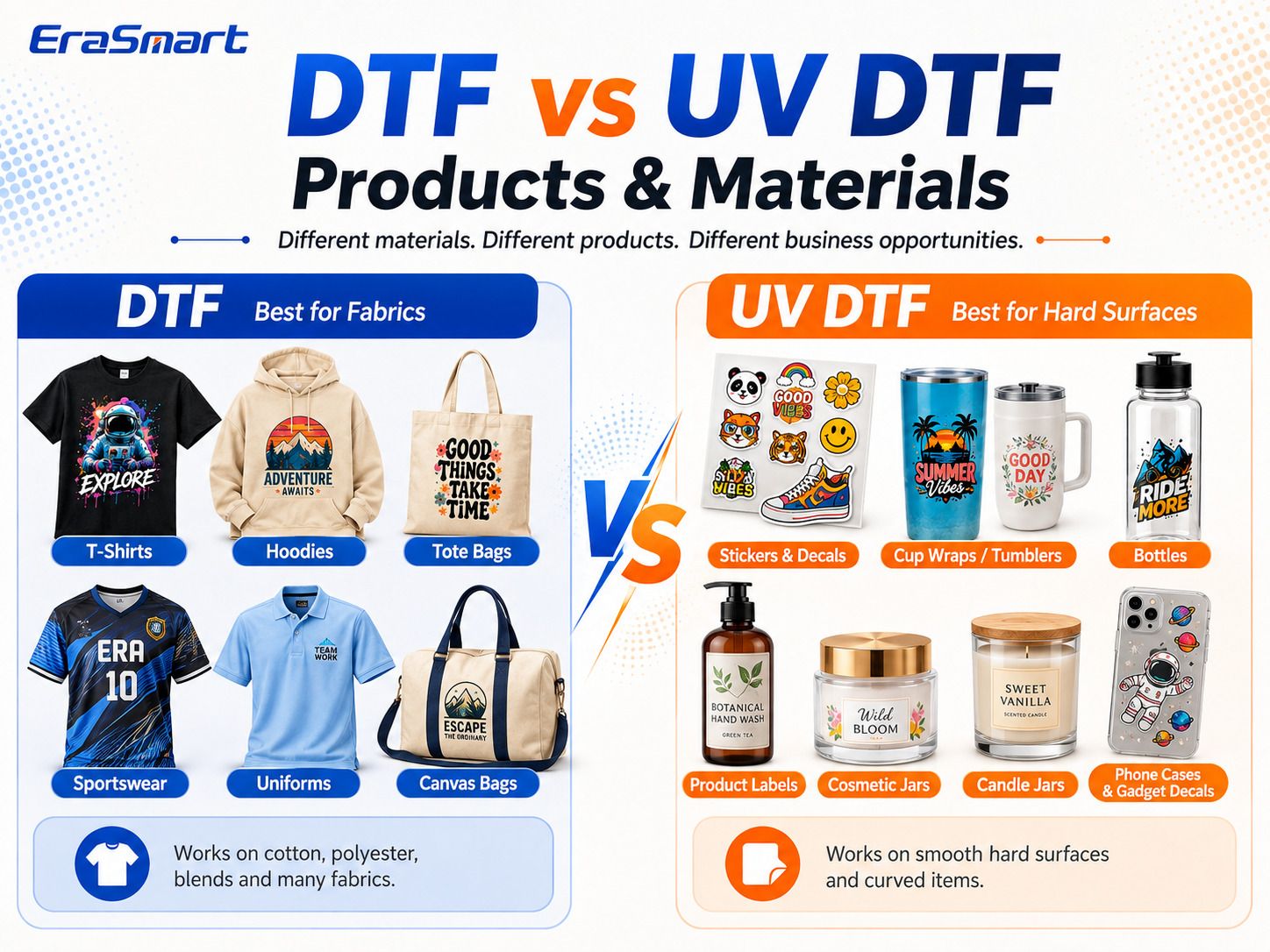
Escolha DTF para vestuário e tecidos
DTF é projetado em torno da decoração têxtil.
Os produtos comuns incluem:
- Camisetas
- moletons
- moletons
- camisas esportivas
- uniformes
- roupa de trabalho
- sacolas
- bolsas de lona
- vestuário de equipe
- mercadoria de marca
- camisas de eventos
- roupas para escola e clube
- roupas personalizadas
- roupas estampadas sob demanda
O DTF é particularmente útil quando uma loja lida com diferentes cores de roupas e quantidades de pedidos mistos.
A tinta branca cria uma base opaca, permitindo que obras de arte coloridas sejam transferidas para roupas escuras e também para tecidos de cores claras.
Uma loja DTF também pode vender elas próprias as transferências, em vez de vender apenas peças de vestuário acabadas. Isto cria outro modelo de negócio potencial: impressão de folhas de gangue ou transferências para empresas locais de vestuário, vendedores de artesanato, escolas ou outros decoradores de vestuário.
Explore o completo Impressora EraSmart DTF alcance se o vestuário for sua direção principal.
Escolha UV DTF para adesivos, etiquetas e produtos de superfície dura
UV DTF é projetado em torno de decalques UV transferíveis.
Os produtos típicos incluem:
- adesivos premium
- decalques de logotipo
- envoltórios de copo
- copos
- garrafas de água
- marca de vidro
- rótulos de potes de velas
- rótulos de frascos de cosméticos
- embalagem do produto
- decalques para caixas de presente
- decalques de capa de telefone
- capas de gadgets
- Etiquetas de código QR
- marca de produto promocional
- rótulos para pequenas empresas
Em vez de colocar o objeto dentro da impressora, primeiro você produz o decalque em filme e depois aplica.
Isso é útil para empresas de produtos com muitos formatos e SKUs.
Por exemplo, a mesma transferência de logotipo pode ser potencialmente aplicada a uma garrafa, jarro, caixa de presente, item de acrílico ou outra superfície lisa compatível após testes de adesão adequados.
Explore o EraSmart Impressora UV DTF linha se decalques e produtos duráveis forem seu mercado principal.
Compatibilidade de materiais: tecido versus superfícies duras
Um erro de compra comum é presumir que o DTF UV é simplesmente “DTF melhor” porque adiciona tinta UV e verniz.
Não é.
Eles resolvem diferentes problemas materiais.
DTF foi projetado para têxteis compatíveis com prensa térmica
As aplicações típicas de DTF incluem algodão, poliéster, misturas, lona e muitos materiais comuns de vestuário.
No entanto, os operadores ainda devem testar novos tecidos, revestimentos, comportamento de estiramento, temperatura de prensagem e adesão antes de aceitarem uma ordem de produção.
UV DTF foi projetado para superfícies duras compatíveis
UV DTF é geralmente usado em superfícies duras limpas e lisas, como:
- vidro
- acrílico
- metal
- recipientes revestidos
- produtos plásticos
- embalagem
- garrafas
- potes
- superfícies de madeira selecionadas
- gadgets e acessórios
Textura superficial e matéria energética superficial.
Um decalque UV DTF que adere muito bem ao vidro liso pode se comportar de maneira diferente em um plástico oleoso, madeira crua, material semelhante ao silicone, superfície com muita textura ou produto flexível.
Testar o branco real é sempre recomendado antes da produção em volume.
Aparência da impressão e experiência do cliente
DTF e UV DTF também criam produtos acabados muito diferentes.
DTF: gráficos de vestuário flexíveis
Uma boa transferência DTF pode fornecer:
- obras de arte vibrantes e coloridas
- base branca para roupas escuras
- detalhe gráfico fino
- personalização de pequenos lotes
- decoração de vestuário flexível
A sensação final depende da cobertura da arte, da densidade da tinta, do pó adesivo, da cura, da prensagem e da própria peça de roupa.
Um gráfico grande e sólido será naturalmente diferente de um logotipo pequeno no peito com mais espaço negativo.
UV DTF: decalque premium e efeitos em relevo
DTF UV pode usar:
CMYK + Branco + Verniz
O verniz permite efeitos como:
- lustro
- brilho pontual
- detalhes em relevo
- efeitos de logotipo premium
- detalhes decorativos texturizados
Isso torna o UV DTF atraente para rótulos de marcas, copos, embalagens, produtos para presentes e gráficos decorativos premium.
Ainda deve ser pensado como uma camada de decalque transferida, em vez de ser impressa diretamente no substrato.
Equipamentos e consumíveis: o que você realmente precisa?
A impressora é apenas parte do investimento.
Você deve comparar o sistema de produção completo.
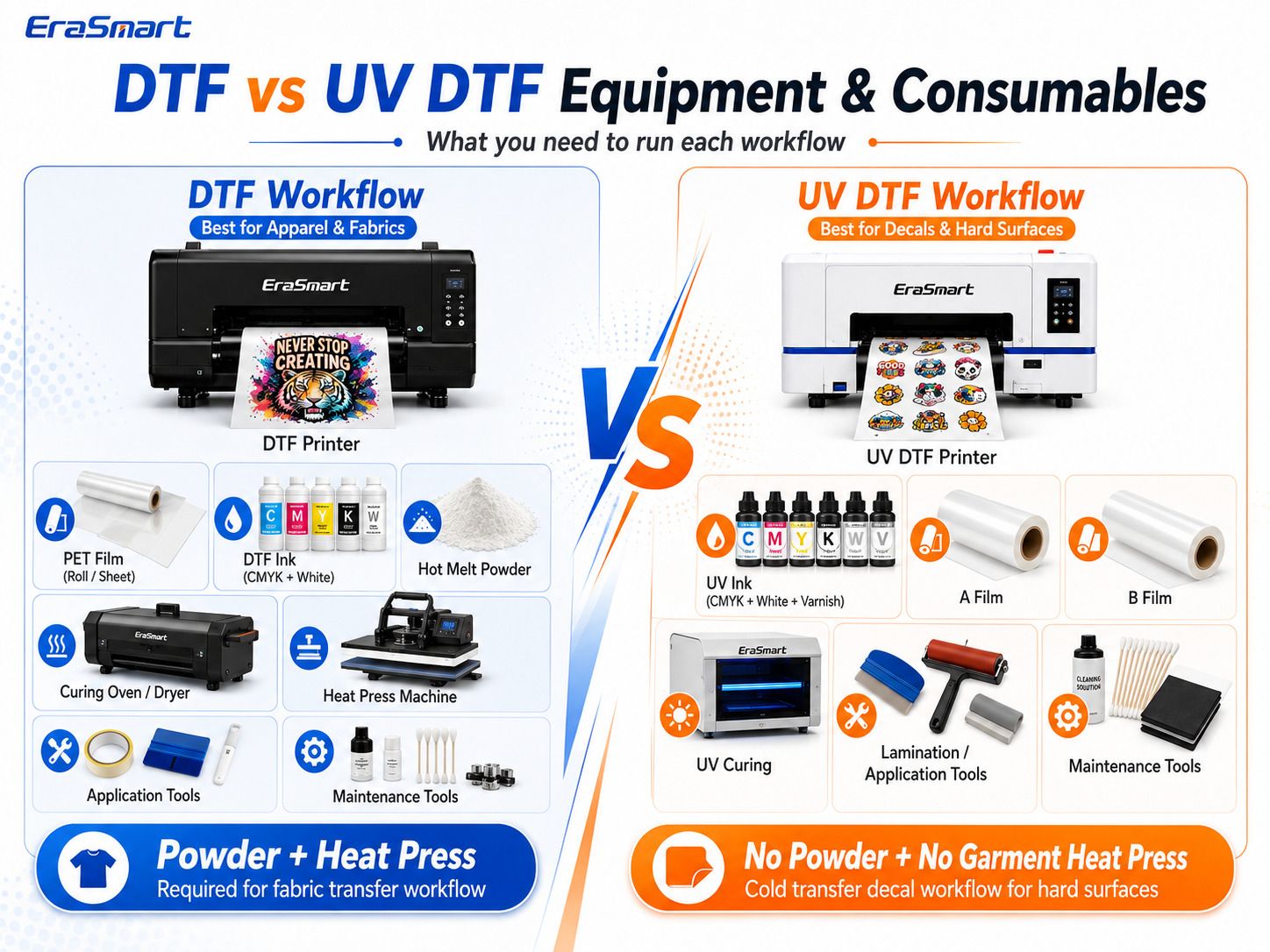
Sistema de produção DTF
Um fluxo de trabalho DTF completo pode exigir:
- Impressora DTF
- Tinta CMYK + DTF branca
- Filme de transferência de animais de estimação
- adesivo em pó termofusível
- sistema de aplicação de pó
- forno de cura ou secador
- prensa térmica
- RIP Software
- solução de limpeza
- ferramentas de manutenção
- vestuário em branco
Pequenas lojas podem aplicar o pó manualmente e usar equipamentos de cura separados.
À medida que a produção aumenta, um agitador e secador de pó automático pode reduzir o trabalho manual e melhorar a consistência.
Para compradores que estão considerando essa atualização, o EraSmart também oferece o Impressora A3 MAX XP600 DTF com agitador de pó.
Sistema de produção UV DTF
Um fluxo de trabalho UV DTF geralmente precisa de:
- Impressora UV DTF
- Tinta UV CMYK
- tinta UV branca
- verniz
- O filme
- Filme B
- Sistema de cura UV
- sistema de laminação
- RIP Software
- ferramentas de corte/aplicação
- materiais de limpeza e manutenção
O fluxo de trabalho EraSmart UV DTF não contém pó e não requer uma prensa térmica para aplicação de decalque padrão.
Isto torna a estrutura de produção muito diferente do DTF têxtil.
Qual fluxo de trabalho tem mais etapas?
Depende do que você conta.
DTF precisa de etapas adicionais de produção de vestuário após a impressão da transferência:
pó → cura → prensa térmica → descascar
Necessidades de DTF UV:
Cura UV durante a impressão → laminado → aparar → aplicar → descascar
Portanto, a pergunta não deveria ser “Qual deles tem menos etapas?”
A melhor pergunta é:
Qual fluxo de trabalho se adapta aos produtos que você deseja vender repetidamente?
Se 90% dos seus pedidos forem camisetas, um fluxo de trabalho DTF parecerá natural.
Se 90% dos seus pedidos forem embalagens de copos e decalques para embalagens, um fluxo de trabalho UV DTF fará muito mais sentido.
Manutenção: Qual impressora é mais fácil de possuir?
Nenhum dos sistemas deve ser tratado como isento de manutenção.
As impressoras DTF e UV DTF contêm cabeçotes de impressão a jato de tinta e sistemas de tinta branca que precisam de rotinas operacionais adequadas.
Prioridades de manutenção DTF
Os operadores DTF precisam gerenciar:
- Circulação de tinta branca
- verificações de bicos
- condição do cabeçote de impressão
- estação de nivelamento
- limpador
- linhas de tinta
- contaminação por pó
- armazenamento de filmes
- temperatura ambiente e umidade
- rotinas de tempo ocioso
A tinta branca contém pigmento mais pesado e é um dos principais motivos pelos quais a operação e manutenção regular do DTF são importantes.
EraSmart Guia de manutenção DTF fornece orientação adicional de manutenção.
Prioridades de manutenção UV DTF
Os operadores de UV DTF também precisam gerenciar:
- condição do cabeçote de impressão
- sistema de tinta branca
- Tinta UV
- canal de verniz
- verificações de bicos
- capeamento e limpeza
- Armazenamento de filmes A/B
- qualidade de laminação
- Sistema de cura UV
- poeira e contaminação
O UV DTF remove o pó termofusível do fluxo de trabalho, mas isso não significa que a impressora em si possa ficar sem uso indefinidamente sem cuidados.
Para qualquer um dos sistemas, a disciplina operacional diária é mais importante do que frases de marketing como “manutenção fácil”.
O que é mais fácil para um iniciante?
Não existe uma resposta universal.
A impressora mais fácil para um iniciante geralmente é aquela que corresponde à primeira categoria de produto do iniciante.
DTF é mais fácil de entender se você já deseja vender roupas
Se a sua ideia de negócio é:
“Quero vender camisetas e moletons personalizados.”
DTF tem um caminho claro:
design → transferência → prensa térmica → peça de vestuário.
Suas principais áreas de aprendizagem serão:
- preparação de arte
- Configuração RIP
- gerenciamento de tinta branca
- cura em pó
- pressionando
- teste de roupas
UV DTF é mais fácil de entender se você deseja vender decalques e produtos duráveis personalizados
Se a sua ideia de negócio é:
“Quero vender embalagens para copos, etiquetas e decalques de produtos personalizados.”
UV DTF oferece um fluxo de trabalho que combina naturalmente com esses produtos.
Suas principais áreas de aprendizagem serão:
- Configuração CMYK/branco/verniz
- Filme A/B
- laminação
- posicionamento do decalque
- técnica de aplicação
- teste de adesão de substrato
Comprar o sistema errado cria uma experiência para iniciantes muito mais difícil do que escolher qualquer uma das tecnologias corretamente.
Modelos de negócios DTF vs UV DTF
A diferença fica ainda mais clara quando você para de pensar em impressoras e começa a pensar nos clientes.
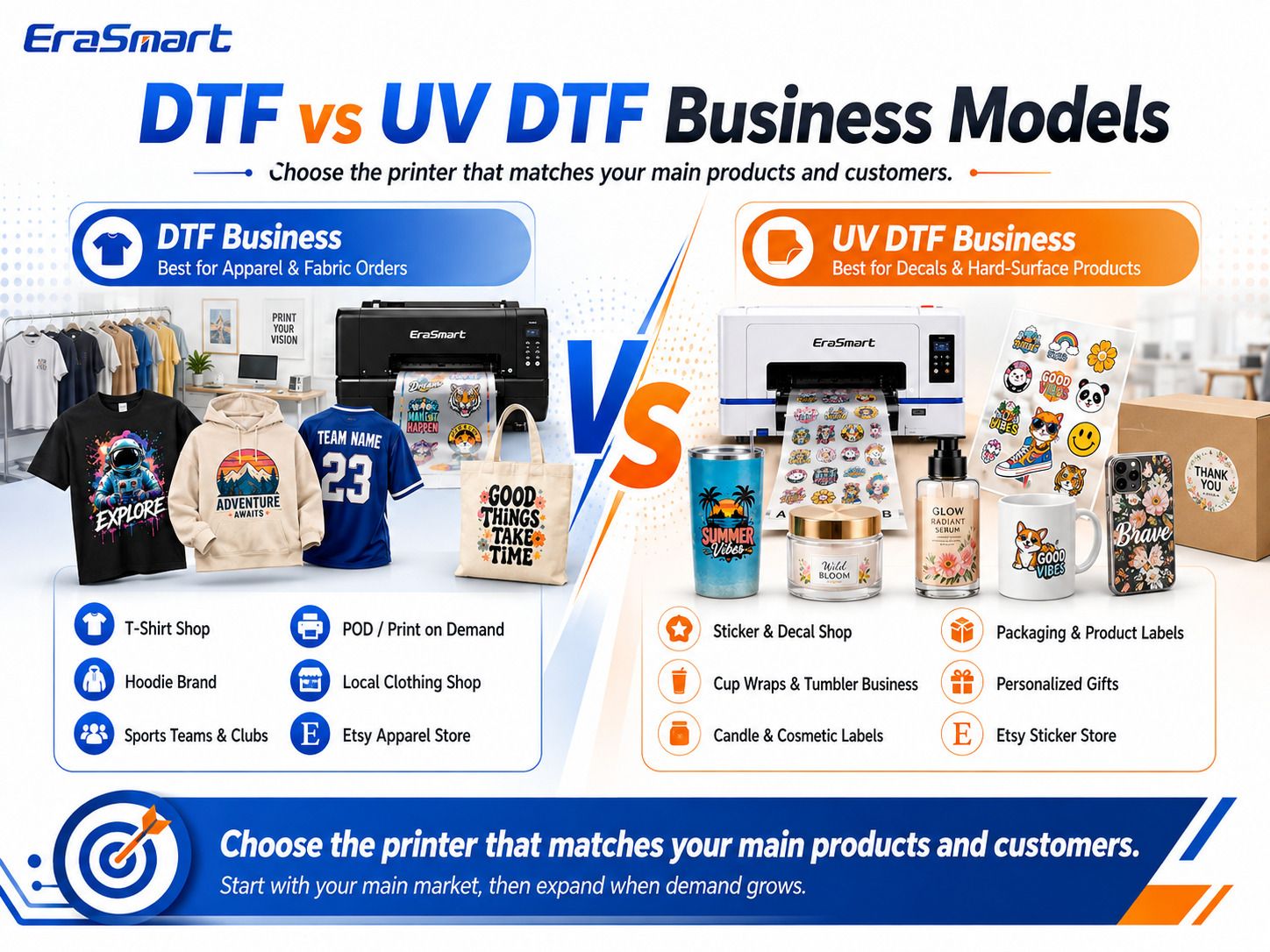
Modelos de negócios DTF
DTF é uma ótima opção para:
Loja de camisetas personalizadas
Os clientes enviam designs e encomendam camisetas em pequenas ou médias quantidades.
Vestuário impresso sob demanda
Vários designs podem ser preparados e produzidos conforme os pedidos chegam.
Marcas de streetwear e roupas
As marcas podem lançar pequenas coleções sem preparar telas para cada design.
Vestuário escolar, de equipe e de clube
Nomes, números, logotipos e designs variáveis são adequados para a produção de transferência digital.
Mercadoria Corporativa
Camisas para funcionários, roupas para eventos, roupas de trabalho e roupas de marca podem gerar novos negócios.
Fornecedor de transferência DTF
Em vez de passar as roupas você mesmo, você pode vender decalques prontos para outros decoradores.
Modelos de negócios UV DTF
UV DTF é uma ótima opção para:
Loja de adesivos e decalques
Produza transferências premium de superfícies duras para consumidores e empresas.
Negócio de embrulho de copo
Crie obras de arte para copos, copos de vidro, garrafas e copos.
Embalagens e rótulos de produtos
Atenda pequenas marcas que desejam rótulos e decalques atraentes de curta tiragem.
Marca de velas e cosméticos
Crie marcas decorativas para potes e recipientes compatíveis.
Negócio de presentes personalizados
Use decalques para personalizar diferentes produtos para presentes sem imprimir diretamente cada item.
Fornecedor de marca B2B
Atende cafés, salões de beleza, lojas de presentes, marcas de produtos locais, empresas de eventos e empresas de produtos promocionais.
O que é melhor para o Etsy e as lojas online?
Ambos podem funcionar bem, mas levam a lojas diferentes.
Loja Online DTF
Produtos possíveis:
- camisetas gráficas
- moletons personalizados
- roupas esportivas personalizadas
- camisas de eventos
- sacolas
- mercadoria do criador
- transferências de vestuário
Esse modelo atende vendedores cuja identidade visual é baseada em roupas.
Loja on-line UV DTF
Produtos possíveis:
- folhas de adesivos
- envoltórios de copo
- decalques de copo
- rótulos de garrafas
- coleções de decalques sazonais
- etiquetas personalizadas
- pacotes de branding para pequenas empresas
As transferências UV DTF também podem ser vendidas sem o branco acabado, reduzindo a necessidade de estocar todos os designs possíveis de copos, jarras ou garrafas.
O que é melhor para gráficas locais?
Isso depende da sua base de clientes local.
O DTF é atraente se você recebe regularmente:
- encomendas de camisas para funcionários de restaurantes
- roupas de times esportivos
- camisas escolares
- pedidos de construção/roupas de trabalho
- mercadoria do clube
- vestuário para eventos
- uniformes corporativos
UV DTF é atraente se seus clientes precisarem de:
- rótulos de embalagens
- marca de garrafa
- decalques de produtos
- personalização do copo
- Decalques de código QR
- brindes promocionais
- rótulos de cosméticos/velas
- marca de pequena tiragem
Uma gráfica local pode eventualmente ter demanda por ambos.
Qual tem melhor potencial de crescimento?
Nenhuma das tecnologias gera automaticamente mais dinheiro.
O lucro depende de:
- demanda local
- preço de venda
- custo de materiais
- desperdício
- utilização da máquina
- trabalho
- posicionamento do produto
- marketing
- retenção de clientes
- repetir pedidos
DTF oferece um caminho de crescimento dentro do vestuário.
Você pode passar de:
pequenos pedidos personalizados → trabalho de marca de vestuário → folhas de gangue → venda por transferência → sistemas de produção maiores.
UV DTF oferece um caminho de crescimento dentro da decoração de superfícies duras.
Você pode passar de:
adesivos → copos → rótulos de embalagens → marca B2B → produtos promocionais → maior produção de decalques.
A melhor plataforma de crescimento é aquela conectada à base de clientes que você pode construir de forma realista.
Você pode executar DTF e UV DTF juntos?
Sim. Na verdade, os dois sistemas podem ser complementares porque visam categorias de produtos diferentes.
Imagine que um cliente de um café deseja um pacote completo de mercadorias de marca.
Com DTF você poderia produzir:
- camisetas de funcionários
- moletons promocionais
- camisas de eventos
- sacolas
Com UV DTF você poderia produzir:
- decalques do logotipo da copa
- marca de garrafa
- Adesivos de código QR
- rótulos de embalagens
- marca de caixa de presente
Um cliente pode, portanto, gerar pedidos para vários tipos de produtos.
É por isso que uma loja de customização madura pode eventualmente operar ambos os sistemas.
Mas isso faz não significa que um iniciante deve comprar ambos automaticamente no primeiro dia.
Comece com o sistema que corresponda à sua melhor oportunidade de produto. Adicione o segundo fluxo de trabalho quando a demanda do cliente justificar.
Impressora EraSmart A3 MAX DTF vs A3 UV DTF
Para um exemplo de compra mais prático, considere dois sistemas EraSmart classe A3.
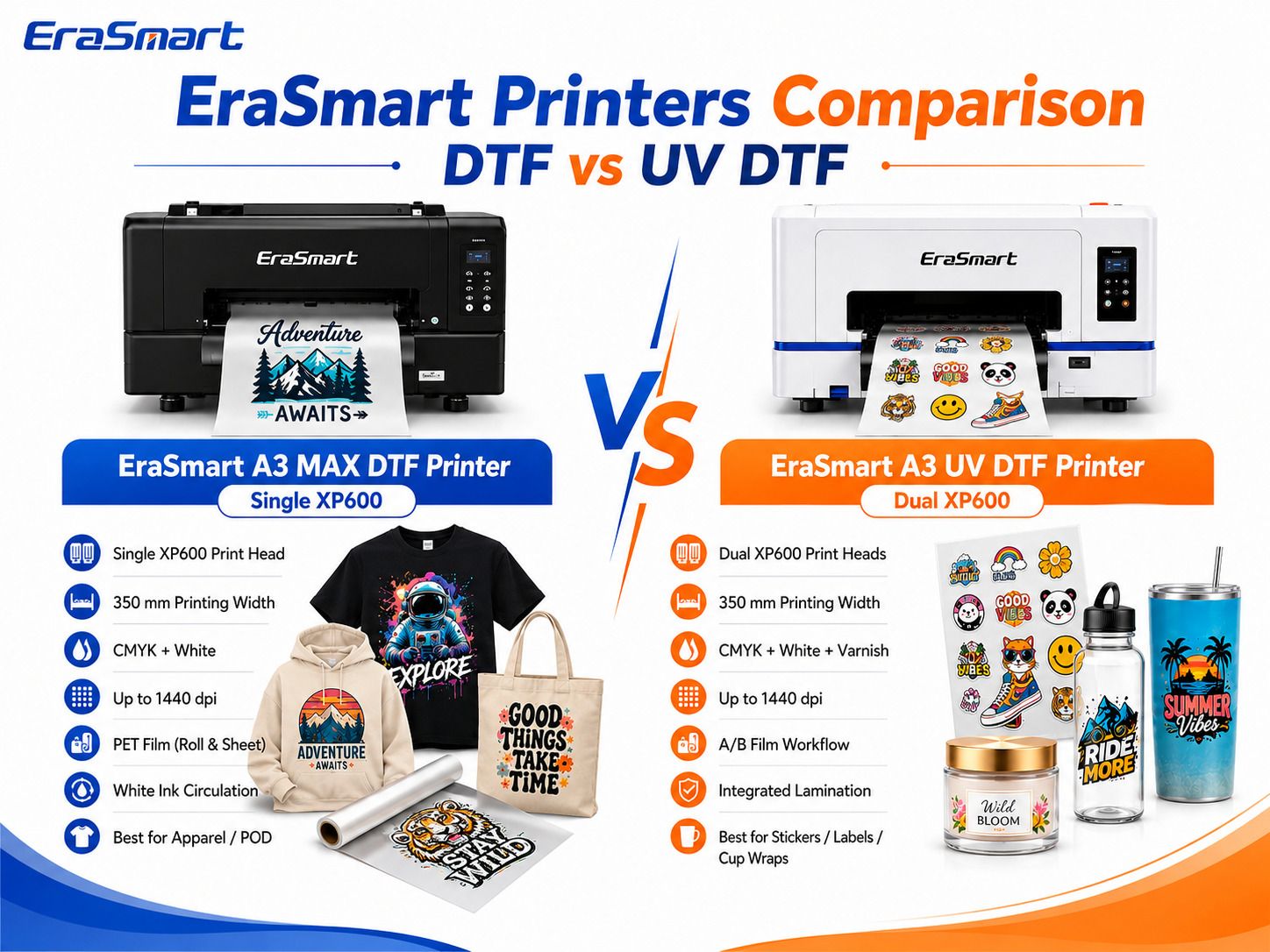
| Especificação | Impressora EraSmart A3 MAX DTF | Impressora EraSmart A3 UV DTF |
|---|---|---|
| Aplicação Principal | Transferências de vestuário | Decalques de superfície dura |
| Cabeçote de impressão | Único XP600 | XP600 duplo |
| Largura máxima de impressão | 350 milímetros | 350 milímetros |
| Sistema de cores | CMYK + Branco | CMYK + Branco + Verniz |
| Resolução | Até 1440 dpi | Até 1440 dpi |
| Filme | Filme, rolo e folha PET | Filme UV DTF A/B |
| Fluxo de trabalho adesivo | Pó termofusível | Sistema adesivo de filme A/B |
| Cura | É necessária cura em pó | Cura UV LED |
| Laminação | Não faz parte do fluxo de trabalho padrão de transferência DTF | Fluxo de trabalho integrado/laminação a frio |
| Prensa térmica | Necessário para aplicar na roupa | Nenhuma prensa térmica de roupas para aplicação de decalque padrão |
| Gerenciamento de tinta branca | Circulação de tinta branca | Gerenciamento de tinta branca/UV |
| Melhor ajuste | Vestuário, POD, têxteis | Adesivos, etiquetas, embalagens para copos, decalques |
Impressora EraSmart A3 MAX DTF – XP600 única
O Impressora EraSmart A3 MAX DTF – XP600 única é uma impressora de transferência têxtil classe A3 projetada em torno de um fluxo de trabalho de filme PET de 350 mm.
Os principais recursos incluem:
- Cabeça de impressão XP600 única
- largura de impressão de até 350 mm
- CMYK + branco
- Rolo de filme PET e suporte para folhas
- até 1440 dpi
- Circulação de tinta branca
- Fluxo de trabalho Riin/EraRip
- projetado para vestuário personalizado e aplicações POD
É uma orientação prática para lojas que desejam produzir suas próprias transferências de vestuário internamente, sem passar imediatamente para uma plataforma de produção A1 mais ampla.
Impressora UV DTF EraSmart A3 — Dual XP600
O Impressora EraSmart A3 UV DTF foi projetado em torno do fluxo de trabalho de decalques de filme A/B.
Sua configuração principal inclui:
- Cabeças de impressão duplas XP600
- largura de mídia de até 350 mm
- CMYK + branco + verniz
- até 1440 dpi
- Fluxo de trabalho de filme A/B
- Cura UV
- fluxo de trabalho de laminação a frio/integrado
- sem pó termofusível
- sem prensa térmica de roupas para aplicação de decalque padrão
- projetado para adesivos, etiquetas, embalagens para copos e transferências em superfícies duras
A diferença importante não é que uma máquina tenha um cabeçote de impressão e a outra tenha dois.
A diferença importante é que as máquinas são projetadas para dois negócios diferentes.
Não compare a contagem de cabeçotes de impressão sem comparar o fluxo de trabalho
Isto merece atenção especial.
Um comprador pode ver:
- XP600 único em uma impressora
- Dual XP600 em outra impressora
e assumir imediatamente que a máquina de duas cabeças é simplesmente “melhor”.
Essa não é uma comparação útil.
Os cabeçotes de impressão são configurados de acordo com o sistema de tinta da máquina, largura, requisitos de camada e fluxo de trabalho pretendido.
Uma impressora UV DTF pode precisar gerenciar requisitos de CMYK, branco, verniz e cura/laminação.
Uma impressora DTF têxtil é otimizada para produção de transferência CMYK + branco.
Portanto:
Não escolha DTF versus DTF UV com base apenas na contagem de cabeçotes de impressão.
Escolha de acordo com o que você precisa fazer.
Custo: o que é mais barato para operar?
Não existe uma resposta universal responsável porque os custos variam de acordo com o mercado, fornecedor, tamanho do produto, cobertura de tinta, desperdício, mão de obra e tipo de pedido.
Em vez disso, compare a estrutura de custos.
Estrutura de custos DTF
Incluir:
- Tinta DTF
- Filme de animal de estimação
- pó termofusível
- energia de cura
- prensa térmica
- roupas em branco
- materiais de limpeza
- transferências falhadas
- manutenção
- trabalho
Estrutura de custos UV DTF
Incluir:
- Tinta UV
- tinta branca
- verniz
- O filme
- Filme B
- laminação
- materiais de limpeza
- decalques falhados
- trabalho de aplicação
- manutenção
- produtos em branco se você vende produtos acabados
O custo mais barato por metro quadrado não produz necessariamente o melhor negócio.
Um decalque de copo premium ou uma etiqueta de cosmético pode ser vendido de maneira muito diferente de uma grande estampa de camiseta.
Sempre calcule o custo com base no produto acabado que você vende, não apenas a tinta ou o filme.
Requisitos de espaço
Ambos os sistemas A3 podem caber em ambientes de impressão personalizada relativamente compactos, mas os fluxos de trabalho circundantes são diferentes.
Espaço de trabalho DTF
Planeje espaço para:
- impressora
- Filme de animal de estimação
- pó
- sistema de cura
- prensa térmica
- preparação de roupas
- transferências concluídas
- contenção de pó
- ventilação
Se você adicionar um agitador de pó automático, o espaço de produção se tornará maior, mas o fluxo de trabalho se tornará mais automatizado.
Espaço de trabalho UV DTF
Planeje espaço para:
- Impressora UV DTF
- Armazenamento de filmes A/B
- laminação
- cortar/aparar
- aplicação de decalque
- armazenamento de produtos duros
- materiais de limpeza
Uma empresa UV DTF pode não precisar de uma prensa térmica para roupas, mas pode exigir muito mais armazenamento se você vender muitos produtos duros em branco diferentes.
Qual sistema é melhor para pedidos pequenos de alta variedade?
É aqui que ambas as tecnologias apresentam bom desempenho, mas em mercados diferentes.
O DTF é forte quando um pedido do cliente contém:
- cinco modelos de camisa
- várias cores de roupas
- nomes diferentes
- números da equipe
- baixas quantidades por projeto
UV DTF é forte quando um pedido contém:
- vários decalques de logotipo
- vários tamanhos de garrafas
- envoltórios de copo
- rótulos de embalagens
- nomes personalizados diferentes
Ambos os fluxos de trabalho ajudam as pequenas empresas a evitar os altos requisitos tradicionais de configuração.
A diferença é a categoria do produto.
Qual sistema você deve comprar primeiro?
Use o seguinte guia de decisão.
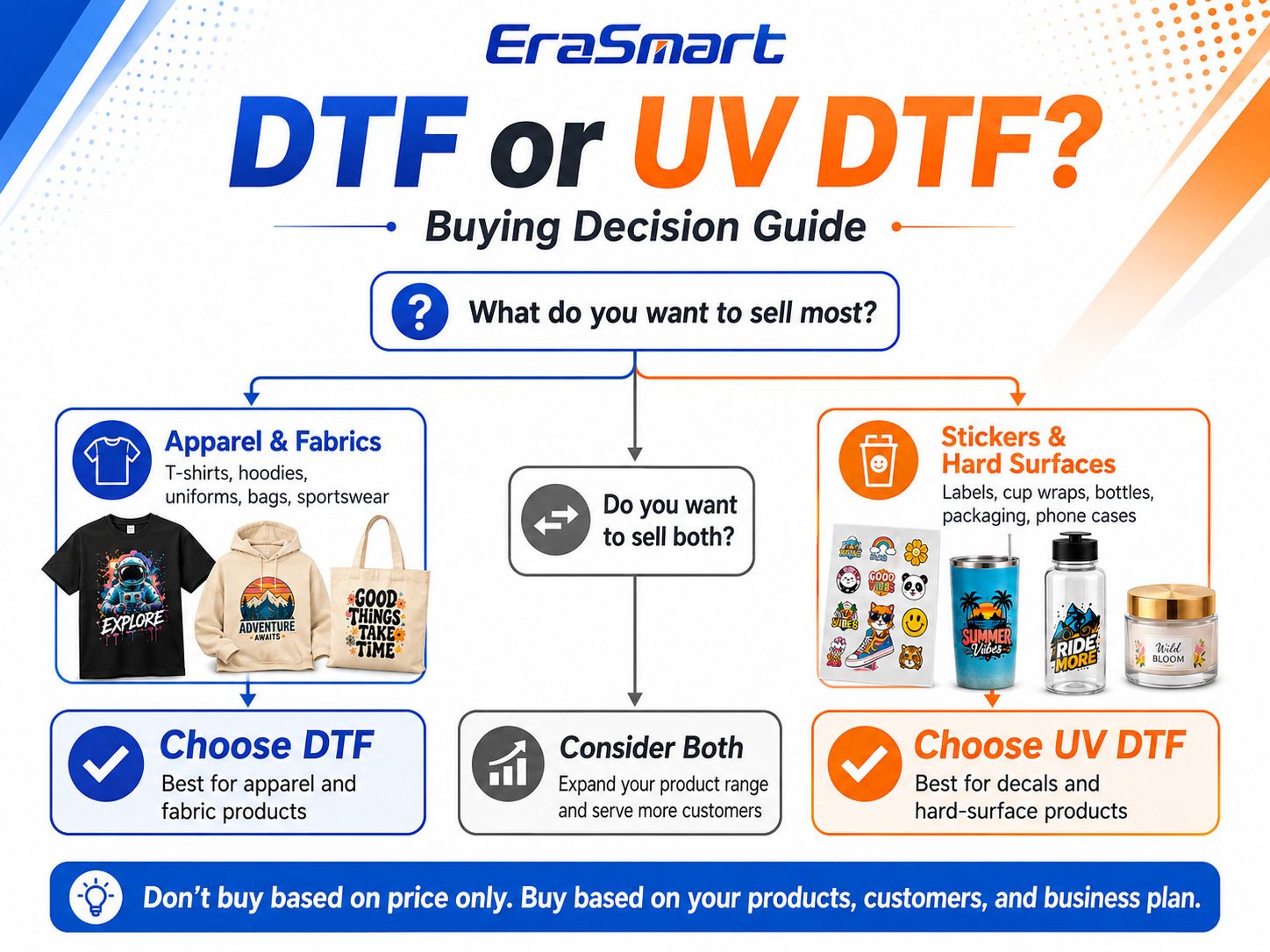
Escolha DTF se:
- a maioria dos seus produtos são roupas
- os clientes querem camisetas e moletons
- você quer construir uma marca de roupas
- você quer servir equipes e escolas
- você planeja vender transferências DTF
- você precisa de impressão colorida em roupas escuras
- Vestuário POD é o seu principal negócio
Comece com o Impressora EraSmart DTF faixa.
Escolha UV DTF se:
- adesivos e decalques são seus principais produtos
- você quer vender embalagens para copos
- você serve velas ou marcas de cosméticos
- rótulos de embalagens são um mercado importante
- os clientes trazem garrafas, potes ou produtos para presente
- você quer efeitos de verniz pontual
- você quer um negócio de transferência de superfície dura
Comece com o Impressora EraSmart UV DTF faixa.
Considere ambos se:
- você já tem clientes solicitando roupas e produtos duráveis de marca
- você deseja oferecer pacotes completos de mercadorias
- seus clientes atuais da DTF querem rótulos e embalagens para copos
- seus clientes existentes de decalques querem roupas
- o volume do seu pedido pode suportar dois fluxos de trabalho separados
- você tem espaço de trabalho e equipe suficientes para manter ambos os sistemas
Não compre duas máquinas simplesmente porque deseja “mais possibilidades”.
Compre o segundo sistema depois que a demanda do cliente provar que essas possibilidades são reais.
DTF vs UV DTF: comparação final
| Categoria | Dtf | DTF UV |
|---|---|---|
| Mercado Primário | Vestuário | Decalques de superfície dura |
| Produtos Típicos | Camisetas, moletons, uniformes, bolsas | Adesivos, copos, garrafas, rótulos, embalagens |
| Tinta | Tinta pigmentada DTF | Tinta curável por UV |
| Configuração de cores | CMYK + Branco | CMYK + Branco + Verniz |
| Filme | BICHO DE ESTIMAÇÃO | Filme A/B |
| Adesivo | Pó termofusível | Adesivo de filme A/B |
| Cura | Cura em pó | LED UV |
| Transferência Final | Prensa térmica | Aplicação a frio |
| Prensa térmica | Sim | Normalmente não |
| Pó | Sim | Não |
| Efeitos de verniz | Nenhuma camada de verniz padrão | Sim |
| Foco Principal de Manutenção | Fluxo de trabalho de tinta branca, cabeçote de impressão e pó | Tinta branca, tinta UV, verniz, cabeçote de impressão, filme/laminação |
| Melhor iniciante | Iniciante focado em vestuário | Iniciante focado em decalques/produtos duráveis |
| Melhor Direção de Negócios | POD, vestuário, transferências | Adesivos, etiquetas, marcas de presentes/produtos |
Resposta final: UV DTF ou DTF – Qual impressora você deve comprar?
Se o seu negócio é construído em torno Camisetas, moletons, uniformes, roupas esportivas, sacolas e produtos têxteis, compre um Impressora DTF.
Se o seu negócio é construído em torno adesivos, rótulos, embalagens para copos, garrafas, potes, embalagens, gadgets e decalques para superfícies duras, compre um Impressora UV DTF.
Se seus clientes precisam consistentemente de marcas de roupas e produtos, considere operar ambos os sistemas assim que o volume de pedidos justificar o investimento.
O maior erro de compra é escolher de acordo com as especificações antes de escolher o produto.
Não comece com:
Qual impressora tem mais cabeçotes de impressão?
Não comece com:
Qual impressora tem o DPI mais alto?
E não comece com:
Qual impressora é mais barata?
Comece com:
O que vou vender e quem vai comprar?
Uma vez que a resposta esteja clara, a escolha entre DTF e UV DTF torna-se muito mais fácil.
Perguntas frequentes
O UV DTF é melhor que o DTF?
Não. UV DTF e DTF são projetados para diferentes aplicações. O DTF é mais adequado para transferências de têxteis e vestuário, enquanto o DTF UV é projetado para decalques aplicados em superfícies duras compatíveis.
Uma impressora UV DTF pode imprimir camisetas?
O DTF UV não deve ser tratado como um substituto do DTF têxtil. Para camisetas, moletons, uniformes e produtos de tecido, use um tecido Impressora DTF.
Uma impressora DTF pode fazer embalagens para copos?
As transferências DTF têxteis padrão são projetadas para têxteis compatíveis com prensagem térmica. Para embalagens de copos, garrafas, rótulos e decalques de superfícies duras, use um Impressora UV DTF.
O UV DTF requer uma prensa térmica?
Os decalques UV DTF padrão usam um fluxo de trabalho de filme A/B de transferência a frio e normalmente não requerem uma prensa térmica para aplicação.
O DTF requer pó?
Sim. A produção têxtil padrão de DTF utiliza pó adesivo termofusível que é aplicado ao transfer impresso e curado antes da prensagem térmica.
O UV DTF usa pó?
Não. O DTF UV usa tinta curável por UV e um sistema de transferência de filme A/B em vez de pó DTF termofusível.
Qual é a diferença entre o filme DTF e o filme UV DTF?
O DTF têxtil geralmente usa filme de transferência PET que contém tinta DTF e pó adesivo termofusível antes da prensagem térmica.
UV DTF normalmente usa um sistema de filme A/B. A imagem é impressa e curada por UV em filme A, depois laminada e transferida usando filme B.
O que é melhor para uma pequena empresa?
Se a empresa vende principalmente roupas, o DTF geralmente é o melhor sistema inicial. Se a empresa vende principalmente adesivos, etiquetas, embalagens para copos e produtos duráveis, o UV DTF geralmente é o melhor sistema inicial.
O que é mais fácil de manter?
Ambos exigem manutenção de rotina da impressora jato de tinta. O DTF requer um gerenciamento cuidadoso do fluxo de trabalho de tinta branca e pó. O UV DTF também requer cabeçote de impressão, tinta branca, verniz, tinta UV e gerenciamento de filme/laminação. Nenhum deles deve ser considerado livre de manutenção.
Posso começar com DTF e adicionar UV DTF mais tarde?
Sim. Este é um caminho prático de expansão para uma empresa de vestuário que começa a receber solicitações de decalques, copos, rótulos de embalagens e outros produtos de superfície dura.
Posso começar com UV DTF e adicionar DTF mais tarde?
Sim. Empresas de adesivos, presentes e marcas de produtos podem adicionar DTF posteriormente quando os clientes começarem a solicitar camisetas, moletons, uniformes de funcionários e mercadorias de vestuário.
Não tem certeza se DTF ou UV DTF se adapta ao seu negócio?
Diga ao EraSmart:
- quais produtos você deseja vender
- quais materiais você irá personalizar
- sua quantidade típica do pedido
- sua produção diária esperada
- seu espaço de trabalho
- se você está começando em casa ou administrando uma gráfica
- seu futuro plano de expansão de produto
Nossa equipe pode ajudá-lo a comparar o produto certo Impressora DTF e Impressora UV DTF fluxo de trabalho baseado em seus produtos reais, em vez de recomendar uma máquina apenas por especificações.
Pode ser você também

Copyright 2020 © Erasmart. | Sitemap