小型サイズのフラットベッドインクジェットプリンターメーカー

86-18566233796 [email protected]

ブログ DTF Ink vs Sublimation Ink vs DTG and UV Ink: Key Differences

DTF Ink vs Sublimation Ink vs DTG and UV Ink: Key Differences

July 20, 2026 ブログ

Ink is not simply a colored liquid added to a printer.

Every printing process requires an ink formulation designed for a specific printhead, printing surface, curing method and production workflow. DTF ink, sublimation ink, DTG ink and UV ink may all produce full-color images, but they cannot be used interchangeably.

Using the wrong ink can cause:

  • Poor color output

  • Weak adhesion

  • Printhead clogging

  • Ink separation

  • Failed curing

  • Damaged ink lines

  • Short product life

  • Permanent printer damage

For a custom printing business, choosing the correct ink is therefore just as important as choosing the printer itself.

This guide explains how the main types of digital printing ink work, which materials they support, why white ink requires special maintenance and why printer ink, media, RIP software and color profiles must be treated as one complete system.

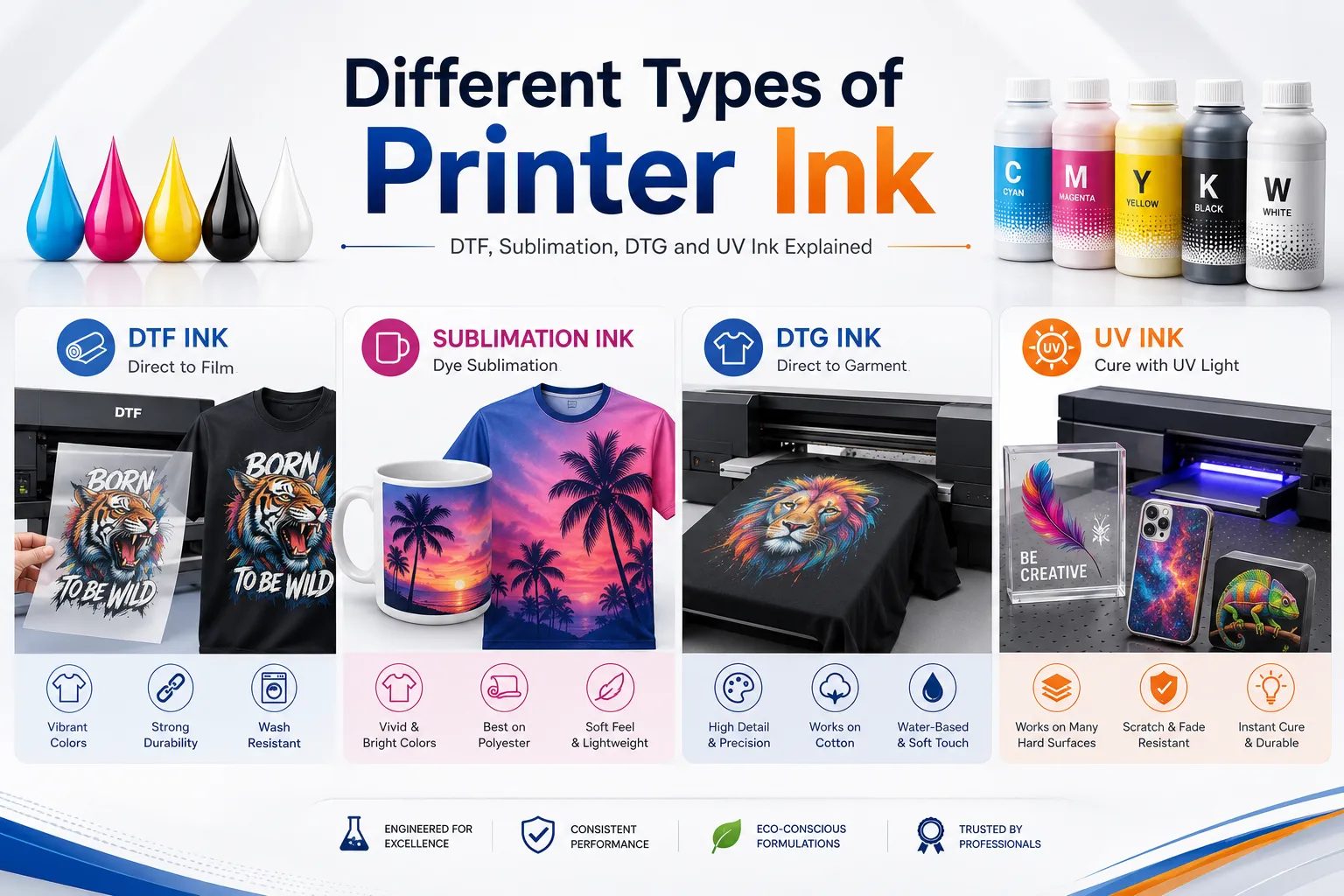
Printer Ink Types at a Glance

インクの種類Main printing processTypical colorant or curing method最高のアプリケーション
DTFインクDirect-to-film transferHeat-transfer pigment inkCotton, polyester, blends and dark apparel
昇華インクDye-sublimation transferDisperse dyePolyester and polymer-coated products
DTG inkDirect-to-garment printingWater-based pigment inkCotton garments and selected treated fabrics
UVインクUV flatbed and UV DTF printingUV硬化型インクAcrylic, glass, metal, plastic, wood and coated surfaces
Standard dye inkDocuments and photographsWater-soluble dyePaper and photo media
Standard pigment inkDocuments and fine-art printingPigment particlesPaper, labels and archival prints
Solvent inkSign and graphics printingSolvent-carried colorantVinyl, banners and outdoor signage

The four most relevant types for a personalized printing business are DTF, sublimation, DTG and UV ink.

What Is Printer Ink Made Of?

Although formulations differ, inkjet ink usually contains several functional components.

Colorant

The colorant creates the visible color.

It may be:

  • Pigment particles

  • Dissolved dyes

  • Disperse dyes

  • UV-curable color components

Pigments remain as very small solid particles in the formulation. Dyes are dissolved or dispersed and interact differently with the final material.

Carrier Liquid

The carrier helps move the ink through the ink system and printhead.

Depending on the ink technology, the carrier may be primarily:

  • Water

  • Solvents

  • Glycols

  • UV-curable liquid components

Binder or Resin

Binders help the colorant attach to the printing surface.

They influence:

  • 接着力

  • 柔軟性

  • Gloss

  • Scratch resistance

  • 耐洗濯性

  • 表面感

Additives

Additives control properties such as:

  • Surface tension

  • Viscosity

  • Drying behavior

  • Foam control

  • Ink flow

  • Storage stability

  • Nozzle performance

Small formulation differences can significantly affect how an ink behaves inside a printhead. This is one reason inks from different systems should not be mixed casually.

What Is DTF Ink?

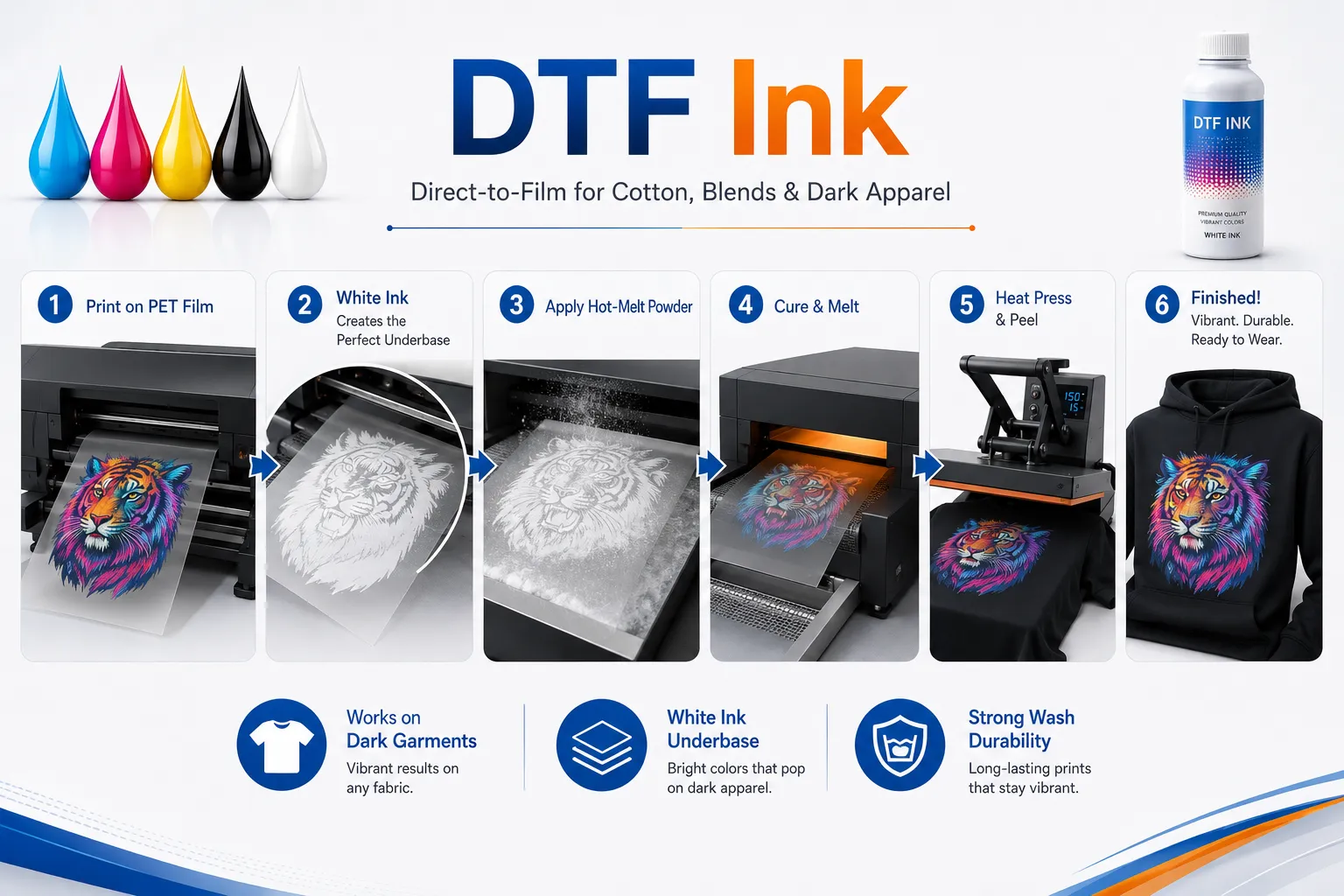
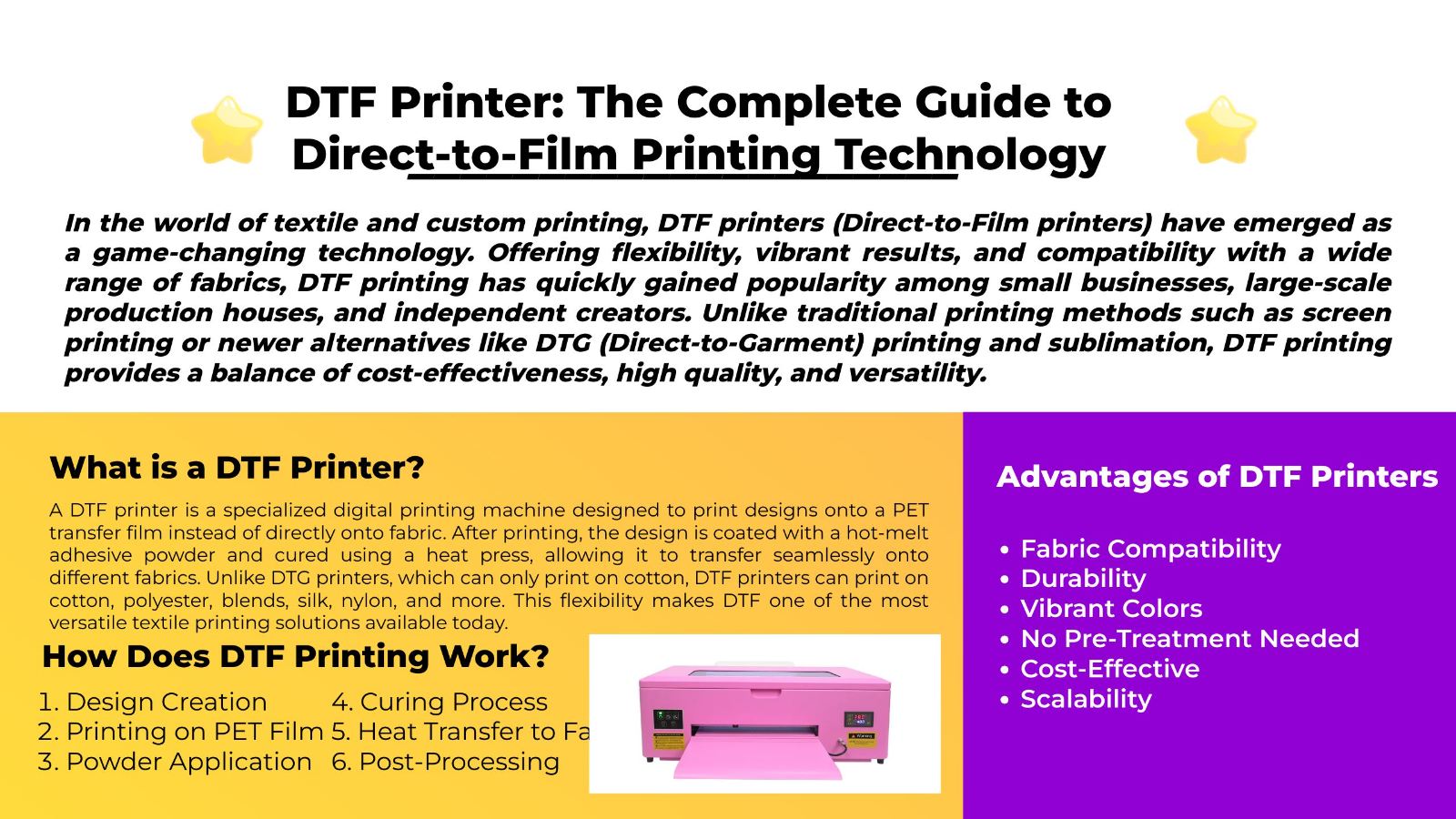
DTF ink is designed for direct-to-film transfer printing.

The ink is printed onto a specially coated PET film rather than directly onto the garment. After printing, hot-melt adhesive powder is applied and cured. The completed design is then transferred to the fabric using a heat press.

Professional DTF systems commonly use five ink channels:

  • シアン

  • マゼンタ

  • 黄色

How DTF Ink Works

一般的な DTF ワークフローには次のものが含まれます。

  1. Printing the color layer onto coated PET film

  2. Printing a white ink layer

  3. ホットメルト接着剤パウダーの塗布

  4. Curing the powder

  5. Positioning the transfer on the garment

  6. Heat pressing the transfer

  7. キャリアフィルムを剥がす

  8. Completing a finishing press when required

The ink, film, adhesive powder and pressing conditions must work together.

You can learn more about the complete material system in EraSmart’s DTF 消耗品ガイド

What Materials Can DTF Ink Print?

DTF transfers can commonly be used on:

  • コットン

  • ポリエステル

  • 綿とポリエステルの混紡

  • キャンバス

  • フリース

  • デニム

  • 軽装

  • 暗い色の衣服

The white ink underbase allows the color layer to remain visible on black, navy, red and other dark fabrics.

Advantages of DTF Ink

DTF ink supports:

  • Full-color graphics

  • White printing

  • Dark garment decoration

  • 細かい部分

  • Small-batch production

  • Multiple fabric types

  • Custom gang sheets

  • Flexible apparel workflows

Limitations of DTF Ink

DTF ink also introduces several challenges:

  • White ink requires circulation and maintenance.

  • Ink must match the PET film and powder.

  • Incorrect curing can weaken adhesion.

  • Poor-quality ink may increase nozzle problems.

  • Large solid designs may produce a more noticeable surface feel.

  • The printer should not remain idle without proper maintenance.

What Is Sublimation Ink?

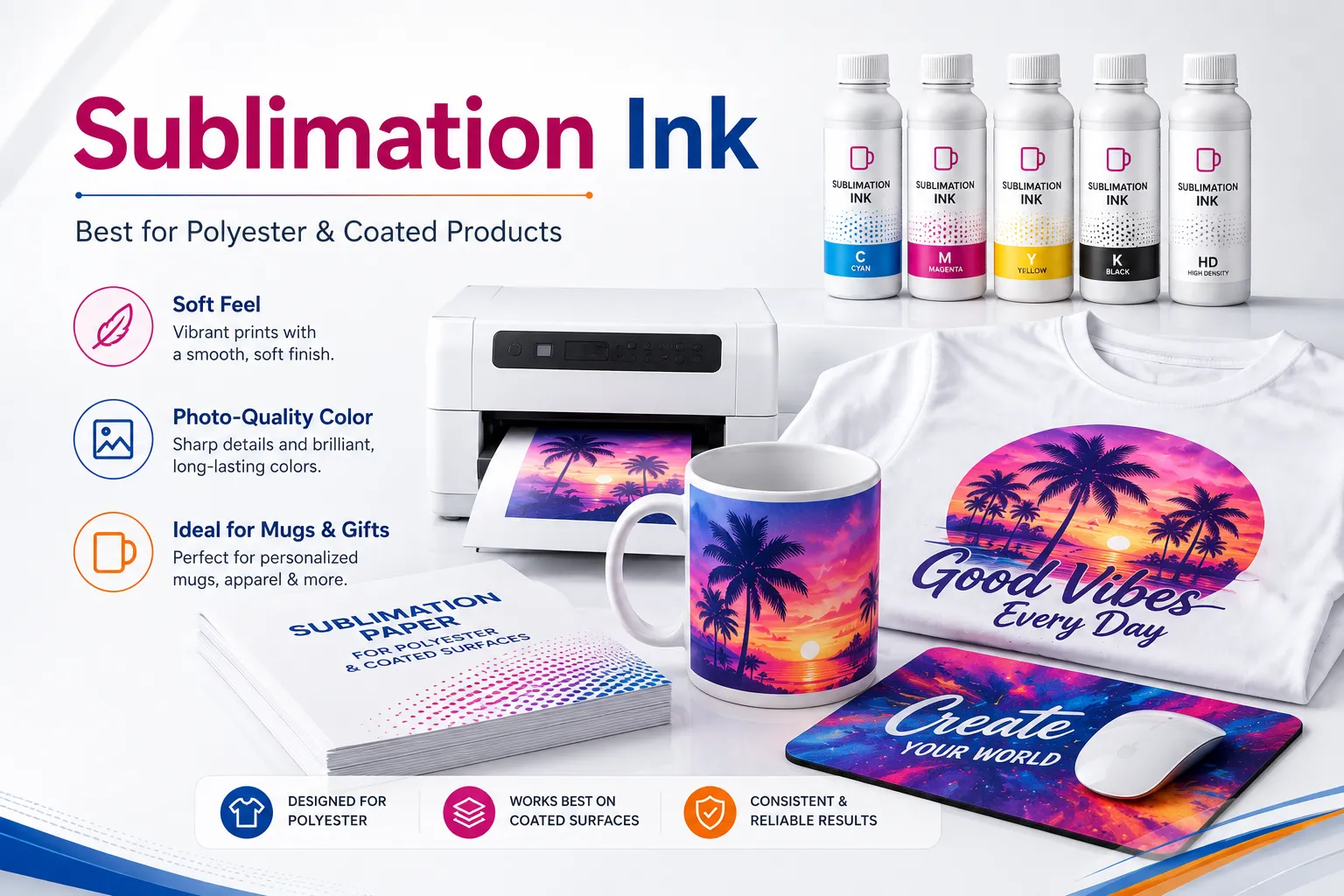
Sublimation ink is a dye-based ink formulated for heat transfer onto polyester or polymer-coated products.

The design is first printed onto sublimation paper. During heat pressing, the disperse dye becomes mobile and enters the polyester fiber or compatible coating. After cooling, the color becomes part of the material.

How Sublimation Ink Works

The basic process includes:

  1. Printing a mirrored design onto sublimation paper

  2. Positioning the paper on the product

  3. Fixing it with heat-resistant tape

  4. Applying the required heat, time and pressure

  5. Removing the transfer paper

  6. Allowing the product to cool

The exact pressing conditions depend on the ink, paper, blank, coating and heat press. There is no single universal setting for every sublimation product.

What Materials Can Sublimation Ink Print?

昇華は次の場合に最適に機能します。

  • 白いポリエステルシャツ

  • Light-colored polyester garments

  • Coated ceramic mugs

  • コーティングタンブラー

  • マウスパッド

  • Phone case inserts

  • ポリエステル枕カバー

  • Coated aluminum panels

  • キーホルダー

  • コースター

  • Photo gifts

Why Sublimation Does Not Work Well on Cotton

Sublimation dye needs polyester or a compatible polymer coating.

Ordinary cotton does not provide the same dye-binding structure. A sublimated design on untreated cotton may appear weak and may not provide acceptable wash durability.

Why Sublimation Is Limited on Dark Products

Sublimation ink is transparent and normally does not include white ink.

The color of the product remains visible underneath the design. This is why sublimation performs best on white or light surfaces.

Advantages of Sublimation Ink

Sublimation can provide:

  • 滑らかな勾配

  • Photo-quality output

  • No raised transfer layer

  • Strong durability on compatible materials

  • Full-color gift products

  • Low material consumption

  • Easy personalization

Limitations of Sublimation Ink

Its limitations include:

  • Restricted material compatibility

  • Poor visibility on dark products

  • No white ink

  • Dependence on coating quality

  • Potential ghosting if paper moves

  • Color variation caused by incorrect ICC profiles or pressing conditions

For a more detailed business comparison, see DTF印刷と昇華印刷

DTF Ink vs Sublimation Ink

DTF and sublimation are both heat-transfer processes, but the inks behave differently.

比較DTFインク昇華インク
Ink categoryHeat-transfer pigment inkDisperse dye ink
Printing mediumCoated PET film昇華紙
白インクはいいいえ
接着剤粉末必須必要ありません
Best fabrics綿、ポリエステル、混紡ポリエステル
暗い色の衣服SuitableGenerally unsuitable
Coated hard products限定Highly suitable
表面感転写層が残るDye becomes part of the material
Printer maintenanceHigher because of white inkGenerally lower
Main products衣服Apparel and personalized gifts

The correct choice depends more on the product than on which ink is “better.”

Choose DTF for dark cotton apparel, hoodies, uniforms and tote bags. Choose sublimation for polyester garments, mugs, mousepads and coated photo gifts.

What Is DTG Ink?

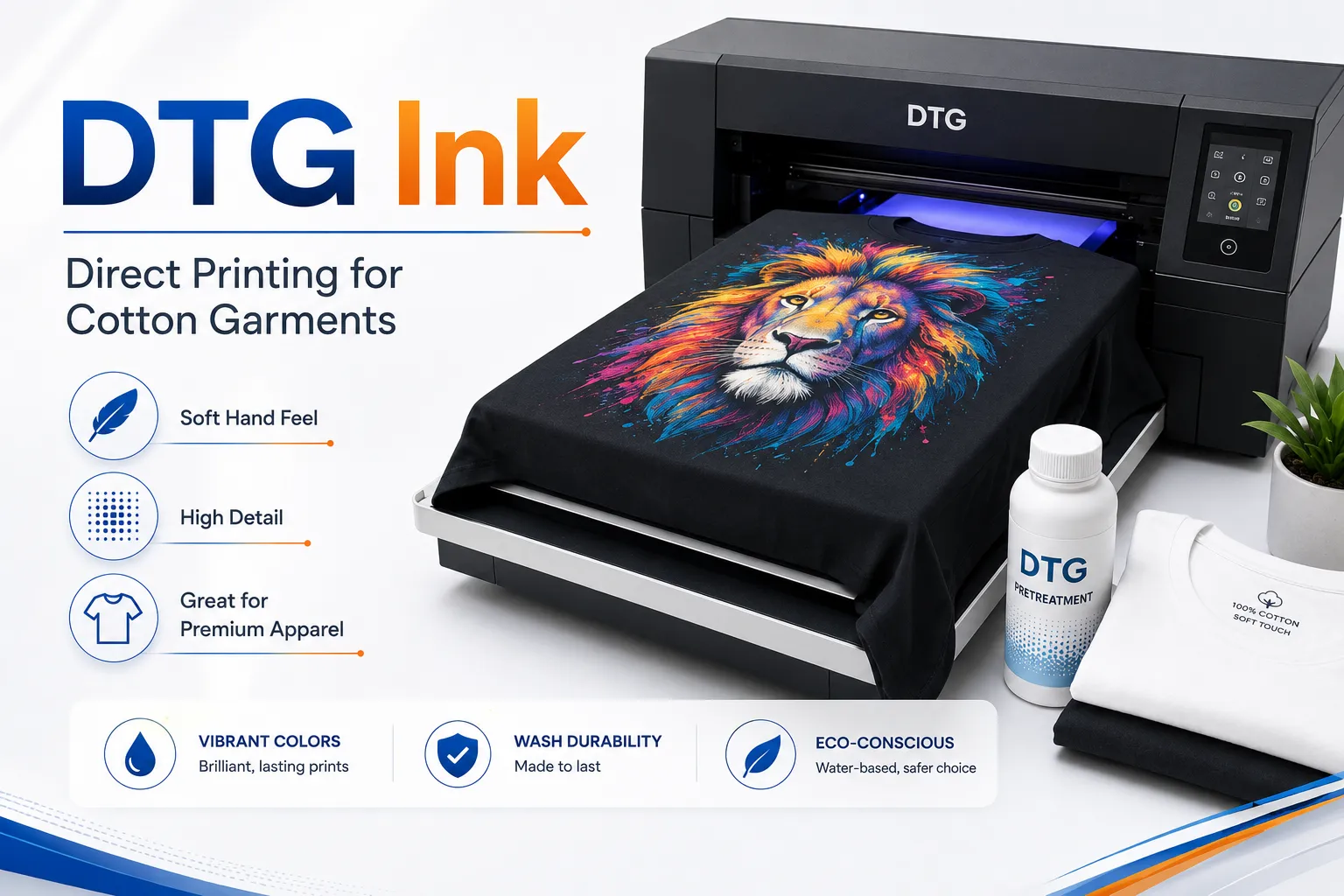
DTG stands for direct-to-garment printing.

Unlike DTF, DTG ink is printed directly onto the garment. The printed fabric is then heat-cured to fix the ink.

DTG systems commonly use water-based pigment inks in:

  • シアン

  • マゼンタ

  • 黄色

How DTG Ink Works

A typical DTG workflow includes:

  1. Preparing the garment

  2. Applying pretreatment when required

  3. Drying or pressing the pretreatment

  4. Loading the garment onto the platen

  5. Printing directly onto the fabric

  6. Heat curing the printed garment

Best Applications for DTG Ink

DTG is commonly used for:

  • Premium cotton T-shirts

  • Detailed artwork

  • Photographic shirt printing

  • One-off custom garments

  • Small-batch fashion products

  • Designs requiring a softer feel on cotton

DTF Ink vs DTG Ink

比較DTFインクDTG ink
Printed ontoペット映画衣服
接着剤粉末必須必要ありません
PretreatmentUsually not applied to the garmentOften required
Fabric rangeBroadStrongest on suitable cotton
ワークフローTransfer production and pressingDirect printing and curing
Storage of printsTransfers can be produced in advanceGarment is printed directly
Fine cotton feel良いOften softer on suitable garments

You can explore the differences further in EraSmart’s DTG printer vs DTF printer guide

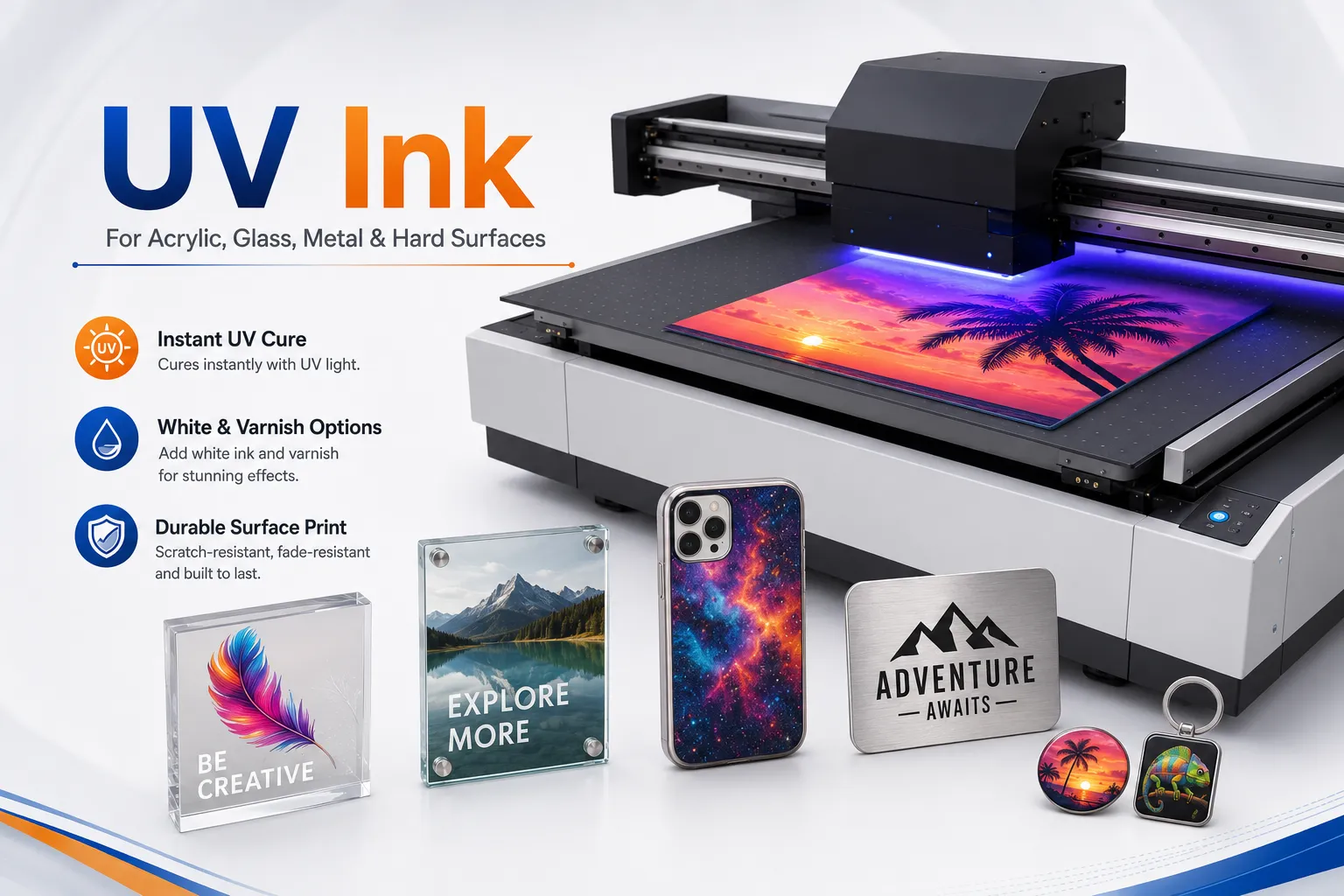
What Is UV Ink?

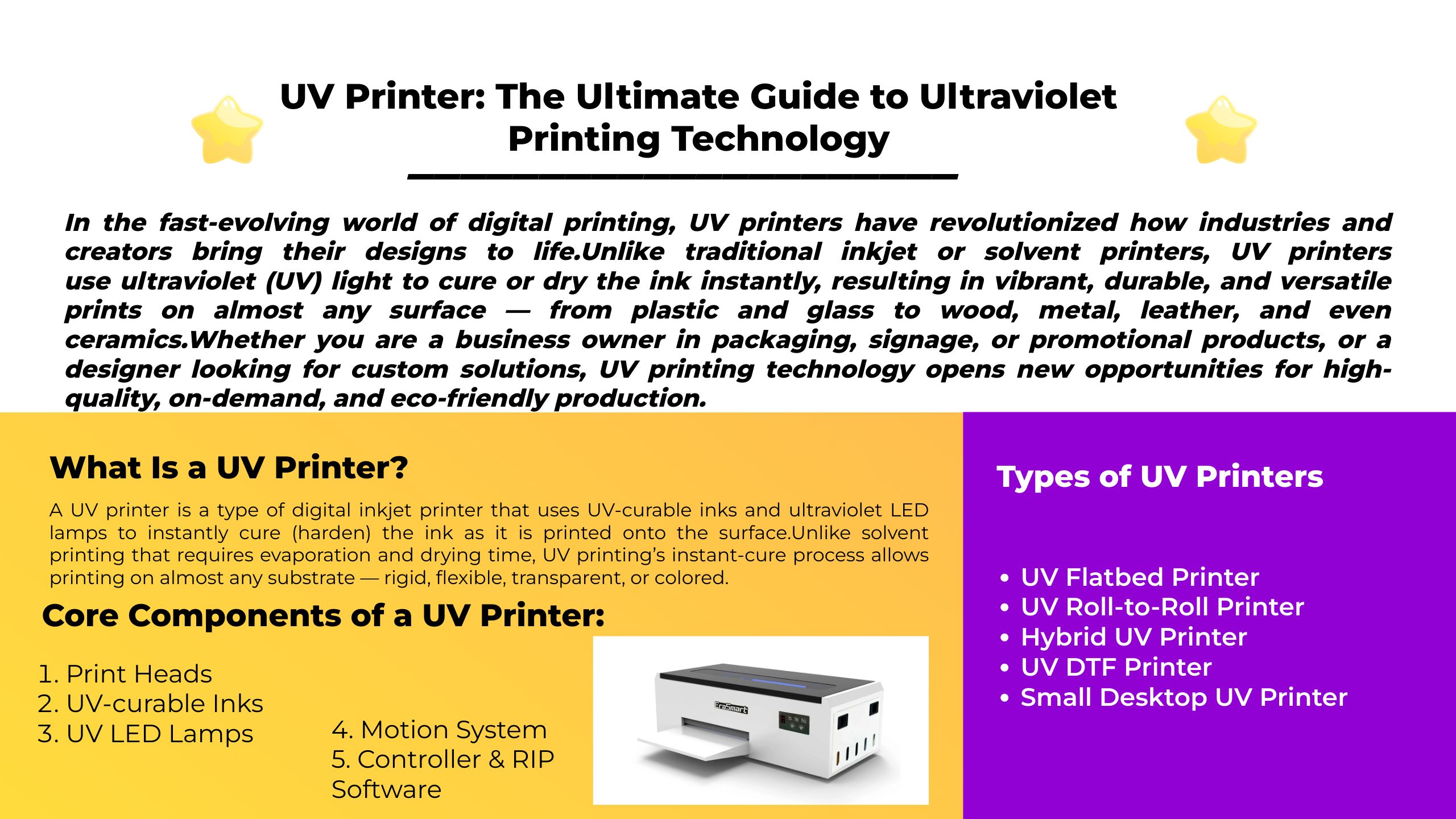
UV ink is designed to cure under ultraviolet light.

Instead of drying primarily through evaporation or being heat-transferred into a fabric, UV-curable ink changes into a solid printed layer when exposed to the printer’s UV LED lamps.

Mimaki explains that UV ink cures and adheres directly to the substrate under UV radiation. UV systems can print on non-absorbent materials such as plastic, glass and metal, and different hard or flexible formulations are available for different applications.

Common UV Ink Channels

A UV printer may use:

  • シアン

  • マゼンタ

  • 黄色

  • Varnish or clear ink

  • Primer in supported systems

  • Light cyan and light magenta in some configurations

What Can UV Ink Print?

Depending on the printer and fixture, UV ink may be used on:

  • アクリル

  • ガラス

  • 金属

  • 木材

  • プラスチック

  • レザー

  • セラミック

  • 電話ケース

  • 販促品

  • Signs

  • パッケージング

  • フラットパネル

White UV Ink

White UV ink can be used as:

  • An underbase beneath color

  • A backing layer on transparent material

  • A standalone white design

  • Part of multilayer printing

Varnish Ink

Clear or varnish ink can create:

  • Gloss effects

  • Spot highlights

  • Textured surfaces

  • Raised details

  • Protective visual effects

Read EraSmart’s UV ink guide for CMYK, white and varnish for a more detailed explanation.

UV Ink vs DTF Ink

DTF and UV printing are designed for different product categories.

比較DTFインクUVインク
Primary productsFabric and apparelHard and semi-rigid products
硬化方法Powder curing and heat pressingUV LED curing
Transfer mediumペット映画Usually direct printing
白インクはいCommonly available
ワニスNormally noAvailable on supported systems
Cotton garmentsSuitable through transferGenerally not the main application
Acrylic and metalNot the main useSuitable
表面感Flexible transfer layerCured ink film

UV DTF is a separate process that uses UV ink to print onto an adhesive film system before transferring the graphic to a hard product.

To avoid confusing these technologies, see UV DTF vs textile DTF vs UV flatbed printing

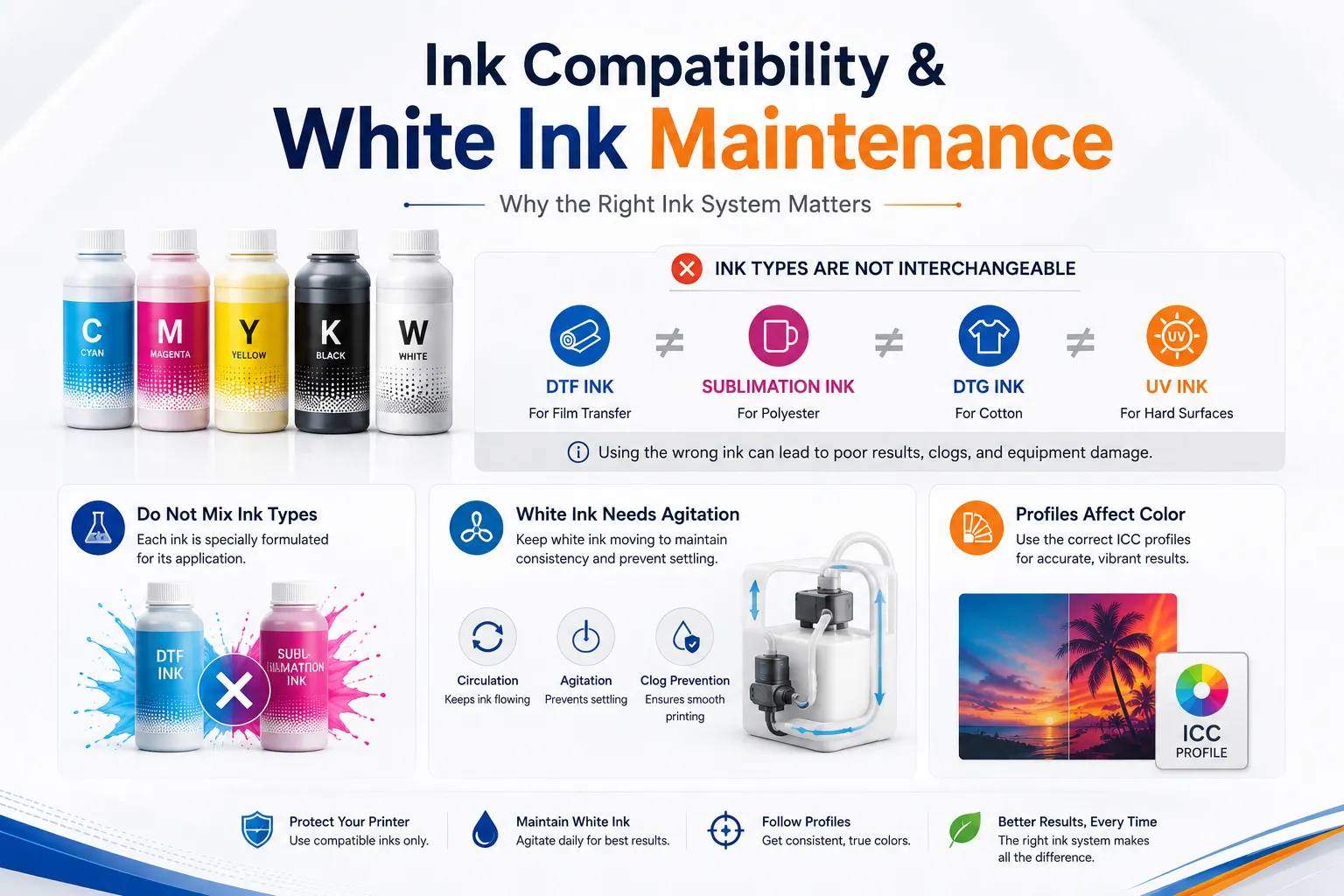
Why White Ink Requires More Maintenance

White ink behaves differently from standard CMYK ink.

White formulations contain dense pigment to create opacity. These particles are more likely to settle when the printer remains idle or when the ink is not circulated correctly.

Potential problems include:

  • Reduced white density

  • Nozzle loss

  • Ink separation

  • Uneven underbase

  • White ink mist

  • Deflected droplets

  • Clogged ink paths

Printer manufacturers therefore use features such as:

  • 白インクの循環

  • Automatic stirring

  • Scheduled head refresh

  • Cartridge or ink-pack agitation

  • Guided cleaning cycles

The correct procedure depends on the printer model. Follow the machine manual rather than applying a generic maintenance schedule.

For practical prevention steps, read how to prevent white ink clogging

Why Different Printer Inks Cannot Be Mixed

Two ink bottles may appear to contain the same CMYK colors, but their formulations may differ in:

  • Viscosity

  • Surface tension

  • Pigment size

  • Dye concentration

  • Resin chemistry

  • Drying behavior

  • Curing requirements

  • pH

  • Printhead compatibility

Mixing incompatible inks may cause:

  • Chemical reactions

  • Sediment

  • Gel formation

  • Ink separation

  • Color shifts

  • Blocked dampers

  • Damaged printheads

  • Unstable white ink

Never combine:

  • DTF ink and sublimation ink

  • UV ink and water-based ink

  • DTG ink and UV ink

  • Cleaning solution and ink without an approved procedure

  • Different brands merely because the colors appear similar

Even two products labeled “DTF ink” may not be suitable for mixing.

Before changing ink, confirm whether the printer requires:

  • Complete draining

  • Flushing solution

  • New dampers

  • New ink lines

  • New ICC profiles

  • Printer recalibration

EraSmartの DTF インク互換性ガイド explains the checks that should be completed before switching ink.

How Ink Affects the ICC Profile

An ICC profile or RIP ink curve controls how color data is converted into printer output.

The final result depends on the combination of:

  • プリンター

  • プリントヘッド

  • インク

  • メディア

  • 解決

  • Pass mode

  • 白インクの濃度

  • RIP設定

  • Curing or pressing conditions

Changing the ink can change:

  • 色の濃さ

  • Gray balance

  • Total ink limit

  • Black generation

  • Saturation

  • Drying behavior

  • White underbase requirements

A profile created for one ink, film and printer combination may not reproduce the same colors after any component is changed.

This is why apparently identical CMYK values can produce different printed results.

For additional color-management guidance, see 正しい色を印刷する方法

How to Choose the Correct Ink

Confirm the Printing Technology

First identify whether the machine is:

  • DTF

  • 昇華

  • DTG

  • UVフラットベッド

  • UV DTF

  • Eco-solvent

  • Standard aqueous inkjet

Do not select ink based only on bottle size or color.

Confirm the Printer and Printhead

チェック:

  • Printer model

  • Printhead model

  • Ink channel configuration

  • Ink delivery system

  • Manufacturer specifications

A compatible printhead does not automatically mean the entire printer is compatible with the ink.

Confirm the Application

Choose the ink based on what you intend to produce.

Use DTF ink for:

  • コットンアパレル

  • 暗い色の衣服

  • パーカー

  • トートバッグ

  • Fabric transfers

Use sublimation ink for:

  • ポリエステルシャツ

  • マグカップ

  • タンブラー

  • マウスパッド

  • Coated photo products

Use DTG ink for:

  • Direct garment printing

  • Premium cotton T-shirts

  • Detailed one-off apparel

Use UV ink for:

  • アクリル

  • ガラス

  • 金属

  • プラスチック

  • 電話ケース

  • Rigid promotional products

Confirm the Complete Consumable System

For DTF, verify compatibility among:

  • インク

  • ペット映画

  • 接着剤粉末

  • RIPプロファイル

  • 硬化装置

  • ヒートプレスの設定

For sublimation, verify:

  • インク

  • ICCプロファイル

  • ブランクコーティング

  • Pressing settings

For UV printing, verify:

  • Ink hardness or flexibility

  • Substrate

  • Primer

  • 白インク

  • ワニス

  • UV lamp settings

Ink Storage and Handling

Always follow the label, user manual and safety data sheet supplied with the ink.

General best practices include:

  • Store ink in its original sealed container.

  • Keep it away from direct sunlight.

  • Avoid extreme heat or freezing.

  • Keep the bottle clean before opening.

  • Do not return used ink to the original container.

  • Record the opening date.

  • Use older stock first.

  • Follow the stated expiration date.

  • Wear suitable protective equipment.

  • Keep ink away from children and food areas.

  • Review the relevant safety data sheet.

Do not apply one universal shelf-life rule to every ink. Storage life varies by formulation, packaging and manufacturer.

Common Ink-Related Printing Problems

Missing Nozzles

考えられる原因は次のとおりです。

  • Dried ink

  • Settled white pigment

  • Air in the ink line

  • Expired ink

  • Contaminated dampers

  • Incorrect maintenance

Weak Color

考えられる原因は次のとおりです。

  • 不正な ICC プロファイル

  • Low ink density

  • Incorrect media

  • Poor curing

  • Low-quality coating

  • Settled pigment

  • Incorrect print mode

Ink Not Adhering

考えられる原因は次のとおりです。

  • Wrong ink technology

  • Incompatible surface

  • Missing primer

  • Incorrect curing

  • Incorrect film coating

  • Contaminated material

Color Changes After Switching Ink

考えられる原因は次のとおりです。

  • Different pigment or dye characteristics

  • Old ink remaining in the system

  • 不正な ICC プロファイル

  • Changed white ink density

  • Different media response

Frequent Printhead Clogging

考えられる原因は次のとおりです。

  • Incompatible ink

  • Poor storage

  • Mixed formulations

  • Long idle periods

  • Insufficient white ink circulation

  • Incorrect cleaning solution

  • Contamination

Should You Always Use Manufacturer-Matched Ink?

A matched ink system usually provides the lowest operational risk because the printer, ink delivery system, RIP profile and maintenance procedure have been tested together.

This can help improve:

  • 色の一貫性

  • Nozzle stability

  • White ink performance

  • 接着力

  • テクニカルサポート

  • トラブルシューティング

  • Warranty clarity

The lowest-priced ink is not necessarily the lowest-cost ink to operate.

A cheaper bottle can become expensive if it causes:

  • Failed prints

  • Wasted film

  • Damaged garments

  • Excessive cleaning

  • Shortened printhead life

  • Production downtime

Evaluate ink by total production cost rather than bottle price alone.

最終的な考え

DTF, sublimation, DTG and UV ink are different chemical and production systems.

DTF ink is a heat-transfer pigment system designed for PET film, adhesive powder and fabric pressing.

Sublimation ink uses disperse dye to color polyester fibers and polymer-coated products.

DTG ink is printed directly onto prepared garments and then heat-cured.

UV ink cures under UV LED light and creates a durable printed layer on many rigid or non-absorbent materials.

None of these inks should be substituted based only on color or appearance.

Before purchasing ink, confirm:

  • Printer technology

  • Printer model

  • プリントヘッド

  • Ink channel configuration

  • メディア

  • 硬化方法

  • RIPプロファイル

  • 応用

  • Supplier support

The best ink is not simply the one that produces the brightest test print. It is the ink that provides stable jetting, predictable color, reliable adhesion and repeatable production throughout the life of the printer.

EraSmart provides DTF, DTG, UV and UV DTF printing solutions for different custom printing workflows. Explore the EraSmart DTF printer range or review the UV printer guide to choose a printing system suited to your materials and business model.

よくある質問

Is DTF ink the same as sublimation ink?

No. DTF ink is a heat-transfer pigment ink used with coated PET film and adhesive powder. Sublimation ink uses disperse dye and is transferred from paper into polyester or a polymer coating.

Can sublimation ink be used in a DTF printer?

No. Sublimation ink does not provide the white underbase, film behavior or adhesive workflow required for textile DTF production.

Can DTF ink be used for sublimation?

No. DTF pigment ink is not designed to diffuse into polyester in the same way as sublimation dye.

Is DTF ink water-based?

Commercial DTF inks are commonly formulated as aqueous heat-transfer pigment inks, but users should confirm the specification and safety data sheet of the exact product.

Why does DTF use white ink?

White ink creates an opaque underbase beneath CMYK colors, allowing designs to remain vivid on dark and colored garments.

Why does sublimation not use white ink?

Sublimation relies on transparent dyes entering polyester or a polymer coating. White areas normally come from the white product surface itself.

Why does white ink clog more easily?

White ink contains dense pigment for opacity. The pigment can settle when the ink is not circulated or agitated according to the printer’s maintenance requirements.

Can different brands of DTF ink be mixed?

Mixing is not recommended unless compatibility has been explicitly confirmed. Differences in chemistry, viscosity and pigment behavior can cause instability or printhead damage.

Does changing ink require a new ICC profile?

It often does. Different ink formulations can alter color density, gray balance, saturation and total ink limits.

Which ink is best for a small custom printing business?

Choose according to your products:

  • DTF for cotton and dark apparel

  • Sublimation for polyester and coated gifts

  • DTG for direct premium garment printing

  • UV for hard and promotional products


あなたも好きかもしれません

  • Erasmartプリンター

    UVプリンター
    DTFプリンター
    DTGプリンター
    ヒートプレスマシン
    広告プリンター

  • プリンターツール

    DTFオーブン
    ホットプレス
    カービングマシン
    マグ熱伝達
    ラミネートマシン

  • 消耗品

    印刷インク
    携帯電話ケース
    ガラス製品
    液体の洗浄
    綿棒

  • お問い合わせ

    WhatsApp:+8618566233796
    WeChat:+8618566233796
    モバイル:+8618566233796
    ウェブ:www.erasmart.com
    店:www.erasmartmall.com

  • プリンターの価格が必要ですか?

    印刷のニーズをお聞かせください。私たちのチームが 24 時間以内に返信いたします。

    見積もりをリクエストしてください

    いくつかの詳細を提供するだけで、簡単な見積もりを手に入れるのに役立ちます!