小型サイズのフラットベッドインクジェットプリンターメーカー

86-18566233796 [email protected]

ブログ UV 印刷ビジネスを始める方法: 費用、設備、90 日プラン

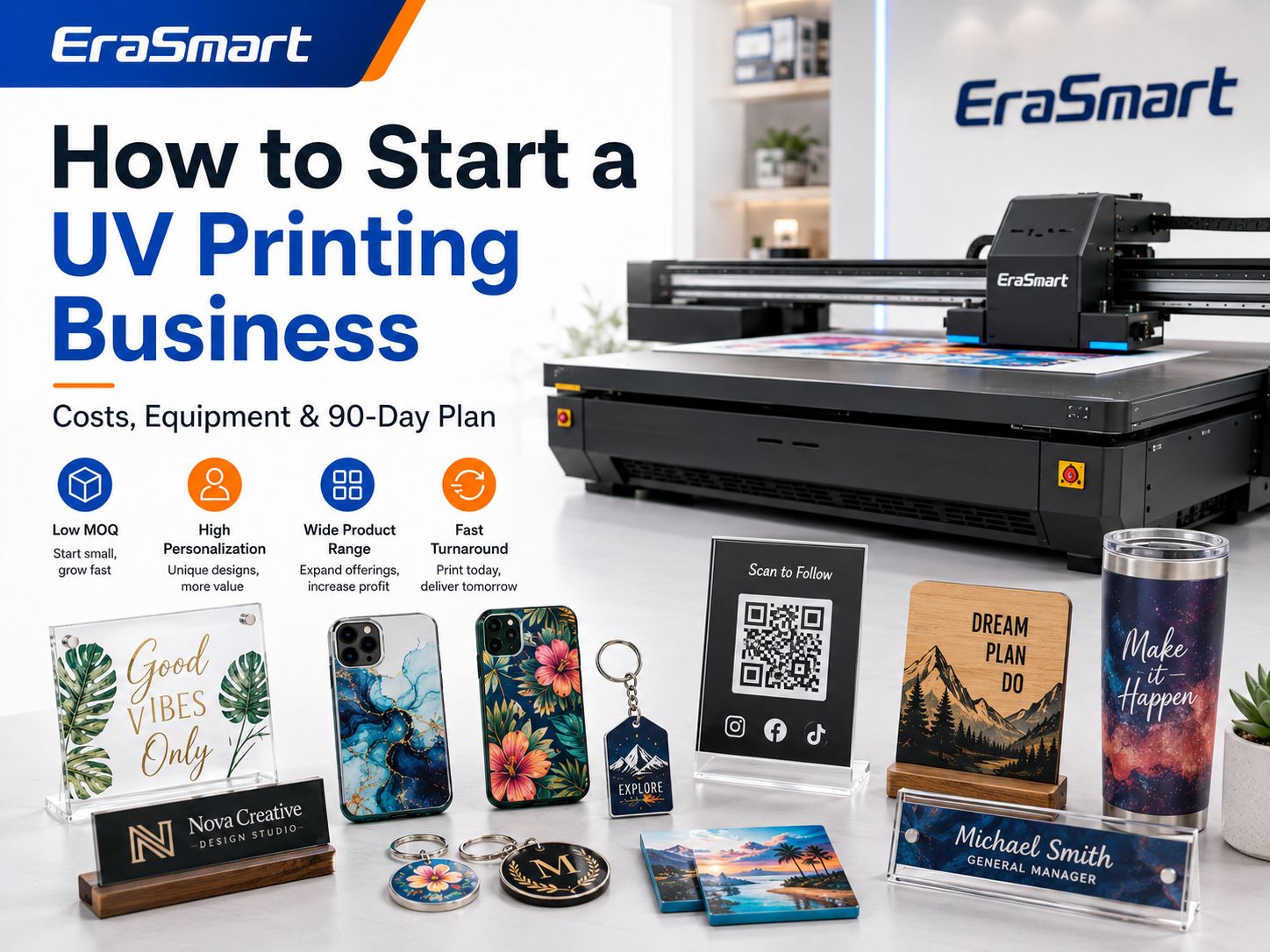
UV 印刷ビジネスを始める方法: 費用、設備、90 日プラン

2026 年 8 月 13 日 ブログ

Starting a UV printing business can be an attractive way to enter the personalized-products market because one printer can support many different product categories.

Depending on the printer, ink configuration and fixtures, you may be able to produce:

  • アクリルサイン
  • 電話ケース
  • キーホルダー
  • 木のギフト
  • メタルカード
  • Business nameplates
  • QRコードの表示
  • 受賞歴
  • 包装サンプル
  • 販促品
  • 結婚式の装飾
  • 写真パネル
  • 製品ラベル
  • Custom corporate gifts

Unlike traditional printing methods that may require screens, plates or transfer steps, a UV flatbed printer can print full-color graphics directly onto many suitable rigid surfaces and cure the ink during the printing process. EraSmart UV printer systems are designed around applications such as acrylic, phone cases, signs, gifts and other direct-to-object products.

But buying a UV printer does not automatically create a profitable business.

A successful UV printing business requires the right combination of:

  • 顧客の要求
  • Product selection
  • プリンターサイズ
  • Ink configuration
  • 信頼のブランク
  • 価格設定
  • 生産効率
  • メンテナンス
  • マーケティング
  • リピート注文

The safest way to start is not to buy the largest printer you can afford.

It is to identify a specific market, validate several products, choose equipment that fits those products and expand only after real orders justify additional investment.

This guide walks through the complete process.

UV Printing Business at a Glance

Business DecisionWhat You Need to Determine
Target customerWho will buy your products?
Product nicheWhat will you sell first?
ビジネスモデルB2C, local B2B, online, wholesale or mixed
プリンターサイズA5, A4, A3, A2 or larger
Ink configurationCMYK, white, varnish and possibly primer
材料Acrylic, plastic, wood, glass, metal and coated blanks
ソフトウェアDesign software + RIP software
ワークスペースPrinting, cleaning, storage and packaging areas
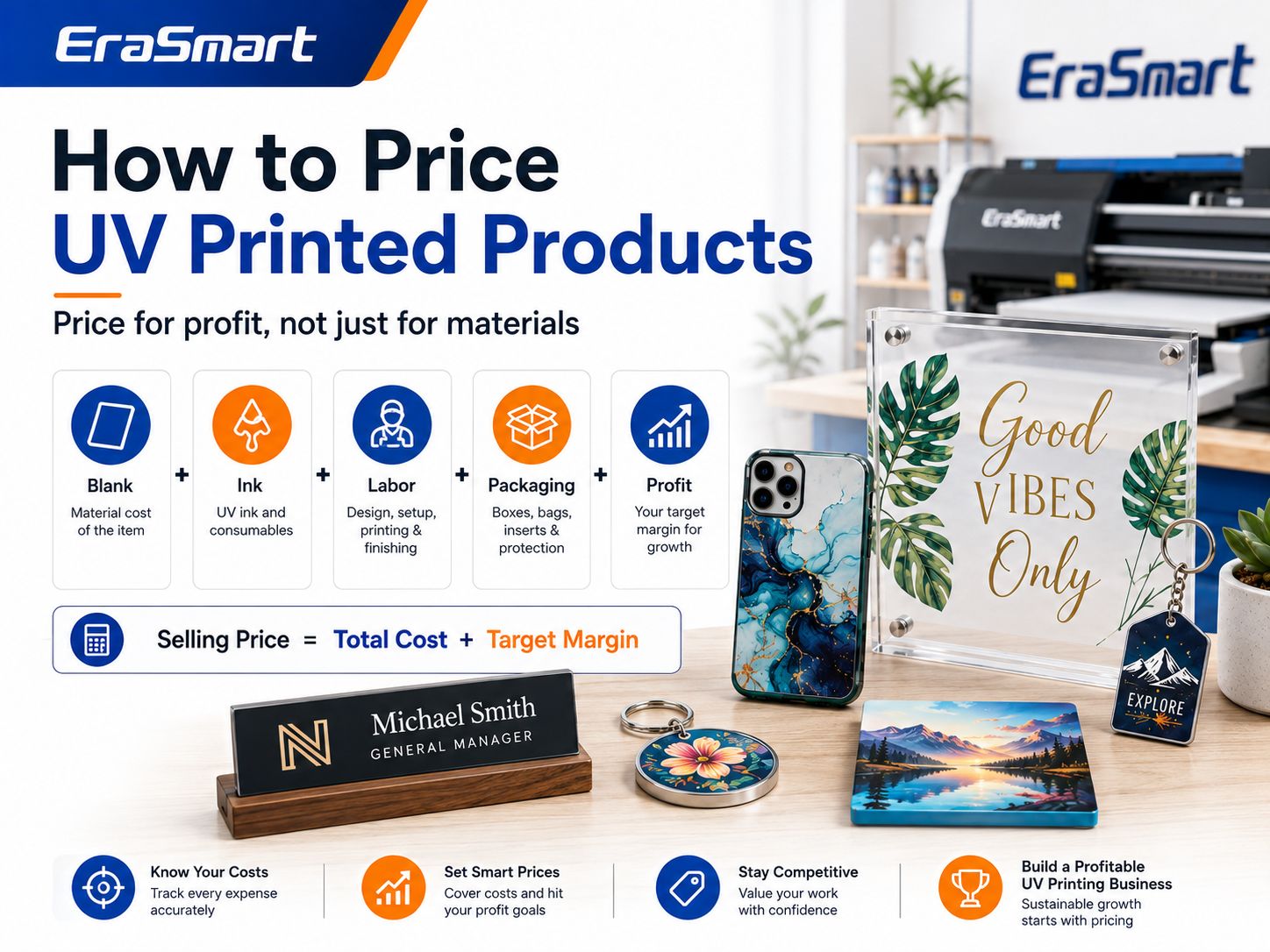
価格設定Blank + ink + labor + waste + fees + profit
マーケティングWebsite, local outreach, marketplaces and social media
成長Larger printer, second printer, UV DTF or more automation

A good UV printing business plan starts with the products and customers rather than the machine specification sheet. The U.S. Small Business Administration similarly recommends evaluating market demand, competition and startup costs before committing major capital to a new business.

Is a UV Printing Business Worth Starting?

It can be, but only when the printer supports a product people actually want to buy.

UV printing has several characteristics that make it suitable for small-batch customization.

Low Minimum Quantities

Digital printing allows the artwork to change between products.

次のものを生成できます。

  • One personalized plaque
  • Ten different employee nameplates
  • Twenty custom phone cases
  • Fifty company gifts with variable names

without creating a separate screen or plate for each design.

High Personalization Potential

Customers may pay more for products containing:

  • Their name
  • Their photograph
  • Their logo
  • An event date
  • A QR code
  • A custom message
  • A personalized pattern

The value of the finished product is therefore not determined only by the blank material.

幅広い製品範囲

A suitable UV printer can support several rigid-product categories instead of forcing a small studio to depend on one item. EraSmart’s UV printer selection guidance emphasizes choosing the printer according to product type, material size, height, white-ink requirements, varnish needs and expected daily volume.

Short-Run Production

UV printing is particularly useful when customers need customized products in quantities that are too small for mass-production methods.

例としては次のものが挙げられます。

  • Startup product samples
  • Wedding signage
  • スタッフネームプレート
  • Corporate awards
  • Prototype packaging
  • Local-business signs

The opportunity is not simply “UV printing.”

The opportunity is solving small-batch customization problems quickly and profitably

Step 1: Choose Your UV Printing Business Model

Before choosing a printer, decide how the business will make money.

Several models are possible.

Personalized Product Store

You purchase blank products, print them and sell the finished products to consumers.

例としては次のものが挙げられます。

  • Personalized phone cases
  • アクリルフォトブロック
  • Pet gifts
  • キーホルダー
  • 結婚式のサイン
  • ネームプレート
  • Desk décor

潜在的なチャネルには次のようなものがあります。

  • Your own website
  • Etsy
  • Social media
  • Craft markets
  • Local pickup

This model gives you control over product presentation and retail pricing but also requires more marketing.

Local B2B Printing

Instead of selling individual gifts, you work with businesses.

潜在的な顧客には次のものが含まれます。

  • レストラン
  • カフェ
  • ホテル
  • フェア
  • 学校
  • Clinics
  • Offices
  • Real estate agencies
  • Event companies
  • Manufacturers

考えられる製品は次のとおりです。

  • QRコード標識
  • 営業時間の標識
  • デスク銘板
  • ロゴプレート
  • 受賞歴
  • 機器ラベル
  • プロモーションギフト
  • Product display panels

B2B orders can be attractive because businesses may reorder when they hire new employees, open new locations, update branding or attend another event.

Online Custom Printing Service

Customers upload their artwork and you print their products.

You may specialize in:

  • アクリル
  • 電話ケース
  • 金属
  • 木材
  • 販促品
  • Prototype parts

This model competes more on:

  • 品質
  • Turnaround
  • Minimum quantity
  • Material choice
  • Technical capability

Trade Printing

You print for:

  • デザイナー
  • サインショップ
  • レーザー彫刻事業
  • ギフトストア
  • マーケティング代理店
  • Other customization businesses

The trade customer handles the final sale.

Margins per item may be lower, but repeat volume can be more predictable.

Prototype and Sample Printing

Small brands frequently need:

  • プロトタイプのパッケージング
  • ロゴサンプル
  • 製品モックアップ
  • デバイスカバー
  • コントロールパネル
  • ブランドのエンクロージャ

These orders often require more setup work but can be valuable because the customer is buying speed and flexibility rather than mass-production pricing.

UV DTF Transfer Business

UV DTF creates transferable graphics for hard products.

Instead of shipping a finished bottle or cup, you can sell:

  • Logo transfer sheets
  • カップラップ
  • 製品ラベル
  • カスタムギャングシート
  • Small-business branding transfers

If irregular or curved products become a major part of your business, compare direct flatbed UV printing with UV DTF印刷 before choosing equipment.

Step 2: Choose a Specific Customer Niche

“Anyone who wants custom products” is not a useful target customer.

Choose one initial market.

例としては次のものが挙げられます。

結婚式

Products:

  • ウェルカムサイン
  • テーブル番号
  • Seating signs
  • アクリル製招待状
  • Name cards
  • Keepsakes

Local Businesses

Products:

  • QR signs
  • ロゴプレート
  • デスクサイン
  • プロモーションギフト
  • 銘板

Pet Owners

Products:

  • 写真プレート
  • 電話ケース
  • 記念品
  • キーホルダー
  • Desk décor

Corporate Gifts

Products:

  • 受賞歴
  • デスク製品
  • メタルカード
  • Branded boxes
  • 従業員への贈り物

Creators and Online Sellers

Products:

  • Private-label gifts
  • Custom accessories
  • UV DTF 転送
  • 印刷されたコンポーネント

Product Startups

Products:

  • Prototype packaging
  • 製品ハウジング
  • コントロールパネル
  • Branding samples

A narrow niche makes it easier to create samples, photography, landing pages and advertising.

Step 3: Validate Products Before Buying Too Much Equipment

Start with three to five products.

For example, a local-business UV printing startup might test:

  1. Acrylic QR code sign
  2. Desk nameplate
  3. Logo plaque
  4. Metal business card
  5. Branded keychain

Produce real samples.

Then show them to real potential buyers.

Do not evaluate demand only from:

  • Likes
  • Followers
  • Compliments
  • Poll responses

A product is more meaningfully validated when customers are willing to pay for it.

Market research can reduce risk by helping a business assess demand, market size, competition and customer preferences before launch.

Step 4: Choose Your First UV-Printed Products

A beginner should favor products that are:

  • フラット
  • 位置決めが簡単
  • Affordable if a print fails
  • Easy to photograph
  • Easy to package
  • Frequently personalized
  • Available from consistent suppliers

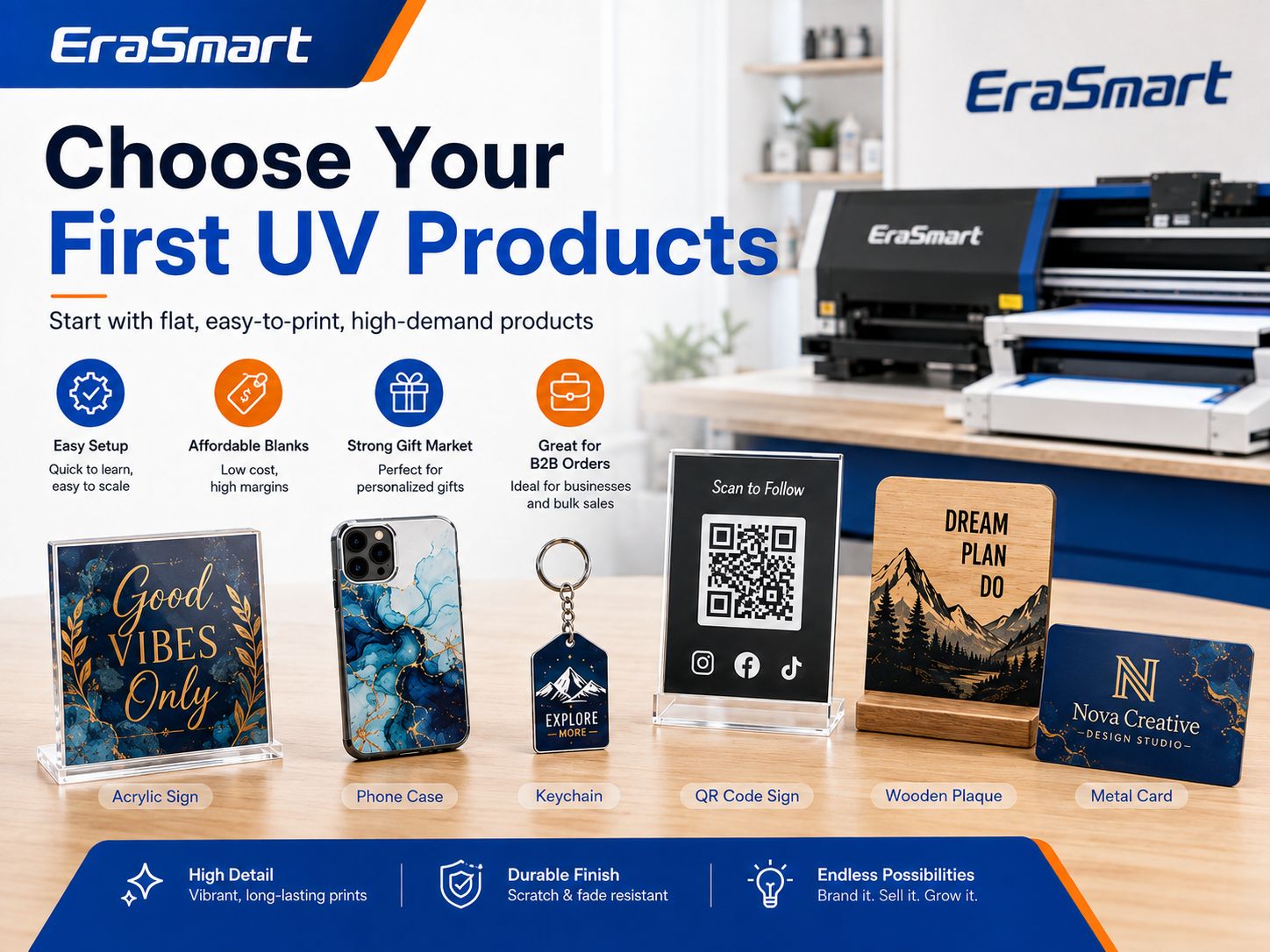
Good beginner products include:

製品Difficultyなぜ機能するのか
Acrylic keychains低いCheap blanks and easy batch jigs
電話ケースLow-MediumStrong personalization demand
Acrylic desk signs低いFlat surface and high perceived value
QRコードの表示低いGood local B2B product
メタルカードLow-MediumPremium appearance
Wood plaques中くらいStrong gift market
アクリル賞中くらいHigher selling value
包装サンプル中くらいB2B opportunity
プロモーションギフト中くらいリピート注文の可能性
Large acrylic signsMedium-HighHigher order value but larger equipment

製品のインスピレーションの詳細については、以下を参照してください。 Things to Print with a UV Printer

Step 5: Choose the Right UV Printer Size

Do not automatically buy the largest machine.

Match the print area to your main products.

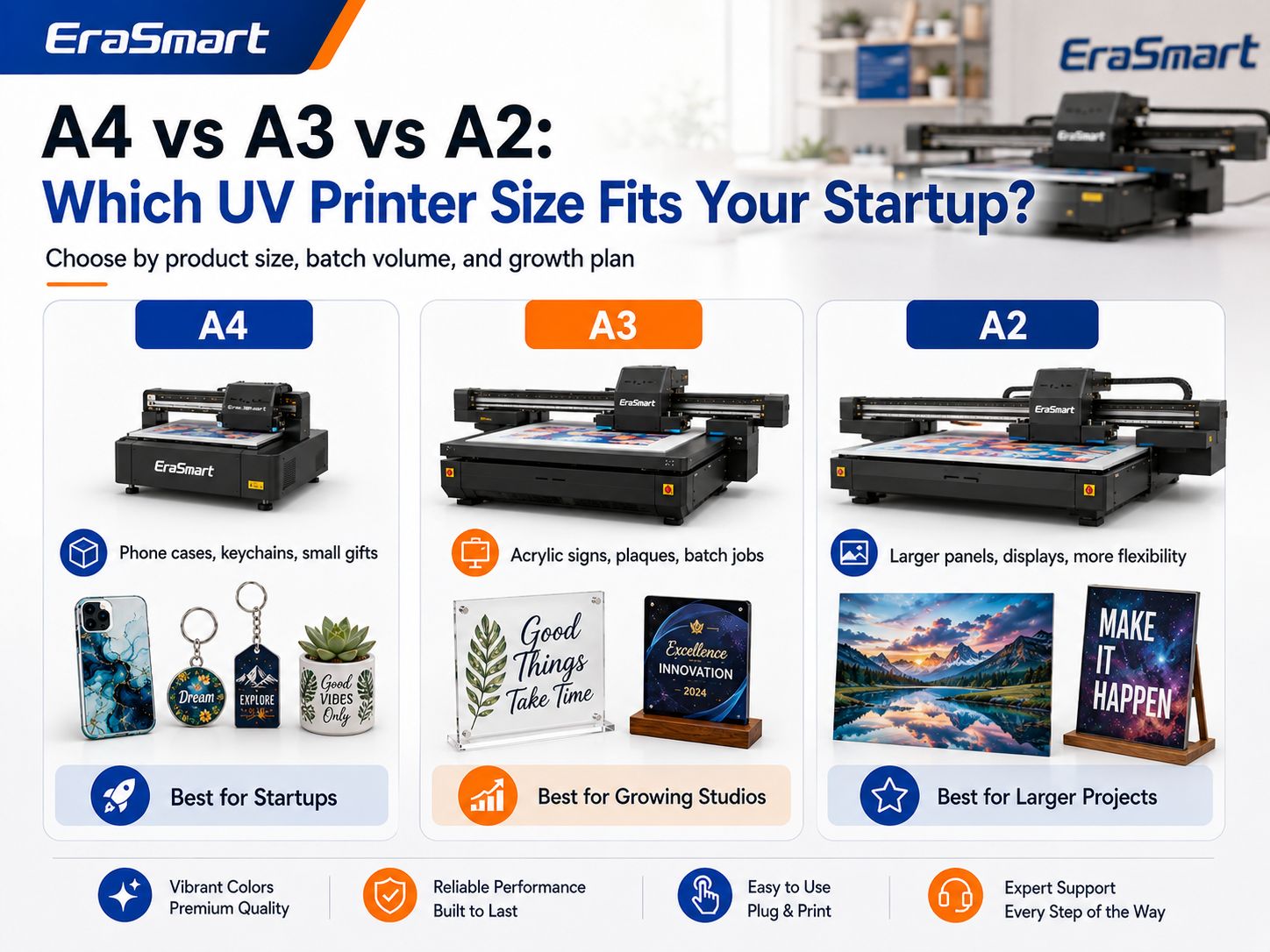
EraSmart’s current UV printer selection framework separates compact A5/A4 systems from broader A3 production and larger A2 applications based on product size and business scale.

A5 UVプリンター

Best suited to:

  • Samples
  • 小さなキーホルダー
  • Small accessories
  • Compact gifts
  • Testing product ideas

利点:

  • Smaller workspace
  • Lower entry complexity
  • Good for testing products

Limitation:

  • Small platform restricts future product size.

A4 UVプリンター

以下に適しています:

  • 電話ケース
  • アクリル板
  • キーホルダー
  • Small signs
  • Gift products
  • 製品サンプル

An A4 UV printer can be a practical starting point for a small personalization studio focused on relatively compact products.

A3 UVプリンター

以下に適しています:

  • アクリルサイン
  • Multiple phone cases
  • Larger plaques
  • Small panels
  • バッチフィクスチャ
  • Broader gift-product ranges

A larger platform can also hold several small products in one jig.

This is useful when your business moves from one-piece personalization to repeated small-batch production.

A2 UVプリンター

以下に適しています:

  • Larger acrylic signs
  • Wall panels
  • Larger boards
  • Commercial display products
  • Multiple products per batch

A2 equipment requires more workspace and makes the most sense when larger products or stable production volume justify the additional platform size.

Quick UV Printer Size Guide

プリンターのサイズBest Starting ProductsTypical Business Stage
A5Samples, tiny gifts, accessoriesテスト
A4Phone cases, keychains, plaquesStartup
A3Acrylic signs, gifts, batch jobsGrowing studio
A2Panels, signs, commercial productionEstablished production

The correct question is not:

What is the biggest printer I can afford?

Ask:

What printer can produce my main products repeatedly with enough room to grow?

を使用します。 UV プリンター購入チェックリスト マシンを比較する前に。

Step 6: Decide Whether You Need White Ink

For most serious customization businesses, white ink is highly useful.

CMYK ink is not fully opaque.

White ink can create a base beneath color when printing on:

  • 透明アクリル
  • Black plastic
  • Dark phone cases
  • 色付きの素材
  • ガラス
  • ダークウッド
  • 金属

Without a white base, the color of the product can influence the artwork.

White ink can also be used for:

  • Standalone white text
  • 白いロゴ
  • Reverse acrylic printing
  • マルチレイヤーエフェクト

However, white ink adds:

  • インク消費量
  • メンテナンス
  • 印刷時間
  • Workflow complexity

White pigment also requires appropriate circulation, agitation and maintenance. EraSmart’s printer-selection guidance specifically identifies white-ink maintenance as a major factor in long-term machine stability.

Step 7: Decide Whether You Need Varnish

Varnish is a clear UV-curable ink.

以下を作成できます。

  • スポットグロス
  • 浮き出たロゴ
  • Textures
  • 装飾的なハイライト
  • 模擬エンボス加工
  • Premium product effects

Varnish can increase perceived value, especially for:

  • アクリル
  • 電話ケース
  • 受賞歴
  • パッケージング
  • Premium gifts

But varnish is not mandatory.

A startup selling basic QR code signs may not need the same configuration as a studio selling luxury decorative phone cases.

See the UVインクガイド when deciding between CMYK, white and varnish configurations.

Step 8: Check Maximum Product Height

Print area receives a lot of attention, but object height can be equally important.

Consider products such as:

  • ギフトボックス
  • Thick acrylic blocks
  • 製品ハウジング
  • Phone cases in fixtures
  • Wooden boxes
  • Assembled promotional products

The total height includes:

Product + Jig + Support Platform

A printer may have enough width and length for the product but still be unable to print it safely if the object is too tall.

確認する:

  • Maximum printable height
  • Height-detection method
  • プリントヘッドのクリアランス
  • Fixture thickness

before purchasing.

Step 9: Plan Your Startup Equipment

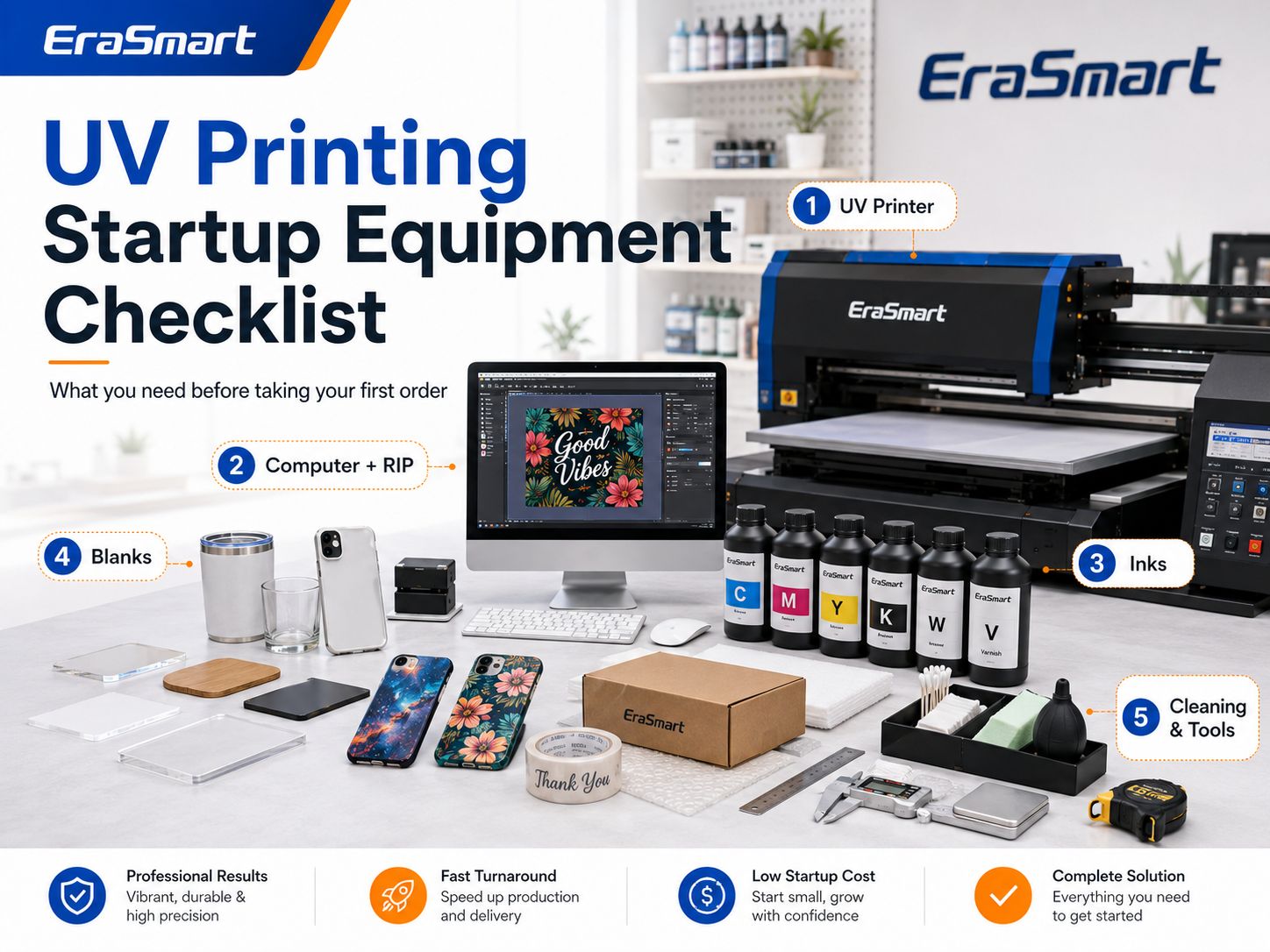
A UV printing business needs more than the printer.

必須の装備

  • UVプリンター
  • コンピューター
  • RIPソフトウェア
  • 設計ソフトウェア
  • 安定した作業台
  • 掃除道具
  • Product alignment tools

Recommended Production Tools

  • Digital caliper
  • Positioning rulers
  • Custom jigs
  • Anti-static cleaning tools
  • 糸くずの出ない布
  • ニトリル手袋
  • Product storage bins
  • Packing table

Optional Equipment

Depending on your product range:

  • Rotary attachment
  • Laser engraver
  • Cutting machine
  • UV DTFプリンター
  • Laminator
  • 写真撮影用照明
  • ラベルプリンター

Do not purchase every accessory immediately.

Add equipment when your product catalog actually requires it.

Step 10: Build Your Consumables List

次のものが必要になる場合があります。

  • CMYK UVインク
  • ホワイトUVインク
  • ワニス
  • プライマー
  • 液体の洗浄
  • メンテナンススワブ
  • 廃棄物容器
  • Replacement dampers
  • Capping components
  • ワイパー
  • Acrylic blanks
  • 電話ケース
  • Metal blanks
  • Wood blanks
  • パッケージング

Your consumables should be tested as a complete production system.

A cheap blank that causes poor adhesion or frequent failures may cost more than a higher-quality blank.

Step 11: Set Up Your Workspace

A UV printing business can sometimes operate from a relatively compact studio, but the workspace should still be treated as a production area.

Separate the space into zones.

Printer Zone

Keep it:

  • クリーン
  • Stable
  • Dust controlled
  • Accessible for maintenance

Blank Storage Zone

Organize materials by:

  • 製品
  • Size
  • Supplier
  • Batch

Cleaning and Preparation Zone

Keep product cleaning away from freshly printed items.

Inspection Zone

Use consistent lighting to inspect:

  • ほこり
  • 接着力
  • Surface defects

Packaging Zone

Keep packaging materials clean and away from ink maintenance activities.

Printing inks and cleaning chemicals should be handled according to their safety documentation, and suitable ventilation, work practices and protective equipment should be considered where chemical exposure may occur. NIOSH identifies local exhaust ventilation and appropriate work practices as important controls in printing operations involving chemical vapors.

Always follow the Safety Data Sheet for the exact ink and cleaner you use.

Can You Start a UV Printing Business from Home?

Potentially, yes, if:

  • Local rules allow the business activity.
  • You have enough dedicated workspace.
  • Electrical requirements are met.
  • Ventilation and chemical handling are appropriate.
  • Children and pets cannot access inks or maintenance chemicals.
  • Products can be stored cleanly.
  • Printer noise and workflow are manageable.
  • Shipping and inventory do not overwhelm the space.

A spare bedroom is not automatically an appropriate production area simply because the printer physically fits.

考慮する:

  • Ink handling
  • メンテナンス
  • 換気
  • cleaning fluids
  • blank storage
  • packing materials
  • waste handling

before deciding on a home setup.

Step 12: Learn the Basic UV Printing Workflow

A typical direct UV printing workflow is:

  1. Prepare artwork.
  2. Clean the blank.
  3. Position the product.
  4. Set product height.
  5. ノズルチェックを実行します。
  6. Configure CMYK, white and varnish layers.
  7. Print a sample.
  8. Inspect curing and color.
  9. Test adhesion.
  10. Print the production batch.
  11. Inspect each product.
  12. Package the finished order.

EraSmart UV Printing Workflow Guide provides a more detailed production process.

Step 13: Learn to Build Jigs

Jigs can dramatically improve repeat production.

A jig holds products in fixed positions.

For example, an A3 bed might hold several:

  • キーホルダー
  • 電話ケース
  • 銘板
  • メタルカード

instead of requiring the operator to position every item manually.

Jigs improve:

  • 位置合わせ
  • 読み込み速度
  • 再現性
  • Batch consistency

They can be created using:

  • アクリル
  • MDF
  • Foam
  • CNC-cut materials
  • 3Dプリント

Save both:

  • The physical jig
  • The matching RIP template

so repeat orders can be reproduced quickly.

Step 14: Calculate Your Real Startup Cost

Do not treat the printer price as the entire startup investment.

The SBA recommends identifying equipment, supplies, inventory, utilities, licenses, insurance, marketing and website costs when estimating a new business’s startup expenses.

For a UV printing business, calculate:

装置

  • UVプリンター
  • コンピューター
  • アクセサリー
  • Worktables
  • 備品
  • Storage

消耗品

  • インク
  • 洗浄液
  • プライマー
  • ブランク
  • パッケージング

事業の設立

  • 登録
  • 保険
  • Webサイト
  • Domain
  • 写真
  • 会計
  • マーケティング

ワークスペース

  • Electrical work
  • 換気
  • Lighting
  • Safety equipment

Reserve

Keep money available for:

  • 失敗した印刷
  • Damaged blanks
  • メンテナンス
  • 交換部品
  • Unexpected shipping
  • 広告
  • Downtime

Do not spend the entire startup budget on the printer.

A business with a printer but no working capital may struggle to purchase blanks or acquire customers.

UV Printing Startup Cost Worksheet

Cost CategoryYour Estimated Cost
UVプリンター
Shipping/import/tax
コンピューター
RIP/software
Initial ink
掃除用品
ブランク
Jigs/fixtures
Workspace setup
パッケージング
Webサイト
写真
マーケティング
保守予備金
運転資本
合計

Use real supplier quotations instead of copying a generic online startup number.

Step 15: Calculate the Real Cost Per Product

A common beginner mistake is:

Blank cost + ink = product cost.

That is incomplete.

含む:

  • 空白
  • インク
  • 白インク
  • ワニス
  • プライマー
  • クリーニング
  • マシンタイム
  • 労働
  • アートワーク
  • Failed-print allowance
  • パッケージング
  • プラットフォーム料金
  • 支払手数料
  • 広告
  • オーバーヘッド

EraSmart’s existing UV cost guide likewise treats UV printing cost as a combination of blanks, ink coverage, white ink, varnish, labor, maintenance and waste rather than one fixed print price.

Product Cost Formula

Product Cost = Blank + Printing + Labor + Waste + Packaging + Selling Fees + Allocated Overhead

Then:

Profit = Selling Price − Product Cost

Suppose a personalized acrylic sign requires:

  • アクリルブランク
  • CMYK + white printing
  • アートワークのセットアップ
  • Printing labor
  • パッケージング

Do not compare the selling price only against the acrylic sheet.

Customer communication and design time may represent a substantial part of a one-piece custom order.

Step 16: Set Your Pricing Structure

Avoid one universal markup.

Different orders require different amounts of work.

One-Piece Custom Price

Higher per-unit price because you must absorb:

  • 顧客とのコミュニケーション
  • アートワーク
  • 設定
  • 印刷
  • Inspection
  • Packing

for one product.

Small-Batch Price

Use quantity discounts when batch production genuinely reduces:

  • Setup time per item
  • Loading time
  • Artwork work
  • 梱包時間

Wholesale Price

Trade customers expect lower prices, but the order should still cover all variable costs and provide enough contribution toward overhead.

Design Fee

Charge separately for:

  • 背景の除去
  • ロゴトレース
  • 写真編集
  • カスタムイラスト
  • Complex layout
  • Excessive revisions

Rush Fee

Urgent jobs may interrupt other production.

Charge for that inconvenience.

Step 17: Calculate Break-Even

Do not evaluate a printer only by:

How much does it cost?

評価する:

How many profitable products must I sell to recover the investment?

The standard break-even formula is:

Break-Even Units = Fixed Costs ÷ (Selling Price − Variable Cost per Unit)

The SBA defines break-even as the point where total revenue equals total costs and recommends using the calculation to evaluate financial risk.

For a UV printer, your fixed investment may include:

  • プリンター
  • Initial accessories
  • Workspace setup

Variable costs include:

  • 空白
  • インク
  • 労働
  • パッケージング
  • 販売手数料

You can model these variables using the EraSmart UV Printer ROI Calculator, which accounts for blanks, ink, varnish, labor, packaging, reject rate and monthly overhead.

Step 18: Track Profit per Production Hour

Two products can have the same profit margin but very different business value.

例:

Product A

Profit: $10
Production time: 5 minutes

Product B

Profit: $20
Production time: 40 minutes

Product B makes more profit per unit.

Product A may make more profit per machine hour.

追跡:

Profit per machine hour

and:

Profit per operator hour

These metrics reveal which products deserve more marketing.

Step 19: Create a Small Launch Catalog

Do not begin with 100 products.

Start with five to ten.

A practical catalog might include:

Product 1

Custom phone case

Product 2

Acrylic QR code sign

Product 3

Personalized acrylic photo plaque

Product 4

Business desk sign

Product 5

Custom keychain

Product 6

Wedding table sign

Product 7

Logo plaque

Each product should have:

  • Clear photographs
  • Size
  • 材料
  • パーソナライゼーションのオプション
  • 制作時間
  • Price
  • アートワークの要件

Once orders arrive, remove weak products and expand strong categories.

Step 20: Build Product Bundles

Bundles can increase average order value.

Café Branding Kit

  • QR code sign
  • Opening-hours sign
  • テーブルサイン
  • スタッフネームプレート

Wedding Acrylic Kit

  • ウェルカムサイン
  • テーブル番号
  • メニューの看板
  • ネームタグ

Business Office Kit

  • Reception sign
  • Logo plaque
  • デスク銘板
  • 受賞歴

Creator Starter Kit

  • Custom product samples
  • Logo plaque
  • Branded packaging prototype

Bundles sell an outcome rather than individual printed pieces.

Step 21: Find Local B2B Customers

Local business outreach can be particularly useful during the launch stage.

Choose one industry.

例えば:

フェア

Create samples:

  • QR review sign
  • Price-list display
  • Logo plaque
  • Staff nameplate

Then approach local salons with those specific examples.

Do not say:

We offer UV printing.

Say:

We produce low-minimum custom acrylic signs, QR displays and branded desk products for salons.

The second offer describes a customer solution.

Step 22: Sell Online

Online channels may include:

  • Your own WooCommerce store
  • ショッピファイ
  • Etsy
  • アマゾンハンドメイド
  • Social media

An independent website is particularly useful long term because you can build:

  • SEO traffic
  • Email lists
  • B2B landing pages
  • Product collections
  • Custom quote forms

Instead of one page called “UV Printing,” build pages around products and customers.

例:

  • Custom Acrylic Signs
  • Personalized Phone Cases
  • Wedding Acrylic Signs
  • Custom QR Code Signs
  • Corporate Awards
  • Custom Metal Cards

These pages match real buying intentions.

Step 23: Use Social Media to Show the Process

UV printing produces visually interesting content.

役立つコンテンツには次のものが含まれます。

  • Blank product → finished product
  • 白インク印刷
  • Varnish close-ups
  • アクリル反転印刷
  • パーソナライズされた名前
  • バッチフィクスチャ
  • Product peeling or unpacking
  • Customer orders
  • パッケージング
  • Maintenance tips

Do not make every post a machine advertisement.

Show what customers can create with the machine.

Step 24: Build Repeat Business

Repeat customers are especially valuable because the initial setup has already been completed.

For every repeat client, save:

  • アートワーク
  • 製品型式
  • Supplier
  • 材料
  • 治具
  • 印刷位置
  • 白濃度
  • Varnish settings
  • RIP preset
  • 梱包要件

Then the next order becomes easier and faster.

Step 25: Maintain the UV Printer

UV printers require routine maintenance.

Important areas include:

  • ノズルチェック
  • プリントヘッドのクリーニング
  • キャッピングステーション
  • ワイパー
  • 白インクの循環
  • 廃インク
  • Platform cleaning
  • Environmental conditions

White ink deserves particular attention because the heavier pigment can settle. EraSmart recommends evaluating white-ink circulation, capping, nozzle cleaning and idle protection when choosing a machine.

読んでください UV Printer Maintenance Guide before planning the operating schedule.

Step 26: Create a Quality-Control Checklist

Before packaging every product, check:

  • Correct customer
  • 正しいアートワーク
  • 正しいスペル
  • 正しい向き
  • Correct product
  • 印刷位置
  • 白い不透明度
  • ワニス
  • ほこり
  • 接着力
  • パッケージング

Do not allow “small custom order” to mean “no quality control.”

One defective personalized product may be impossible to resell.

Step 27: Test Every New Material

“Plastic,” “glass,” “wood” and “metal” are broad categories.

Two products that look similar may have different:

  • Coatings
  • Surface energy
  • テクスチャ
  • Protective layers

Before selling a new blank:

  1. Clean it.
  2. Print a sample.
  3. Check curing.
  4. Test adhesion.
  5. Test scratching.
  6. Test real handling.
  7. Save the results.

読んでください UV プリンター材料ガイド for a more detailed material-testing framework.

Step 28: Avoid Too Much Inventory

New businesses often get excited and order:

  • 20 phone-case models
  • 10 acrylic sizes
  • 8 wood products
  • 12 keychain styles
  • Multiple metal blanks

before receiving orders.

This ties up cash.

Start with small quantities.

Stock more only when:

  • A product sells consistently.
  • Supplier lead times justify inventory.
  • Bulk purchasing provides meaningful savings.
  • You understand the failure rate.

Step 29: Decide When to Add UV DTF

Direct UV printing is excellent for:

  • Flat products
  • アクリル
  • Plaques
  • Panels
  • 電話ケース
  • Rigid gifts

UV DTF becomes useful when customers request:

  • ボトル
  • タンブラー
  • 曲面製品
  • Irregular surfaces
  • Transfer sheets
  • カップラップ

Do not assume one technology must replace the other.

A growing studio may eventually use:

UV Flatbed → Direct products

UV DTF → Curved products and transfers

Step 30: Decide When to Upgrade Your UV Printer

Upgrade when your current equipment creates a real bottleneck.

Signals include:

  • Orders no longer fit the print area.
  • You regularly turn down larger products.
  • Batch capacity is too small.
  • Delivery times become too long.
  • Customers request products outside your current height range.
  • Outsourcing becomes expensive.
  • A larger printer would clearly improve profit per hour.

Do not upgrade simply because a larger printer exists.

EraSmart’s current buying framework recommends matching equipment to product type, print area, object height, order volume, workflow and ROI rather than purchase price or maximum size alone.

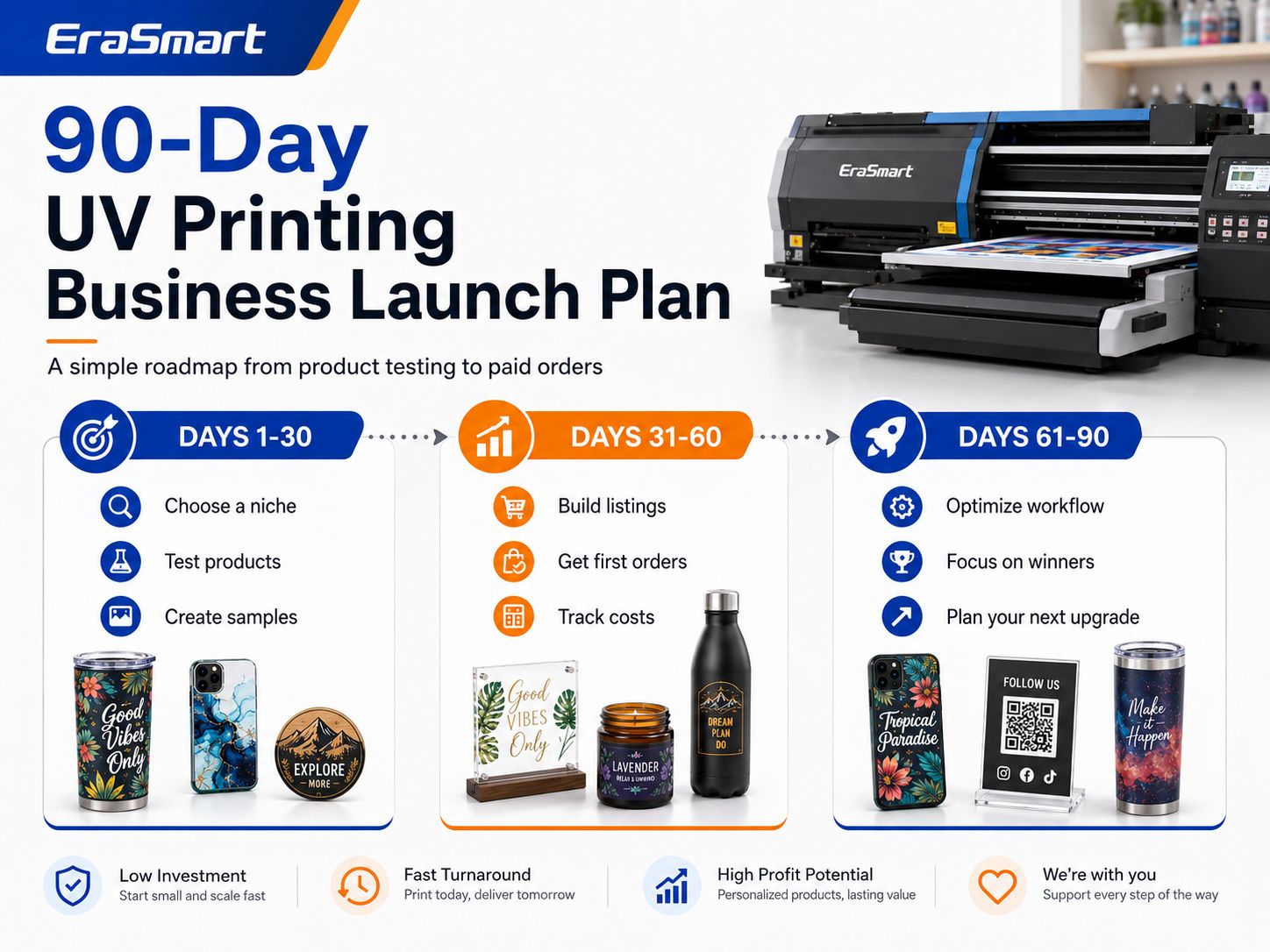
A Practical 90-Day UV Printing Business Launch Plan

Days 1–15: Choose the Market

完了:

  • Select one customer niche.
  • Research competing products.
  • Identify five potential products.
  • Interview potential buyers.
  • Compare blank suppliers.
  • Define your target selling price.

Goal:

Know what you intend to sell before buying equipment.

Days 16–30: Choose Equipment and Produce Samples

完了:

  • Compare UV printer sizes.
  • Confirm product height.
  • Confirm white ink requirements.
  • Decide whether varnish is necessary.
  • Order sample blanks.
  • Produce test prints.
  • Test adhesion.
  • Create basic jigs.

Goal:

Produce five professional samples.

Days 31–45: Build the Sales System

完了:

  • 必要に応じてビジネスを登録します。
  • Set up payment methods.
  • Build a website or sales page.
  • Photograph products.
  • Create pricing.
  • 顧客ポリシーを作成します。
  • Prepare packaging.

Goal:

Be ready to accept paid orders.

Days 46–60: Get the First Customers

完了:

  • 地元企業にお問い合わせください。
  • 製品コンテンツを公開します。
  • Launch several product pages.
  • Post production videos.
  • Attend a local event if relevant.
  • Collect customer feedback.

Goal:

Get real paid orders, not just engagement.

Days 61–75: Measure Production

追跡:

  • 平均注文金額
  • 材料費
  • 印刷時間
  • 労働時間
  • 失敗した印刷
  • 梱包時間
  • お客様からの質問

Goal:

Understand the actual economics of each product.

Days 76–90: Focus and Scale

Identify:

  • Best-selling product
  • Highest-profit product
  • Easiest product to produce
  • Strongest customer niche
  • リピートのお客様
  • 生産のボトルネック

Then decide whether to:

  • Increase blank inventory
  • Create more jigs
  • Add product sizes
  • Increase local outreach
  • Add UV DTF
  • Upgrade the printer
  • Add another machine

Goal:

Scale what customers have already proven they want.

90-Day Roadmap Summary

Period優先度Target Result
Days 1–15ResearchClear niche
Days 16–30Equipment + samplesFive tested products
Days 31–45Sales setupReady to sell
Days 46–60顧客の獲得最初の支払い済みの注文
Days 61–75Cost trackingReal margin data
Days 76–90OptimizationFocused growth plan

Common UV Printing Business Mistakes

Buying the Printer Before Choosing Products

Start with the customer and product.

Then choose the equipment.

Buying the Largest Printer Possible

A large bed does not automatically generate larger profit.

Unused capacity still costs money and space.

提供する製品が多すぎる

A large catalog creates more:

  • 在庫
  • Jigs
  • テスト
  • 写真
  • パッケージング
  • カスタマーサポート

Start focused.

白インクのメンテナンスを無視する

White ink expands your product range but also requires consistent care.

Printing Untested Materials

A product can look beautiful immediately after printing and still fail an adhesion test.

価格だけで勝負する

A small customization studio cannot always beat mass-production factories on price.

Compete on:

  • パーソナライゼーション
  • スピード
  • Small quantities
  • Local service
  • デザイン
  • プレミアム仕上げ

アートワークの労力を無視する

Editing a bad logo can take longer than printing the product.

Charge for design.

Ignoring Failed Prints

A failed $1 blank and a failed $40 acrylic award are not the same risk.

Include waste in pricing.

Making Unsupported Durability Claims

Do not promise:

  • Waterproof
  • Outdoor lifetime
  • Dishwasher safe
  • Food safe
  • Medical safe
  • Scratch proof

unless the exact ink and product system has been tested and supports the claim.

Buying Inventory Before Testing Demand

Cash trapped in unsold blanks cannot pay for advertising, ink or maintenance.

推奨機器の購入順序

実際の起動シーケンスは次のとおりです。

Priority 1 — Buy First

  • Suitable UV printer
  • コンピューター
  • RIPソフトウェア
  • Initial ink
  • 掃除用品
  • Core blanks
  • Basic jigs
  • パッケージング

Priority 2 — Add After First Orders

  • More professional jigs
  • Better photography setup
  • ラベルプリンター
  • 追加のストレージ
  • 空白の在庫が増える

Priority 3 — Add When Demand Requires It

  • Rotary equipment
  • Laser equipment
  • UV DTFプリンター
  • Larger UV printer
  • Second production printer

Do not buy Stage 3 equipment to solve a problem that does not exist yet.

Which EraSmart UV Printer Direction Fits Your Business?

EraSmart currently offers several UV printer sizes for different business stages.

Small Samples and Compact Products

Consider an A5 UV printer if the business focuses on:

  • Samples
  • Small gifts
  • Compact accessories

Home Studio or Small Customization Business

Consider an A4 UVプリンター for:

  • 電話ケース
  • キーホルダー
  • Small acrylic
  • Gift products
  • Personalized products

Growing Small Business

Consider an A3-class UV printer for:

  • アクリルサイン
  • Multiple-product jigs
  • Broader product catalogs
  • 小ロット生産

Larger Commercial Products

Consider an A2 UV printer for:

  • 大きな標識
  • Boards
  • Panels
  • Higher production flexibility

Explore the complete EraSmart UV Printer range after defining your target products, maximum size and expected daily orders.

最終的な考え

Starting a UV printing business is not primarily about buying a printer.

It is about building a profitable product system.

A smart startup process looks like this:

Choose a niche

Select 3–5 products

Validate customer demand

Choose the right UV printer

Test materials

Calculate real cost

Create professional samples

Get paid orders

Standardize production

リピーターの獲得

Scale equipment

Your first UV printer should fit the business you can realistically build today while leaving enough room for the products you are likely to add next.

For many small studios, that may mean starting with a compact A4 or A3-class printer rather than immediately purchasing a large commercial system. EraSmart’s buying checklist emphasizes the same principle: choose according to product fit, material height, ink configuration, daily workflow, support and realistic ROI.

Before purchasing, use these EraSmart resources:

Then compare the EraSmart UV Printer range according to your product size, materials and production plan.

The goal is not to own the biggest machine.

The goal is to build a UV printing workflow that can repeatedly turn blanks into products customers are willing to buy.

よくある質問

Is a UV printing business profitable?

It can be profitable when product prices cover blanks, ink, labor, failed prints, packaging, marketing, maintenance and overhead. Profitability depends more on product demand and production efficiency than on the printer alone.

How much does it cost to start a UV printing business?

There is no universal startup cost. Your budget depends on printer size, ink configuration, shipping, workspace, blanks, accessories, software, marketing and working capital. Calculate using real supplier quotations.

Can I start a UV printing business from home?

Potentially, provided local regulations, electrical capacity, ventilation, chemical handling, workspace and storage requirements can be met safely.

What is the best UV printer size for a beginner?

A5 or A4 can work for compact products and testing. A3 provides more flexibility for acrylic signs, batch fixtures and a broader product range. Choose according to actual products rather than size alone.

What products should a beginner start with?

Good starting options include phone cases, acrylic signs, QR code displays, keychains, nameplates and other relatively flat products that are easy to fixture and inexpensive to test.

白インクは必要ですか?

White ink is highly useful for transparent, dark and colored products. It creates an opaque base beneath CMYK and also allows visible white graphics.

ニスは必要ですか?

Not necessarily. Varnish is valuable for premium spot-gloss and raised effects but increases production time and maintenance.

What software does a UV printing business need?

You normally need design software plus RIP software. RIP software manages print positioning, color, white ink, varnish and layer order.

Do UV printers need daily maintenance?

Maintenance requirements vary by machine, but nozzle checks, white-ink management, cleaning and capping-system care are important parts of stable operation.

Can a UV printer print on any material?

No. UV printers support many materials, but adhesion depends on the exact surface, coating, cleaning process, ink and curing. Test every new blank.

Should I start with B2C or B2B customers?

Either can work. B2C offers personalization and retail pricing, while B2B can provide larger or repeat orders. Many small studios eventually use both.

How do I price UV-printed products?

Calculate the blank, ink, labor, artwork, failed-print allowance, packaging, selling fees and overhead before adding your target profit.

How long does it take to recover the cost of a UV printer?

The payback period depends on your total investment, contribution margin and order volume. Use real production numbers rather than assumed revenue. The EraSmart UV Printer ROI Calculator can help model the result.

When should I buy a larger UV printer?

Upgrade when current print area, batch capacity or product height consistently prevents you from accepting profitable orders.

When should I add UV DTF?

Consider UV DTF when curved, irregular or transfer-based products become an important part of customer demand.

What is the biggest mistake when starting a UV printing business?

Buying equipment before understanding what customers will buy. Define the products and market first, then choose equipment that supports that business model.


あなたも好きかもしれません

  • Erasmartプリンター

    UVプリンター
    DTFプリンター
    DTGプリンター
    ヒートプレスマシン
    広告プリンター

  • プリンターツール

    DTFオーブン
    ホットプレス
    カービングマシン
    マグ熱伝達
    ラミネートマシン

  • 消耗品

    印刷インク
    携帯電話ケース
    ガラス製品
    液体の洗浄
    綿棒

  • お問い合わせ

    WhatsApp:+8618566233796
    WeChat:+8618566233796
    モバイル:+8618566233796
    ウェブ:www.erasmart.com
    店:www.erasmartmall.com

  • プリンターの価格が必要ですか?

    印刷のニーズをお聞かせください。私たちのチームが 24 時間以内に返信いたします。

    見積もりをリクエストしてください

    いくつかの詳細を提供するだけで、簡単な見積もりを手に入れるのに役立ちます!