ผู้ผลิตเครื่องพิมพ์อิงค์เจ็ทขนาดเล็ก

โลโก้ UV-DTF ยกสูง 3 มิติ vs แผ่นแปะซิลิโคน vs งานปัก: แบบไหนที่เหมาะกับการสร้างแบรนด์เครื่องแต่งกายของคุณ?
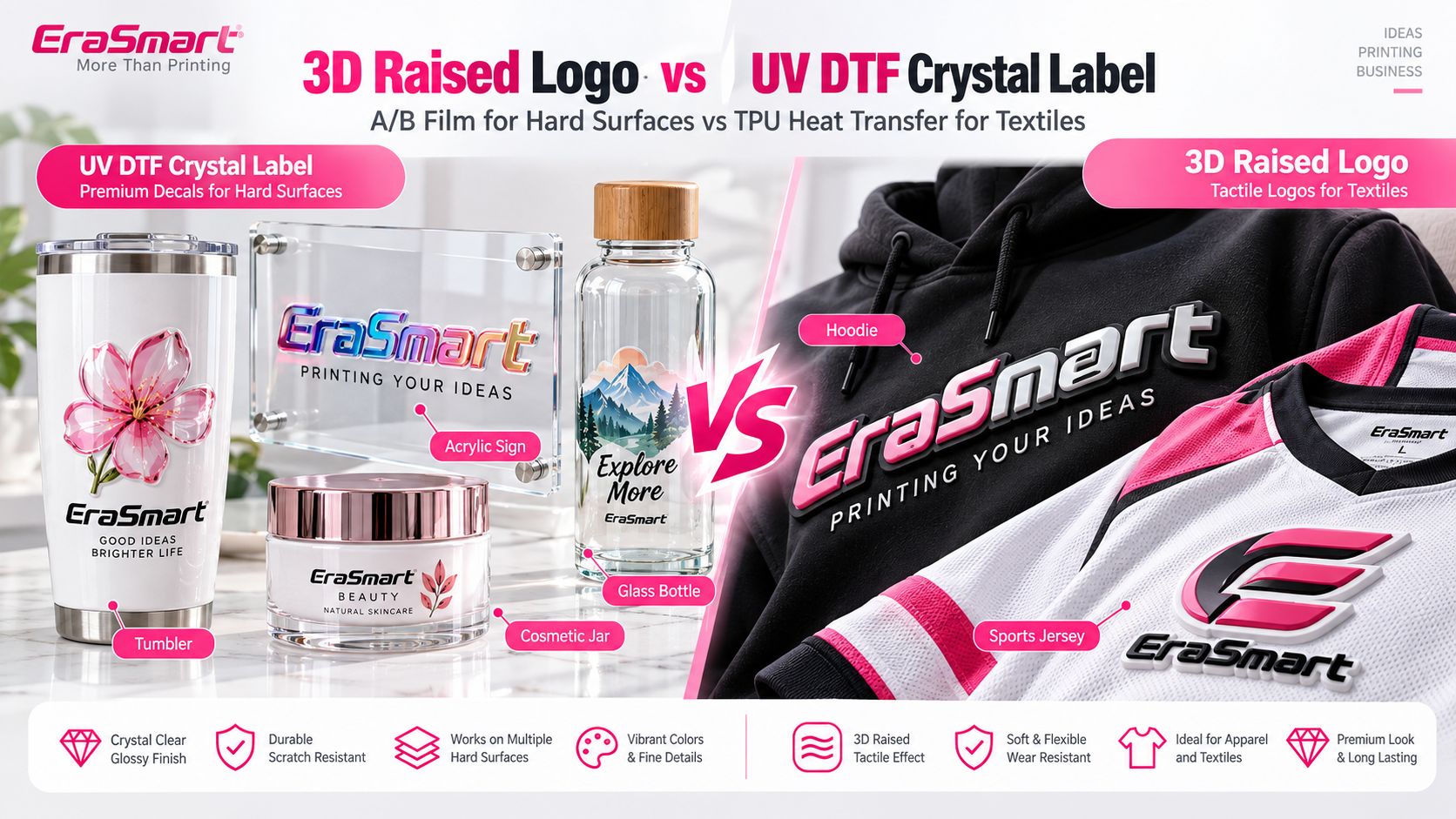
อัน 3D raised UV-DTF logo, ก molded silicone patch และ เย็บปักถักร้อย can all create dimensional branding on clothing, but the three methods are built from completely different materials and production processes.
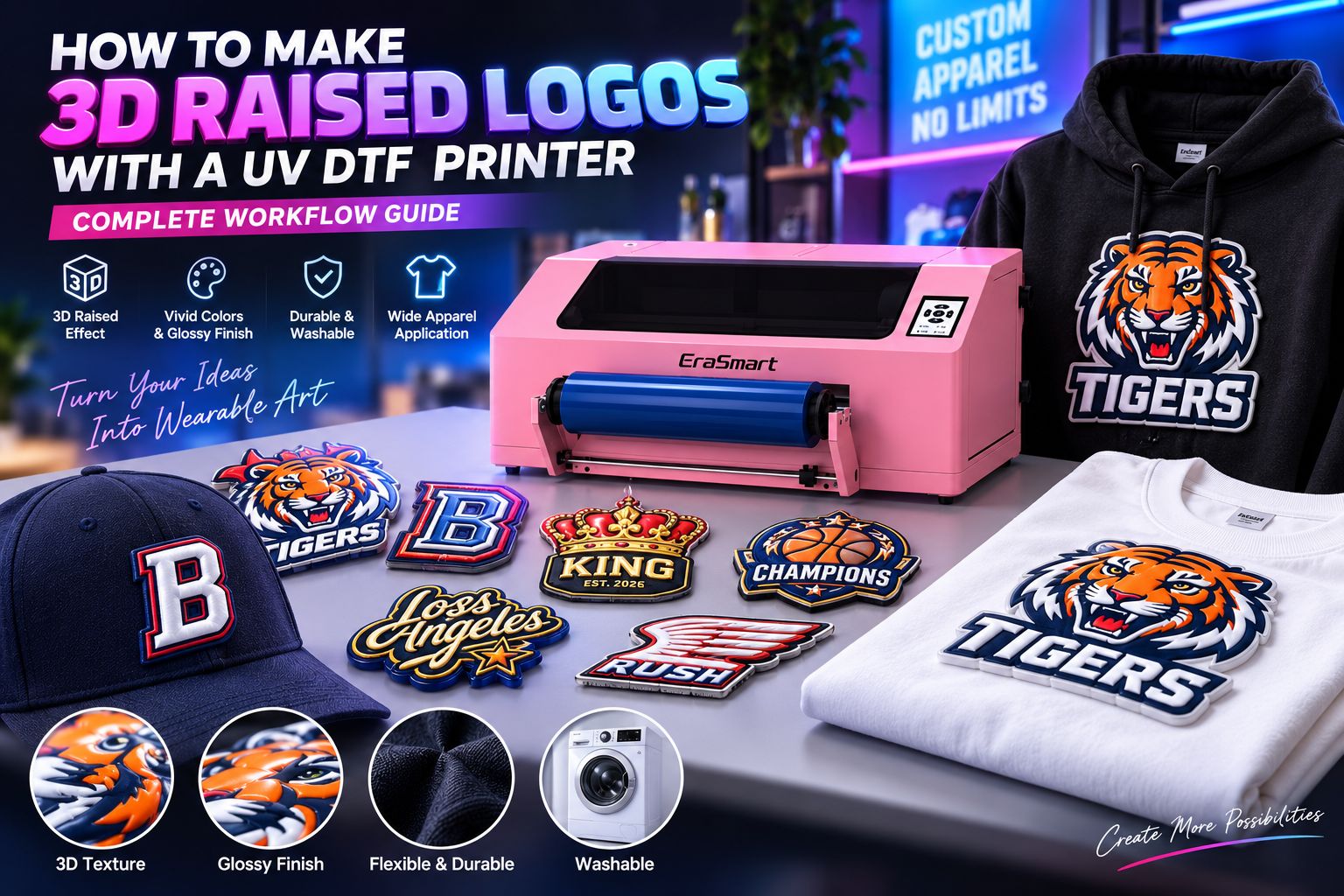
EraSmart’s 3D raised-logo workflow creates physical height digitally with high-build flexible white UV ink, then adds flexible CMYK, varnish and a TPU heat-transfer system.
A silicone patch creates its shape from molded silicone.
Embroidery creates its structure using thread and stitches.
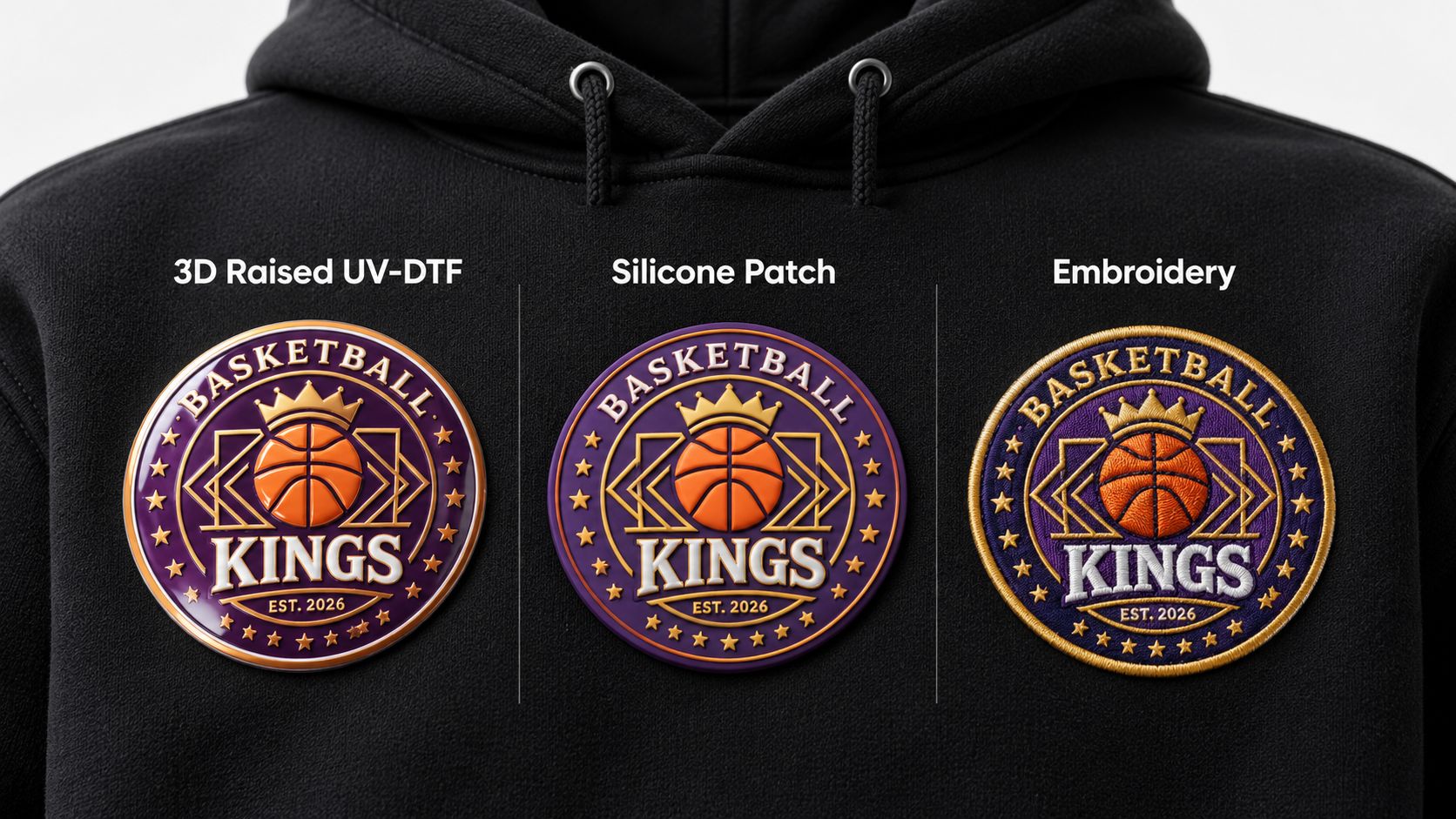
The easiest way to understand the difference is:
3D Raised UV-DTF = Flexible UV Ink + TPU Heat Transfer
Silicone Patch = Molded Silicone Structure
Embroidery = Thread + Stitching
There is no single process that is automatically right for every apparel project. The better choice depends on your artwork, garment, required texture, customization level and production workflow.
การเปรียบเทียบอย่างรวดเร็ว
| การเปรียบเทียบ | 3D Raised UV-DTF Logo | Silicone Patch | Embroidery |
|---|---|---|---|
| Core Material | Flexible UV ink + TPU transfer system | Silicone elastomer | Thread |
| How Height Is Created | Repeated high-build white ink | Molded silicone body | Thread and stitch structure |
| Color Method | Digital CMYK | Depends on molding/color process | Colored thread |
| การไล่ระดับสี | Strong digital capability | Process-dependent | Limited compared with CMYK printing |
| Fine Graphic Detail | Strong for printed artwork | Depends on mold/process | Limited by thread and stitch structure |
| Surface Feel | Smooth, flexible, raised, optionally glossy | Soft, rubber-like, molded | Textile, stitched and tactile |
| Traditional Mold | ไม่จำเป็น | Common for molded silicone production | ไม่จำเป็น |
| Digital Artwork Changes | Easy to change between print jobs | May require tooling changes | Requires embroidery-file changes |
| Garment Attachment | TPU heat transfer | Heat transfer, sew-on or other backing | Direct embroidery or patch attachment |
| Typical Visual Style | Modern, full-color and dimensional | Clean, molded and technical | Classic textile appearance |
| Common Applications | Jerseys, hoodies, T-shirts, caps | Sportswear, outdoor, streetwear | Caps, polos, uniforms, jackets |
The Three Methods Create “3D” in Different Ways
The finished logos may all look raised from a distance, but the source of that height is different.
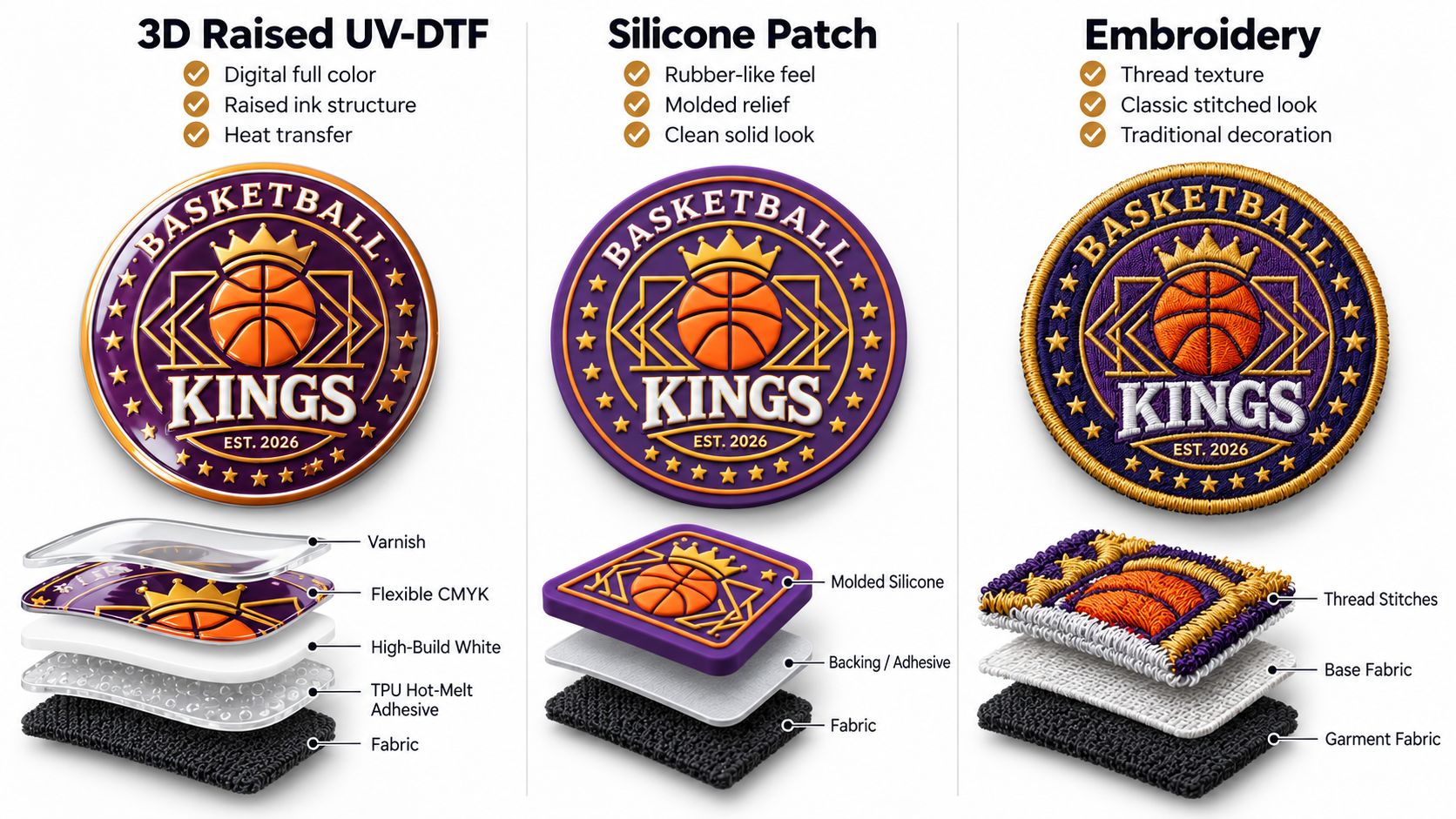
3D Raised UV-DTF Logo
The structure is digitally printed.
A simplified stack is:
วานิช
↓
Flexible CMYK
↓
High-Build Flexible White
↓
TPU Hot-Melt Adhesive System
↓
เสื้อผ้า
In the EraSmart workflow, repeated white ink passes can build approximately 0.3–1.2 mm of raised height, depending on the validated production profile.
The white layer creates the structure, CMYK provides the visible artwork, and varnish adds the final surface finish.
For a deeper explanation of this mechanism, see วิธีที่ชั้นหมึกสีขาวสร้างเอฟเฟกต์สามมิติในการพิมพ์ UV DTF-
Silicone Patch
A silicone patch uses silicone as the main physical body of the decoration.
A simplified structure is:
Molded Silicone
↓
Backing / Adhesive System
↓
เสื้อผ้า
The soft rubber-like feeling comes from the silicone material itself.
Embroidery
Embroidery uses thread as both the visible decoration and the structural element.
A simplified structure is:
Thread
↓
Stitch Structure
↓
Garment Fabric
The dimensional appearance comes from thread thickness, stitch density, stitch direction and embroidery construction.
3D Raised UV-DTF Is Not a Silicone Patch
ความแตกต่างนี้เป็นสิ่งสำคัญ
A finished EraSmart raised logo can have a soft, flexible, silicone-like tactile feel, but the product itself is not molded silicone.
The physical structure comes from repeated layers of flexible UV ink combined with a TPU textile-transfer system.
That matters because the two processes require different:
- production equipment
- การเตรียมงานศิลปะ
- วัสดุ
- finishing methods
- customization workflows
When discussing the EraSmart process, the accurate description is therefore:
3D Raised UV-DTF Logo
หรือ:
Flexible 3D Raised Apparel Logo
rather than simply calling it a silicone logo.
How the Production Methods Differ
The manufacturing sequence shows how different the three technologies really are.
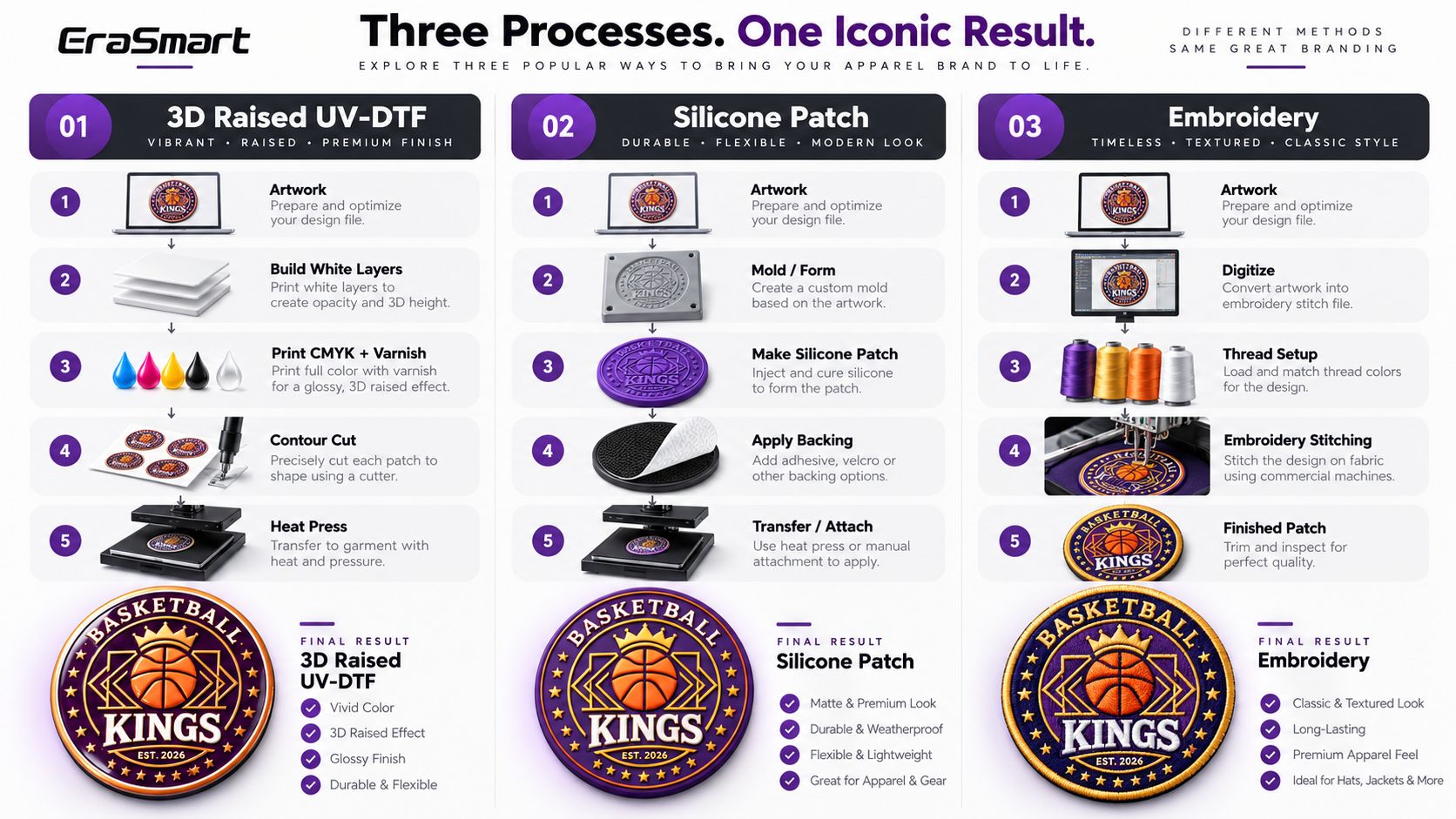
3D Raised UV-DTF Workflow
งานศิลปะ
↓
Structural White / CMYK / Varnish Setup
↓
Build High-White Structure
↓
Print Flexible CMYK
↓
Add Varnish
↓
Controlled LED-UV Curing
↓
ตัดคอนทัวร์
↓
กดความร้อน
↓
Finished Apparel Logo
For the full production sequence, see How to Make 3D Raised Logos with a UV DTF Printer-
Silicone Patch Workflow
A molded silicone-patch process typically involves:
งานศิลปะ
↓
Tool / Mold Preparation
↓
Silicone Forming
↓
การบ่ม
↓
Backing or Adhesive Preparation
↓
Attachment to Garment
The exact process varies according to the patch design and manufacturer.
Embroidery Workflow
A typical embroidery workflow is:
งานศิลปะ
↓
Digitizing
↓
Thread Selection
↓
Hooping / Positioning
↓
Machine Stitching
↓
Trimming and Inspection
These are fundamentally different manufacturing environments.
Color and Artwork Freedom
One of the biggest differences is how each process interprets the artwork.
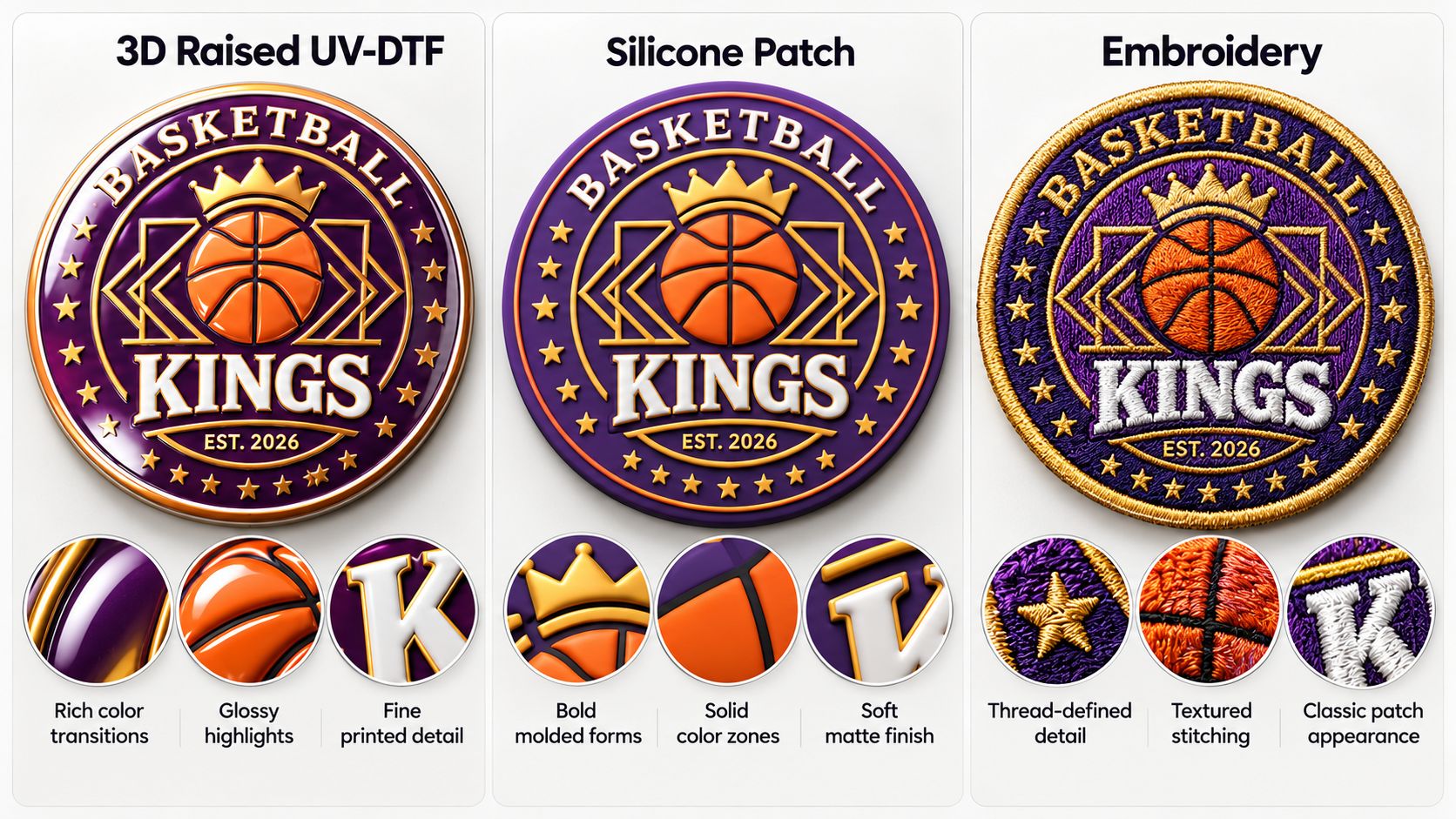
3D Raised UV-DTF
Because the visible image is produced digitally with CMYK, the process is well suited to:
- multicolor artwork
- การไล่ระดับสี
- complex illustrations
- detailed logos
- variable graphics
- changing team colors
- personalized names or numbers
The structural height is controlled independently from the visible color.
That means a logo can contain detailed CMYK graphics without every small element needing the same amount of high-build white.
For professional separation of those layers, see the คู่มืออาร์ตเวิร์คโลโก้ยก 3 มิติ: การตั้งค่าเลเยอร์สีขาว CMYK และวานิช-
Silicone Patch
Silicone works especially well with:
- bold logo shapes
- molded lettering
- clean borders
- dimensional icons
- geometric designs
- strong solid-color branding
The exact color capability depends on the silicone production method, so silicone should not automatically be described as a single-color process.
However, it is a different design system from direct digital CMYK printing.
Embroidery
Embroidery works naturally with:
- ตัวอักษร
- ชื่อย่อ
- ป้าย
- crests
- classic logos
- strong graphic shapes
Thread colors and stitch patterns can create visual depth, but continuous photographic gradients and very complex color transitions are not the typical strength of embroidery.
Surface Texture: Glossy, Molded or Threaded
The difference becomes even more obvious when the logo is viewed up close.
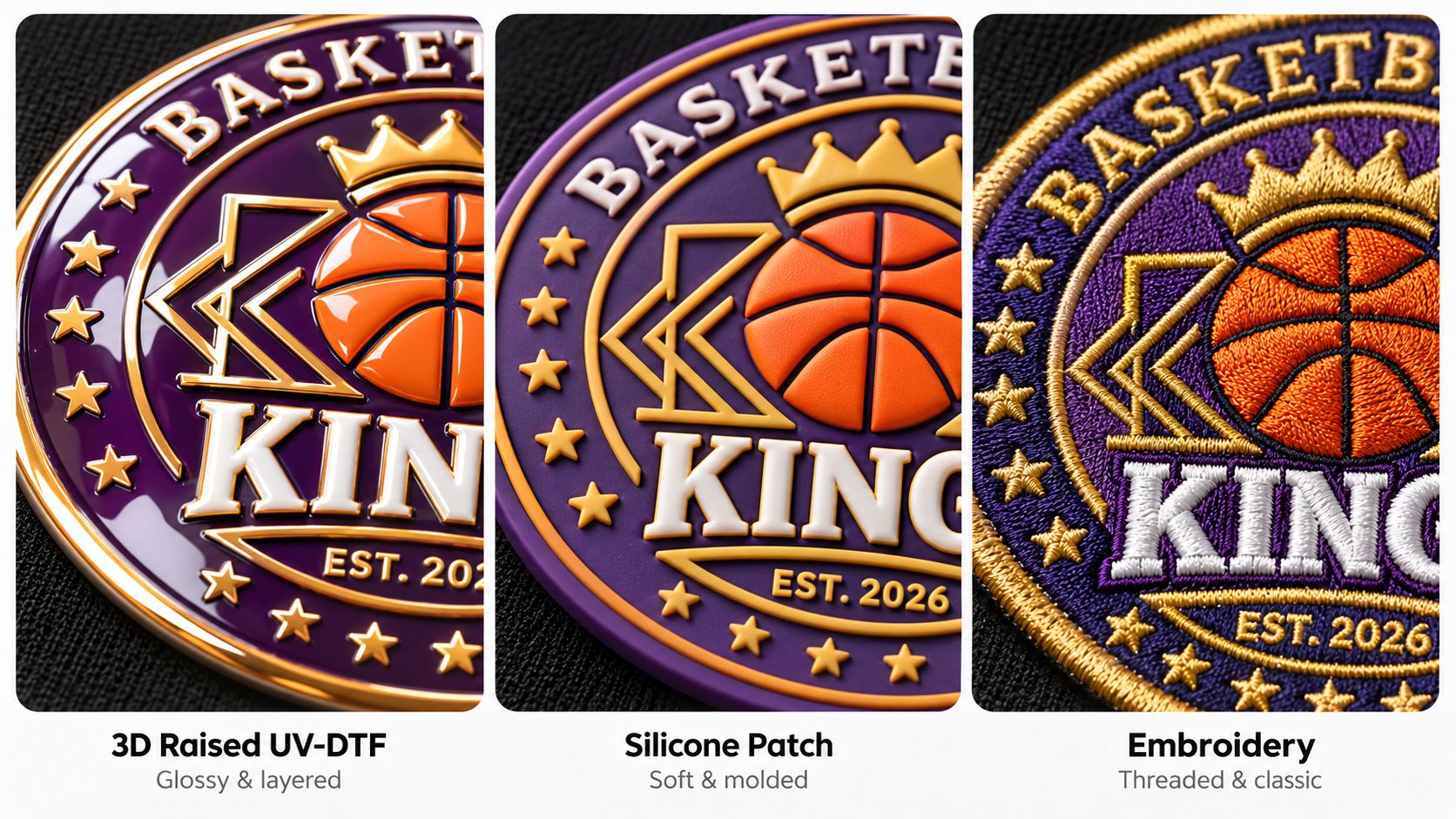
3D Raised UV-DTF
Typical characteristics include:
- smooth raised surfaces
- visible physical height
- flexible tactile structure
- glossy or selectively varnished areas
- detailed printed graphics
The result has a modern digitally printed appearance.
Silicone Patch
Typical characteristics include:
- soft rubber-like touch
- molded edges
- clean dimensional shapes
- matte or glossy surfaces depending on the product
The tactile quality comes directly from the silicone material.
Embroidery
Typical characteristics include:
- visible thread texture
- directional stitches
- woven visual character
- traditional apparel appearance
The surface feels textile-based rather than smooth or molded.
Which Surface Looks More Premium?
ไม่มีคำตอบที่เป็นสากล
Different surfaces communicate different brand styles.
A glossy raised UV-DTF badge can fit:
- esports apparel
- modern sportswear
- สตรีทแวร์
- custom fashion
- สินค้างานอีเว้นท์
A molded silicone patch can fit:
- technical sportswear
- activewear
- outdoor products
- contemporary streetwear
Embroidery naturally fits:
- polo shirts
- เครื่องแบบ
- jackets
- หมวกแก๊ป
- ชุดทำงาน
- heritage-style branding
The more useful question is:
Which surface fits the visual identity of the garment?
How Fine Details Behave
Every method has manufacturing limits.
3D Raised UV-DTF
Digital CMYK can reproduce fine visible artwork, but raised structural white should still be designed carefully.
Very small lettering or narrow isolated lines may not benefit from the same white buildup as large borders and main lettering.
The artwork should distinguish between:
printed detail
และ:
structural detail
Silicone
Fine molded elements depend on factors such as:
- mold geometry
- silicone thickness
- material flow
- manufacturing process
Small details may need to be simplified for reliable forming.
Embroidery
Fine details depend on:
- thread thickness
- needle size
- stitch density
- garment stability
- digitizing
Very small lettering can become difficult to reproduce cleanly.
For all three technologies, the best result comes from designing specifically for the production process.
Which Method Works Better for Full-Color Graphics?
For designs that depend heavily on:
- การไล่ระดับสี
- multi-color graphics
- ภาพประกอบ
- rapid color changes
- variable artwork
a digital process such as 3D raised UV-DTF can provide a more direct production path because the visible image is printed with CMYK.
That does not mean silicone or embroidery cannot be colorful.
It means they convert color into a different manufacturing language.
Silicone converts the artwork into a molded material structure.
Embroidery converts it into thread and stitches.
Short Runs and Personalization
This is one area where the digital raised workflow can be particularly useful.
A 3D UV-DTF job begins with a digital file.
Changing:
- ชื่อลูกค้า
- player number
- team color
- logo variation
- limited-edition artwork
does not require a traditional silicone mold to be manufactured for every graphic change.
This can make the workflow attractive for:
- custom sports teams
- small clubs
- เครื่องแต่งกายของงาน
- สินค้าส่วนบุคคล
- limited collections
- small fashion brands
However, this should not be interpreted as meaning that digital raised printing is always the lowest-cost method at every production volume.
Large standardized production runs can have different economics.
The key advantage is digital flexibility-
Does a 3D Raised UV-DTF Logo Need a Mold?
No traditional silicone molding tool is required for the EraSmart digital workflow.
The raised geometry comes from:
หน้ากากขาว
Repeated High-Build White Printing
This makes it possible to modify the raised structure through the artwork and RIP workflow rather than creating a new physical silicone mold.
Does Embroidery Need Tooling?
Embroidery does not need a silicone mold, but the artwork normally needs to be digitized into embroidery instructions.
Digitizing determines factors such as:
- stitch direction
- stitch density
- underlay
- sequence
- stitch type
A significantly different design may therefore require a new or modified embroidery file.
Garment Application Comparison
The garment itself can influence which decoration method is practical.
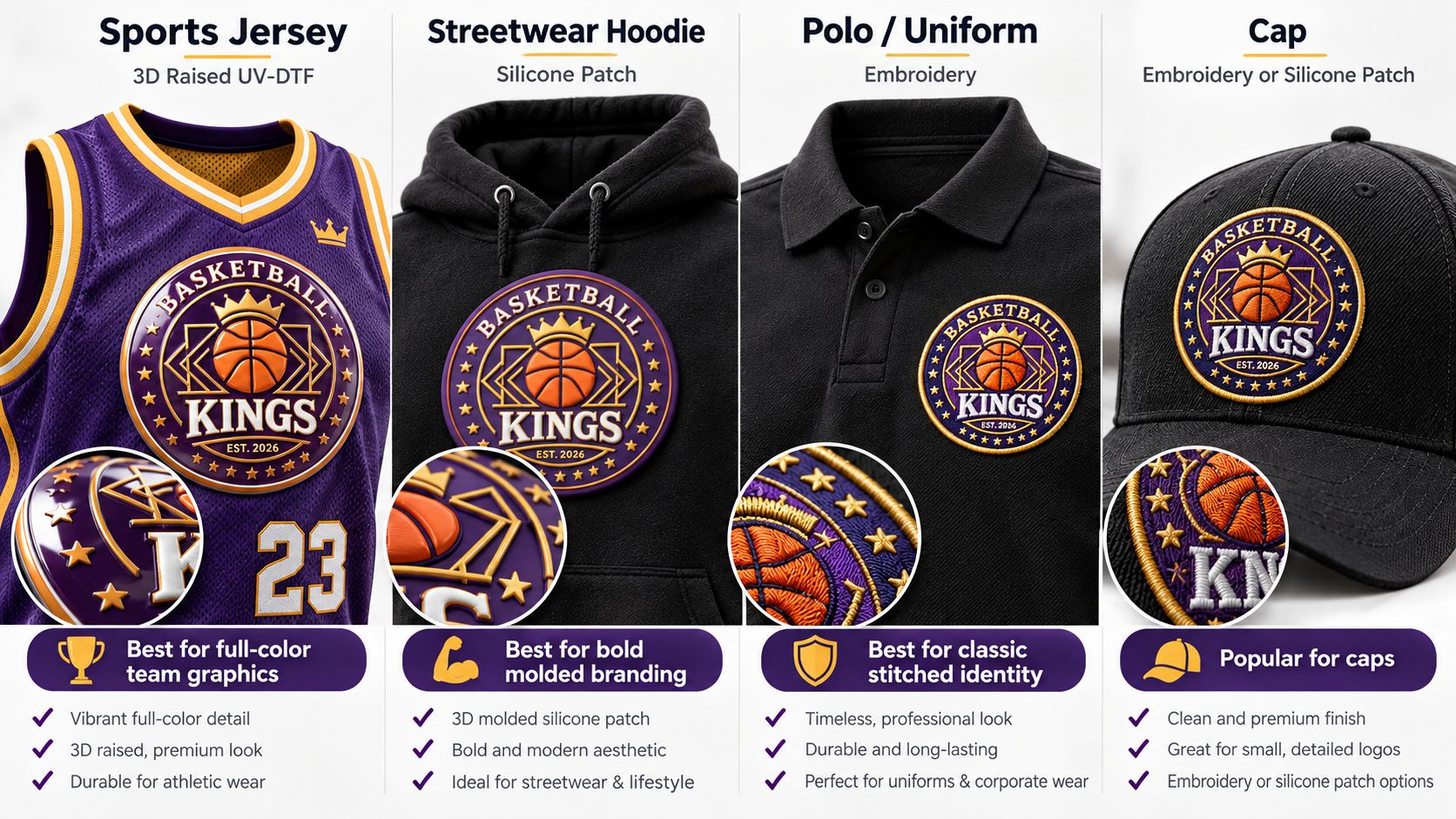
เสื้อกีฬา
3D raised UV-DTF can be useful for:
- full-color team logos
- modern sports emblems
- esports graphics
- club branding
- การออกแบบส่วนบุคคล
Because it is transferred rather than stitched through the complete logo area, it creates a different garment structure from dense embroidery.
Polyester and sublimated jerseys still require careful heat-transfer testing.
ดู 3D Raised Logo Heat Transfer Guide for temperature, pressure, dye migration and testing guidance.
Silicone patches can also fit sportswear where a molded technical appearance is desired.
Embroidery remains possible for many sports garments, although dense stitched areas may change the feel of lightweight or flexible fabrics.
เสื้อฮู้ด
All three methods can work well on hoodies.
3D UV-DTF offers detailed full-color raised graphics.
Silicone offers a molded rubber-like identity.
Embroidery offers traditional textile texture.
For heat-transferred logos, hoodie seams, pockets and fabric thickness must be considered because they can affect pressure distribution.
Polo Shirts
Embroidery is particularly natural on polo shirts because the stitched logo fits the traditional visual language of the garment.
Small silicone or raised digital badges can be used when a more contemporary appearance is required.
หมวก
Embroidery remains a common choice for structured caps.
Silicone patches also work well for molded front-panel branding.
Raised digital heat-transfer logos may be possible when the cap construction and curved heat-press setup are suitable.
เสื้อยืด
T-shirts provide a relatively flat application area and are well suited to digital heat-transfer branding.
For lightweight garments, the badge dimensions and total raised thickness should be balanced with the fabric weight.
Attachment Methods Are Different
3D Raised UV-DTF
The EraSmart process uses a TPU hot-melt adhesive system.
The current reference transfer window is approximately:
150–165°C
10–15 seconds
0.4–0.6 MPa
The actual temperature, time, pressure and peel method must be validated with the specific TPU materials and garment.
Silicone Patch
Attachment depends on the product design and may include:
- heat-transfer backing
- sew-on construction
- other adhesive/backing systems
Embroidery
Embroidery may be stitched directly onto the garment or produced as a separate embroidered patch for later attachment.
Production Equipment Is Different
The three methods also represent different production businesses.
3D Raised UV-DTF Production
An in-house workflow can include:
- เครื่องพิมพ์ UV DTF
- flexible 3D UV ink
- TPU transfer materials
- ซอฟต์แวร์ RIP
- contour cutter
- กดความร้อน
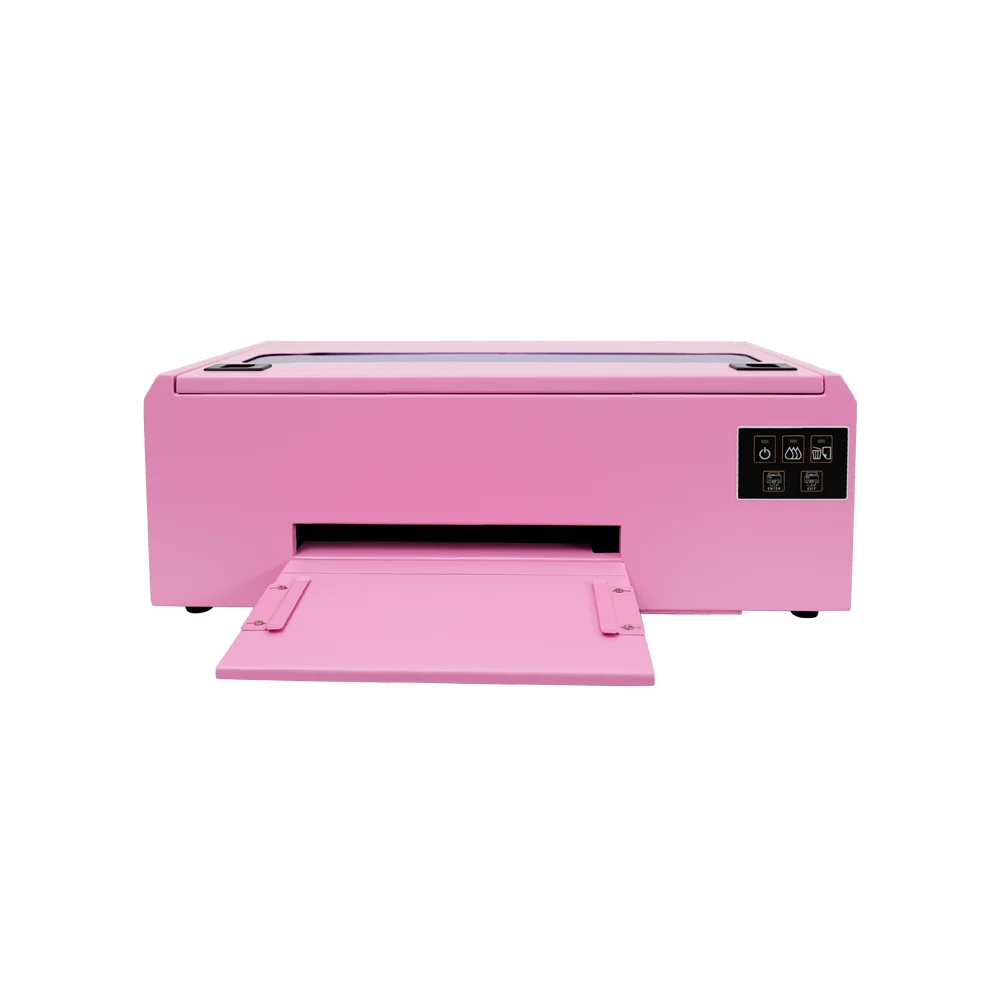
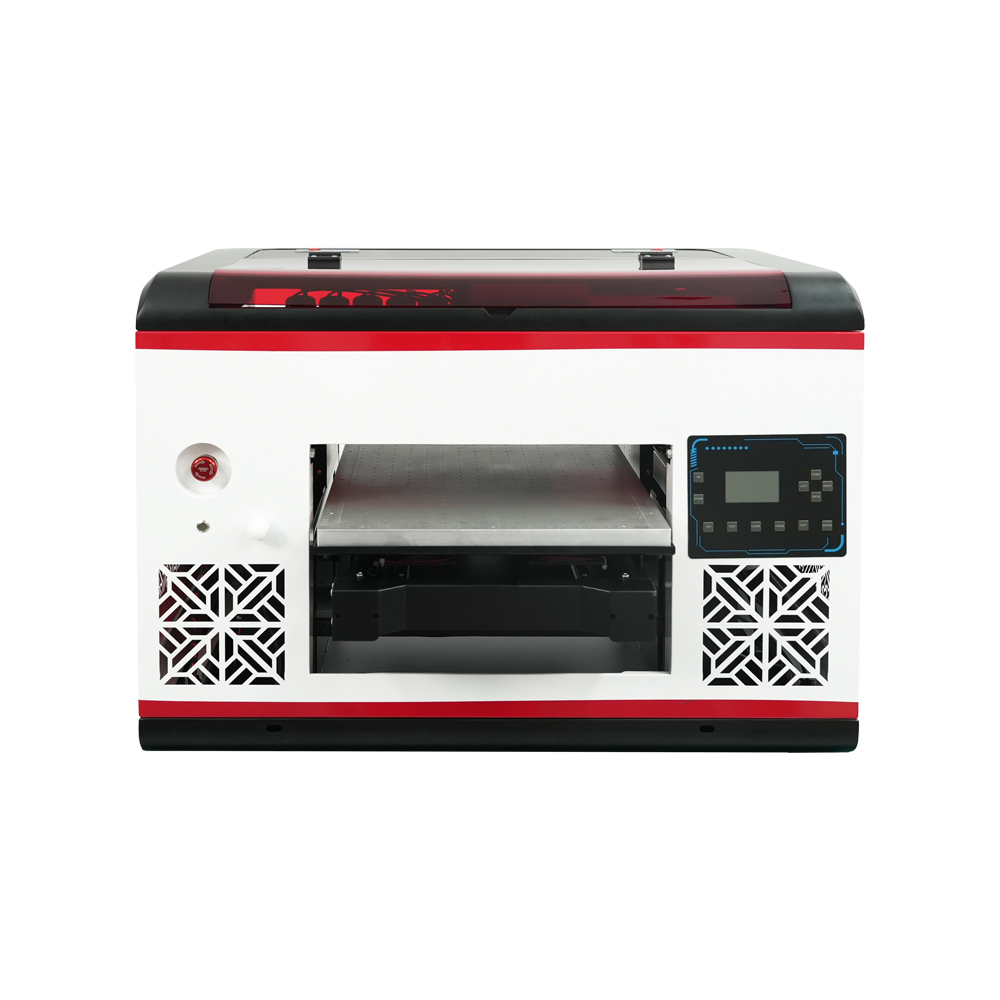
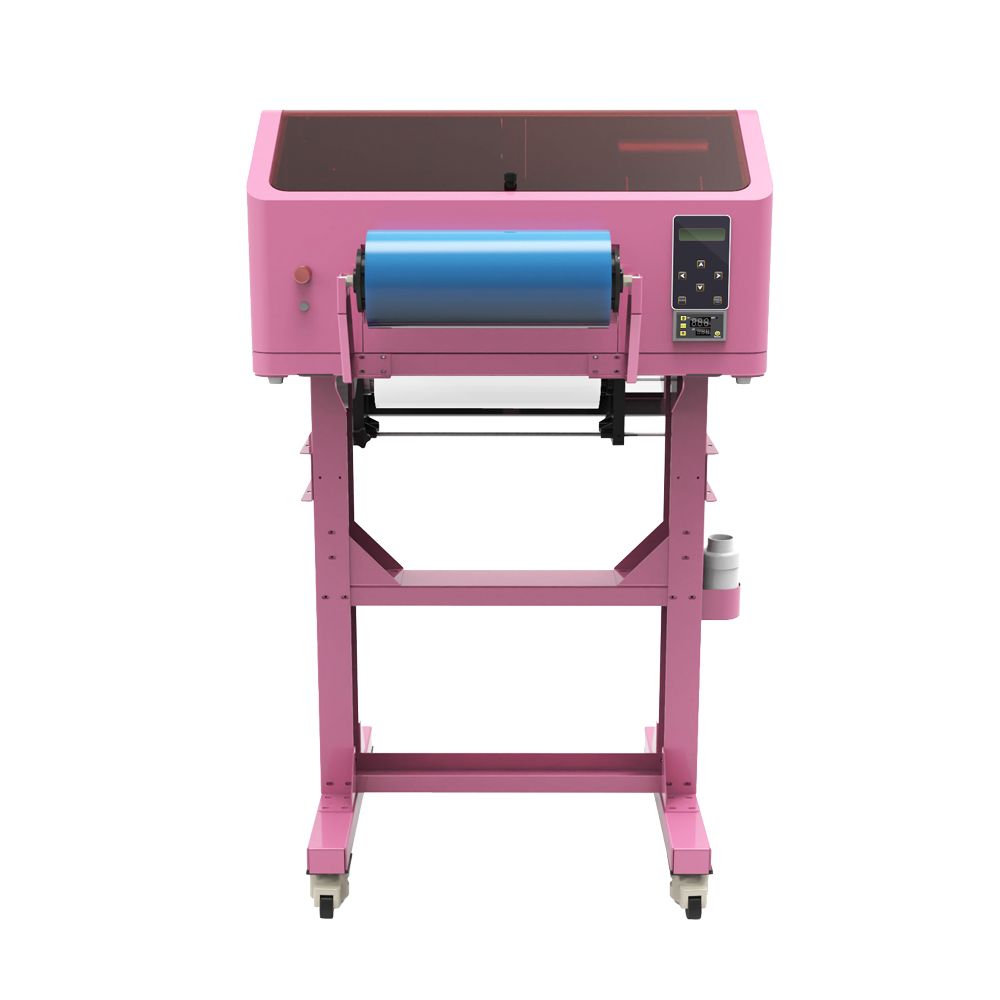
ที่ เครื่องพิมพ์ EraSmart A2 UV DTF can be configured as the printing platform for the EraSmart raised-logo workflow when paired with the appropriate flexible ink, film, curing and downstream equipment.
Silicone Patch Production
Depending on the production model, silicone manufacturing may require:
- molds or tooling
- silicone materials
- forming equipment
- การบ่ม
- backing preparation
- attachment equipment
Embroidery Production
Typical equipment includes:
- embroidery machine
- digitizing software
- threads
- needles
- hoops
- stabilizers
This is why businesses should compare complete workflows rather than comparing only the finished logo.
What About Wash Durability?
There is no useful universal answer such as:
“Process A lasts more washes than Process B.”
Durability depends on the complete production system.
3D Raised UV-DTF Depends On
- flexible UV ink
- white-layer build
- การบ่มด้วยรังสียูวี
- TPU adhesive
- heat-transfer conditions
- วัสดุตัดเย็บเสื้อผ้า
- สภาพการซัก
Silicone Patch Depends On
- silicone construction
- backing
- bonding method
- garment
- use conditions
Embroidery Depends On
- thread
- stitch quality
- digitizing
- garment structure
- รอยขีดข่วน
- washing
The potential failure modes are also different.
A heat-transferred logo may develop edge adhesion problems.
A silicone patch may suffer backing or attachment failure.
Embroidery may experience thread snagging, abrasion or loose stitching.
The correct approach is to validate the actual garment and decoration rather than relying on an unrelated wash-count claim.
Can You Combine These Branding Methods?
ใช่.
These technologies do not need to be mutually exclusive.
A garment can combine:
3D Raised UV-DTF Team Badge + Embroidered Wordmark
หรือ:
Silicone Sleeve Badge + Embroidered Chest Logo
หรือ:
Raised Digital Front Graphic + Traditional Embroidered Detail
Combining different surfaces can create useful visual contrast between:
- smooth and stitched
- glossy and matte
- modern and traditional
- printed color and textile texture
Which Method Fits Your Apparel Project?
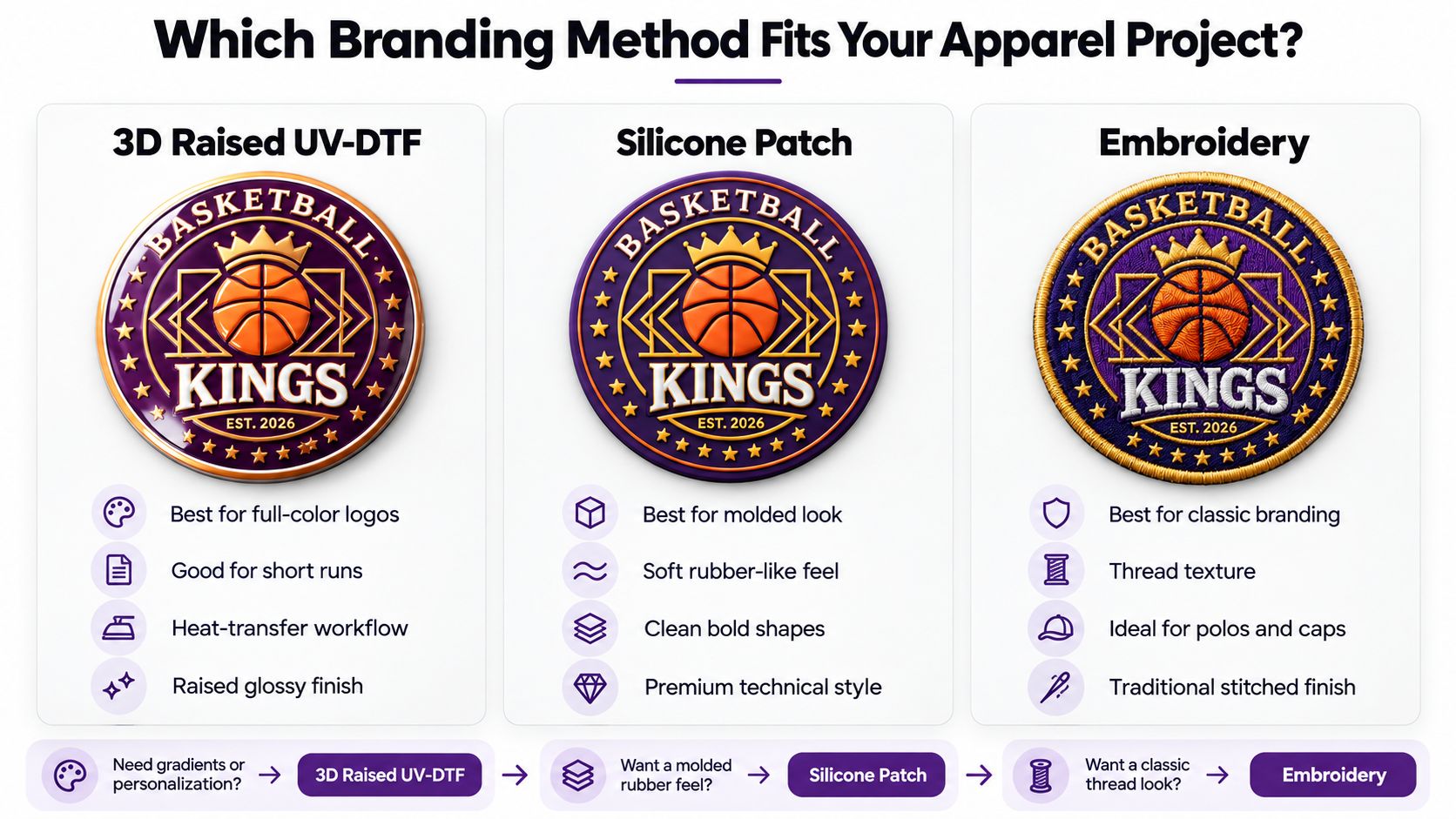
Instead of asking which method is universally best, begin with the design requirement.
Consider 3D Raised UV-DTF When You Need
- digital full-color artwork
- การไล่ระดับสี
- complex graphics
- การออกแบบตัวแปร
- frequent artwork changes
- การปรับเปลี่ยนในแบบของคุณ
- การผลิตระยะสั้น
- a smooth raised surface
- selective gloss
- an in-house digital production workflow
Consider Silicone Patch When You Need
- a true silicone material
- a molded rubber-like feel
- clean bold shapes
- standardized dimensional geometry
- technical sportswear aesthetics
- molded brand identity
Consider Embroidery When You Need
- authentic thread texture
- traditional branding
- ชื่อย่อ
- crests
- polo decoration
- เครื่องแบบ
- jackets
- classic cap branding
Which Method Fits Different Artwork?
A complex multi-color illustrated logo may fit a digital CMYK workflow.
A simple bold emblem designed around molded shapes may fit silicone well.
A traditional wordmark or crest may naturally suit embroidery.
The original artwork should therefore be evaluated before selecting the decoration process.
Which Method Fits Frequent Design Changes?
If a print shop frequently changes:
- ชื่อ
- ตัวเลข
- สี
- club logos
- กราฟิกเหตุการณ์
a digital workflow can provide significant production flexibility because the output changes with the artwork file.
A molded silicone workflow may involve additional tooling considerations.
Embroidery can also change designs, but a new graphic may require new digitizing.
Why EraSmart Focuses on Digital 3D Raised Printing
EraSmart’s 3D raised-logo workflow is not intended to make silicone patches or embroidery obsolete.
It gives digital printing businesses another production option.
The system allows a printer to control:
- structural height
- งานศิลปะสีเต็มรูปแบบ
- วานิช
- การปรับเปลี่ยนในแบบของคุณ
- contour shape
through a digital production workflow.
The complete process is:
งานศิลปะ
↓
Structural White
↓
Flexible CMYK
↓
วานิช
↓
Controlled UV Curing
↓
Contour Cutting
↓
TPU Heat Transfer
This can be particularly useful for businesses already familiar with digital printing and looking to expand into premium apparel branding.
For the complete application overview, see การพิมพ์โลโก้ยก 3 มิติด้วยเทคโนโลยี UV DTF-
Final Comparison
Choosing between 3D raised UV-DTF, silicone and embroidery is ultimately a question of what you want the logo to be.
If you want the logo to behave like a digitally printed, full-color, raised graphic, the EraSmart 3D raised UV-DTF workflow is worth considering.
If you want the decoration itself to be a true molded silicone component, choose a silicone-patch production route.
If you want the brand identity to come from visible textile thread and traditional stitching, embroidery provides that distinct appearance.
The technologies overlap in application, but they do not produce the same product.
That distinction is more useful than trying to identify one universal winner.
To explore EraSmart’s digital raised workflow, continue with:
การพิมพ์โลโก้ยก 3 มิติด้วยเทคโนโลยี UV DTF
How to Make 3D Raised Logos with a UV DTF Printer
How White Ink Layers Create 3D Raised Effects
3D Raised Logo Heat Transfer Guide
Or explore the เครื่องพิมพ์ EraSmart A2 UV DTF used as the printing platform for this application.
คำถามที่พบบ่อย
Is a 3D raised UV-DTF logo the same as a silicone patch?
No. The EraSmart raised logo is produced with flexible UV ink and a TPU heat-transfer system. A silicone patch uses silicone as the main molded material. The finished EraSmart logo can have a silicone-like tactile feel, but it is not molded silicone.
What creates the height in a 3D raised UV-DTF logo?
Repeated high-build flexible white ink layers create most of the physical height. Flexible CMYK provides the visible image, and varnish creates the final surface finish.
How thick can an EraSmart 3D raised logo be?
The current raised-logo workflow is designed around approximately 0.3–1.2 mm of raised thickness, depending on the artwork, ink buildup and validated production profile.
Does a 3D raised UV-DTF logo need a mold?
No traditional silicone mold is required. The raised geometry is created digitally through the White Mask and repeated high-build white printing.
Is silicone better for sportswear?
Silicone is widely used for sportswear because of its molded flexible character, but digital raised UV-DTF can also suit sports jerseys and teamwear when full-color graphics, personalization or short-run digital production are important. The choice depends on the project.
Is embroidery better for polos and uniforms?
Embroidery naturally fits many polo, uniform and workwear designs because the stitched texture is part of the traditional visual language of those garments. Other branding methods can still be used when a more modern appearance is desired.
Can 3D raised UV-DTF reproduce gradients?
Yes. The visible design is printed using flexible CMYK, making gradients and complex color transitions practical. The structural raised areas should still be designed separately from the visible CMYK artwork.
Can silicone patches use multiple colors?
Yes, depending on the specific manufacturing process. Silicone should not be assumed to be a single-color technology, but its color-production method differs from direct digital CMYK printing.
Can embroidery reproduce photographic artwork?
Embroidery can interpret complex designs through thread, but photographic gradients and very fine continuous-tone detail are not its typical strength compared with digital CMYK printing.
Which method is best for small custom orders?
There is no universal answer. Digital raised UV-DTF can be attractive when artwork changes frequently because it does not require traditional silicone mold production. Actual economics still depend on size, quantity, equipment, labor and design.
Can all three methods be used on hoodies?
Yes, depending on the garment and design. Raised UV-DTF provides digital full-color graphics, silicone provides a molded rubber-like surface, and embroidery provides traditional stitched texture.
Can I combine embroidery with a 3D raised logo?
Yes. Different decoration methods can be combined on one garment when the design benefits from multiple textures and finishes.
Is 3D raised UV-DTF washable?
The flexible ink and TPU system is intended for apparel applications, but wash performance depends on the complete production recipe, including ink curing, TPU adhesive, heat-transfer conditions, garment and washing method. Production samples should be validated before making a wash-cycle claim.
อาจเป็นเช่นเดียวกับคุณด้วย
ลิขสิทธิ์ 2020 © Erasmart - แผนผังไซต์