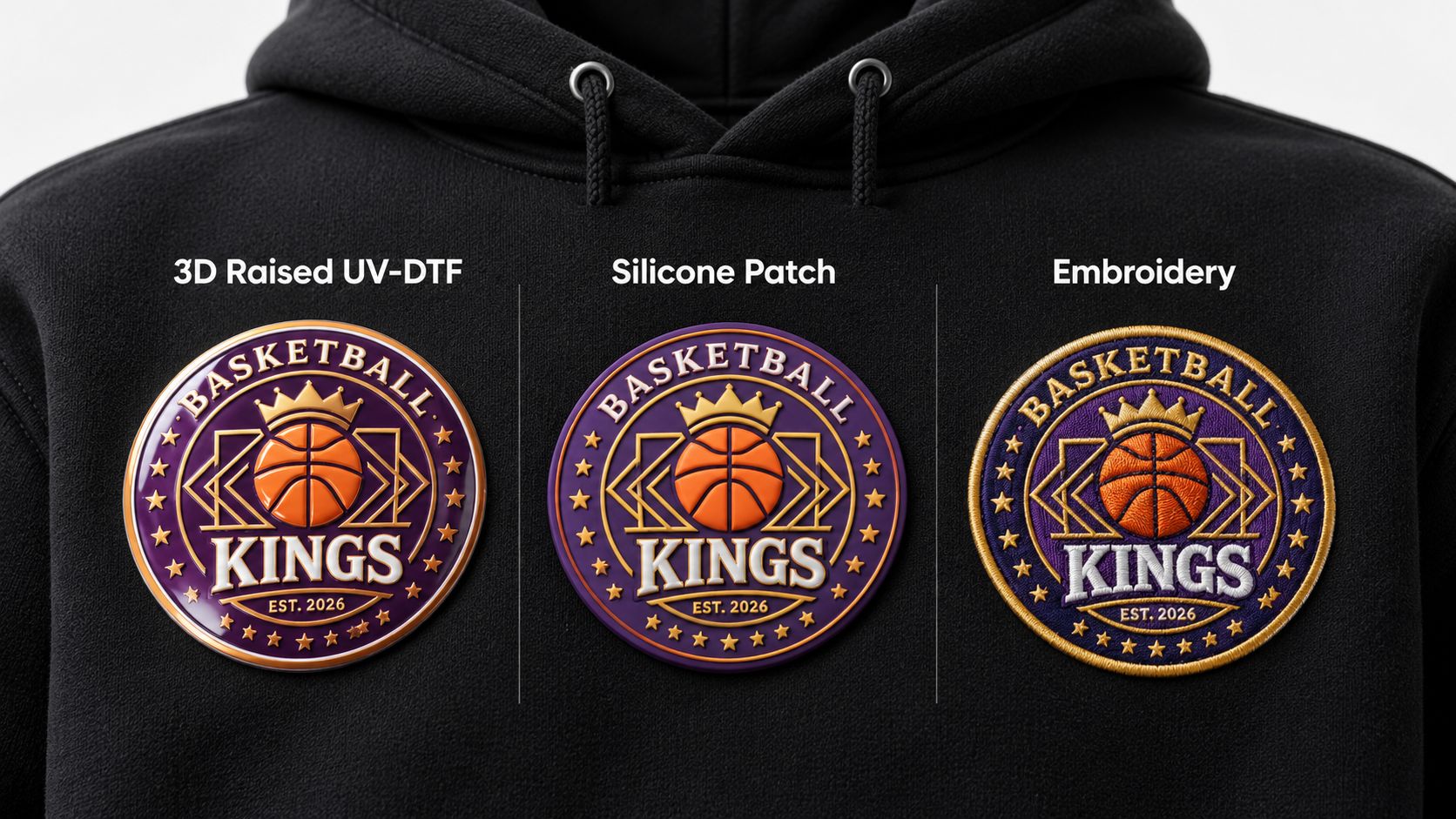
A UV DTF crystal label y un 3D raised apparel logo may be produced from a similar UV printing platform, but they are not the same transfer product.
The most important difference is not simply whether one looks flatter and the other looks more raised.
They use different:
- ink systems
- film systems
- adhesion mechanisms
- transfer methods
- substrate types
- production requirements
A conventional UV DTF crystal label typically uses standard UV-curable ink and Crystal Label A/B Film to transfer graphics onto suitable hard surfaces.
A 3D raised apparel logo uses high-flexibility / 3D embossed UV ink, high-build white ink, flexible CMYK, varnish, TPU transfer materials and TPU hot-melt adhesive before being heat pressed onto textiles.
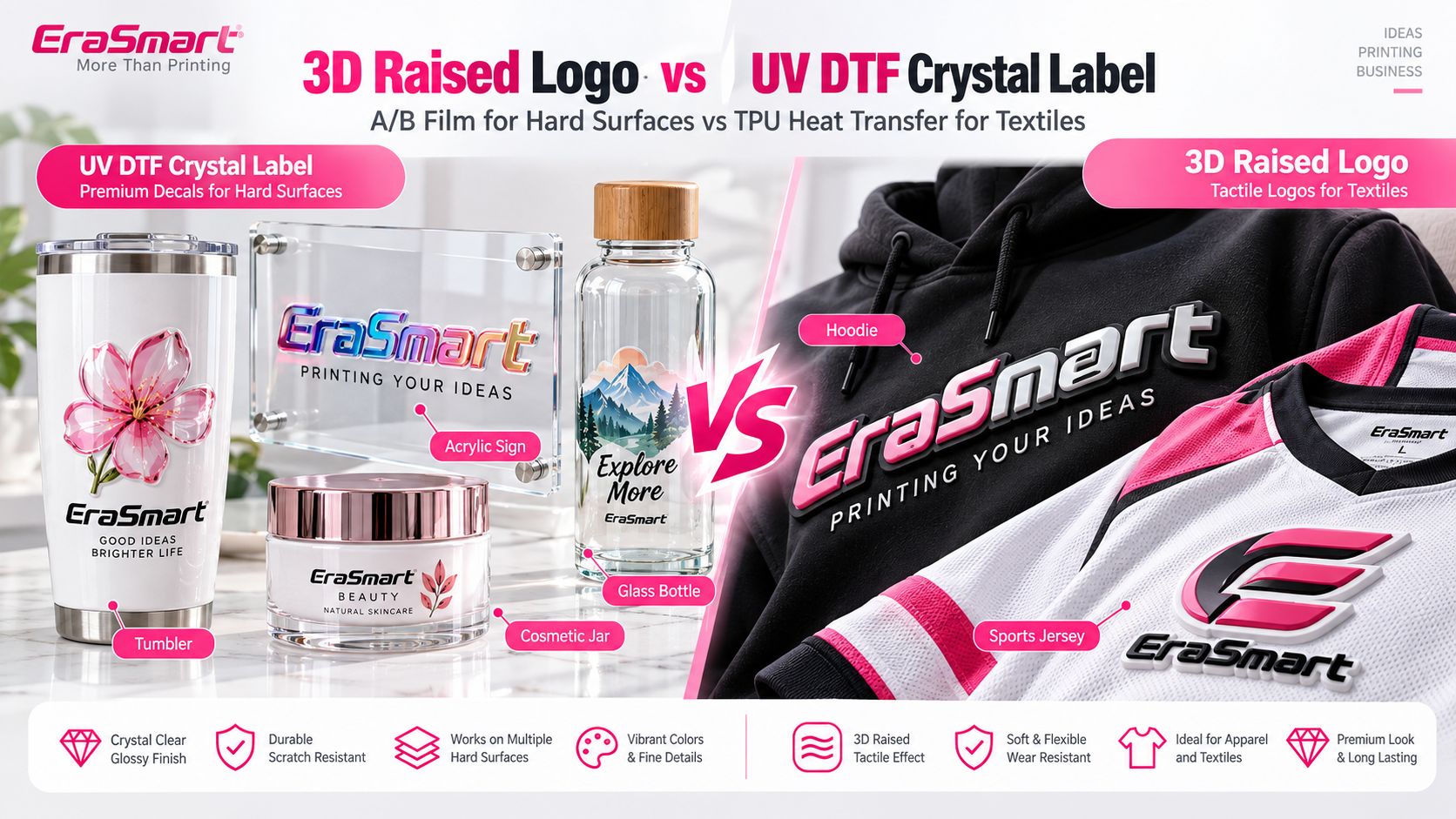
The simplest way to remember the difference is:
Crystal Label = Standard UV Ink + A/B Film + Hard-Surface Transfer
3D Raised Logo = Flexible 3D UV Ink + TPU Transfer System + Heat Press + Textile
If you are deciding which workflow fits your products, the rest of this guide explains the differences in detail.
Quick Comparison: Crystal Label vs 3D Raised Logo
| Comparación | UV DTF Crystal Label | Logotipo de ropa en relieve en 3D |
|---|
| Aplicación principal | Decoración de superficies duras | Apparel and textile decoration |
| Sistema de tinta | Standard UV-curable ink | High-flexibility / 3D embossed UV ink |
| White Ink Role | Primarily opacity and color support | High-build structural layer for physical height |
| Film System | Crystal Label A/B Film | Flexible UV-DTF / TPU transfer film |
| Adhesive System | A/B transfer adhesive system | TPU hot-melt adhesive |
| Transfer Method | Aplicación de presión/frío | prensa de calor |
| Typical Substrates | Glass, acrylic, ceramic, metal, plastic, finished wood | T-shirts, hoodies, jerseys, caps, textile bags |
| Finishing Process | Laminate with B Film, apply and peel carrier | Contour cut, heat press and peel carrier |
| Surface Character | Glossy decorative transfer; varnish may add texture | Flexible, tactile raised structure |
| Typical Raised Height | Not the primary production goal | Approx. 0.3–1.2 mm in the EraSmart raised-logo workflow |
| Flexibility Requirement | Mainly intended for stable hard surfaces | Must bend and move with the garment |
| Downstream Equipment | Lamination / application tools | Contour cutter + heat press |
Why “3D UV DTF” Can Be Confusing
The term 3D UV DTF is used very loosely online.
One supplier may use it to describe a glossy UV DTF sticker with raised varnish.
Another may use it for a thick, flexible TPU apparel badge.
These products can look visually related, but their production systems are different.
That is why the phrase “3D UV DTF” by itself is not enough to identify a workflow.
Instead, ask five questions:
- What ink is being used?
- What film is being used?
- How does the adhesive work?
- How is the transfer applied?
- What substrate is the final product designed for?
Those questions reveal whether you are working with a crystal-label system or a textile raised-logo system.
What Is a UV DTF Crystal Label?
A UV DTF crystal label is a printed transfer designed primarily for suitable hard surfaces.
The artwork is printed onto La película using UV-curable inks, commonly including color, white and varnish.
The printed A Film is then laminated with Película B, which becomes the carrier used to move the printed graphic onto the final object.
Un flujo de trabajo simplificado es:
Print on A Film
↓
Curado UV
↓
Laminate with B Film
↓
Cut / Prepare Transfer
↓
Apply to Hard Surface
↓
Press / Burnish
↓
Peel Carrier
Las aplicaciones típicas incluyen:
- botellas de vidrio
- vasos
- signos de acrílico
- tazas de ceramica
- coated metal
- many plastics
- fundas telefónicas
- finished wood
- productos promocionales
For a deeper explanation of the film system, see the EraSmart A/B Film Guide.
You can also read Cómo hacer pegatinas UV DTF en casa for the complete standard crystal-label workflow.
What Is a 3D Raised Apparel Logo?
A 3D raised apparel logo is designed specifically for flexible textile applications.
Instead of using white ink mainly as a backing layer, the EraSmart 3D workflow repeatedly prints high-build flexible white ink to construct real physical height.
The structure is then completed with:
- flexible CMYK color
- barniz
- controlled UV curing
- flexible base film
- TPU hot-melt transfer materials
- corte de contorno
- prensado en caliente
The resulting badge can reach approximately 0.3–1.2 mm of raised height, depending on the validated production profile.
Las aplicaciones típicas incluyen:
- camisetas
- sudaderas con capucha
- sudaderas
- camisetas deportivas
- tapas
- textile bags
- marca de moda
- team emblems
For the complete application system, see Impresión de logotipos en relieve 3D con tecnología UV DTF.
Difference #1: The Ink System Is Different
This is one of the most important differences.
UV DTF Crystal Label
A conventional crystal-label workflow uses standard UV-curable ink designed for UV DTF hard-surface transfer.
Typical ink functions include:
- CMYK for visible color
- white for opacity
- varnish for gloss and surface effects
The finished transfer is intended primarily for relatively stable hard surfaces.
Logotipo de ropa en relieve en 3D
The textile workflow requires a more flexible ink system.
EraSmart’s raised-logo process uses:
High-Flexibility UV Curable Ink for Textile / 3D Embossed UV Ink
including:
- high-build flexible white
- flexible CMYK
- barniz
The finished ink structure must tolerate:
- garment bending
- textile movement
- transferencia de calor
- routine handling
- validated washing conditions
Using an ink system designed only for rigid surfaces can create an entirely different mechanical result after curing.
Difference #2: White Ink Performs a Different Job
White ink exists in both workflows, but it does not have the same primary purpose.
In a Crystal Label
White ink mainly supports:
- opacidad
- brillo del color
- isolation from the substrate color
- image visibility
It is primarily part of the optical printing structure.
In a 3D Raised Logo
White ink becomes a structural material.
Repeated white layers build physical thickness.
The simplified structure becomes:
White → Cure → White → Cure → White → Continue as Required
Then flexible CMYK and varnish are printed over the raised structure.
This is why the number and stability of white passes can strongly influence the final badge height.
For a deeper technical explanation, read Cómo las capas de tinta blanca crean efectos elevados 3D en la impresión UV DTF.
Difference #3: A/B Film and TPU Transfer Film Are Not the Same System
Film selection is another fundamental difference.
Crystal Label: A/B Film
A/B Film is a two-film transfer system.
La película
receives the printed UV artwork.
Película B
is laminated over the printed design and acts as the transfer carrier.
The finished graphic is then applied to the target hard surface using pressure.
3D Raised Logo: Flexible TPU Transfer System
The raised apparel workflow uses materials designed for flexibility and heat transfer.
Depending on the specific consumable configuration, these may include:
- Flexible UV-DTF Base Film
- TPU Hot Melt Film for 3D Transfer
- TPU Hot Melt Adhesive Film
The TPU hot-melt adhesive is especially important.
During heat pressing, it activates under heat and pressure and forms the bond between the raised badge and the textile surface.
This is fundamentally different from applying an A/B film crystal label to a bottle or acrylic panel.
Difference #4: The Adhesion Mechanism Is Different
A crystal label mainly relies on its transfer adhesive bonding to a compatible smooth surface.
The user positions the transfer, applies pressure and removes the carrier.
A 3D apparel logo uses thermal bonding.
The TPU hot-melt adhesive needs:
heat + pressure + time
to create a reliable bond with the textile.
For the EraSmart 3D raised-logo workflow, the current reference range is approximately:
- 150–165°C
- 10–15 seconds
- 0.4–0.6 MPa
Final conditions must still be tested against the actual TPU film and garment.
For detailed T-shirt, hoodie, jersey and cap transfer guidance, see the 3D Raised Logo Heat Transfer Guide.
Difference #5: The Production Workflow Is Different
The difference becomes especially clear when the full workflows are placed side by side.
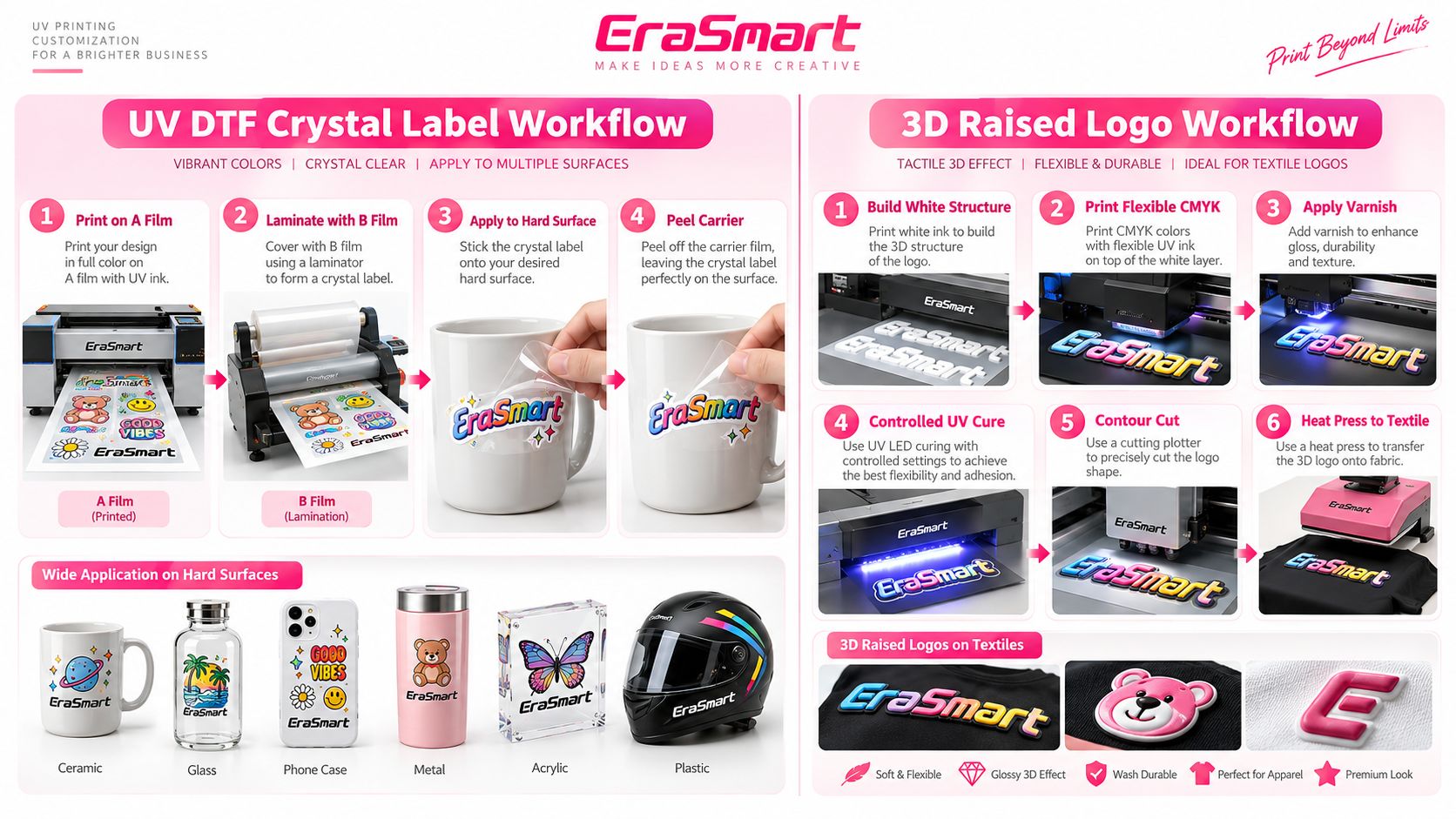
UV DTF Crystal Label Workflow
Obra de arte
↓
Print UV Artwork on A Film
↓
Curado UV
↓
Laminate with B Film
↓
Prepare / Cut Transfer
↓
Apply to Hard Surface
↓
Press / Burnish
↓
Peel Carrier
The product is now decorated.
3D Raised Apparel Logo Workflow
Artwork / RIP Separations
↓
Build High-White Structure
↓
Print Flexible CMYK
↓
Add Varnish
↓
Controlled UV Cure
↓
Corte de contorno
↓
Position on Garment
↓
Prensa de calor
↓
Peel & Inspect
The apparel workflow includes more steps because the printed structure itself becomes a flexible textile component.
For the complete process, see How to Make 3D Raised Logos with a UV DTF Printer.
Difference #6: Varnish Does Not Mean the Same Kind of “3D”
This distinction is easy to misunderstand.
UV varnish can create:
- brillo
- brillo puntual
- transparent texture
- surface relief
- localized raised effects
So a UV DTF crystal label does not have to be visually completely flat.
However, a raised varnish effect on a hard-surface decal is not the same design objective as a flexible apparel badge with approximately 0.3–1.2 mm of physical structure.
Etiqueta de cristal
Varnish may be used to produce:
- brillo
- profundidad transparente
- localized texture
- premium visual effects
Logotipo en relieve 3D
In the EraSmart apparel workflow:
High-build white creates most of the physical structure.
Flexible CMYK creates the visible design.
Varnish creates the final surface finish.
This difference in layer function is important when preparing artwork.
For White, CMYK, Varnish and Cut Line setup, read the 3D Raised Logo Artwork Guide.
Difference #7: Hard Surfaces vs Textiles
The intended substrate is often the easiest way to decide which workflow you need.
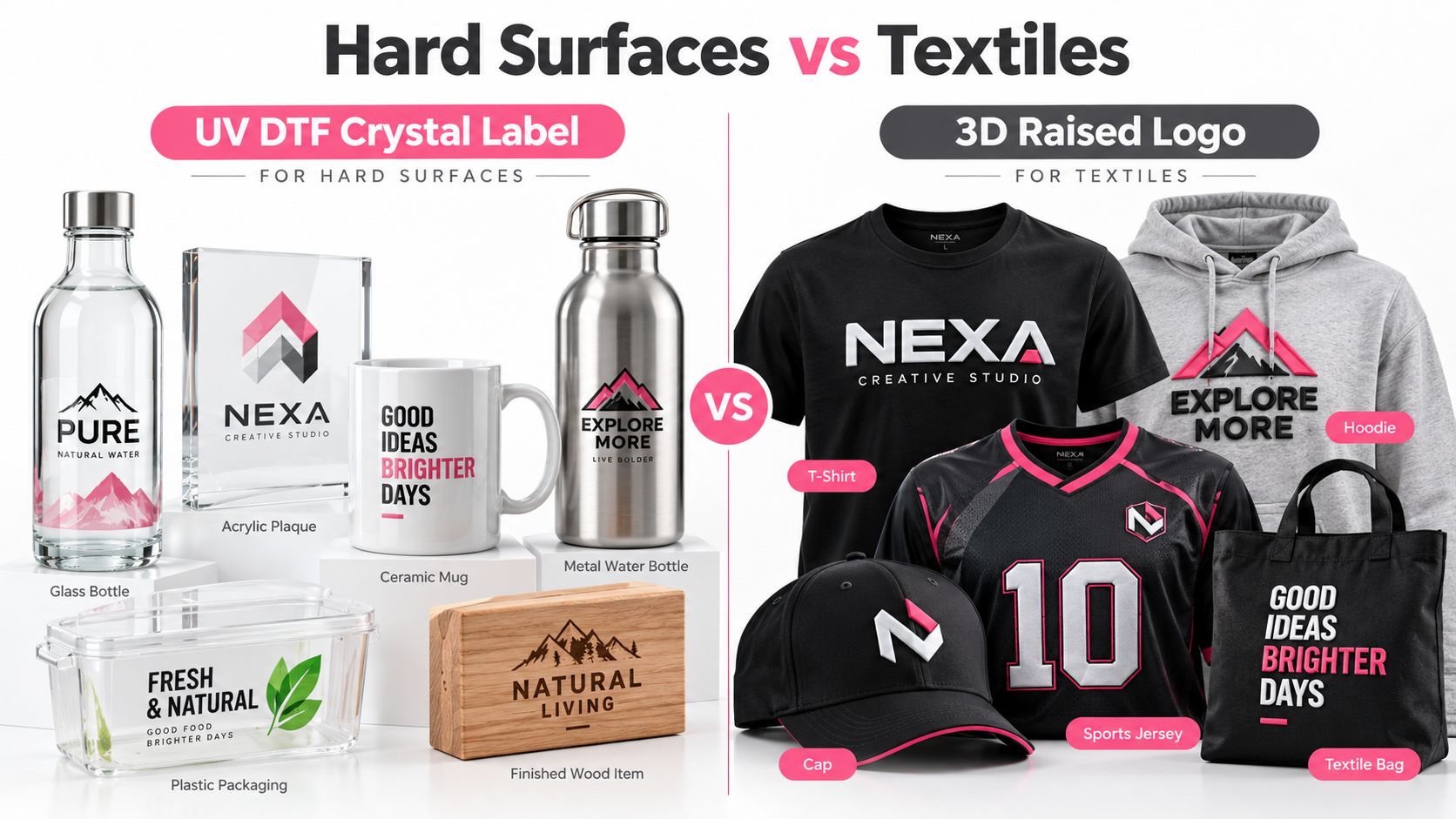
Choose a Crystal Label for Products Such As:
- glass bottle
- tumbler
- acrylic display
- ceramic mug
- metal bottle
- plastic product
- finished wood product
- caja del teléfono
- embalaje
These products provide the relatively stable surface needed for adhesive transfer.
Choose a 3D Raised Logo for Products Such As:
- Camiseta
- sudadera
- sweatshirt
- sports jersey
- baseball cap
- fabric bag
- textile accessory
These applications require a transfer that can remain attached while the substrate bends and moves.
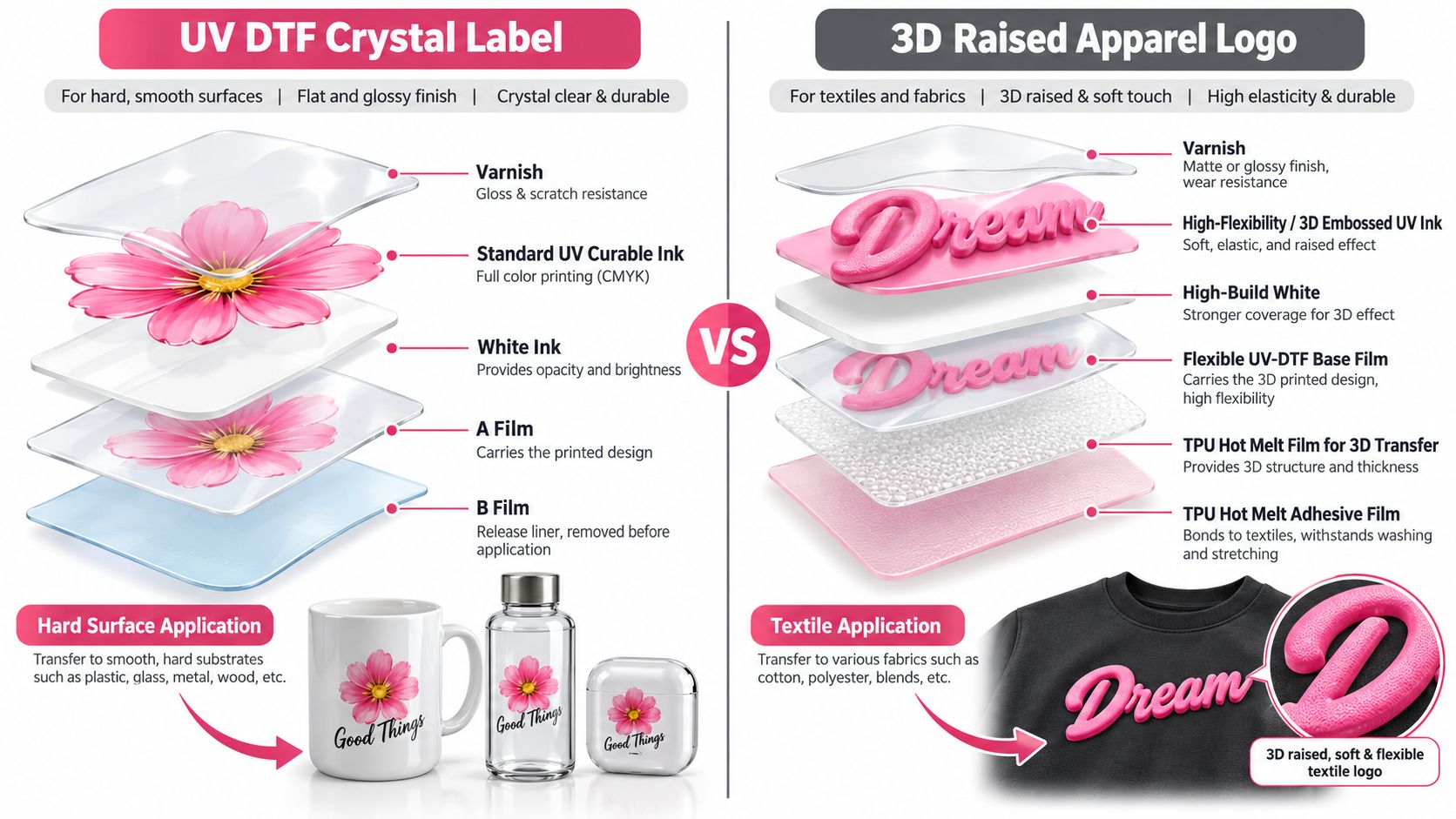
Difference #8: The Physical Layer Structure Is Different
The two systems also look very different in cross-section.
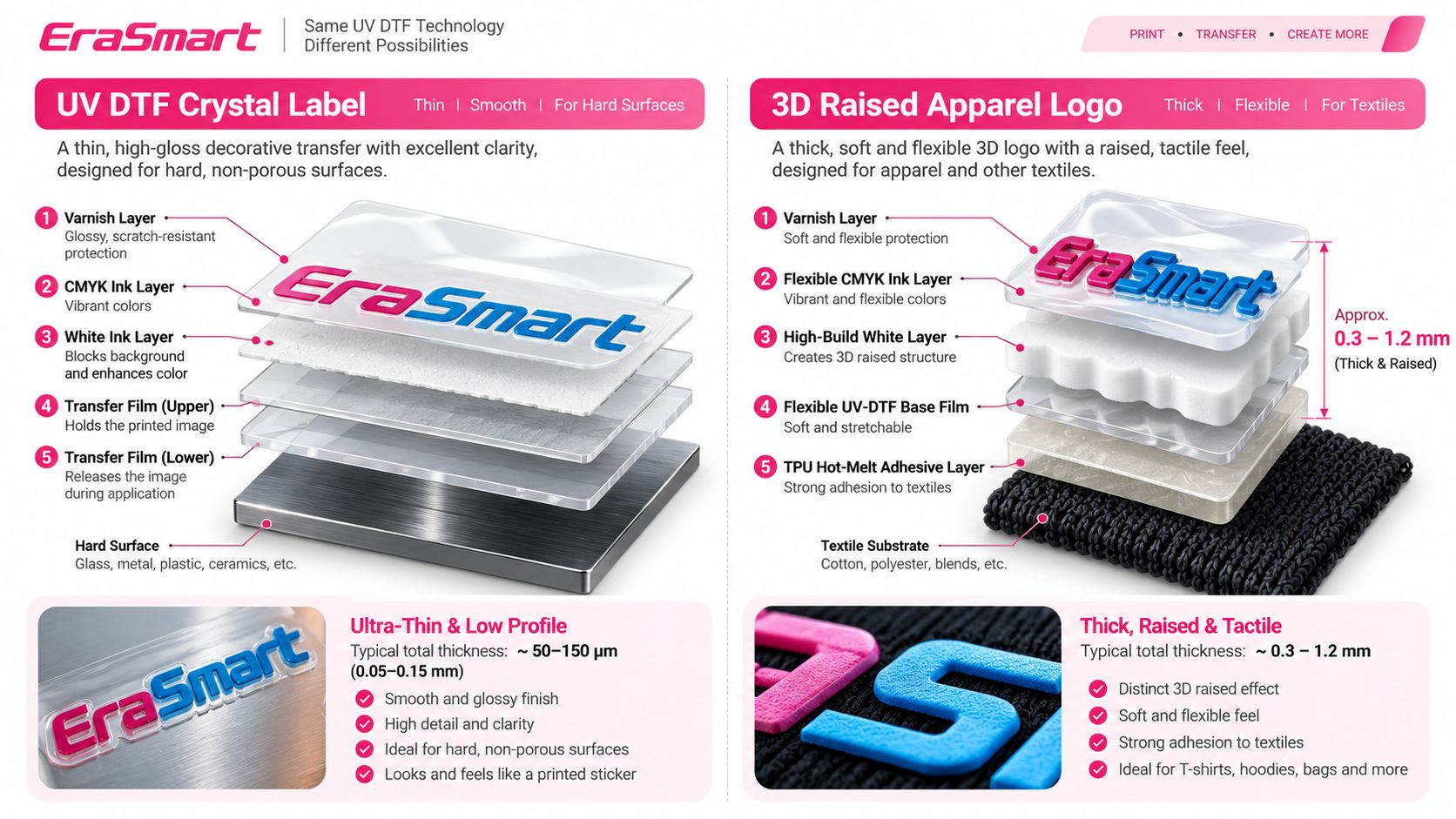
Crystal Label Structure
A simplified crystal-label system includes:
- varnish / clear finishing
- Imagen CMYK
- tinta blanca
- transfer-film system
- adhesive interface
- hard substrate
The exact film structure depends on the A/B consumables being used.
3D Raised Apparel Logo Structure
A simplified raised-logo structure includes:
- barniz
- flexible CMYK
- repeated high-build white structure
- flexible UV-DTF / TPU base film
- TPU hot-melt adhesive layer
- textile substrate
The raised-logo design is therefore engineered around both height and flexibility.
Do Not Use Thickness Alone to Identify the Process
A very glossy or heavily varnished crystal label can appear dimensional.
A poorly configured raised apparel logo may also fail to reach the desired height.
The correct classification comes from the complete system:
Ink + Film + Adhesive + Transfer + Substrate
not appearance alone.
Difference #9: The Printer Configuration Has Different Demands
A compatible UV DTF printer platform may potentially support more than one workflow, but changing from crystal labels to 3D textile logos is not as simple as choosing a different graphic in the RIP.
3D high-build production places additional demands on the system.
Independent White, CMYK and Varnish Output
The printer must be able to control:
- high-build white
- flexible CMYK
- barniz
as separate ink functions.
Adjustable LED-UV Curing
Thick flexible UV ink needs controlled curing.
If only the surface cures too aggressively while the inner structure remains insufficiently cured, problems such as:
- wrinkling
- incomplete internal curing
- layer instability
- delamination
can occur.
Controlled staged curing is therefore more important when producing a thick structure.
White-Ink Circulation
High-build flexible white ink contains a high pigment load.
White ink circulation and stirring help reduce:
- sedimentación de pigmentos
- inconsistent white density
- nozzle problems
The EraSmart A2 platform includes adjustable UV curing hardware and a UV DTF film system for standard crystal-label production; the actual 3D raised-logo configuration must still be matched to the intended flexible ink and consumable workflow.
Can the Same A2 UV DTF Printer Produce Both?
Potentially, the same compatible machine platform can support both types of application when it has the required ink-channel, curing and ink-management capabilities.
But this does not mean the two workflows use the same consumables.
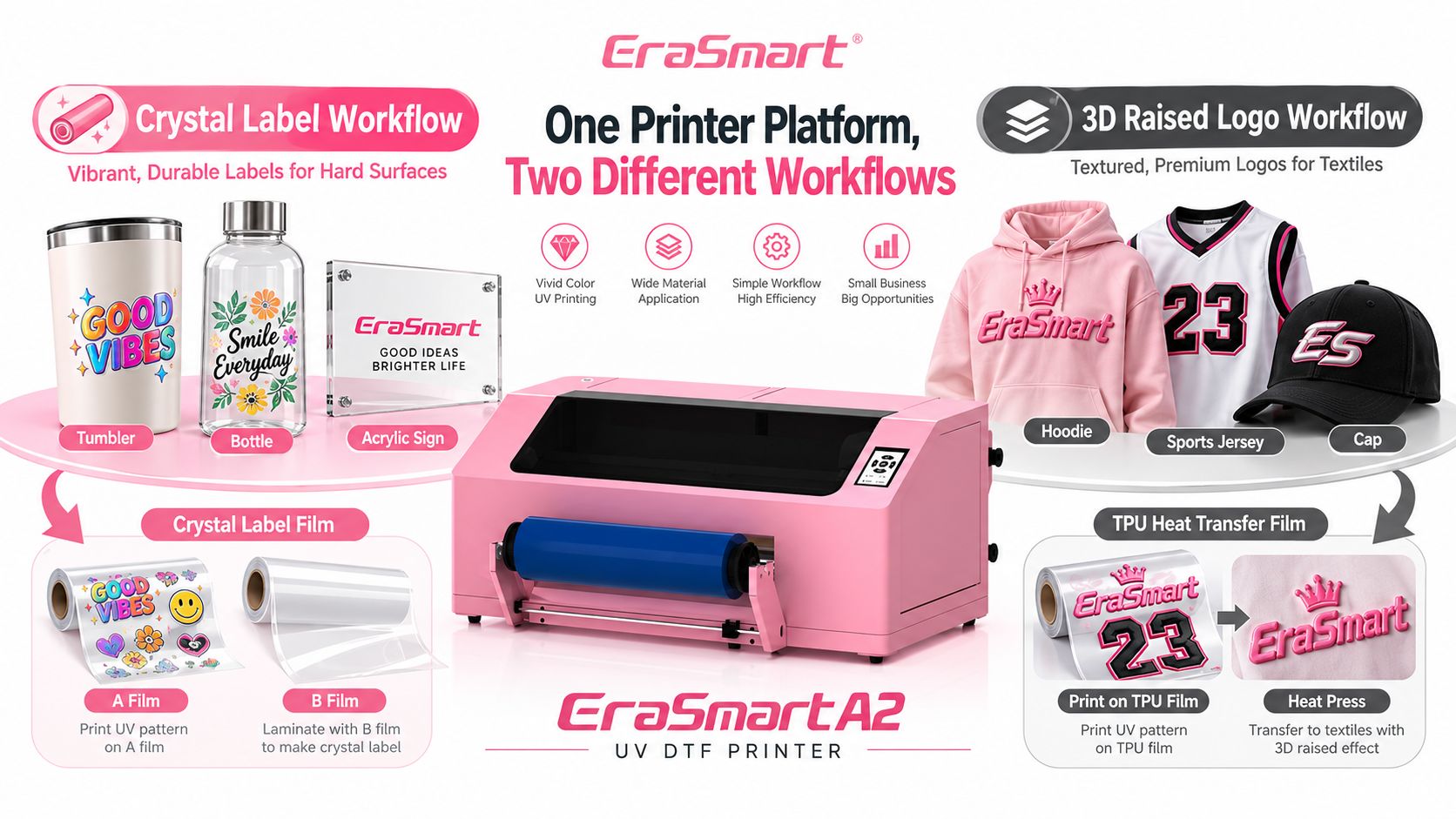
Crystal Label Configuration
Uses:
- standard UV-compatible ink system
- Crystal Label A/B Film
- lamination workflow
- hard-surface application
3D Raised Logo Configuration
Requires:
- high-flexibility 3D UV ink
- high-build structural white
- flexible CMYK
- barniz
- controlled curing
- TPU transfer materials
- corte de contorno
- prensado en caliente
The important concept is:
One compatible printer platform can open different applications, but each application still needs the correct material and production system.
You can view the EraSmart Impresora A2 UV DTF for current machine specifications.
Can You Simply Change the Film?
No.
Film is only one part of the system.
A switch from crystal-label production to raised apparel production may involve changes to:
- tipo de tinta
- película
- adhesivo
- perfil RIP
- white buildup
- curing strategy
- finishing equipment
- transfer equipment
Do not assume that replacing an A/B film roll with a TPU film automatically creates a stable apparel process.
Can You Put a Standard UV DTF Crystal Label on Fabric?
Standard UV DTF A/B film is primarily designed for compatible hard surfaces.
Textile surfaces are:
- flexible
- porous
- textured
- continuously moving during wear
That is very different from applying a decal to acrylic or glass.
A standard crystal-label transfer may appear to adhere temporarily to some materials, but that should not be confused with a dedicated flexible, washable apparel transfer system.
For apparel, use a workflow designed around textile flexibility and heat bonding.
Can You Use the 3D Raised Apparel Workflow on Hard Products?
The raised-logo workflow is optimized around:
- flexible UV ink
- TPU
- heat activation
- textile bonding
For a tumbler, acrylic sign, glass bottle or ceramic product, the standard UV DTF A/B Film workflow is normally the more direct EraSmart solution.
The purpose of choosing the correct workflow is not to make every technology work on every substrate.
It is to use the production system designed for the product you are actually selling.
Which Workflow Is Faster?
This depends on what you mean by faster.
Crystal Labels
The process is highly efficient for decorating hard goods because:
- no direct product printing jig is required
- multiple designs can be produced on film
- transfers can be stored and applied later
- the final object does not require garment heat pressing
3D Raised Logos
The process includes additional steps such as:
- repeated structural white output
- controlled curing
- corte de contorno
- garment positioning
- prensado en caliente
The additional processing creates a completely different finished product.
So production speed should be evaluated against the value and application of the final product rather than compared as if both workflows make the same item.
Which Workflow Is Better for Short-Run Customization?
Both can work well for short-run digital production, but they serve different markets.
Crystal labels are useful for personalized hard goods such as:
- vasos
- regalos
- embalaje cosmético
- productos promocionales
3D raised logos are useful for customized:
- ropa de equipo
- ropa de calle
- fashion garments
- ropa de club
- tapas
- branded textile merchandise
The better workflow depends on what your customer wants to decorate.
¿Cuál deberías elegir?
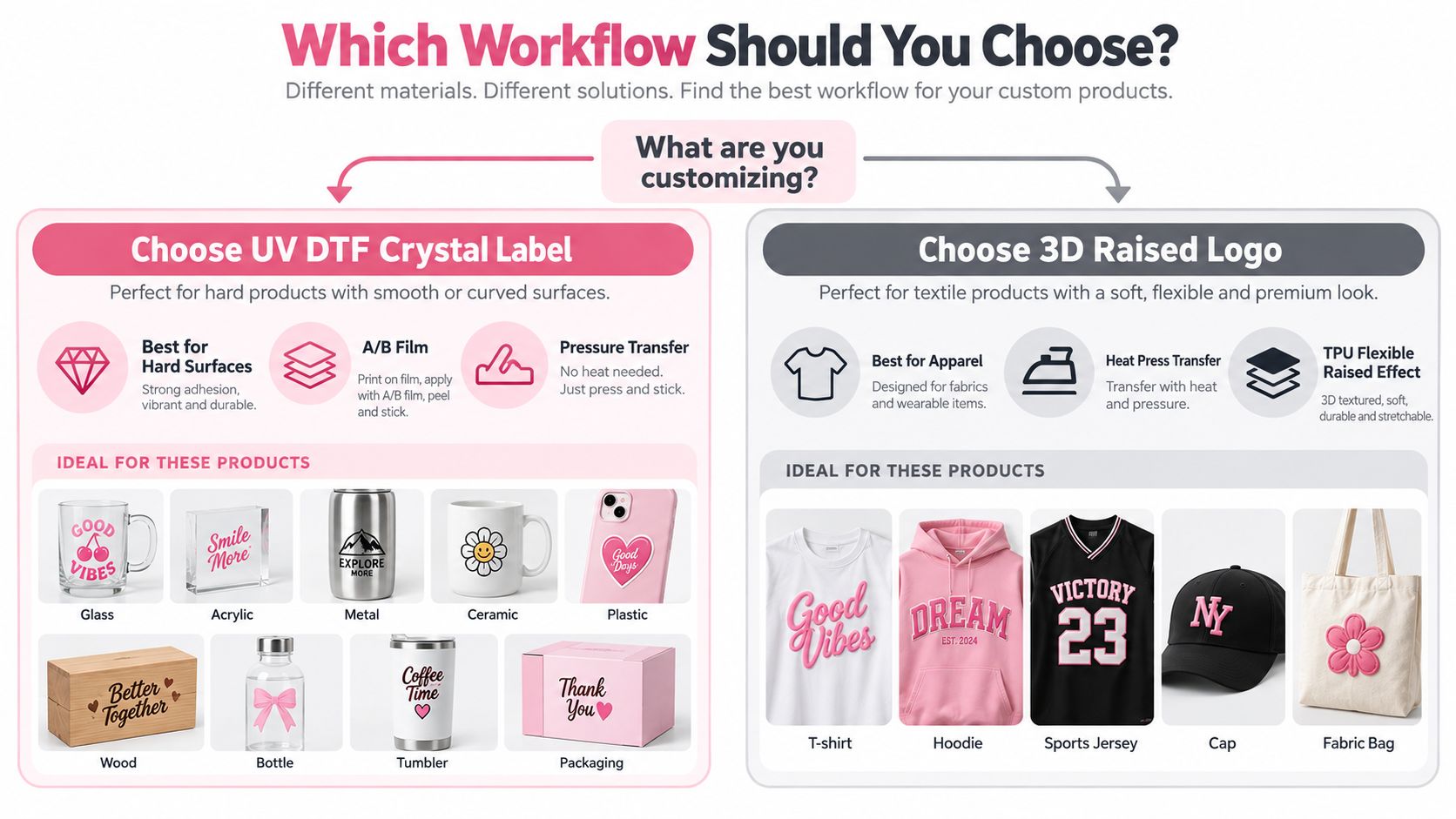
Use a UV DTF Crystal Label when your target product is primarily a compatible hard surface.
Typical examples:
Glass / Acrylic / Ceramic / Metal / Plastic / Finished Wood / Bottles / Tumblers
Elige un Logotipo en relieve 3D when your target product is apparel or another compatible textile where flexibility, tactile height and heat-transfer adhesion are required.
Typical examples:
T-Shirts / Hoodies / Jerseys / Caps / Textile Bags
If your business plans to produce both categories, evaluate the complete production workflow rather than selecting the printer only by print width or printhead model.
You need to consider:
- consumable changeover
- ink compatibility
- configuración de RIP
- curación
- laminación
- corte de contorno
- prensado en caliente
- production volume
A Simple Decision Framework
Preguntar:
Are you decorating a rigid product?
Choose the Crystal Label workflow.
Are you decorating a garment?
Choose the 3D Raised Logo workflow.
Do you mainly need glossy product stickers?
Start with standard UV DTF.
Do you need real tactile height on apparel?
Use the flexible 3D raised-logo process.
Do you want both applications?
Choose a compatible platform and plan each workflow as a separate consumable and finishing system.
Common Mistakes When Comparing the Two
Mistake 1: Assuming Both Use the Same Ink
They have different mechanical requirements.
Rigid-surface and flexible-textile output should not automatically be treated as interchangeable.
Mistake 2: Calling Every Raised UV DTF Product a 3D Apparel Logo
Varnish texture on a bottle label is not automatically the same thing as a flexible 0.3–1.2 mm textile badge.
Mistake 3: Using Standard A/B Film as a Textile Transfer Film
A/B film is designed around crystal-label transfer.
The raised apparel workflow uses an appropriate TPU-based textile system.
Mistake 4: Assuming the Same Transfer Method Works for Both
Crystal labels use pressure-based application.
Raised apparel logos require controlled heat pressing.
Mistake 5: Choosing Only by Visual Appearance
A glossy crystal label and a glossy raised apparel badge may look related in a photograph.
Their actual production structures can be completely different.
Conclusión final
A UV DTF crystal label and a 3D raised apparel logo are best understood as two different application systems built around UV digital printing.
A crystal label is designed around:
Standard UV Ink
Película A/B
Transferencia de superficie dura
A 3D raised apparel logo is designed around:
High-Flexibility 3D UV Ink
High-Build Structural White
Flexible CMYK
Barniz
TPU Transfer & Hot-Melt Adhesive
Prensa de calor
Textil
The printer platform may be compatible with both applications, but the film and ink are only the beginning of the difference.
The entire production workflow must match the final product.
For crystal-label production, explore the EraSmart UV DTF Printer range y A/B Film Guide.
For apparel decoration, continue with the Solución de impresión de logotipos en relieve 3D, Complete 3D Raised Logo Workflow, White Ink Height-Building Guide y 3D Raised Logo Heat Transfer Guide.
Preguntas frecuentes
Is a UV DTF crystal label the same as a 3D raised logo?
No. They may use a similar UV printing platform, but the ink, film, adhesive, transfer process and target substrate are different.
What film does a UV DTF crystal label use?
A conventional UV DTF crystal label uses an A/B Film system. The graphic is printed on A Film, laminated with B Film and then transferred onto a compatible hard surface.
What film does a 3D raised apparel logo use?
The EraSmart raised-logo workflow uses a flexible textile-transfer system based on suitable TPU materials, including a flexible base/transfer film and TPU hot-melt adhesive.
Can UV DTF crystal labels be used on T-shirts?
Standard A/B film crystal labels are primarily designed for suitable hard surfaces rather than flexible, washable textile applications. Apparel should use a transfer system designed for textiles.
What creates the height in a 3D raised logo?
In the EraSmart workflow, repeated high-build flexible white ink layers create most of the physical structure. Flexible CMYK creates the visible color and varnish finishes the surface.
Can crystal labels have a raised effect?
Yes. UV varnish can create gloss, texture and localized raised effects. However, this is not the same production structure as a flexible 3D apparel badge with a high-build white foundation and TPU heat-transfer system.
Does a crystal label need a heat press?
Standard UV DTF crystal-label application normally uses pressure rather than garment-style heat pressing.
Does a 3D raised logo need a heat press?
Yes. The TPU hot-melt adhesive system is activated with controlled heat and pressure before bonding to the textile.
What are the reference heat-transfer settings for the EraSmart 3D raised-logo workflow?
The current reference range is approximately 150–165°C for 10–15 seconds at around 0.4–0.6 MPa. Final settings should always be verified with the actual TPU materials and garment.
Can the same EraSmart A2 printer make both crystal labels and 3D raised logos?
A compatible A2 platform may support both workflows when it has the appropriate ink-channel, curing and ink-management configuration. However, the consumables and downstream process are different, so it should not be treated as a simple film-only change.
Which workflow is better for tumblers and bottles?
UV DTF crystal labels are generally the more appropriate workflow for compatible hard products such as tumblers, bottles, acrylic, ceramic and metal.
Which workflow is better for hoodies and jerseys?
The 3D raised-logo workflow is designed for compatible textiles such as hoodies, T-shirts, jerseys and caps where flexibility, heat-transfer adhesion and raised tactile structure are required.