تولید کننده چاپگر جوهر افشان به اندازه کوچک

White Ink Printing Guide: How to Print White on Dark, Colored & Transparent Materials
White ink is one of the most important differences between ordinary CMYK printing and professional DTF, UV and UV DTF printing.
A standard CMYK printer normally assumes that the printing surface is already white.
If your artwork contains a white logo, standard CMYK printing usually does not create white ink. It simply leaves that area unprinted.
That works on white paper.
It does not work the same way on:
- black acrylic
- dark plastic
- فولاد ضد زنگ
- سرامیک رنگی
- transparent glass
- clear acrylic
- لباس های تیره
Professional white ink printing solves this by adding a dedicated white ink channel that can be controlled separately from CMYK.

Depending on the workflow, white ink can be used as:
- an underbase beneath CMYK
- a backing layer behind transparent prints
- a standalone white graphic
- a selective white layer
- part of a multi-layer raised structure
The most important rule is:
White on the computer screen is not the same thing as a white ink channel in the printer.
This guide explains how white ink works, when you need it, how to prepare white layers, how it differs across UV, DTF and UV DTF printing, and how to troubleshoot common white ink problems.
Quick Answer: How Do You Print White Ink?
To physically print white, you need:
- A printer designed with a white ink system.
- Compatible white ink.
- RIP software that can control the white channel.
- Artwork or a white mask that tells the printer where white ink is required.
- Correct layer order.
- A maintained white ink circulation and printhead system.
For dark rigid products, a common layer concept is:
Material → White Ink → CMYK
For transparent reverse printing, the layer structure may instead be:
Viewer → Transparent Material → CMYK → White Backing
The exact order depends on:
- product
- viewing direction
- اثر هنری
- راه اندازی RIP
- پیکربندی چاپگر
Why Can’t Most CMYK Printers Print White?
Traditional CMYK printing is built around four process colors:
- فیروزه ای
- سرخابی
- زرد
- مشکی
These colors are combined to reproduce photographs, illustrations, logos and gradients.
But there is normally no white channel.
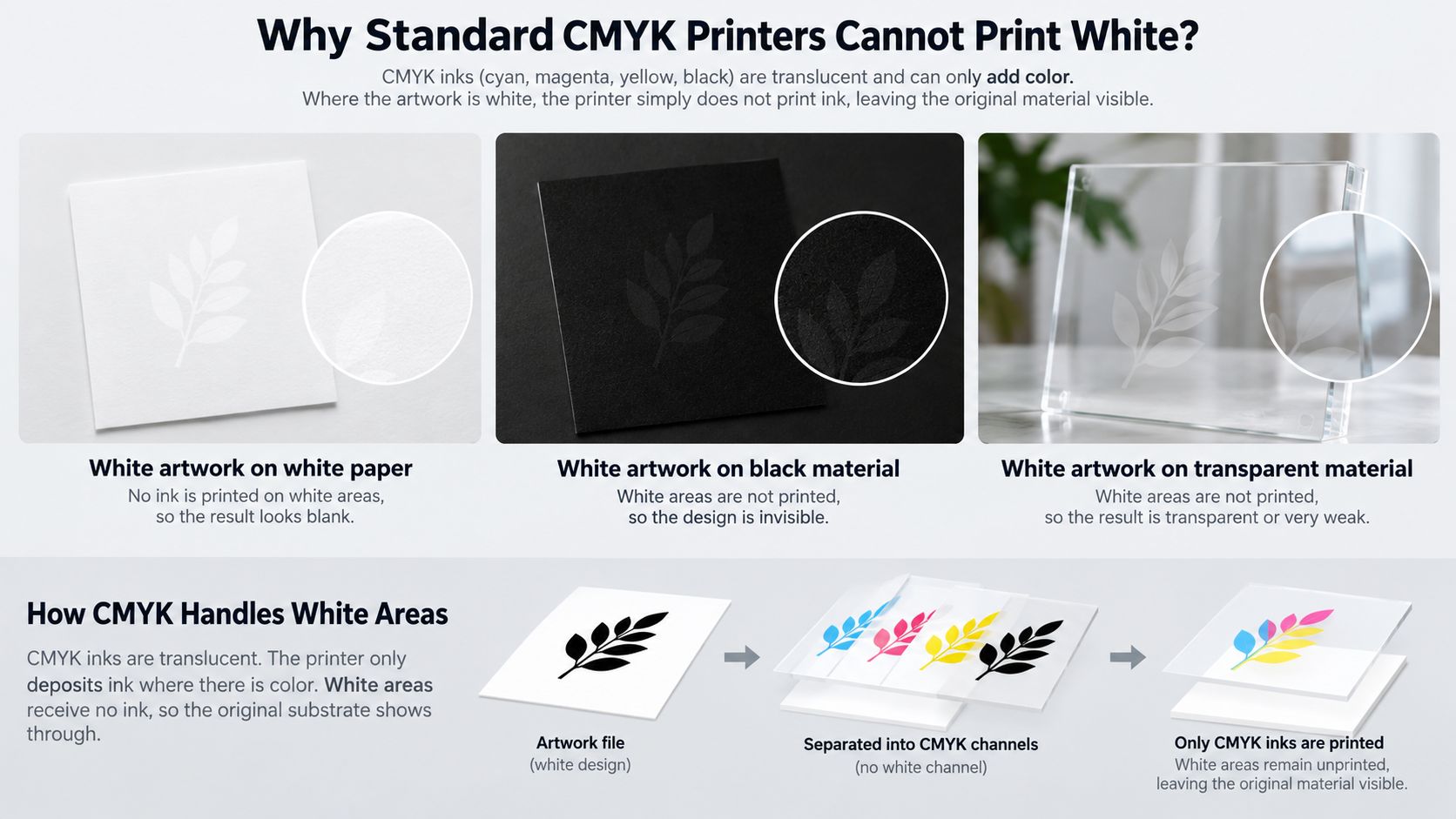
White on White Paper
If a design contains white areas, the printer typically deposits no CMYK ink there.
The white paper itself provides the white.
White on Black Material
The same logic fails.
If the printer deposits no ink, the black substrate remains visible.
The printer does not automatically replace that empty area with white.
White on Transparent Material
On clear acrylic or glass, an unprinted white area simply remains transparent.
This is why dedicated white ink is required when you want real white graphics or an opaque background.
Important: RGB White Is Not White Ink
On a computer, white may be represented as:
RGB: 255 / 255 / 255
or in CMYK artwork as:
C0 M0 Y0 K0
But this normally means:
No process-color ink.
It does not automatically mean:
Print white ink.
The printer needs a dedicated white channel controlled through the RIP software.
That distinction is critical when preparing artwork for professional white ink printing.
What Makes White Ink Different?
White ink must block the color of the material underneath it.
That means it requires a highly opaque pigment system.
This makes white ink different from normal CMYK inks, which are designed to combine visually and create process color.
The higher pigment loading of white ink also means it requires more careful management.
Common considerations include:
- ته نشین شدن رنگدانه
- گردش خون
- agitation depending on printer design
- وضعیت نازل
- capping
- تمیز کردن
- idle-time maintenance
For a broader explanation of UV ink chemistry and curing, read:
The 5 Main Ways White Ink Is Used
White ink is not only used for one purpose.
1. White Underbase
A white underbase is printed underneath CMYK.
Typical structure:
Dark Material → White → CMYK
This helps isolate the color image from the substrate.
مفید است برای:
- black acrylic
- قاب گوشی تاریک
- پلاستیک رنگی
- فلز تیره
- سرامیک رنگی
- dark promotional products
2. White Backing
White can be printed behind color when working with transparent materials.
This is common in:
- clear acrylic
- شیشه ای
- transparent plastic
White backing prevents CMYK from appearing too transparent.
3. Standalone White Graphics
White does not always need CMYK.
مثالها عبارتند از:
- white logo on black acrylic
- white text on dark metal
- white pattern on a black phone case
- minimalist white graphics on colored products
4. Selective White
You can print white only in selected areas.
For example, on clear acrylic:
- سفید پشت لوگو
- white behind text
- no white behind transparent decorative sections
این ترکیبی از موارد زیر را ایجاد می کند:
opacity + transparency
in the same design.
5. Multiple White Ink Layers
On supported workflows, repeated white layers can also be used to build additional physical thickness.
This is different from simply increasing white opacity.
For EraSmart’s dedicated raised-logo workflow, see:
چگونه لایههای جوهر سفید جلوههای سه بعدی را در چاپ UV DTF ایجاد میکنند
How a White Ink Underbase Works on Dark Materials
Dark substrates can absorb the visual impact of CMYK because process-color inks are not intended to completely hide a dark background.
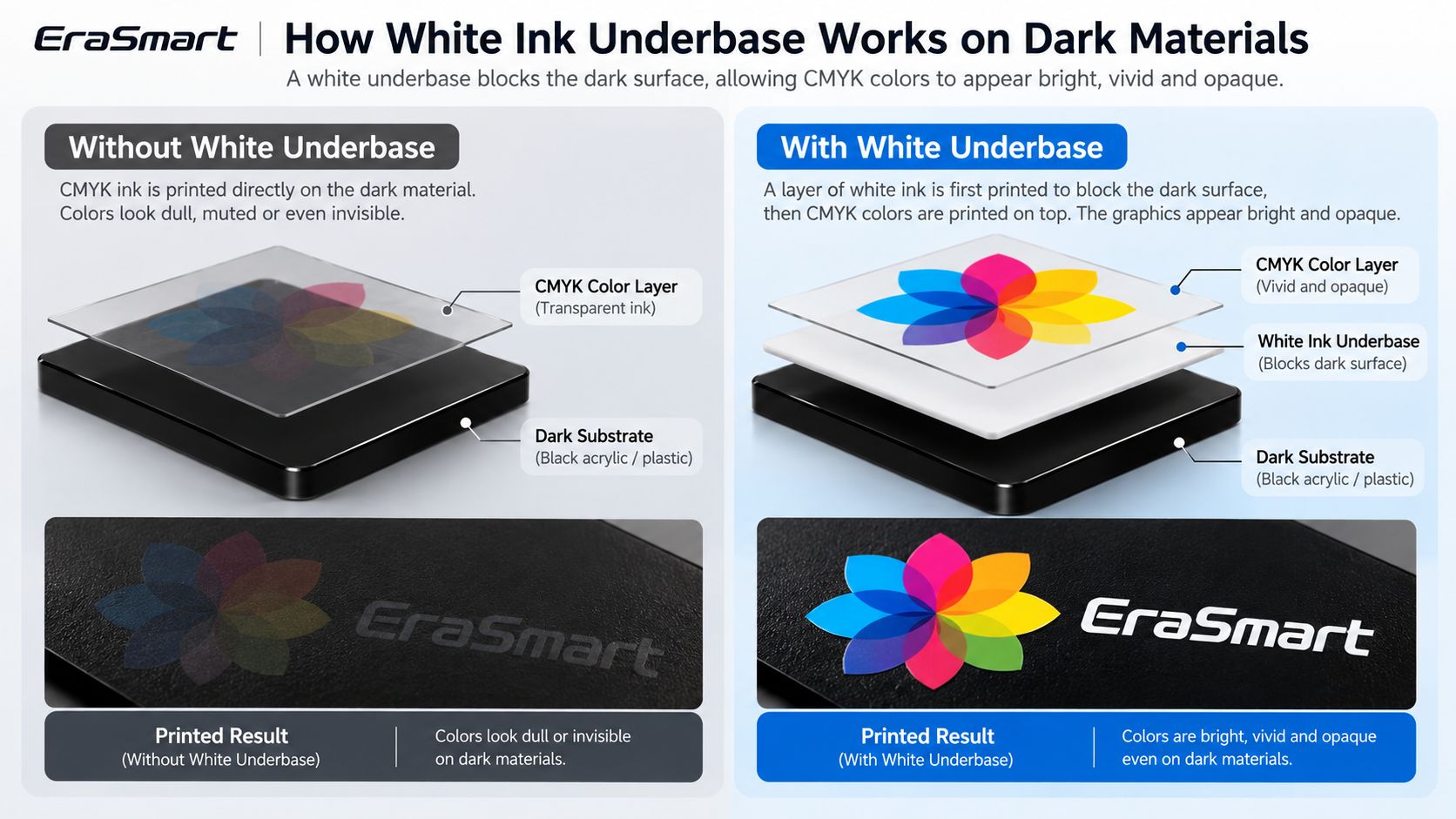
Without White Underbase
Structure:
Dark Material → CMYK
نتیجه احتمالی:
- رنگ های کسل کننده
- weak yellow
- weak cyan
- low contrast
- artwork influenced by substrate color
With White Underbase
Structure:
Dark Material → White → CMYK
نتیجه احتمالی:
- کدورت قوی تر
- CMYK روشن تر
- improved contrast
- رنگ های برند قابل پیش بینی تر
The white layer acts like a printable white canvas.
White Ink Density: More Is Not Always Better
It can be tempting to assume:
More white ink = better print.
That is not always true.
Excessive white ink can increase:
- مصرف جوهر
- زمان چاپ
- layer thickness
- curing demand
and may affect the finished appearance.
The correct white density depends on:
- substrate color
- مواد
- اثر هنری
- چاپگر
- حالت چاپ
- desired opacity
Use the RIP settings validated for your actual workflow rather than applying one universal white percentage.
How to Print White Ink on Dark Materials
A practical UV printing workflow is:
مرحله 1: کار هنری را آماده کنید
شناسایی کنید:
- CMYK areas
- white areas
- مناطق شفاف
- varnish areas if required
Step 2: Create the White Layer
The RIP needs a defined white mask.
Depending on the software, this may be generated from:
- artwork objects
- spot color
- image transparency
- automatic white generation
Step 3: Choose the Layer Order
For a dark opaque product, a typical structure is:
Material → White → CMYK
Step 4: Check White Ink Output
Before production, run:
- بررسی نازل
- white-channel check
- registration check
Step 5: Print a Sample
بازرسی کنید:
- کدورت
- روشنایی رنگ
- edge registration
- متن کوچک
- white uniformity
Step 6: Save the Successful Preset
Once the result is approved, record the RIP setup for repeat jobs.
Printing White Ink on Transparent Materials
Transparent materials create additional possibilities because the design can be viewed through the substrate.
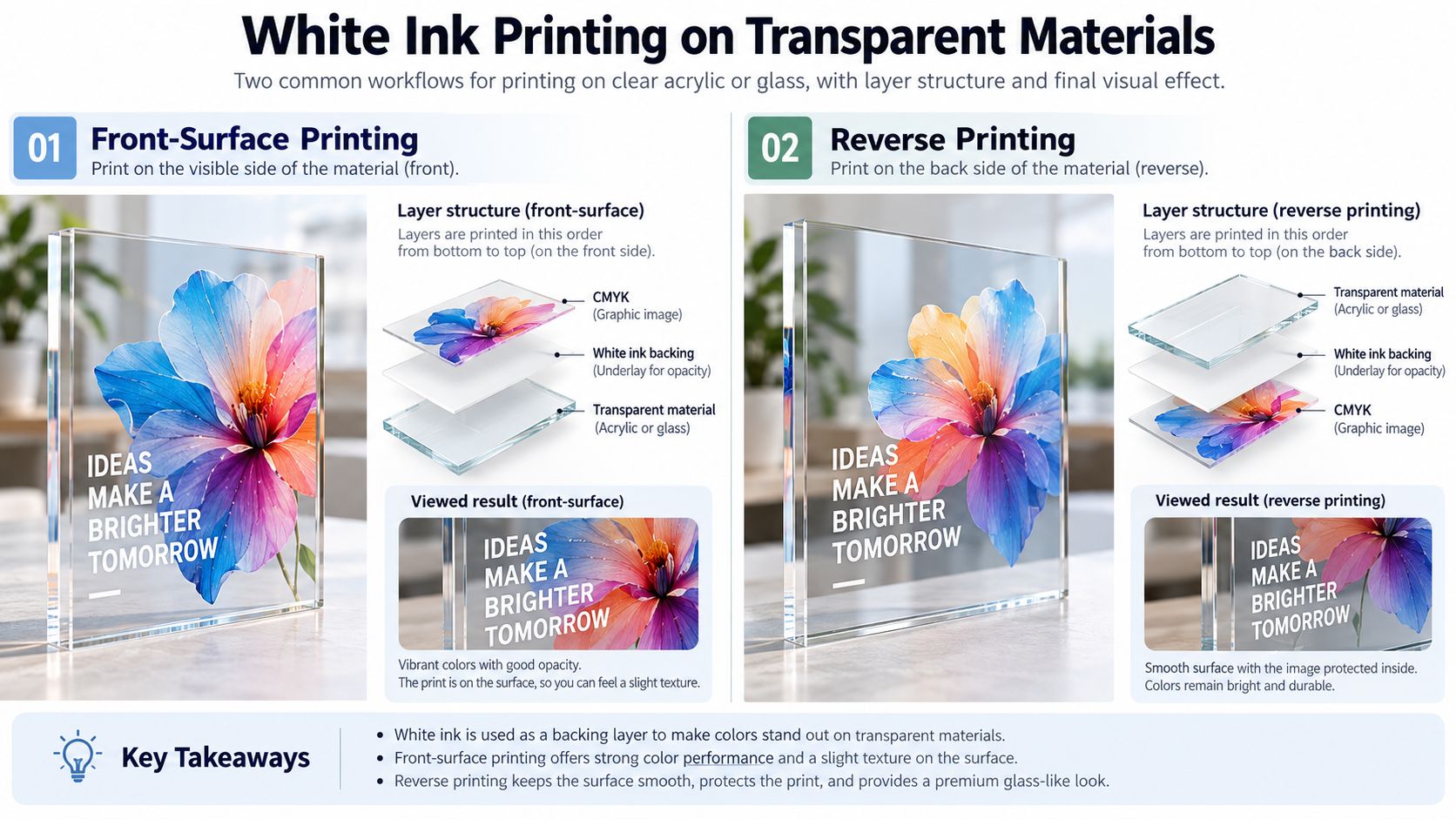
There are two major approaches.
چاپ سطح جلو
اثر هنری در سمتی که رو به روی بیننده است چاپ شده است.
A common opaque-color structure is:
Transparent Material → White → CMYK
depending on viewing direction and printer layer configuration.
This is useful when you want:
- direct surface graphics
- tactile varnish
- front-facing texture
چاپ معکوس / سطح دوم
The artwork is printed on the back of the transparent material and viewed through the front.
آثار هنری معمولاً باید آینه شوند.
A typical visual concept is:
Viewer → Clear Material → CMYK → White
The white layer sits behind the color.
این می تواند ایجاد کند:
- smooth front surface
- premium glass-like appearance
- protected-looking graphics
- strong color viewed through the substrate
For a detailed glass workflow, see:
For acrylic applications, see:
Selective White on Clear Acrylic and Glass
You do not need to cover the entire design with white.
Suppose your artwork contains:
- colorful flower
- لوگوی شرکت
- transparent decorative background
You might use:
White behind flower + logo
while leaving:
background without white
This keeps selected parts transparent.
The result can look more premium than applying a solid white rectangle behind the entire artwork.
White Ink Printing on Metal
Metal is another interesting case because sometimes you want to hide the metallic appearance—and sometimes you want to preserve it.
Use White Underbase
Choose white when you want:
- رنگ قوی تر
- opaque logo
- more predictable branding
- reduced metallic influence
Do Not Use White Underbase
CMYK directly over suitable metal can intentionally preserve some of the metallic appearance.
This can create a different visual effect.
There is no single correct method.
For surface preparation and adhesion, see:
White Ink Printing on Wood
Wood provides another example where white ink is a design decision rather than an automatic requirement.
فقط CMYK
Lets the natural:
- دانه
- رنگ
- بافت
show through the artwork.
سفید + CMYK
Creates:
- کدورت قوی تر
- brighter color
- more predictable image reproduction
سفید انتخابی
Combines:
- visible natural wood
- high-opacity design areas
See:
White Ink Printing on Plastic
Plastic varies significantly by type.
For dark plastic:
سفید + CMYK
is often useful for strong color.
For transparent plastic:
سفید انتخابی
can help control opacity.
But successful printing also depends on:
- نوع پلیمری
- پوشش
- انرژی سطحی
- تمیز کردن
- چسبندگی
See:
White Ink Printing on Ceramic
White ceramic often already provides a useful neutral base.
Therefore, a full white underbase may not always be necessary.
روشن:
- سرامیک مشکی
- blue ceramic
- colored tiles
- dark plaques
white becomes much more useful.
For the complete ceramic workflow, see:
UV vs DTF vs UV DTF White Ink
EraSmart uses white ink across several different printing technologies.
But these are different ink systemsبشر
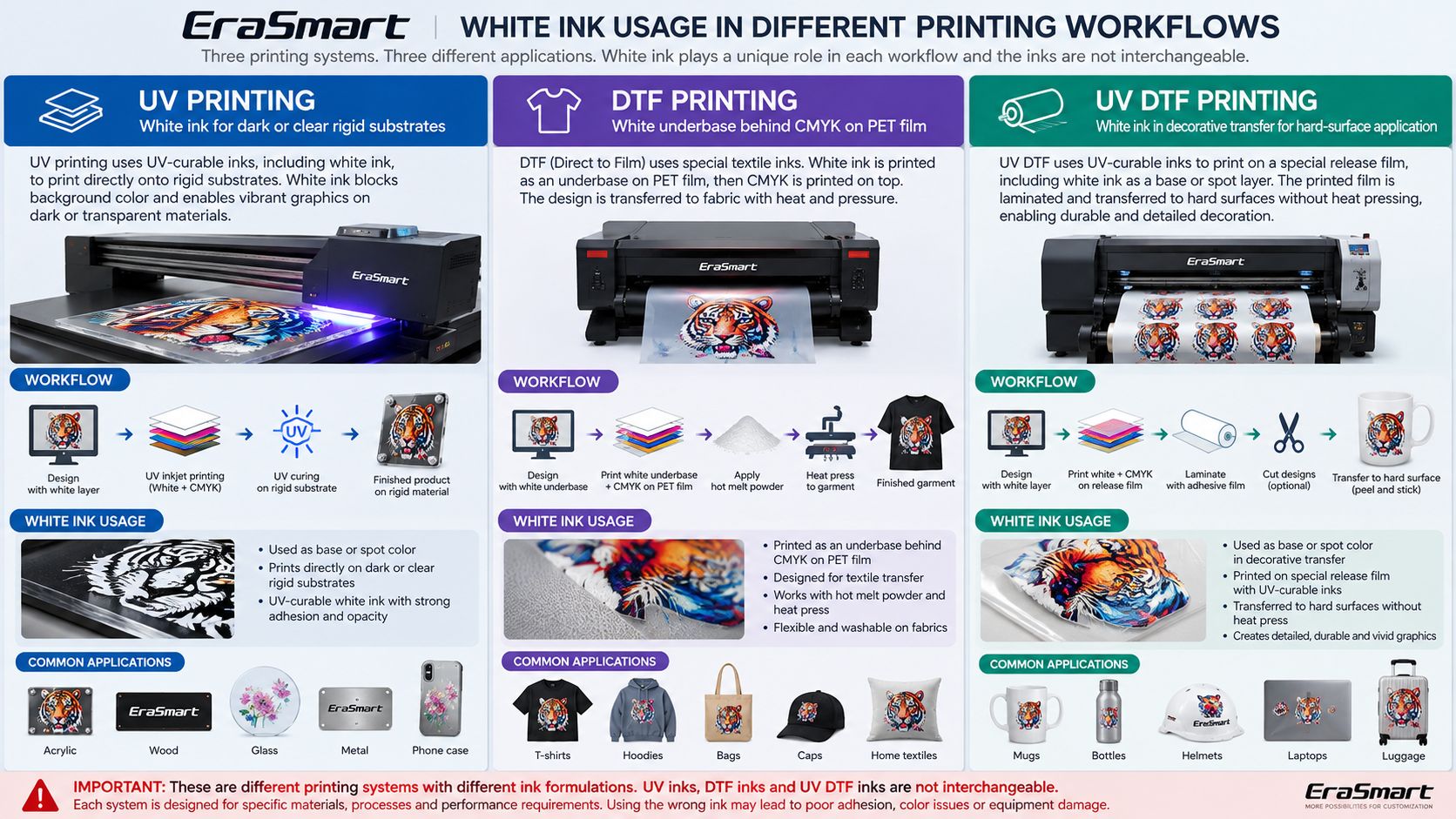
UV Printing White Ink
Main purpose:
- dark rigid products
- transparent products
- colored substrates
- standalone white graphics
- زیر پایه سفید
محصولات معمولی عبارتند از:
- اکریلیک
- شیشه ای
- فلزی
- چوب
- پلاستیک
- سرامیک
- قاب های گوشی
کاوش:
DTF Printing White Ink
In textile DTF, white ink is typically part of the transfer structure.
یک فرآیند ساده شده عبارت است از:
PET Film → CMYK → White → Adhesive Powder → Cure → Garment
After transfer, white acts as the base behind the color, especially on:
- تی شرت های مشکی
- هودی های تیره
- colored garments
This helps CMYK remain visible and vibrant.
کاوش:
UV DTF White Ink
UV DTF uses UV-curable ink printed onto a special transfer film system.
White ink helps provide:
- کدورت
- پشتیبان
- visibility on dark objects
- color stability
محصولات معمولی عبارتند از:
- بطری ها
- لیوان
- کوزه ها
- شیشه ای
- hard-surface promotional products
For the complete workflow, see:
نحوه ساخت استیکرهای UV DTF در خانه
کاوش:
Can You Use the Same White Ink in UV, DTF and UV DTF Printers?
خیر
Do not treat all products labeled “white ink” as interchangeable.
These workflows use different ink chemistry and printing systems.
| گردش کار | Main Ink Type | برنامه اصلی |
|---|---|---|
| چاپ UV | جوهر قابل درمان با اشعه ماوراء بنفش | Direct hard-surface printing |
| چاپ DTF | جوهر DTF نساجی | Garment transfer |
| UV DTF | UV-curable transfer system | برگردان های سطح سخت |
Always use ink designed and approved for the specific printer system.
استفاده از جوهر نامناسب می تواند باعث شود:
- poor output
- مشکلات چسبندگی
- curing problems
- مشکلات نازل
- ink-system damage
How White Ink Affects Color Accuracy
White ink is also part of color management.
On a dark product, weak white coverage can make CMYK appear:
- dull
- dirty
- تاریک
- inconsistent
If white coverage changes between jobs, the same CMYK artwork may look different.
This is why color accuracy is not controlled by CMYK alone.
The complete result can depend on:
Artwork + RIP + CMYK + White Ink + Material + Printhead + Curing + Environment
For more detail, read:
Common White Ink Printing Problems
White ink needs more maintenance than many operators initially expect.
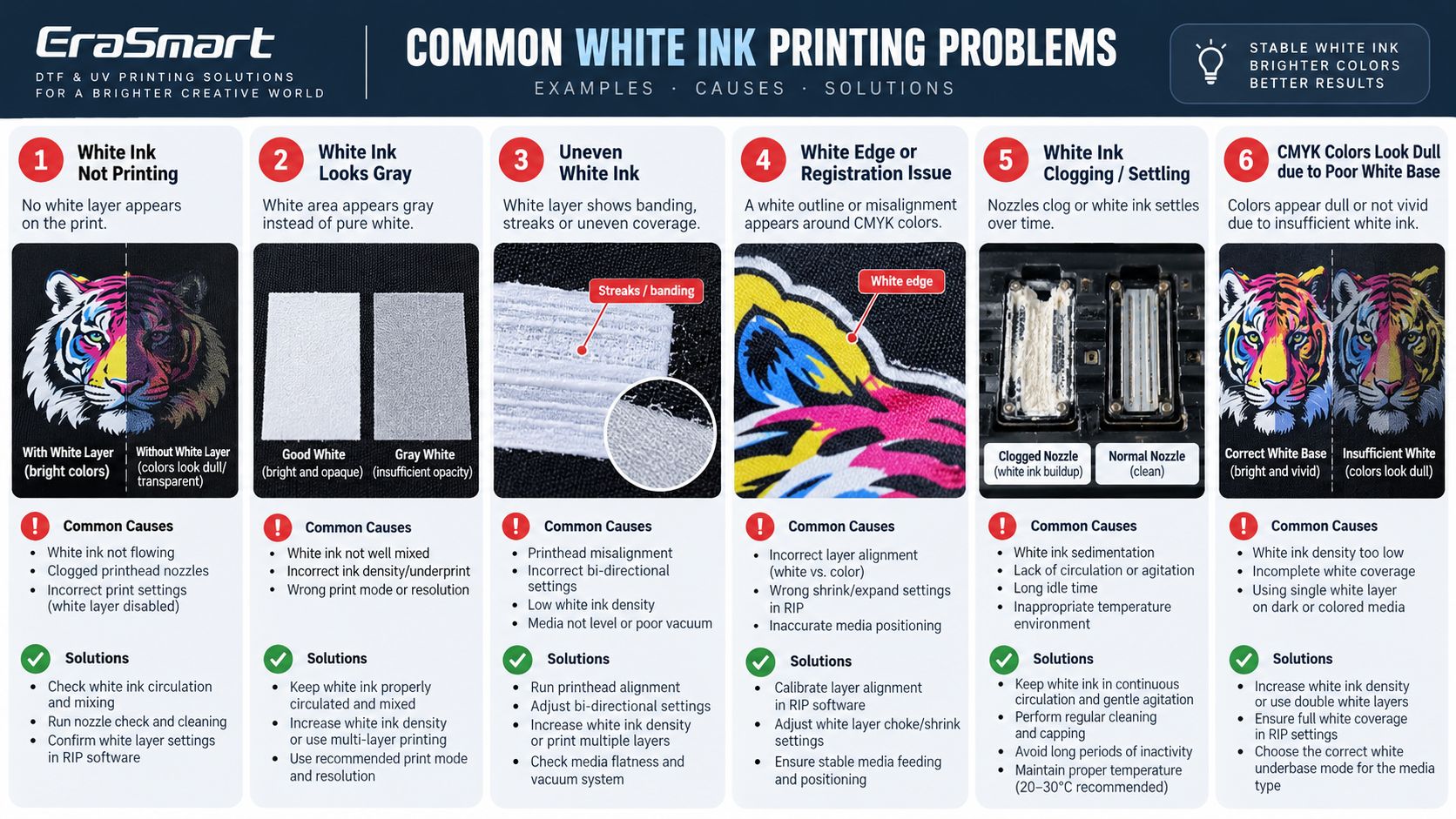
Problem 1: White Ink Does Not Print
علل احتمالی عبارتند از:
- نازل های از دست رفته
- گرفتگی نازل ها
- incorrect RIP white settings
- white channel disabled
- ink-flow problem
- maintenance issue
چه چیزی را بررسی کنید
- چک نازل را اجرا کنید.
- Confirm white layer in RIP.
- گردش جوهر سفید را بررسی کنید.
- Inspect the maintenance system.
- Follow the printer’s cleaning procedure.
Problem 2: White Ink Looks Gray
علل احتمالی عبارتند از:
- insufficient opacity
- weak white coverage
- nozzle loss
- pigment instability
- incorrect print mode
Do not immediately increase white density to the maximum.
First check nozzle condition and ink-system stability.
Problem 3: White Ink Is Uneven
Symptoms may include:
- streaks
- باندبندی
- inconsistent density
علل احتمالی:
- نازل های از دست رفته
- white ink settling
- circulation problem
- printhead alignment
- تنظیمات RIP
Problem 4: White Border Around CMYK
Sometimes a visible white outline appears around the colored artwork.
This can result from:
- layer-registration error
- white mask too large
- RIP spread / choke settings
- positioning error
Professional RIP software may provide controls for slightly reducing or expanding the white mask.
The correct amount should be validated with a physical sample.
Do not use one universal choke value for every printer and artwork.
Problem 5: White Ink Settles or Clogs
White pigment is heavier than process-color pigment.
Over time, settling can contribute to:
- reduced opacity
- مشکلات نازل
- inconsistent output
This is why many professional systems use features such as:
- گردش جوهر سفید
- agitation
- تمیز کردن خودکار
- scheduled maintenance
depending on printer configuration.
Problem 6: CMYK Still Looks Dull
If a dark product still looks dull after using white ink, check:
- کدورت سفید
- پوشش سفید
- وضعیت نازل
- اثر هنری
- پروفایل RIP
- CMYK output
- سطح مواد
The problem may not be CMYK itself.
Why White Ink Needs More Maintenance
White pigment systems naturally require more attention.
A white ink printer may include circulation to help keep pigment suspended.
But circulation does not mean:
maintenance is no longer necessary.
You still need to monitor:
- وضعیت نازل
- گردش خون
- capping
- برف پاک کن
- ink level
- idle time
- environment
Follow the maintenance instructions for your specific EraSmart printer.
Daily White Ink Checks
A practical routine can include:
- inspect white ink condition
- confirm circulation if equipped
- run nozzle check
- inspect white output
- keep the capping area clean
- verify white layer before important jobs
The exact maintenance routine depends on the printer model.
Do not apply one universal cleaning schedule to every printer.
White Ink After Long Idle Periods
White ink systems should not simply be left unused for long periods without following the printer’s idle procedure.
If the machine will not be used for an extended period:
- follow the model-specific shutdown procedure
- maintain the capping system
- follow ink-system instructions
- avoid improvised flushing procedures
Incorrect long-term storage can create more problems than normal daily printing.
When Do You Need White Ink?
The answer depends on both the material and the design.
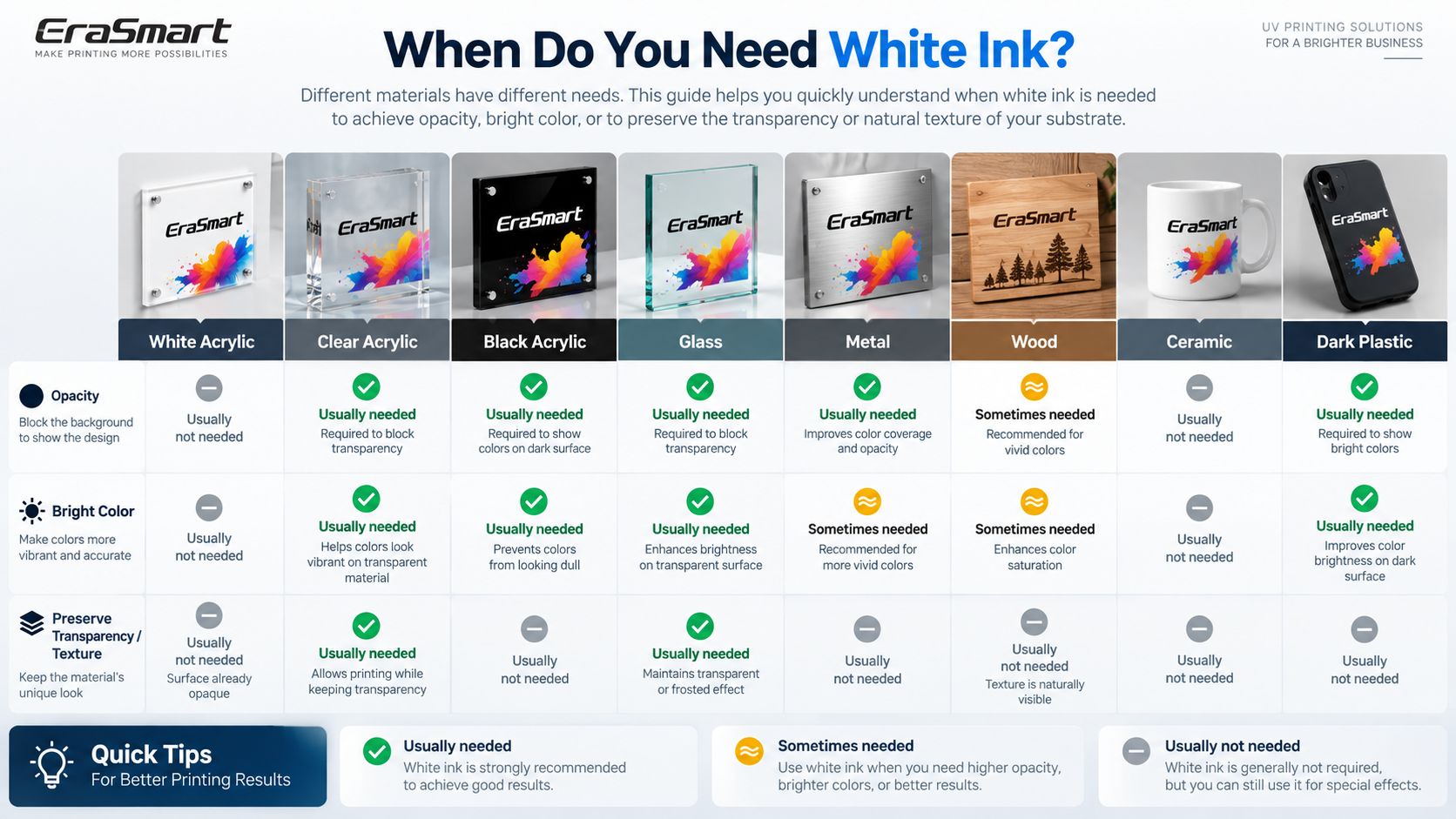
| مواد | White Ink Recommendation | چرا |
|---|---|---|
| اکریلیک سفید | معمولا اختیاری است | Surface already provides white background |
| اکریلیک شفاف | Often useful | Controls opacity |
| Black acrylic | Usually required for vivid CMYK | Blocks dark substrate |
| Clear glass | Often useful | Creates white backing and opacity |
| فلز | Depends on effect | Can hide or preserve metallic appearance |
| Natural wood | Depends on design | Can preserve or cover wood grain |
| White ceramic | معمولا اختیاری است | Ceramic provides white background |
| Colored ceramic | Often useful | Improves opacity |
| پلاستیک تیره | Usually useful | Blocks substrate color |
| Transparent plastic | Often useful | Controls transparent/opaque areas |
This table is only a starting point.
The correct setup still depends on:
- اثر هنری
- رنگ محصول
- شفافیت
- desired visual effect
When You May Not Need White Ink
White ink is powerful, but it is not automatically necessary.
You may intentionally skip it when printing on:
White Materials
The substrate already provides a white background.
Natural Wood
You want the wood grain to remain visible.
Brushed Metal
You want a metallic effect to show through the color.
Clear Acrylic or Glass
You deliberately want a translucent design.
Reducing unnecessary white ink can also:
- reduce ink usage
- shorten production time
- create more interesting material effects
The goal is not to use maximum white ink.
The goal is to use the right white ink strategyبشر
White Ink vs Varnish
White ink and varnish serve completely different functions.
جوهر سفید
Controls:
- کدورت
- background blocking
- white graphics
- CMYK support
لاک الود
Controls:
- براق
- نکات برجسته انتخاب شده
- بافت
- decorative surface effects
For a complete explanation, see:
راهنمای جوهر UV: CMYK، جوهر سفید و لاک
White Ink vs Primer
These should also not be confused.
جوهر سفید
Changes the visual appearance of the print.
پرایمر
May be used to improve adhesion on specific difficult substrates.
White ink does نه automatically solve poor adhesion.
For example, a beautiful opaque white print can still fail an adhesion test if the substrate:
- is oily
- has an incompatible coating
- has low surface energy
- requires pretreatment
این امر به ویژه در موارد زیر مهم است:
- شیشه ای
- فلزی
- پلاستیک ها
- سرامیک لعابدار
How to Prepare Artwork for White Ink
Before sending a job to the printer, decide:
What Should Be White?
مثال ها:
- متن
- لوگو
- complete underbase
What Should Remain Transparent?
مهم برای:
- شیشه ای
- اکریلیک
- transparent signs
Where Is CMYK Required?
Is Varnish Required?
What Side Will the Customer View?
This changes layer order for reverse printing.
A good artwork file should separate visual intent from production intent.
The computer image alone does not tell the machine how to build the physical ink layers.
How to Test White Ink Before Production
For a new material:
مرحله 1
یک نمونه کوچک چاپ کنید.
مرحله 2
Check white opacity.
مرحله 3
Check CMYK brightness.
مرحله 4
Check registration between white and color.
مرحله 5
Check material adhesion.
مرحله 6
Test the actual viewing conditions.
For transparent materials, place the sample against:
- white background
- پس زمینه تیره
- natural lighting
because transparency can dramatically change the perceived result.
مرحله 7
Save the successful RIP preset.
This is especially valuable for repeat orders.
Which White Ink Printing System Should You Choose?
Choose according to the final product.
Hard, Flat Products
مثال ها:
- اکریلیک
- فلزی
- چوب
- پانل های شیشه ای
- کاشی و سرامیک
- قاب های گوشی
شروع با:
پوشاک
مثال ها:
- تی شرت
- هودی
- کیف های حمل بار
- لباس ورزشی
شروع با:
Curved and Irregular Hard Products
مثال ها:
- بطری ها
- لیوان
- کوزه ها
- بسته بندی
- برگردان های سطح سخت
در نظر بگیرید:
The correct machine is determined by the product workflow—not simply by the fact that all three technologies use white ink.
Final Answer: How Does White Ink Printing Work?
Standard CMYK printing normally relies on the substrate to provide white.
Professional white ink printing adds a dedicated white channel so the printer can create real white graphics and opaque backing layers.
The most common strategies are:
زیرپایه سفید
Dark Material → White → CMYK
Standalone White
Dark Material → White Graphic
Transparent Front Printing
Clear Material → White + CMYK
چاپ معکوس
Viewer → Clear Material → CMYK → White
سفید انتخابی
White only where opacity is required
White ink gives DTF, UV and UV DTF printing the ability to work on products that ordinary CMYK printing cannot handle effectively.
But successful white ink production requires more than simply installing a white ink bottle.
شما نیاز دارید:
correct artwork + RIP control + layer order + white ink circulation + nozzle maintenance + material testing
The goal is not maximum white ink.
The goal is:
Use white exactly where it improves opacity, color and design.
For deeper reading:
UV Ink Guide: CMYK, White Ink & Varnish
سوالات متداول
Can a normal printer print white ink?
Most standard CMYK printers do not have a dedicated white ink channel. White areas are normally created by leaving the white paper or substrate unprinted.
Why doesn’t CMYK create white?
CMYK inks add cyan, magenta, yellow and black color. Removing all four process colors leaves the substrate visible; it does not generate physical white ink.
How do you print white on black material?
Use a printer with a dedicated white ink channel. White can be printed alone or as an underbase beneath CMYK.
Why do I need white ink under CMYK?
On dark or colored substrates, white blocks the background and gives CMYK a neutral base, improving opacity and visual brightness.
Do you need white ink on clear acrylic?
Often, but not always. Use white when you need opacity. Skip or selectively apply white when transparency is part of the design.
Do you need white ink on glass?
White ink is useful for opaque graphics, strong colors and reverse printing, but translucent designs can intentionally use CMYK without a full white backing.
Do you need white ink on white ceramic?
Often not for normal CMYK graphics because the ceramic itself provides a white background.
Do you need white ink when printing on wood?
It depends on the design. Use CMYK only to preserve natural grain or add white beneath CMYK for stronger opacity.
Can white ink be printed by itself?
Yes. White ink can be used for standalone logos, text and decorative graphics on dark or colored materials.
What is selective white ink?
Selective white means printing white only beneath specific areas of the design while leaving other areas transparent or showing the natural substrate.
What is a white underbase?
A white underbase is a layer of white ink printed beneath CMYK to reduce the influence of a dark, colored or transparent substrate.
Why is my white ink gray instead of white?
Possible causes include weak opacity, missing nozzles, pigment settling, insufficient white coverage or incorrect RIP settings.
چرا جوهر سفید راحت تر مسدود می شود؟
White ink contains a dense opaque pigment system, so circulation, maintenance, capping and correct idle procedures are especially important.
Why is there a white outline around my CMYK artwork?
The white mask may extend beyond the CMYK image or the layers may be misregistered. Check printhead calibration and the RIP white choke/spread settings.
Can I use UV white ink in a DTF printer?
No. UV printing and textile DTF use different ink chemistries and production systems.
Can DTF white ink be used in a UV DTF printer?
No. Use only ink designed and approved for the specific printer system.
Is white ink always necessary on dark material?
If you need bright, opaque CMYK, it is usually important. For certain intentional dark or translucent effects, you may choose another design approach.
Does more white ink always improve print quality?
No. White density should be matched to the material, artwork and desired opacity. More ink is not automatically better.
Is white ink the same as primer?
No. White ink controls appearance and opacity. Primer is used in certain workflows to improve substrate adhesion.
Is white ink the same as varnish?
No. White ink provides opacity. Varnish provides gloss, highlights or decorative texture.
Which EraSmart printer should I choose for white ink printing?
Choose according to the product:
- چاپگر اشعه ماوراء بنفش for suitable rigid products
- چاپگر DTF for textile transfers
- چاپگر UV DTF for hard-surface transfer applications
Build the Right White Ink Workflow
If you are choosing an EraSmart printer, tell us:
- what products you want to print
- مواد
- رنگ محصول
- transparent or opaque substrate
- flat or curved surface
- required print size
- whether you need white-only graphics
- whether you need varnish
- حجم تولید
The right workflow depends on the product—not simply on whether the printer has white ink.
Control the white layer. Control the color. Build a repeatable printing workflow.
ممکن است شما هم باشید


کپی رایت 2020 © Erasmart. | نقشه سایت