
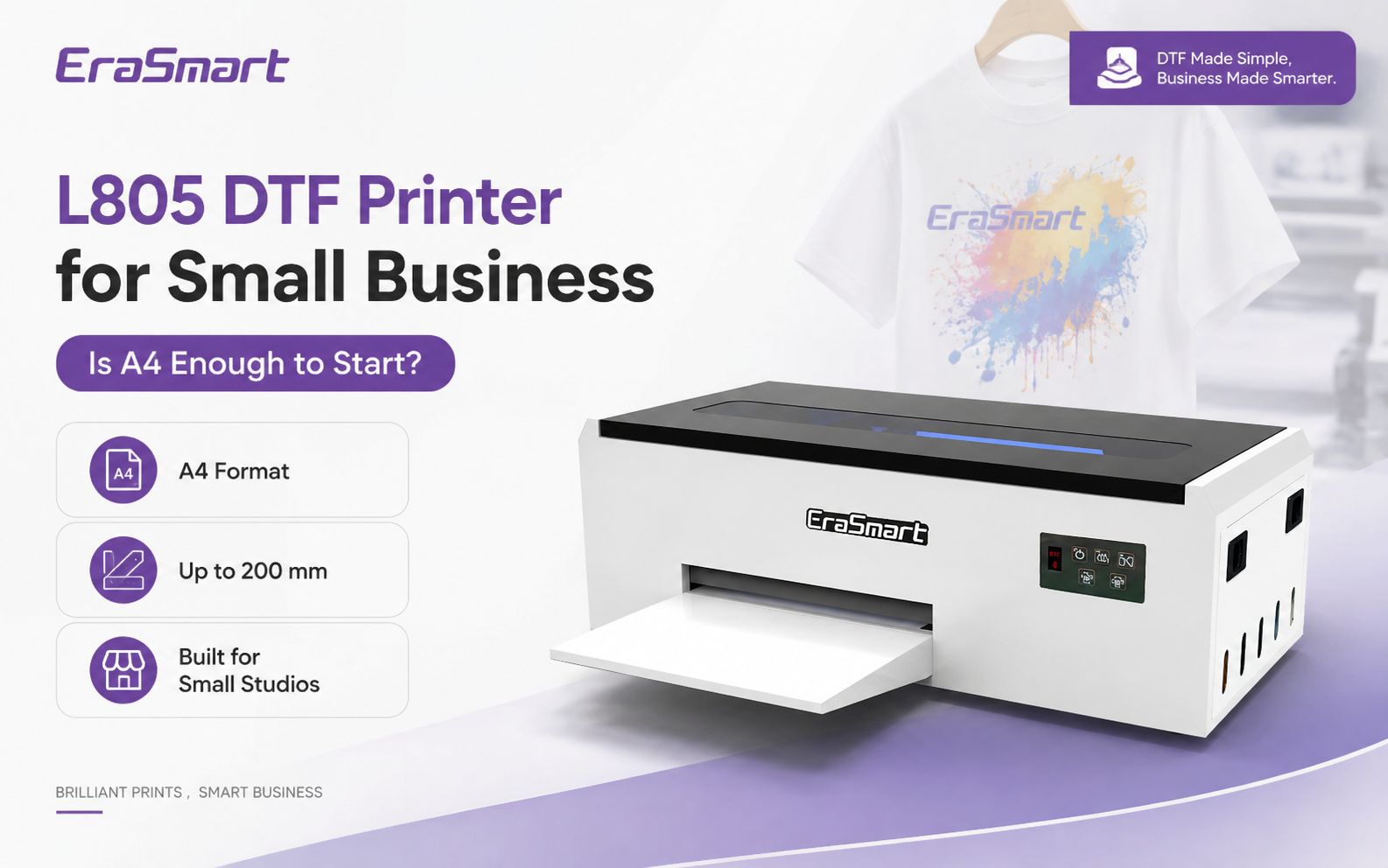
L805 DTF Printer for Small Business: Is A4 Enough to Start?
An A4 L805 DTF printer can be a practical starting point when your business is built around compact graphics, short custom runs and a small workspace. The decision is less about whether A4 is “good enough” in general and more about whether 200 mm print width, single-head production and your expected order mix fit the products you plan to sell every week.
Quick answer
Choose an A4 L805 setup if you are starting a POD shop, home studio or small custom-apparel business where logos, sleeve graphics, kidswear, tote-bag designs and other compact transfers make up most of your orders.
Move to A3 earlier if adult front/back graphics, larger gang sheets or continuously queued jobs are already part of the business model. Buying A4 first only makes sense when A4 actually fits the work.
- A compact desktop footprint
- A lower entry barrier
- Small-batch and personalized production
- Roll and sheet PET film flexibility
- A simpler single-printhead workflow
What the EraSmart A4 L805 Actually Offers
This guide is centered on the EraSmart A4 Roll DTF Printer L805. It is a Single L805 platform designed for startups, personal studios and small-batch production rather than a scaled-down version of a 60 cm production line.
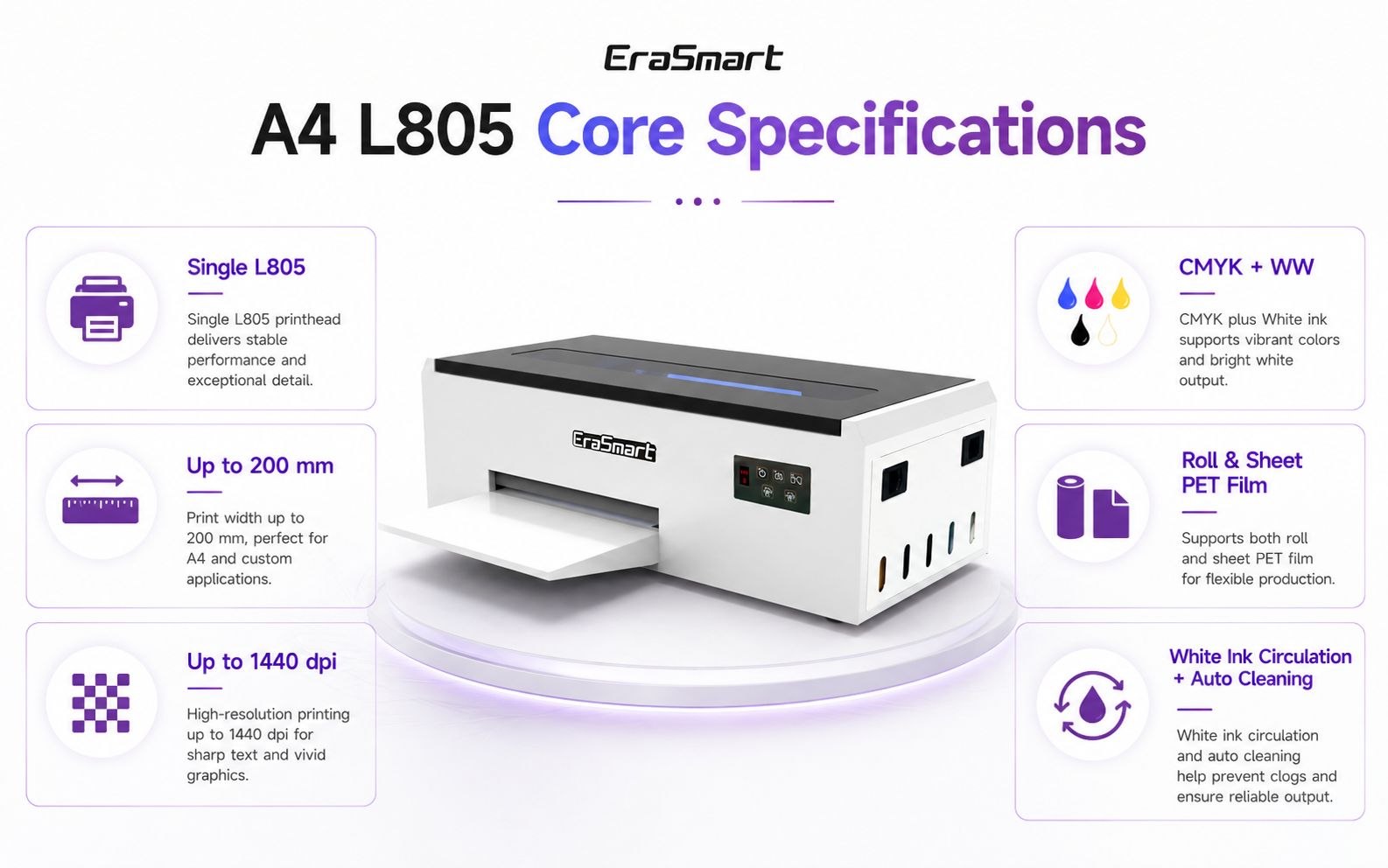
Compact A4 DTF production for small orders
The current A4 reference output is approximately one A4 print in about three minutes at the specified 1440 dpi reference mode. Actual job time still depends on artwork, RIP settings and operating conditions.
What Can You Realistically Print with 200 mm Width?
This is the most important question on the page. A4 can print DTF transfers for many products, but the available width changes how efficiently you arrange artwork. If your normal jobs are compact, 200 mm can be enough. If wide adult chest graphics dominate your catalog, the limitation appears much sooner.
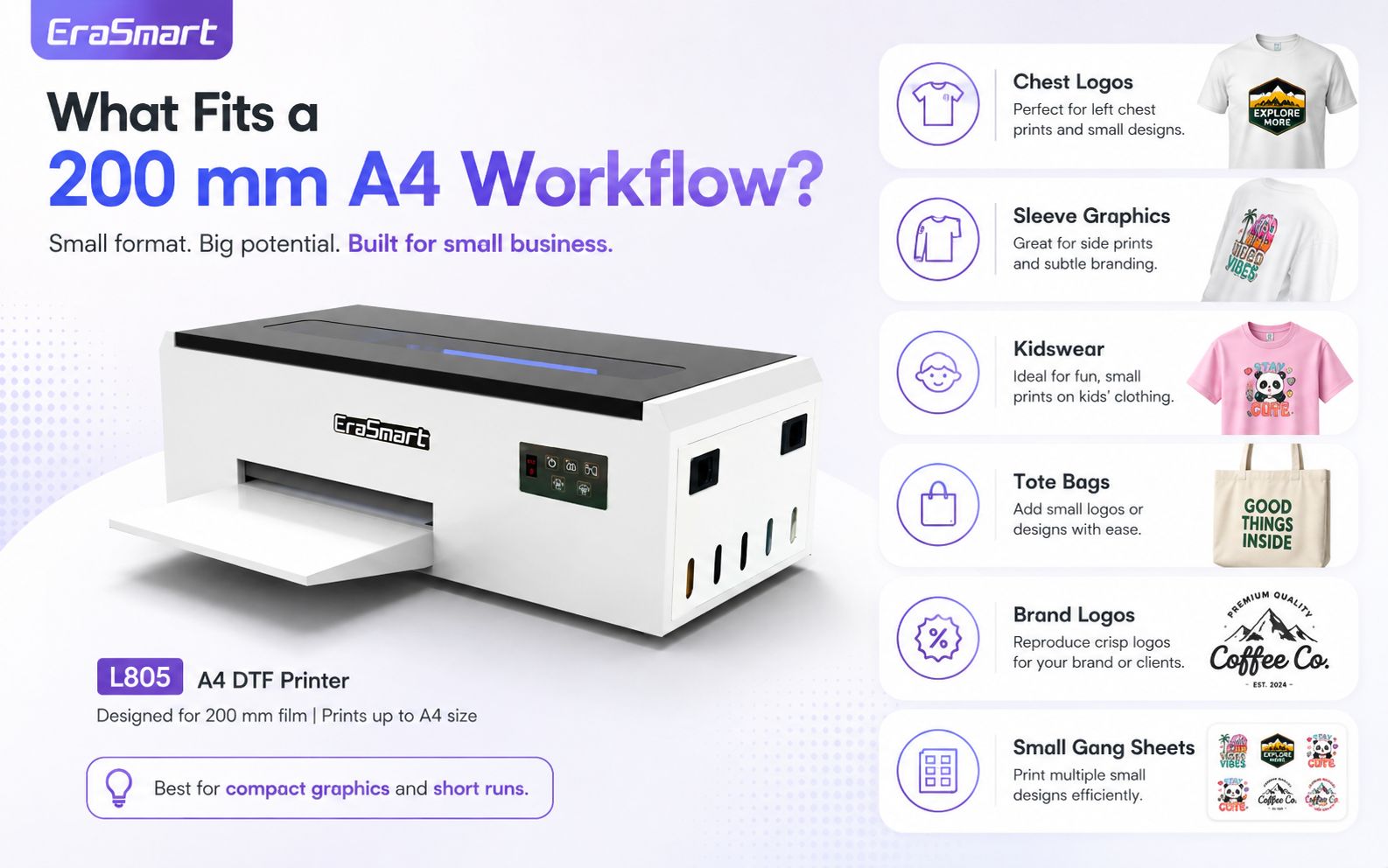
Chest logos
Brand marks, uniforms, company logos and smaller left-chest placements fit naturally into an A4 workflow.
Sleeve graphics
Names, numbers and compact decorative graphics can be produced without needing a wider printer.
Kidswear
Smaller garment panels often match the available print area better than adult full-front artwork.
Tote bags & accessories
Small designs for bags, caps and selected accessories are a strong fit for short custom runs.
Branding & teamwear
Repeat logos, sponsor marks and small names are useful applications for local business and team orders.
Small gang sheets
Multiple compact transfers can be arranged together, but layout efficiency is naturally lower than on wider media.
A4 L805 vs A3: The Real Small-Business Decision
Small businesses often compare price first. A better comparison is how much of your expected work fits the media width without awkward layouts, extra cutting or frequent re-planning.
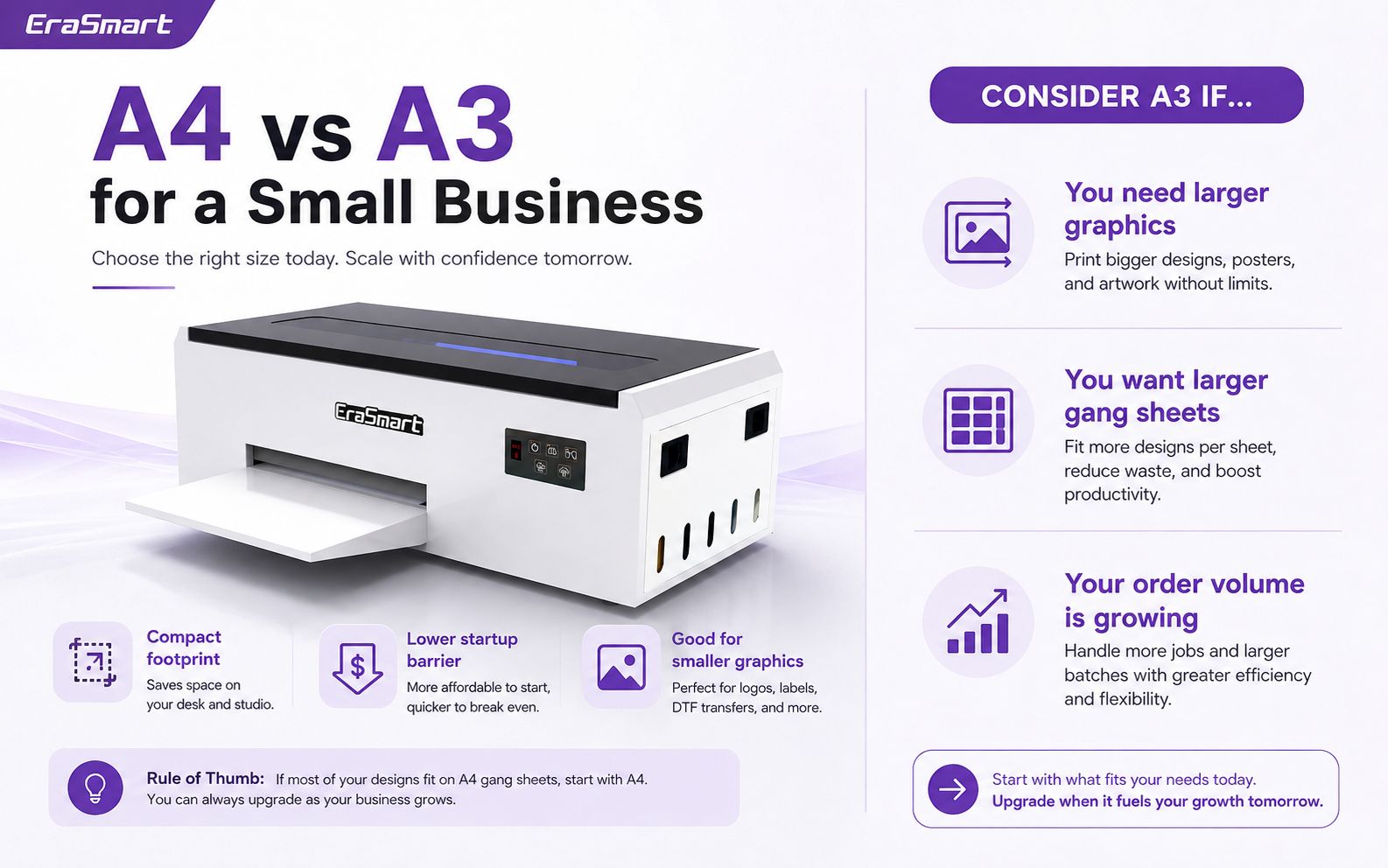
| Buying factor | A4 L805 | A3-class platform |
|---|---|---|
| Best starting point | Small personalized orders, logos, compact designs | Businesses expecting larger graphics or more layout flexibility |
| Print-width direction | Up to 200 mm | Wider A3-class workflow |
| Workspace | Compact desktop setup | Requires more working area |
| Gang-sheet flexibility | Good for compact transfer groups | More room to combine larger or more numerous designs |
| Growth headroom | Best when demand remains small-batch | Better when size and order mix are already expanding |
If you want a broader comparison across several printer sizes, use DTF Printer for Small Business. This page stays focused on whether the L805 itself is enough.
Who Should Start with an A4 L805?
A strong fit for...
- Home-based custom apparel businesses
- POD sellers testing or validating demand
- Small studios producing short customized runs
- Uniform, teamwear or branding shops focused on smaller graphics
- Creators who need roll/sheet flexibility without a large production footprint
Probably too small if...
- Wide adult front graphics are one of your main products
- You plan to sell large gang sheets as a core service
- Orders are expected to stay queued for long periods
- You already know you need more daily production headroom
- Your growth plan depends on 60 cm-class roll production
How the L805 Fits into a Small-Business DTF Workflow
Buying the printer is only one stage of the production process. You still need a repeatable path from artwork to finished garment. For a smaller operation, simplicity is valuable because the same person may handle artwork, printing, powder, curing, heat pressing, quality control and packing.
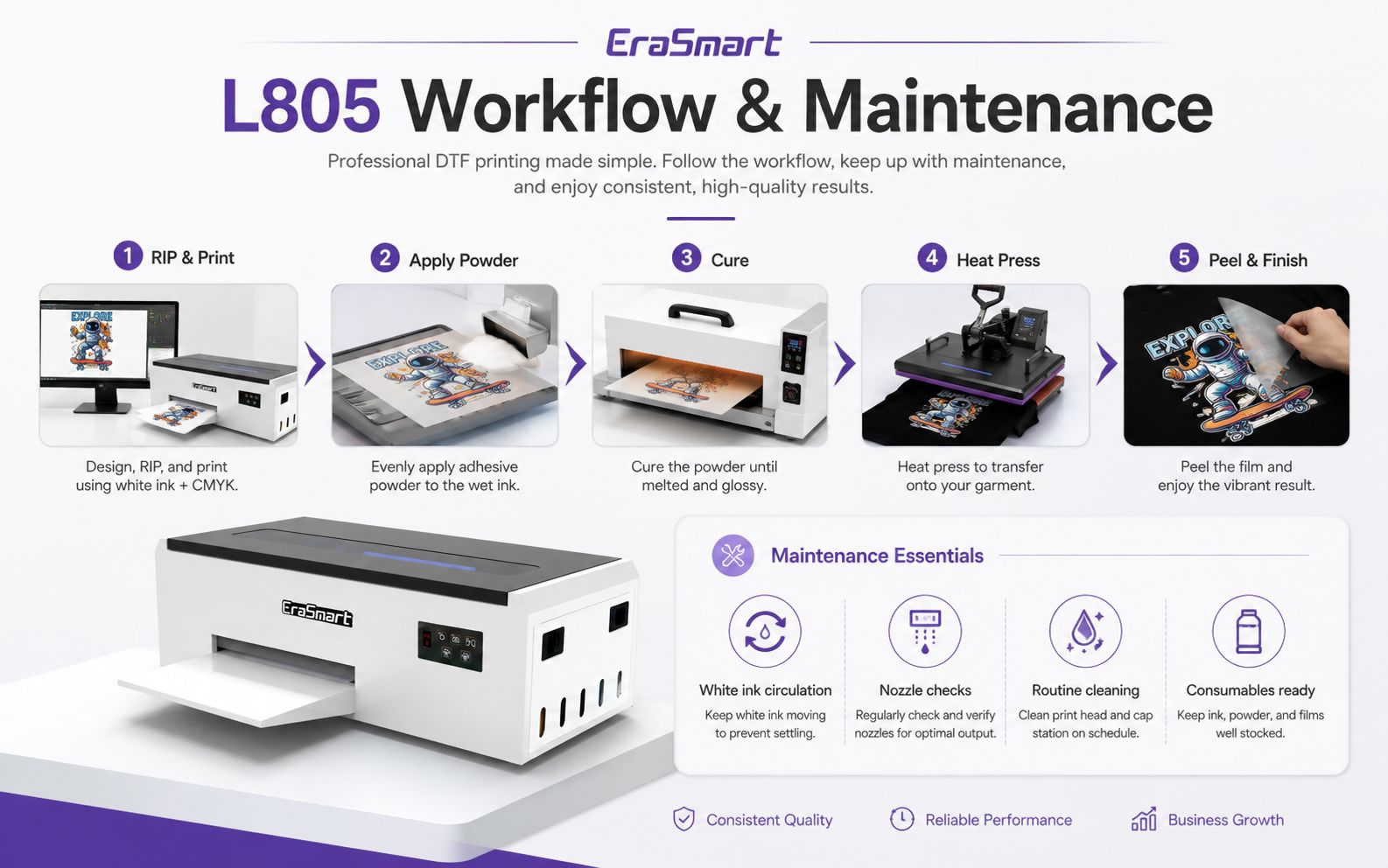
1RIP & print
Prepare artwork, manage white output in the RIP and print onto PET film.
2Powder & cure
Apply hot-melt powder evenly and cure it using a method appropriate for your workload.
3Heat press
Transfer the printed design to the garment with controlled time, temperature and pressure.
For the full process rather than the L805-specific buying decision, see the DTF Production Workflow Guide.
Maintenance Matters More Than Beginners Expect
The L805 platform is attractive to startups because it keeps the machine side relatively compact, but DTF still uses white ink, and white pigment needs regular attention. Good maintenance habits protect print consistency and reduce avoidable waste.
Daily operating habits
- Run nozzle checks before important production jobs.
- Keep the white-ink circulation routine active.
- Keep the print and capping areas clean.
- Watch for changes in nozzle output before they become rejected transfers.
Business-side habits
- Keep ink, film and powder in stock before paid orders arrive.
- Plan for test prints and occasional waste.
- Avoid long unmanaged idle periods.
- Make maintenance somebody's responsibility, even in a one-person studio.
Use the DTF Maintenance Guide for a more detailed maintenance schedule.
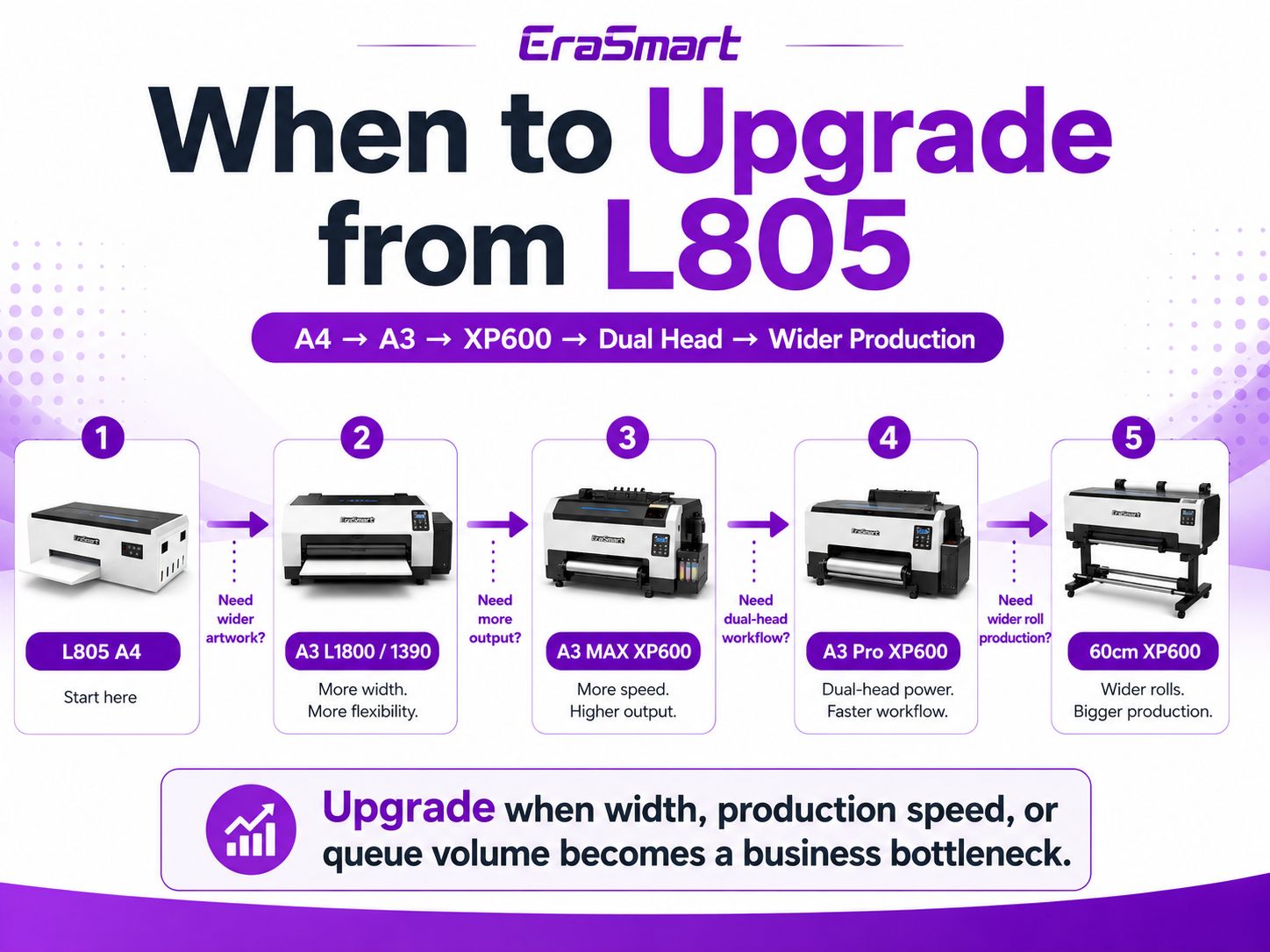
When Does the L805 Start to Become a Bottleneck?
A printer becomes “too small” when it creates a repeated business constraint. That might be width, production capacity, layout efficiency or turnaround—not simply the age of the machine.
Keep using L805 if...
- Your orders remain manageable.
- Most graphics fit within the 200 mm workflow.
- Short custom runs remain the core of the business.
- Your current turnaround still meets customer expectations.
Move up when...
- Larger graphics are requested repeatedly.
- Large gang sheets would materially improve layout efficiency.
- Orders stay queued and dispatch times begin slipping.
- The cost of limited capacity becomes greater than the cost of upgrading.
What Should You Upgrade to After L805?
The next printer should solve the problem you actually have. If the problem is width, move to a wider platform. If the problem is A3 production capacity, compare A3 printhead configurations. Those are different upgrade decisions.
| Your next constraint | Direction to compare | Why |
|---|---|---|
| Need more room than A4 | A3 Single L1800 | Moves the business into an A3-class workflow without jumping directly to a wide-format platform. |
| Need stronger A3 production efficiency | A3 MAX Single XP600 | Useful when you want another A3 production tier rather than simply more width. |
| Recurring A3 batch work is growing | A3 Pro Dual XP600 | More appropriate when sustained A3 capacity becomes commercially important. |
| Need 60 cm-class production | A1 Dual XP600 | This is a platform-width decision, not simply a printhead upgrade. |
Small-Business Buying Checklist
For a broader purchasing checklist, see DTF Printer Buying Checklist.
Frequently Asked Questions
Is an L805 DTF printer good for a small business?
Yes, when your business focuses on compact graphics, small personalized orders and an A4 workflow. It is especially relevant to home studios, POD sellers and startups that do not yet need larger gang sheets or higher production capacity.
What is the print width of the EraSmart A4 L805?
The EraSmart A4 Roll DTF Printer L805 supports up to 200 mm print width.
What can I print with a 200 mm DTF printer?
Common applications include chest logos, sleeve graphics, kidswear, tote-bag designs, teamwear logos and small gang sheets. Larger adult front/back graphics may be easier to produce on an A3 platform.
Does the L805 support white ink circulation?
Yes. The EraSmart A4 L805 configuration covered in this guide supports white-ink circulation.
Can the L805 print roll and sheet PET film?
Yes. The current EraSmart A4 L805 is specified for both roll and sheet PET film workflows.
Should I buy A4 or A3 for a new DTF business?
Choose A4 when most repeated products use compact artwork and workspace or startup budget matters. Choose A3 earlier if larger graphics, gang-sheet efficiency or production headroom are already important to the business.
When should I upgrade from L805?
Upgrade when 200 mm width repeatedly limits the products you can sell, larger gang sheets would save substantial time, or production queues begin hurting turnaround and dispatch.
Is L805 better than XP600 for beginners?
“Better” depends on workload. L805 is attractive for compact A4 small-batch production, while XP600 options may make more sense when an A3 business needs a different level of production capacity. Compare the full machine platform rather than printhead names alone.
Not Sure Whether A4 L805 Is Enough for Your Business?
Tell EraSmart what products you plan to sell, your common artwork size, expected weekly order volume and available workspace. We can help you decide whether A4 is the right starting point or whether moving directly to A3 will save you an early upgrade.