White toner printing and DTF printing are both popular transfer printing methods for custom apparel businesses. At first glance, they may look similar because both can create transfers that are applied to garments with heat and pressure. Both can be used for short runs, personalized designs, dark garments, and full-color graphics.
However, they are not the same technology.
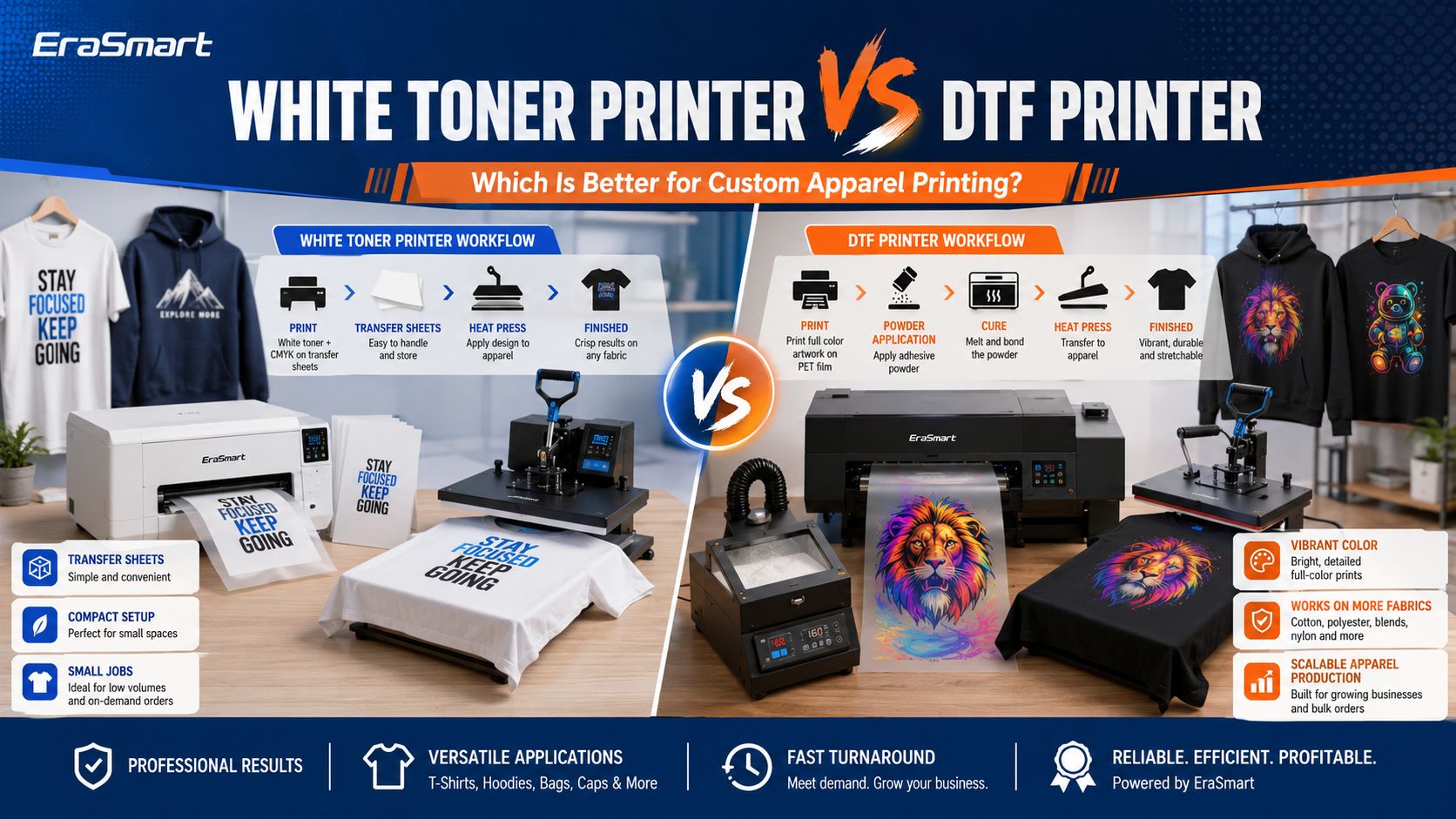
A white toner printer is based on laser printing technology and uses dry toner powder, including white toner, to create transfer prints. A DTF printer uses liquid textile ink, usually CMYK plus white ink, to print onto PET transfer film, followed by adhesive powder, curing, and heat pressing.
For a small business, the real question is not simply “Which printer is better?” A better question is:
Which printing method matches your product type, order volume, artwork style, maintenance ability, production space, and long-term business plan?
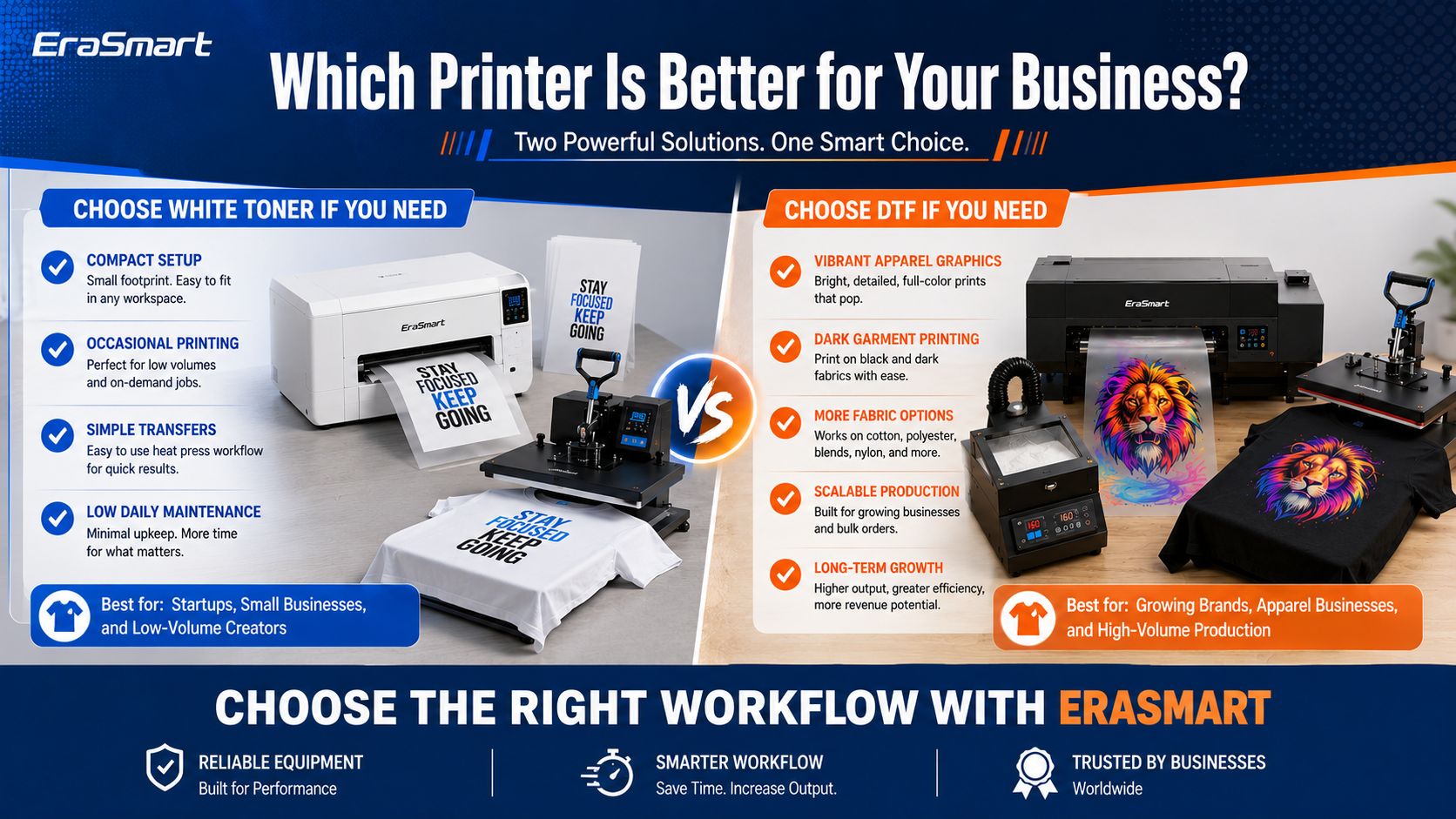
If your business focuses on occasional one-off transfers and compact desktop operation, white toner printing may look attractive. If your business wants vibrant apparel graphics, better stretchability, lower cost per print at scale, roll printing, small-batch production, and a more scalable textile workflow, DTF printing is usually the stronger direction.
This guide explains the key differences between white toner printers and DTF printers, helping you choose the right equipment for your custom apparel business.
Choose a white toner printer if you mainly need a compact transfer printing setup for occasional jobs, small custom batches, simple personalization, and lower daily maintenance.
Choose a DTF printer if you want to build a more scalable apparel printing business with full-color designs, vibrant output, cotton and polyester compatibility, dark garment printing, lower cost per print at volume, and better workflow expansion.
For most growing apparel businesses, an EraSmart DTF Printer is a better long-term choice because it is designed specifically for textile transfer production, including T-shirts, hoodies, tote bags, uniforms, sportswear, and small-batch custom apparel.
| Factor | White Toner Printer | DTF Printer |
|---|---|---|
| Printing technology | Laser-based toner printing | Inkjet-based textile transfer printing |
| Ink type | Dry toner powder | Liquid CMYK + white textile ink |
| Transfer media | Transfer sheets, often A/B sheet workflow | PET film, roll or sheet depending on machine |
| Adhesive method | Adhesive transfer sheet | Hot-melt adhesive powder |
| Best for | Occasional transfers, compact setup, small jobs | Custom apparel, small batches, growing production |
| Color performance | Good for simple and colorful graphics | Stronger color vibrancy and smoother gradients |
| White layer | White toner cartridge | White ink underbase |
| Fabric compatibility | Many fabrics with correct transfer paper | Cotton, polyester, blends, dark garments and more |
| Print feel | Can feel thicker or slightly plastic-like on large designs | Usually softer and more flexible when properly produced |
| Durability | Depends heavily on transfer paper and pressing | Strong when ink, film, powder, curing, and pressing are controlled |
| Production scalability | Limited by sheet size and manual workflow | Better for roll printing, gang sheets, and higher output |
| Maintenance | Lower risk of ink clogging | Requires regular ink and printhead maintenance |
| Best business fit | Hobby, low-volume, occasional customization | Apparel business, online store, local print shop, transfer production |
A white toner printer is a laser-based transfer printer that uses toner powder instead of liquid ink. Standard laser printers usually use CMYK toner, but white toner printers add a white toner channel so designs can appear on dark or colored surfaces.
A typical white toner workflow includes:
White toner printing can be useful for small transfer jobs because it is compact, relatively clean, and does not involve liquid ink maintenance. It can also be used on different garment colors when the right transfer paper and pressing process are used.
However, the final result depends heavily on the transfer media, adhesive sheet, pressing settings, and artwork type.
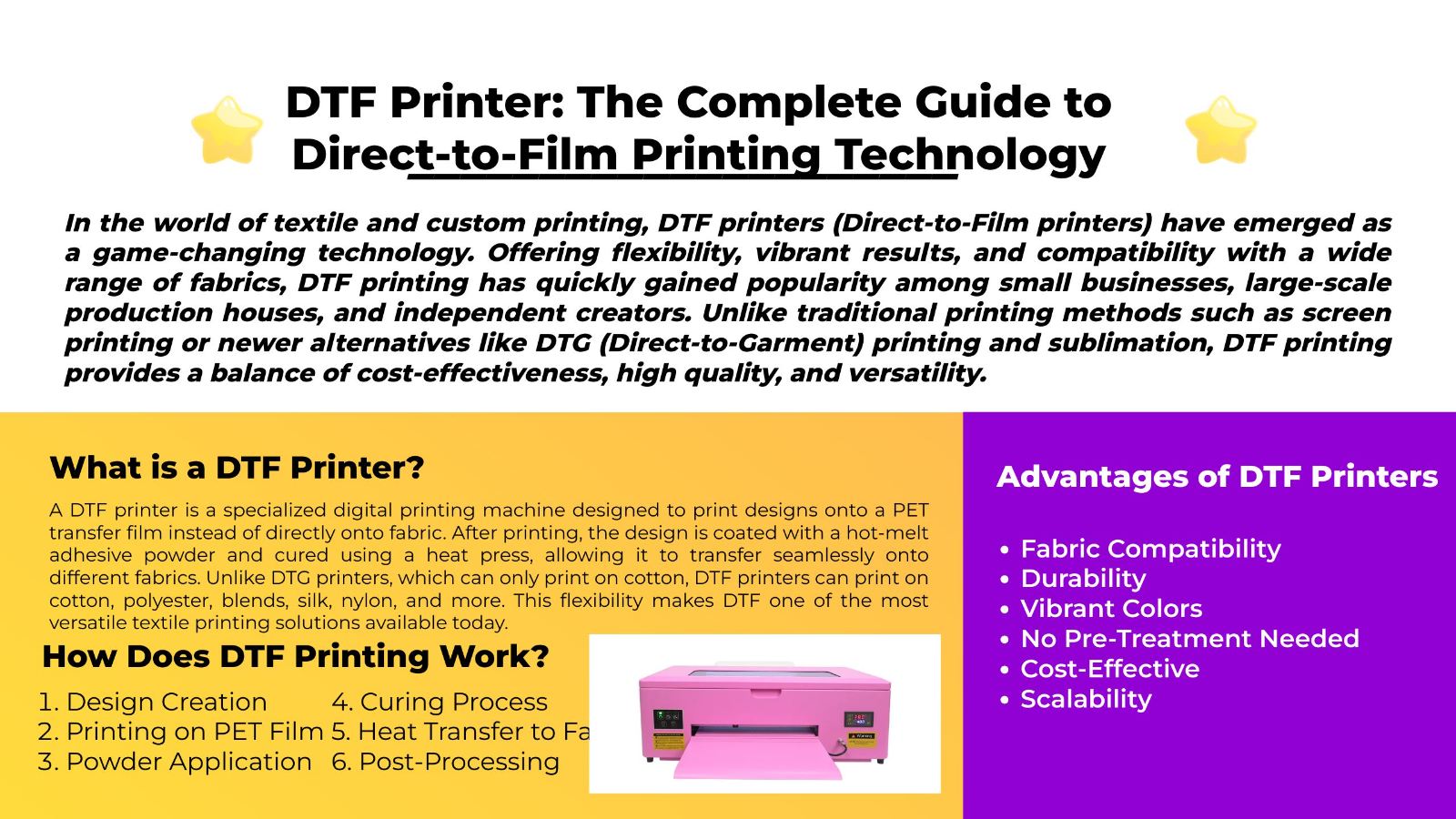
DTF stands for Direct to Film. It is a textile transfer printing method where the design is printed onto PET film using textile ink, then adhesive powder is applied, cured, and heat pressed onto the garment.
A typical DTF workflow includes:
EraSmart’s DTF Production Workflow explains this process in more detail, including artwork preparation, RIP setup, film printing, powdering, curing, pressing, and final quality control.
DTF printing is designed for custom apparel businesses that need full-color graphics, dark garment support, small-batch flexibility, and scalable production.
White toner printing uses laser printer technology. The printer applies dry toner powder to transfer media. The printed design is then combined with an adhesive layer and heat pressed onto the garment.
The key characteristics are:
White toner printing can be a practical option for occasional customization, but it may become less efficient when the business needs higher output, lower cost per print, roll production, or many gang-sheet designs.
DTF printing uses liquid textile ink. The printer prints the design onto PET film, usually with CMYK first and white ink as the underbase. The printed film is coated with hot-melt adhesive powder while the ink is still wet. After curing, the transfer can be heat pressed onto the garment.
The key characteristics are:
If your business is focused on T-shirts, hoodies, tote bags, uniforms, or sportswear, the EraSmart DTF Printer lineup is the more relevant equipment direction.
Color performance is one of the biggest reasons many apparel businesses choose DTF printing.
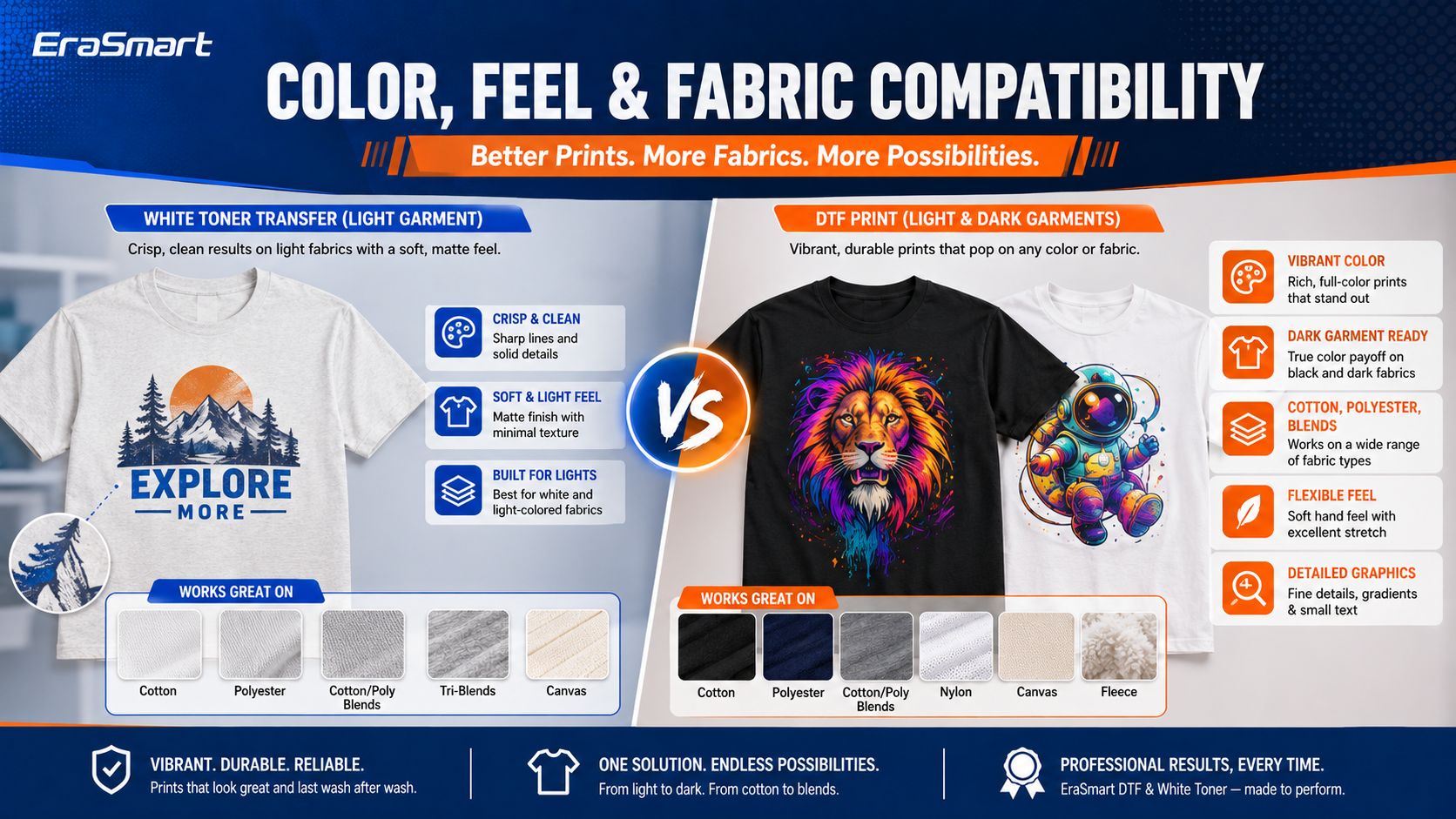
White toner printing can produce good colors, especially for simple logos and standard transfer designs. However, because it uses toner powder, the color effect can sometimes look less smooth than liquid ink printing, especially for gradients, photo-style artwork, rich color transitions, and detailed illustrations.
DTF printing uses liquid pigment-based textile ink, which is better suited for:
White ink is also important. In DTF printing, the white ink underbase helps colors appear stronger on dark garments. When white ink is properly controlled, DTF prints can look bright, sharp, and commercially attractive.
For color control in production, EraSmart’s article on How to Print the Correct Colors can help explain artwork files, RIP settings, ICC profiles, white ink, material testing, and color proofing.

Both white toner printing and DTF printing can be used on many fabrics, but DTF is usually more practical for apparel businesses that need daily production flexibility.
DTF printing is suitable for many common apparel products, including:
This fabric flexibility is one of DTF’s strongest advantages. It allows a small business to accept more customer orders without limiting buyers to one garment type.
White toner printing can also work on different fabrics when the correct transfer media is used, but production consistency depends heavily on the paper system, pressing process, and transfer quality.
If your business wants a textile-focused workflow, EraSmart’s How to Choose a DTF Printer can help you compare printer size, print width, printhead configuration, white ink system, production volume, and upgrade path.
Both white toner and DTF transfers sit on top of the fabric. They are not the same as dyeing the fabric itself. However, the feel can be different.
White toner prints may feel thicker or more plastic-like, especially on large solid designs. This can be acceptable for logos, small designs, and certain products, but it may not be ideal for large fashion graphics or garments where softness matters.
DTF prints are generally more flexible when the workflow is well controlled. Good film, proper ink density, correct powder application, stable curing, and accurate heat pressing can help create a smoother and more wearable result.
For better hand feel in DTF printing:
If your customers care about apparel comfort, stretchability, and daily wear, DTF is usually the better business direction.
Durability depends on the full workflow, not only the printer type.
For white toner printing, durability depends on:
For DTF printing, durability depends on:
A properly controlled DTF workflow can produce strong wash performance for commercial apparel. However, poor curing, weak powder bonding, incorrect pressing, or incompatible consumables can reduce durability.
EraSmart’s DTF Consumables Guide explains why ink, film, powder, and maintenance materials must work together for stable output and durability.
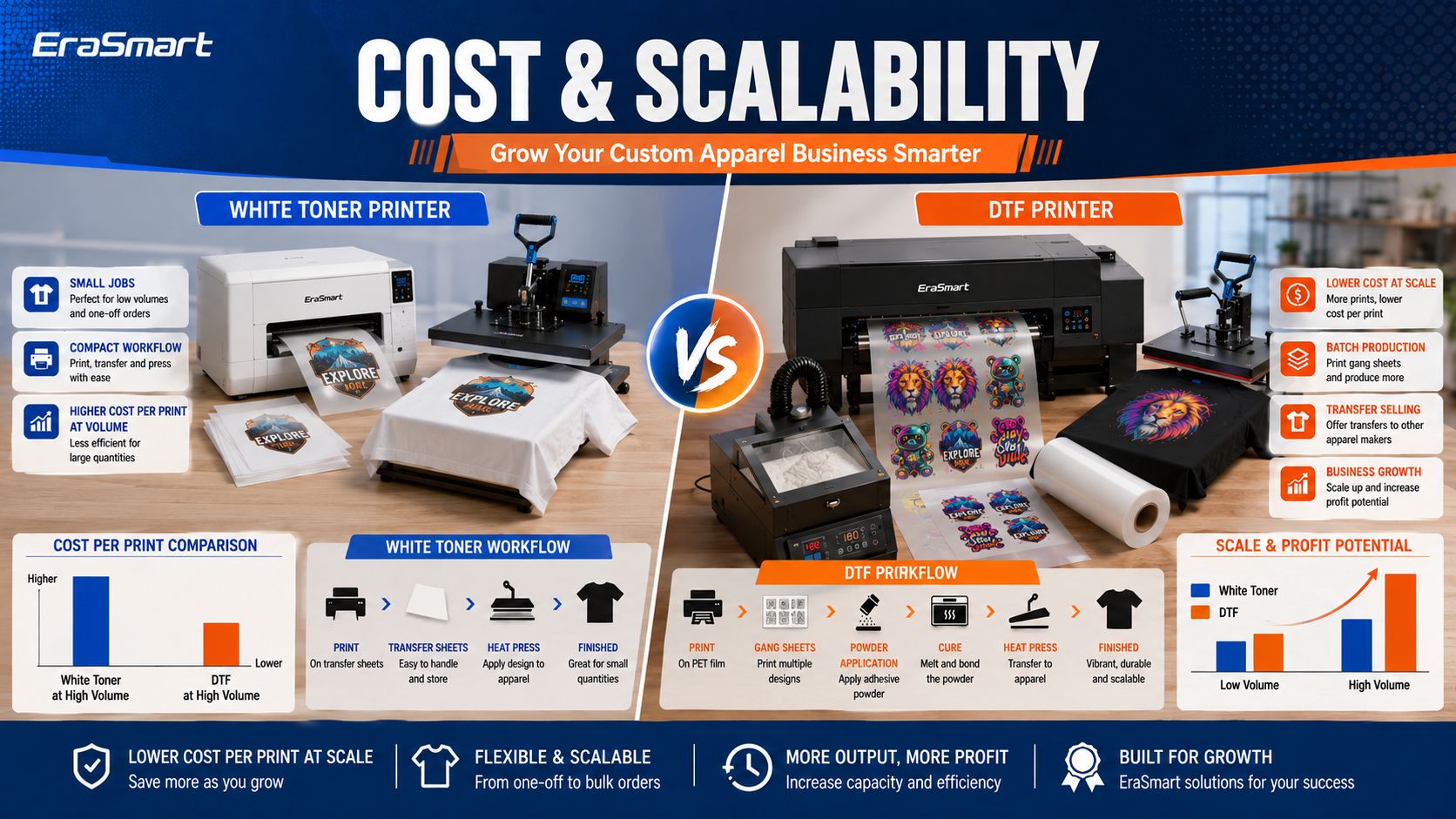
White toner printers are often compact and convenient for small jobs. They are usually sheet-based, which makes them easy to understand for beginners. However, sheet-based production can become limiting when order volume grows.
DTF printing can scale more effectively because many DTF systems support:
This makes DTF more suitable for growing businesses.
For example, a small apparel shop may start with custom T-shirts and later expand into hoodies, tote bags, event shirts, teamwear, and DTF transfer sales. A DTF printer gives more room for this kind of growth.
If your business expects steady orders, read EraSmart’s DTF Printer Buying Checklist before choosing a machine. It can help you evaluate output, support, maintenance, consumables, software, and upgrade path.

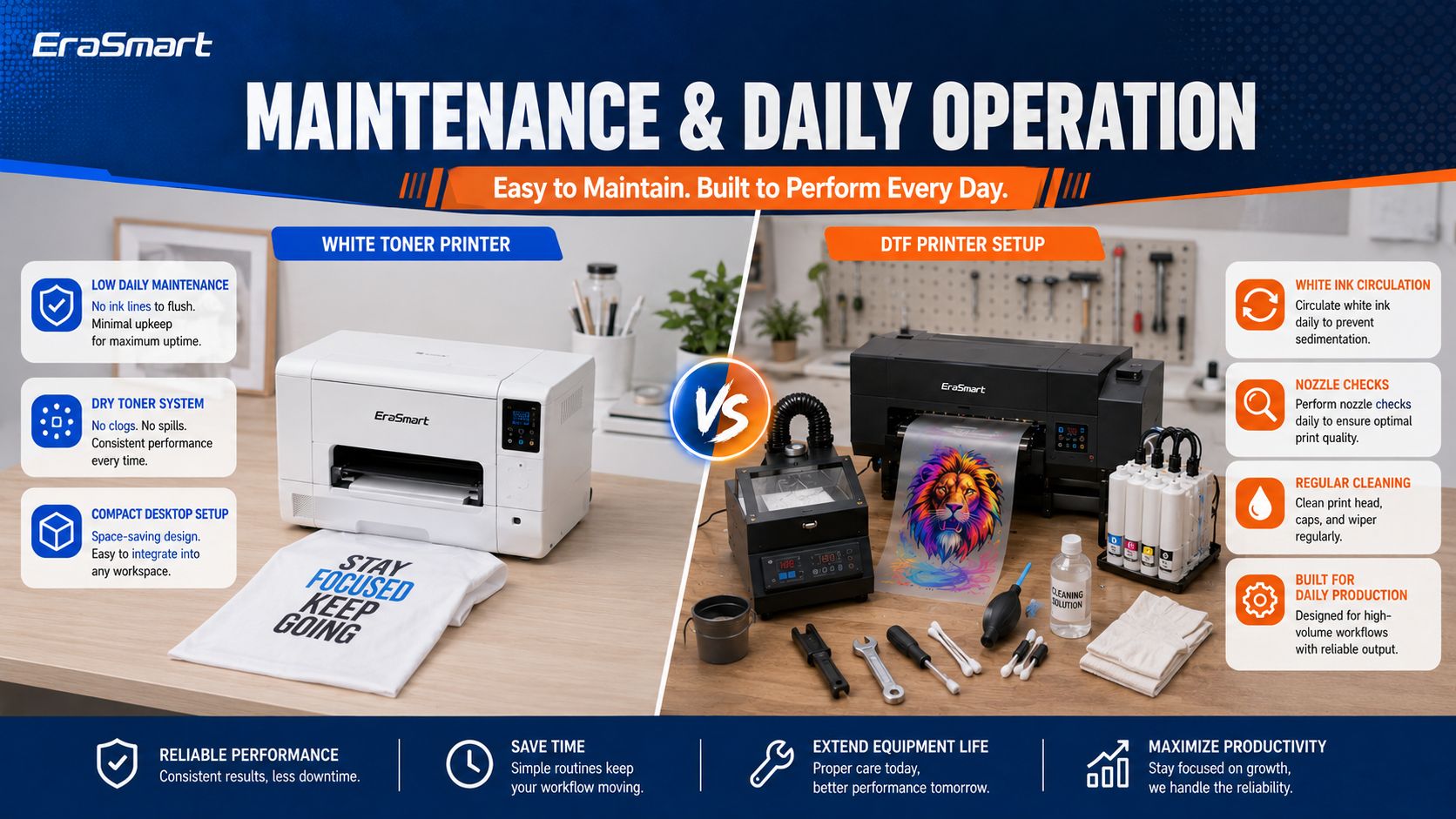
White toner printers usually have a maintenance advantage because toner is dry. There is no liquid ink flow, no white ink sedimentation, and no inkjet nozzle clogging. This makes white toner printing easier for occasional users who may not print every day.
DTF printers require more routine care because they use liquid ink, especially white ink. White ink contains heavier pigment particles and needs circulation, shaking, cleaning, and regular printing habits to stay stable.
DTF maintenance may include:
This does not mean DTF is a bad choice. It means DTF should be treated as a production system, not a casual desktop printer.
For businesses that print regularly, DTF maintenance becomes part of normal operation. EraSmart’s DTF Printer Maintenance Guide can help users understand daily care, white ink stability, nozzle checks, and ways to reduce clogging risk.

Cost depends on machine level, consumables, labor, order volume, transfer size, waste rate, and workflow efficiency.
White toner printing may look attractive for occasional users because the setup is compact and maintenance is simpler. But toner cartridges and transfer papers can be relatively expensive per print.
DTF printing requires more workflow components, including ink, PET film, powder, curing equipment, and heat press. However, once production becomes regular, DTF can often provide better cost efficiency for apparel orders, especially when using gang sheets, roll film, and batch production.
When comparing cost, do not only calculate printer price. Consider:
For a hobby user, white toner may be convenient. For an apparel business, DTF usually offers better growth potential.
The answer depends on the business model.
Choose white toner printing if your business needs:
Choose DTF printing if your business needs:
For most custom apparel businesses, DTF is the better long-term investment because it is built around textile production and supports more growth paths.
For T-shirts, DTF usually has stronger commercial value because it supports vibrant colors, dark garments, mixed fabrics, and scalable production.
| T-Shirt Requirement | Better Choice |
|---|---|
| Occasional one-off shirt | White toner or DTF |
| Full-color artwork | DTF |
| Dark cotton T-shirts | DTF |
| Small-batch custom apparel | DTF |
| Many different designs | DTF |
| Large gang sheets | DTF |
| Low daily maintenance | White toner |
| Compact desktop setup | White toner |
| Growing apparel business | DTF |
| Transfer selling | DTF |
If your business focuses on apparel, explore EraSmart’s DTF Printer category for different production stages, from compact startup systems to larger DTF workflows.
Hoodies and sweatshirts usually need strong adhesion, good stretch behavior, and durable print quality. They also often use dark fabrics, which require a strong white base.
DTF is usually a better option for hoodies because it can create vibrant full-color prints with a white underbase and flexible transfer feel when produced correctly.
Good DTF hoodie products include:
For higher-value apparel products like hoodies, print quality and feel matter. DTF provides more room to build a professional product line.
If you want to sell transfers to other crafters or small shops, DTF is usually the stronger direction.
DTF transfer selling benefits from:
White toner transfers can also be sold, but DTF transfers are more widely aligned with modern custom apparel production and are often easier to scale when order volume grows.
A compact machine is convenient, but it may limit production as orders grow. Consider your 6-month and 12-month business plan before buying.
The machine price is only one part of the cost. Consumables, waste, labor, and reprints can affect profit more than the initial purchase price.
DTF printing needs regular maintenance, especially for white ink. If you are not ready for daily or routine care, you may experience clogging or unstable output.
White toner printing may be easier to maintain, but it can be less scalable for apparel production and may not deliver the same color richness or flexibility as DTF in many textile applications.
Always test on the actual garment before selling. Fabric type, color, texture, pressing settings, and wash conditions can all affect the result.
Do not buy equipment before knowing whether you will sell T-shirts, hoodies, transfers, uniforms, local custom orders, online apparel, or low-volume hobby products.

Before choosing between white toner and DTF, answer these questions:
If you print only occasionally, white toner may feel easier because dry toner does not clog like liquid ink.
If you print regularly, DTF becomes more practical because daily use helps keep the ink system active and supports better production efficiency.
For T-shirts, hoodies, tote bags, uniforms, and sportswear, DTF is usually the stronger textile workflow.
For occasional small transfer products, white toner may be enough.
If your designs include gradients, photo-style artwork, detailed illustrations, and colorful fashion graphics, DTF is usually better.
Both methods can support dark garments, but DTF’s white ink underbase is usually better suited for vibrant textile graphics on dark apparel.
If you want to grow into gang sheets, transfer selling, daily orders, or larger apparel production, DTF is the better path.
DTF requires regular care. If you are prepared to maintain the printer properly, DTF offers stronger long-term production potential.
For most apparel-focused businesses, EraSmart recommends choosing a DTF workflow because it is more aligned with modern custom textile production.
Choose an EraSmart DTF Printer if your business wants to print:
For beginners, compact DTF models are suitable for learning, testing designs, and small custom orders. For growing shops, A3 and A3 MAX systems provide stronger production flexibility. For higher daily output, a powder shaker workflow can help improve consistency and reduce manual labor.
To compare equipment choices, start with EraSmart’s How to Choose a DTF Printer and DTF Printer Buying Checklist.
White toner printing is better for users who need a compact, lower-maintenance transfer setup for occasional printing, simple personalization, and low-volume jobs.
DTF printing is better for apparel businesses that need vibrant color, dark garment support, flexible fabric compatibility, small-batch production, lower cost per print at volume, gang sheet capability, and long-term scalability.
If your goal is a hobby setup or occasional transfer printing, white toner may be enough.
If your goal is to build a real custom apparel business, DTF printing is usually the better choice.
The best printer is not only the one that is easiest to start with. The best printer is the one that matches your products, customers, workflow, order volume, maintenance ability, and growth plan.
Ready to build a custom apparel business with DTF printing? Explore the EraSmart DTF Printer lineup and choose the right machine for your business stage.
Whether you are starting with custom T-shirts, expanding into hoodies and tote bags, producing DTF transfers, or building an online apparel brand, EraSmart can help you choose the right DTF printer, consumables, heat press workflow, powder shaker, and upgrade path for stable production.
uv printer
DTF printer
DTG printer
Heat press machine
Advertising printer
DTF oven
Hot Press
Carving machine
Mug heat transfer
Laminating machine
Printing INK
Cellphone case
Glass product
Cleaning fluid
Cotton swab
WhatsApp:+8618566233796
WeChat: +8618566233796
Mobile: +8618566233796
Web:www.erasmart.com
Shop:www.erasmartmall.com
WhatsApp us
Tell us your printing needs. Our team will reply within 24 hours.
Just provide a few details and we will help you get quick quotes!