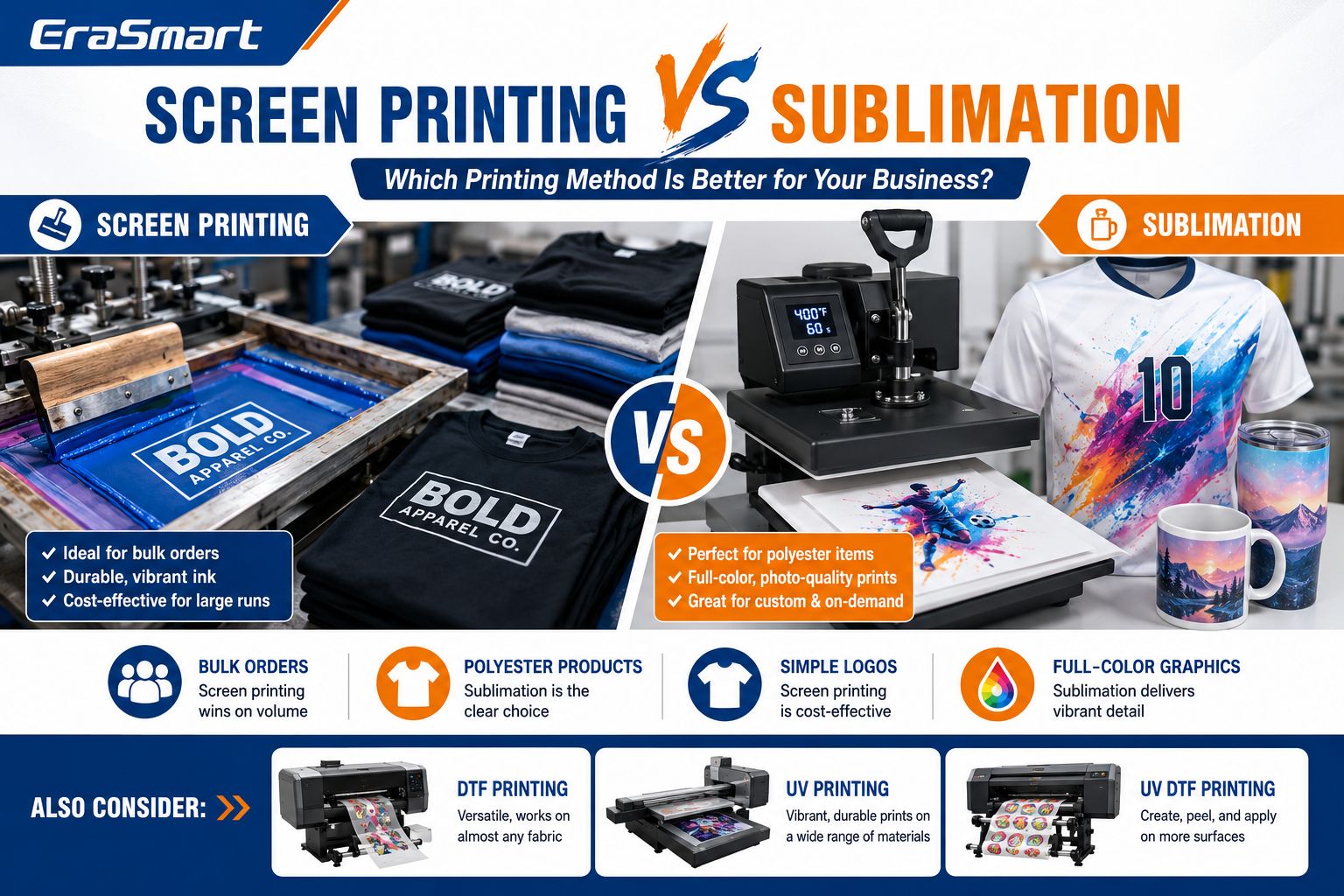
Screen printing and sublimation are two popular printing methods for custom products, apparel, gifts, promotional items, and small business merchandise. Both can create attractive products, but they are built for different materials, different order types, and different business models.
Screen printing is strong for bulk apparel orders, simple designs, solid colors, and repeat production. Sublimation is strong for polyester fabrics, light-colored garments, mugs, tumblers, coated blanks, and full-color all-over designs.
However, neither method is perfect for every business. If your customers want dark cotton T-shirts, small-batch full-color designs, personalized apparel, hard-surface decals, or mixed product orders, you may also need to consider modern digital workflows such as DTF printing, UV printing, or UV DTF printing.
This guide explains the real differences between screen printing and sublimation, their advantages and limitations, and how to choose the right printing method for your product business.
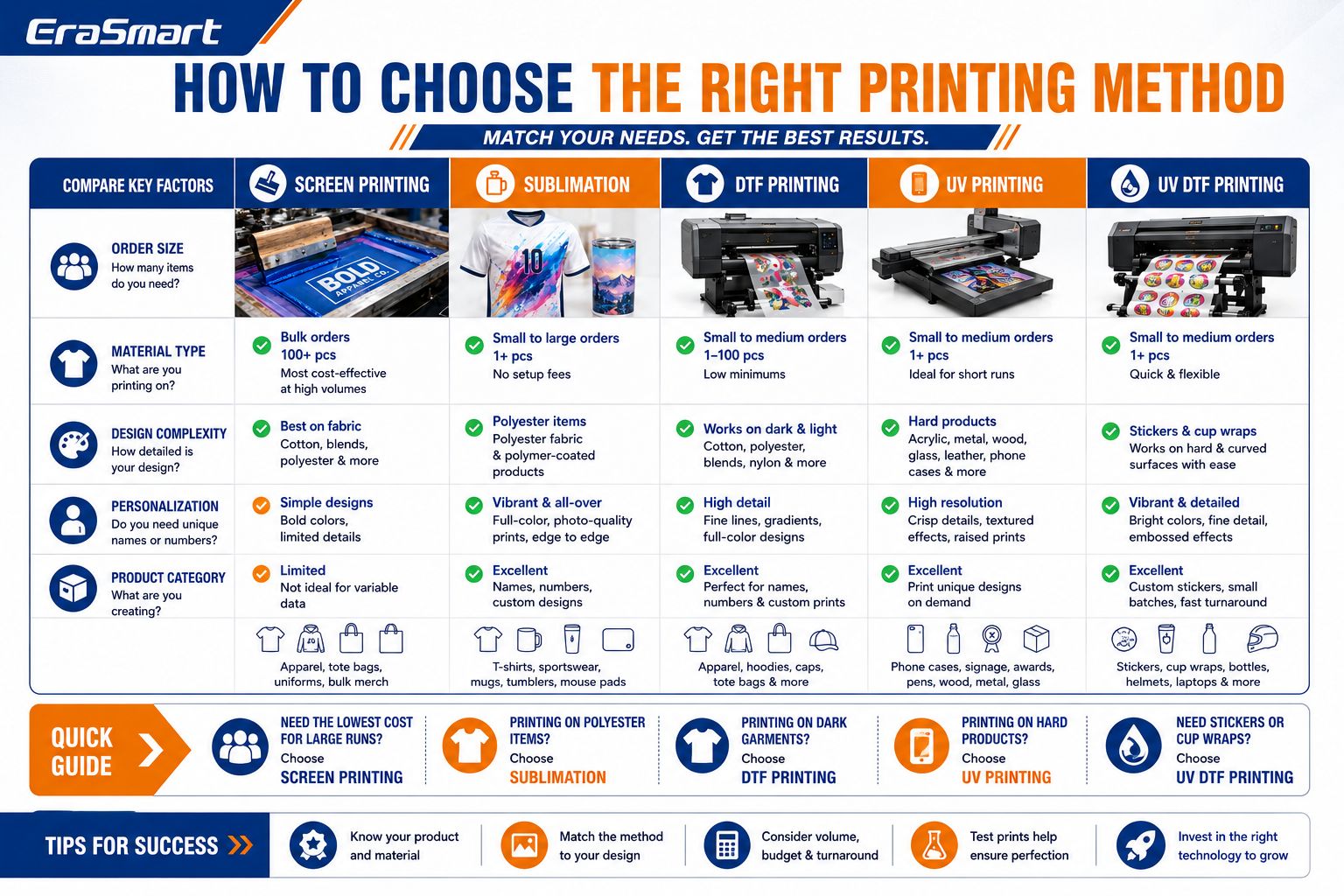
Choose screen printing if your business mainly produces large quantities of the same design, especially simple logos, solid colors, uniforms, team shirts, and promotional apparel.
Choose sublimation if your business mainly produces full-color designs on polyester or coated products, such as sportswear, mugs, tumblers, mouse pads, ceramic blanks, and light-colored polyester garments.
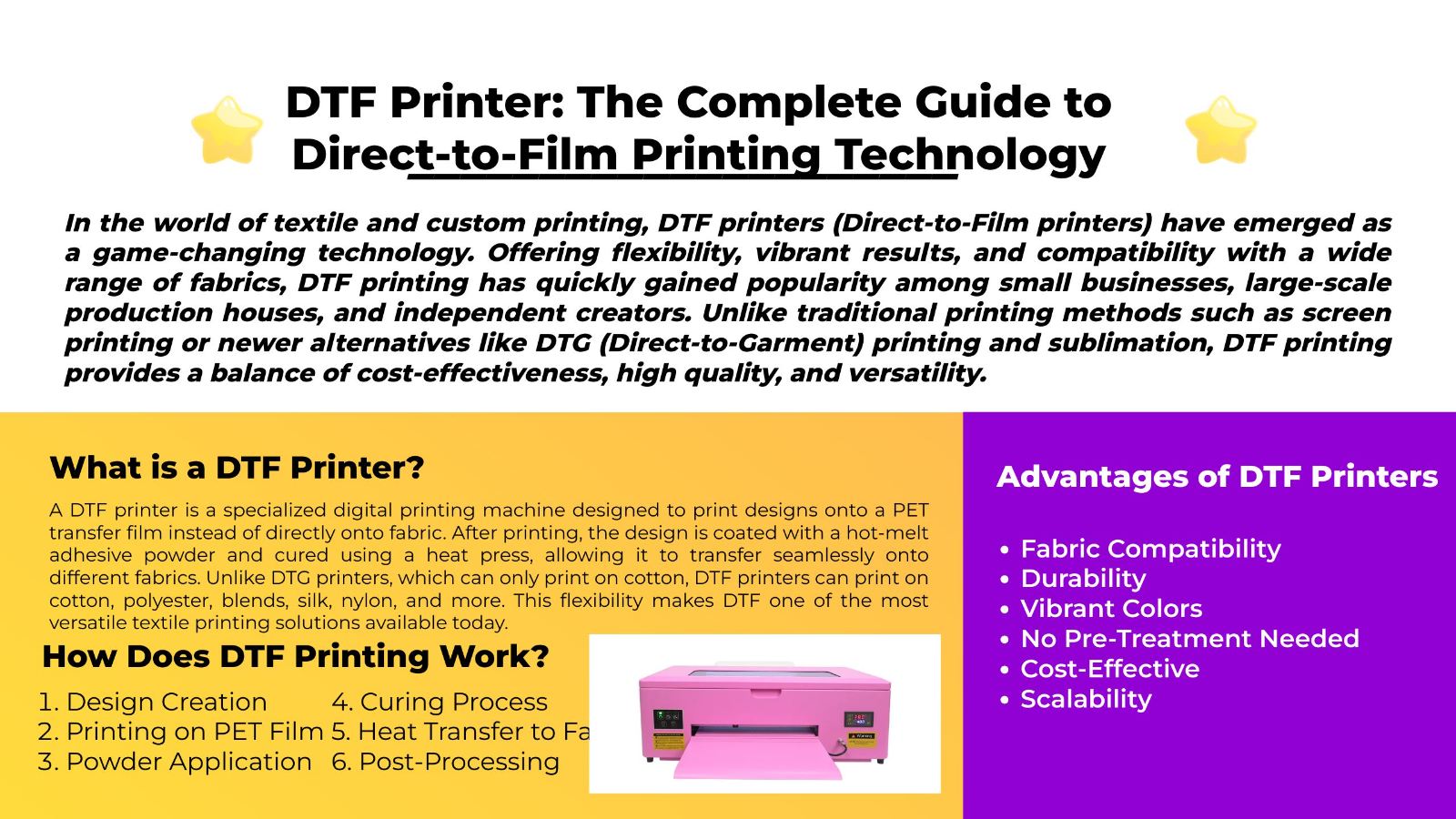
Choose DTF printing if your business needs full-color designs, small batches, cotton, polyester, blends, dark garments, personalized orders, and flexible apparel production.
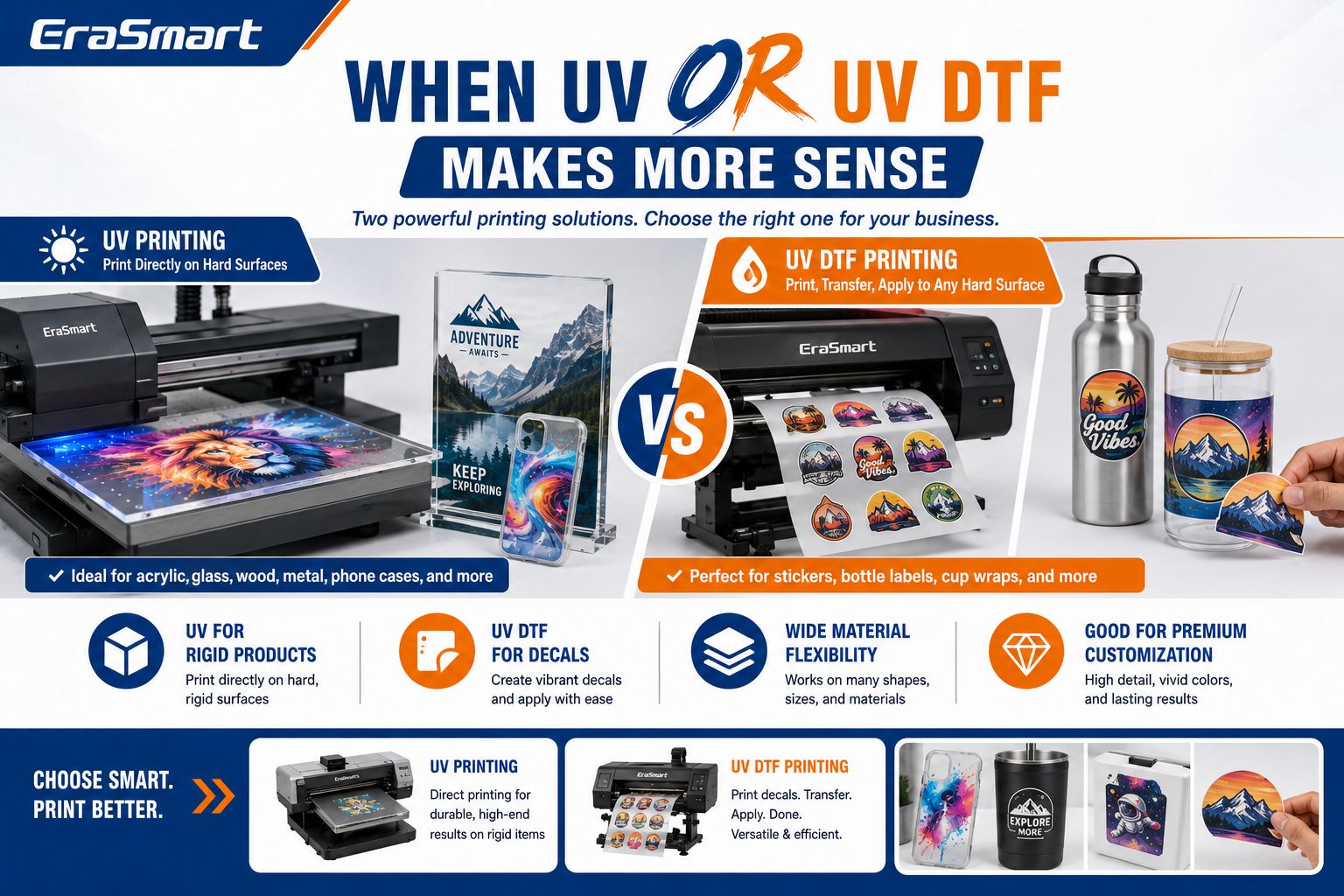
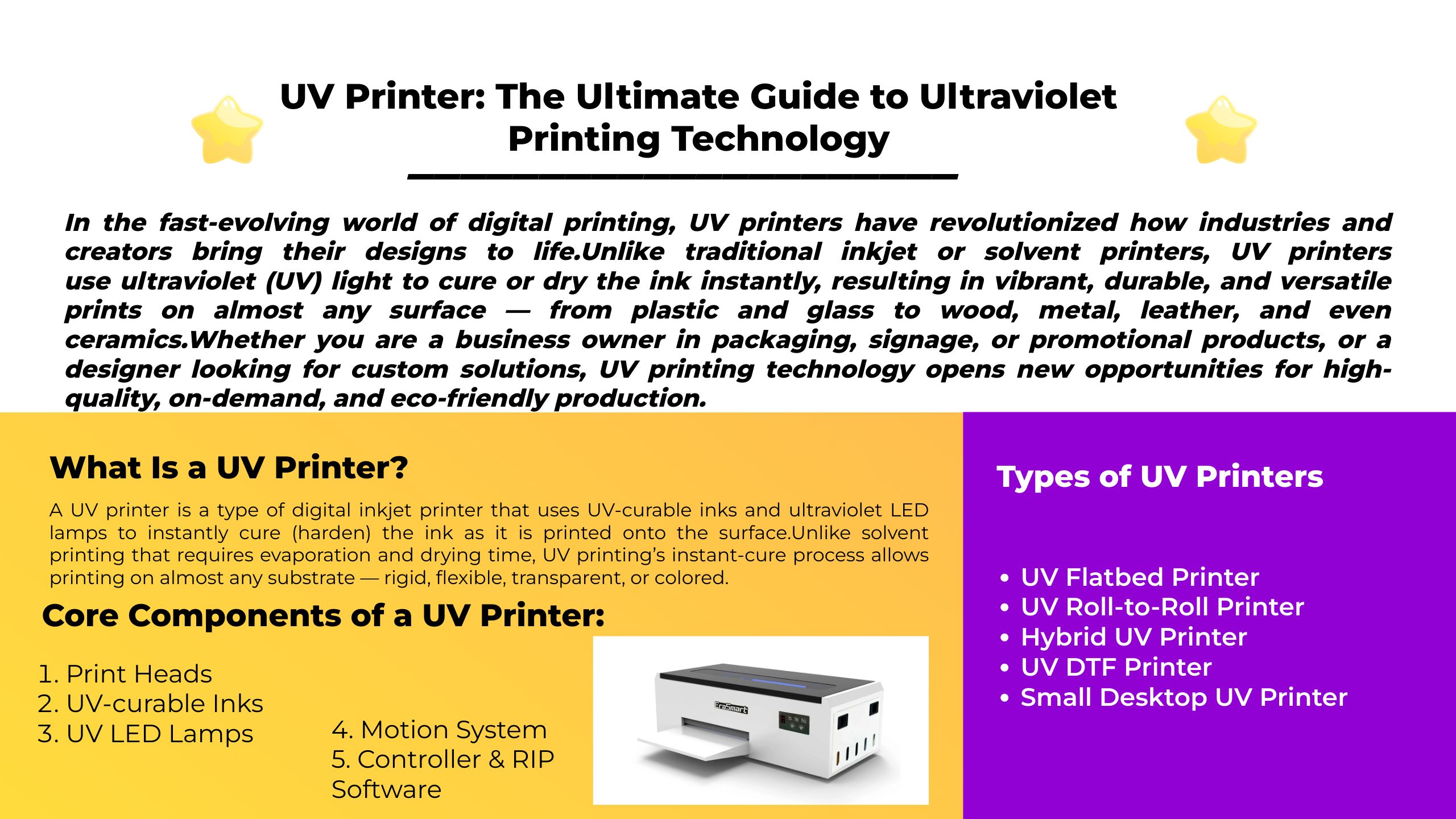
Choose UV printing if your business wants to print directly on hard products such as acrylic, glass, metal, wood, plastic, phone cases, signs, and packaging samples.
Choose UV DTF printing if your business wants to create premium stickers, labels, cup wraps, bottle decals, gadget skins, and hard-surface transfers.
| Factor | Screen Printing | Sublimation Printing |
|---|---|---|
| Best for | Bulk apparel, simple logos, solid designs | Polyester products, coated blanks, full-color designs |
| Material compatibility | Cotton, blends, some synthetic fabrics with correct ink | Polyester or sublimation-coated surfaces |
| Best garment color | Light or dark garments depending on ink setup | Best on white or light-colored polyester |
| Design style | Simple, bold, low-color artwork | Full-color artwork, gradients, all-over prints |
| Setup | Screens required for each design/color | Digital transfer workflow |
| Best order size | Medium to large bulk orders | Small to medium custom product orders |
| Feel on fabric | Ink sits on or bonds into fabric surface | Dye becomes part of polyester fiber or coating |
| Dark garment performance | Possible with proper ink and underbase | Not suitable for standard dark cotton garments |
| Personalization | Less efficient for many unique designs | Easier for individual designs |
| Business fit | Bulk production and repeat orders | Custom gifts, sportswear, mugs, coated blanks |

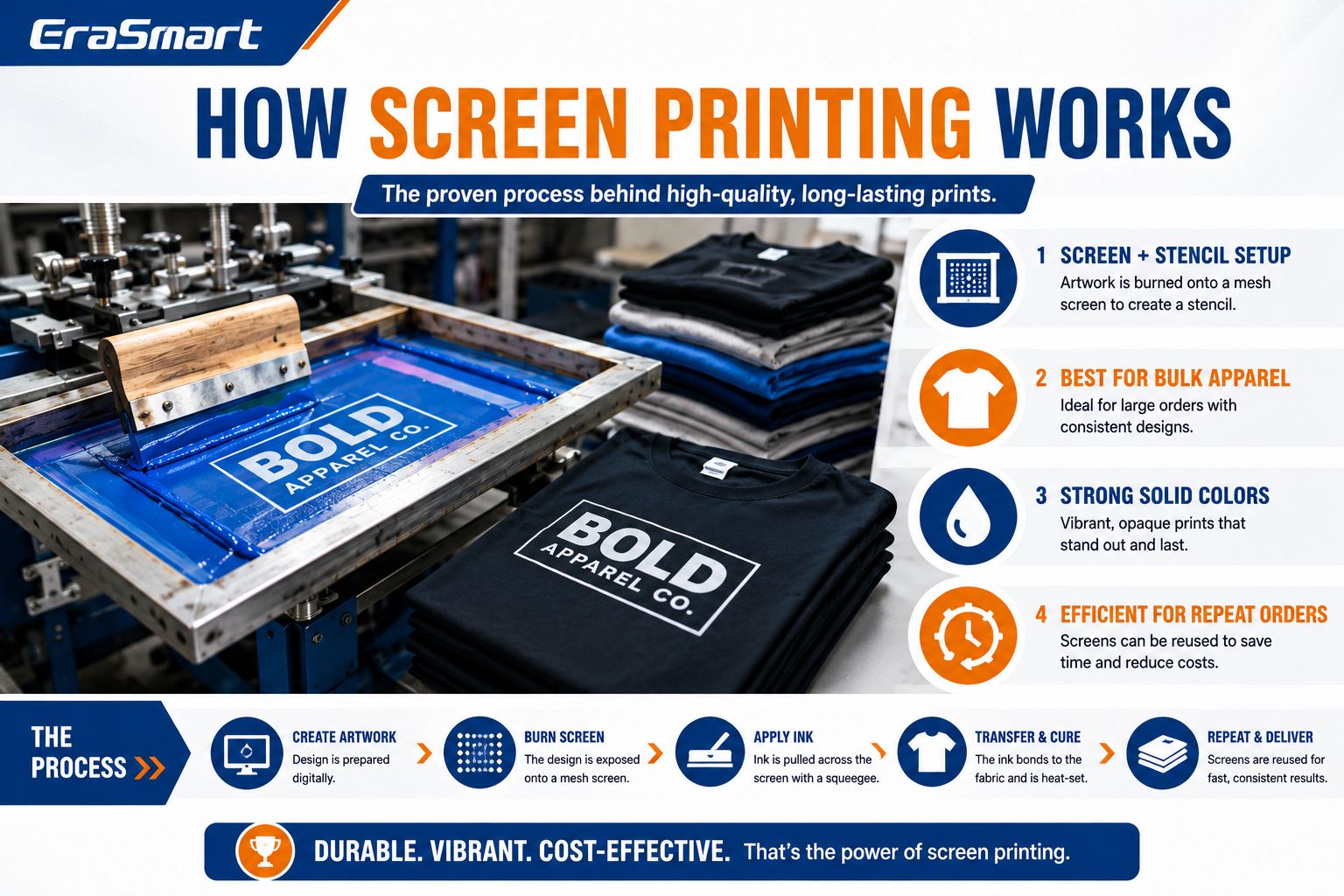
Screen printing is a traditional printing method that uses a mesh screen and stencil to transfer ink onto a surface. For apparel, ink is pushed through the screen onto the garment. Each color usually requires its own screen, which means setup is more involved when the design has multiple colors.
Screen printing is widely used for:
T-shirts
hoodies
uniforms
teamwear
tote bags
promotional apparel
event shirts
corporate logo shirts
school shirts
bulk merchandise
Its biggest strength is bulk production. Once the screen setup is complete, printing many pieces of the same design can be efficient and cost-effective.
Screen printing becomes more economical when the order quantity is high. The setup cost can be spread across many garments, making the unit cost lower for large repeat orders.
This makes screen printing suitable for:
company uniforms
school event shirts
sports team shirts
promotional campaigns
wholesale apparel
large event merchandise
repeat logo orders
Screen printing can produce bold, strong, and opaque colors, especially for simple designs and solid graphics. With the right ink and underbase, it can also work on dark garments.
When properly printed and cured, screen printing can be very durable. It is often used for workwear, uniforms, teamwear, and promotional shirts because it can handle repeated wearing and washing.
Screen printing is especially strong for designs with:
one or few colors
bold text
solid logos
simple shapes
brand marks
team names
large repeat designs
If the artwork is simple and the quantity is large, screen printing can be very efficient.
Screen printing requires screen preparation. If the customer only needs one or five shirts, the setup may not be worth it.
For small batches, custom names, many design variations, or personalized orders, DTF printing is often more practical. EraSmart’s DTF Printer lineup is designed for businesses that need flexible apparel production without traditional screen setup.
Each color may require a separate screen. This makes complex artwork, gradients, photo-style graphics, and multi-color illustrations more difficult and more expensive.
If your business changes designs often or accepts many custom orders, screen printing can slow down production because each new design requires setup.
Names, numbers, small custom details, and one-off designs are not the strongest use case for screen printing. Digital workflows such as DTF are usually more efficient for personalized apparel.

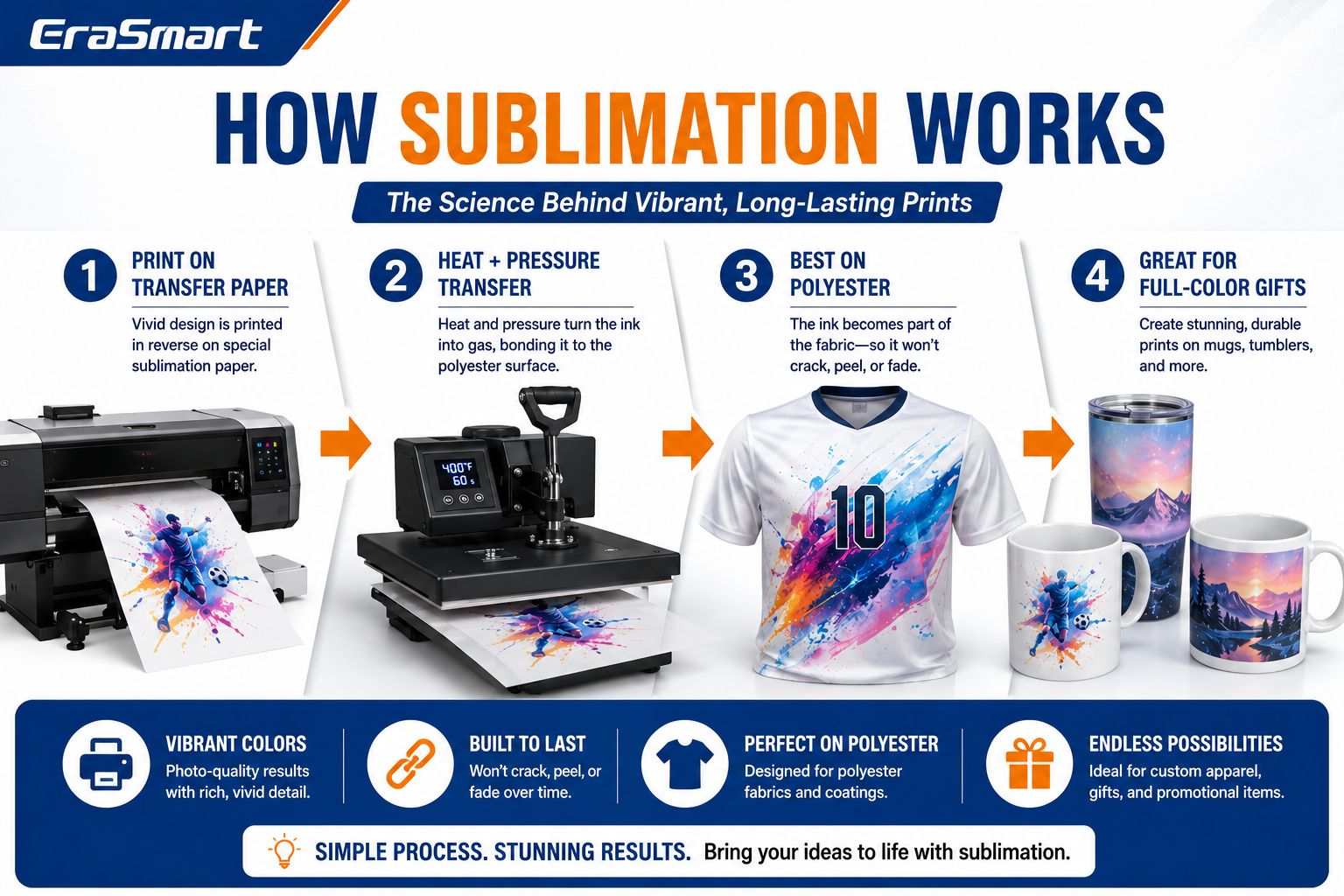
Sublimation is a digital transfer printing process. A design is printed onto sublimation paper using sublimation ink, then transferred to the product with heat and pressure.
During the heat process, the dye turns into gas and bonds with polyester fibers or a polymer coating. This means sublimation works best on polyester fabrics and specially coated blanks.
Sublimation is commonly used for:
polyester sportswear
white or light polyester T-shirts
mugs
tumblers
mouse pads
phone cases with coating
ceramic tiles
keychains
photo panels
hardboard blanks
promotional gifts
Sublimation is strong for colorful artwork, gradients, photos, patterns, and all-over designs. It does not require separate screens for each color.
This makes it suitable for:
photo gifts
sports jerseys
patterned apparel
mugs and tumblers
personalized gifts
all-over print designs
promotional products
Because sublimation dye bonds with the polyester fibers instead of sitting on top of the fabric, the print can feel very soft. There is usually no heavy print layer on the garment surface.
Sublimation works well on products with the correct polymer coating, such as mugs, tumblers, tiles, photo panels, and coated phone cases.
Since sublimation uses a digital transfer workflow, it can be suitable for small custom gift orders, individual names, photos, and personalized designs.
Sublimation works best on polyester. It is not suitable for standard cotton T-shirts unless special coating or hybrid methods are used, and results may not meet expectations.
If your apparel business needs cotton, polyester, blends, denim, nylon, leather-like materials, and dark garments, a DTF printer is usually more flexible.
Sublimation does not print white ink. The final color depends on the base material. On dark garments, the design will not appear clearly because the dye cannot create an opaque white base.
For dark T-shirts and hoodies, DTF printing is usually a better solution because it uses white ink underbase to support full-color designs.
For mugs, tumblers, tiles, and hard products, sublimation requires a special polymer coating. Ordinary glass, metal, acrylic, or plastic products cannot be sublimated properly unless they are coated for sublimation.
If your business wants to print on many hard materials without depending on sublimation coating, consider an EraSmart UV Printer for direct hard-surface printing or an EraSmart UV DTF Printer for premium transfer decals.
Sublimation performs best on white or light-colored surfaces. If the base product is not white, the final color can shift because the ink becomes part of the material or coating.
For T-shirts, the best method depends on fabric, color, artwork, and order quantity.
| T-Shirt Requirement | Better Choice |
|---|---|
| Large bulk order with simple logo | Screen Printing |
| Full-color design on white polyester | Sublimation |
| Dark cotton T-shirt | DTF Printing |
| Small batch custom T-shirts | DTF Printing |
| Personalized name and number shirts | DTF Printing |
| Sports polyester jerseys | Sublimation or DTF |
| Corporate cotton shirts | Screen Printing or DTF |
| Many designs in small quantities | DTF Printing |
| Soft feel on white polyester | Sublimation |
| Full-color design on cotton | DTF Printing |
For most small apparel businesses, DTF printing offers a more flexible starting point than screen printing or sublimation because it works across more garment types and order sizes.
EraSmart’s DTF Production Workflow explains how DTF printing works from artwork preparation to film printing, powdering, curing, heat pressing, and quality control.
If your business is built around large repeat apparel orders, screen printing can still be a strong option.
If your business is focused on polyester sportswear, mugs, and coated gifts, sublimation can be a useful workflow.
If your business needs flexibility across different fabrics, dark garments, full-color graphics, and small batches, DTF printing may be a better fit.
A small business should think about:
What products will I sell first?
Are my customers ordering one piece or hundreds?
Do they want cotton, polyester, or mixed fabrics?
Do they prefer dark garments?
Do they need full-color artwork?
Do they want names and personalization?
Do I want to sell apparel, hard goods, or both?
Do I need fast design changes?
Do I want to avoid large inventory?
The best method is not the one that sounds most popular. The best method is the one that matches your real customer demand.

DTF printing is often better when your business needs flexibility.
Choose DTF if you want to print:
cotton T-shirts
polyester shirts
blended fabrics
dark garments
hoodies
tote bags
uniforms
sportswear
personalized apparel
full-color graphics
small-batch orders
online custom apparel
print-on-demand products
Unlike screen printing, DTF does not require a screen for each color. Unlike sublimation, DTF is not limited to white polyester or coated blanks.
For beginners and growing apparel businesses, EraSmart’s How to Choose a DTF Printer and DTF Printer Buying Checklist can help compare print width, printhead type, white ink system, workflow, maintenance, and upgrade path.
Sublimation is useful for coated mugs, tumblers, and gift blanks. But it depends on sublimation-compatible coatings.
UV printing is more flexible when you want to print directly onto hard materials such as:
acrylic
glass
metal
wood
plastic
ceramic
phone cases
packaging samples
signage
promotional products
An EraSmart UV Printer is suitable for businesses that want to create custom gifts, phone cases, acrylic products, signs, packaging samples, decorative panels, and hard-surface products.
For material planning, EraSmart’s UV Printer Materials Guide can help you understand how different substrates affect UV printing results.

UV DTF printing is useful when you want to create decals, labels, cup wraps, and hard-surface transfers without printing directly on each object.
Choose UV DTF if you want to sell:
premium stickers
logo decals
cup wraps
bottle labels
cosmetic labels
candle jar labels
packaging decals
phone case decals
gadget skins
acrylic labels
short-run brand transfers
Compared with sublimation, UV DTF does not require the same kind of sublimation coating. It is designed for clean, smooth hard surfaces and uses A/B film, UV ink, white ink, varnish, and lamination.
If your business focuses on stickers, decals, cup wraps, and packaging labels, explore EraSmart’s UV DTF Printer and A/B Film for UV DTF Printing.

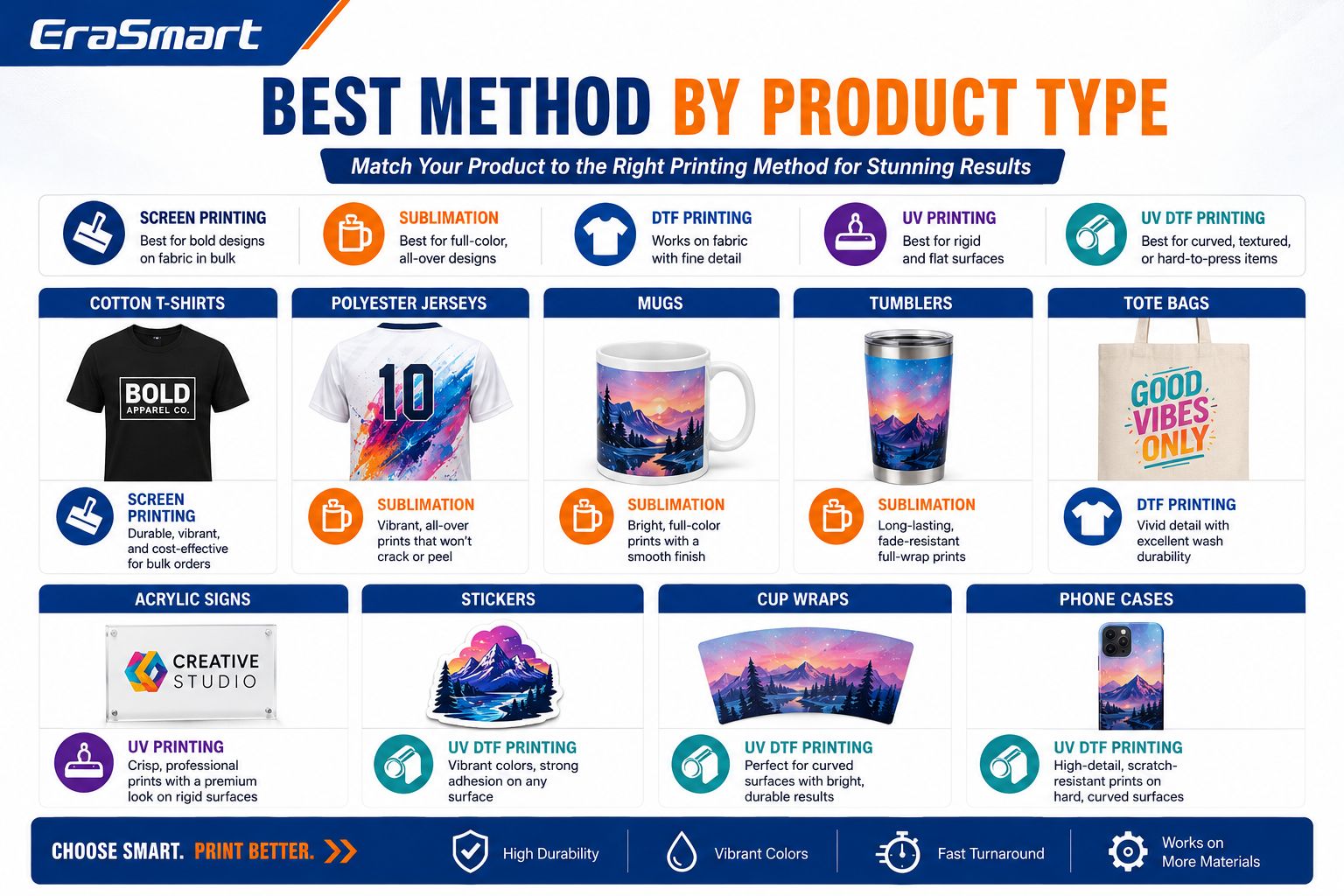
| Product Type | Recommended Method |
|---|---|
| Bulk cotton T-shirts with simple logo | Screen Printing |
| White polyester sportswear | Sublimation or DTF |
| Dark cotton T-shirts | DTF Printing |
| Small-batch custom apparel | DTF Printing |
| Personalized hoodies | DTF Printing |
| Tote bags | DTF Printing |
| Mugs with sublimation coating | Sublimation |
| Acrylic signs | UV Printing |
| Glass products | UV Printing or UV DTF |
| Metal labels | UV Printing or UV DTF |
| Cup wraps | UV DTF Printing |
| Bottle decals | UV DTF Printing |
| Phone cases | UV Printing or UV DTF |
| Candle jar labels | UV DTF Printing |
| Packaging samples | UV Printing or UV DTF |
| Sticker sheets | UV DTF Printing |
Cost depends on equipment, ink, blanks, labor, order size, design complexity, waste rate, and production speed.
In general:
Screen printing has higher setup cost but lower unit cost at larger quantities.
Sublimation has lower setup for one-off products but requires compatible blanks.
DTF has flexible setup and works well for small to medium apparel orders.
UV printing can create higher-value hard products.
UV DTF can support premium decals, labels, and cup wraps with good product variety.
For small businesses, the lowest cost method is not always the most profitable method. A method that allows more product types, faster customization, and better customer fit may create better margins.
Durability depends on the full workflow, not just the printing method.
Screen printing can be very durable when ink is properly cured.
Sublimation can be durable on polyester and coated blanks because the dye bonds with the material or coating.
DTF can be durable when film, ink, powder, curing, and heat press settings are controlled properly.
UV printing can be durable when the surface is compatible, clean, and properly cured.
UV DTF decals can be durable when applied to clean, smooth hard surfaces with proper lamination and application technique.
For DTF production, EraSmart’s DTF Consumables Guide explains why ink, film, powder, and maintenance materials must work together for consistent results.

For beginners, the best method depends on the product direction.
Choose screen printing if you already have bulk apparel customers and simple repeated designs.
Choose sublimation if you want to focus on polyester products and sublimation-coated gifts.
Choose DTF if you want to start a flexible apparel business with T-shirts, hoodies, tote bags, dark garments, full-color graphics, and small-batch orders.
Choose UV if you want to print directly on acrylic, glass, metal, wood, phone cases, and hard products.
Choose UV DTF if you want to sell stickers, decals, cup wraps, labels, and hard-surface transfers.
For many small businesses, DTF is the most flexible apparel starting point, while UV DTF is a strong choice for stickers, labels, cup wraps, and hard-surface product decoration.
If your business mainly sells T-shirts, hoodies, uniforms, sportswear, tote bags, and custom apparel, choose an EraSmart DTF Printer.
If your business mainly sells acrylic, glass, metal, wood, phone cases, signs, packaging samples, and hard-surface custom products, choose an EraSmart UV Printer.
If your business mainly sells stickers, labels, cup wraps, bottle decals, gadget skins, cosmetic labels, candle jar labels, and hard-surface transfers, choose an EraSmart UV DTF Printer.
If you are comparing product directions, EraSmart’s UV DTF vs Textile DTF vs UV Flatbed guide can help you decide which workflow fits your business.
Screen printing is better for large apparel orders with simple designs, solid colors, and repeat production.
Sublimation is better for polyester fabrics, light-colored garments, coated mugs, tumblers, and full-color gift products.
But if your business needs flexible apparel production across cotton, polyester, blends, dark garments, small batches, and personalized designs, DTF printing may be the better choice.
If your business wants to print on hard products, UV printing may be better than sublimation.
If your business wants stickers, labels, decals, cup wraps, and hard-surface transfers, UV DTF printing may be the better business direction.
The best printing method is not the one that wins every comparison. The best method is the one that matches your products, customers, order size, material type, design style, and profit model.
Need help choosing the right printing method for your business? Share your target products, material type, order size, design style, expected daily volume, and budget range with EraSmart.
Our team can help you choose the right DTF Printer, UV Printer, or UV DTF Printer for your custom printing business.
uv printer
DTF printer
DTG printer
Heat press machine
Advertising printer
DTF oven
Hot Press
Carving machine
Mug heat transfer
Laminating machine
Printing INK
Cellphone case
Glass product
Cleaning fluid
Cotton swab
WhatsApp:+8618566233796
WeChat: +8618566233796
Mobile: +8618566233796
Web:www.erasmart.com
Shop:www.erasmartmall.com
WhatsApp us
Tell us your printing needs. Our team will reply within 24 hours.
Just provide a few details and we will help you get quick quotes!