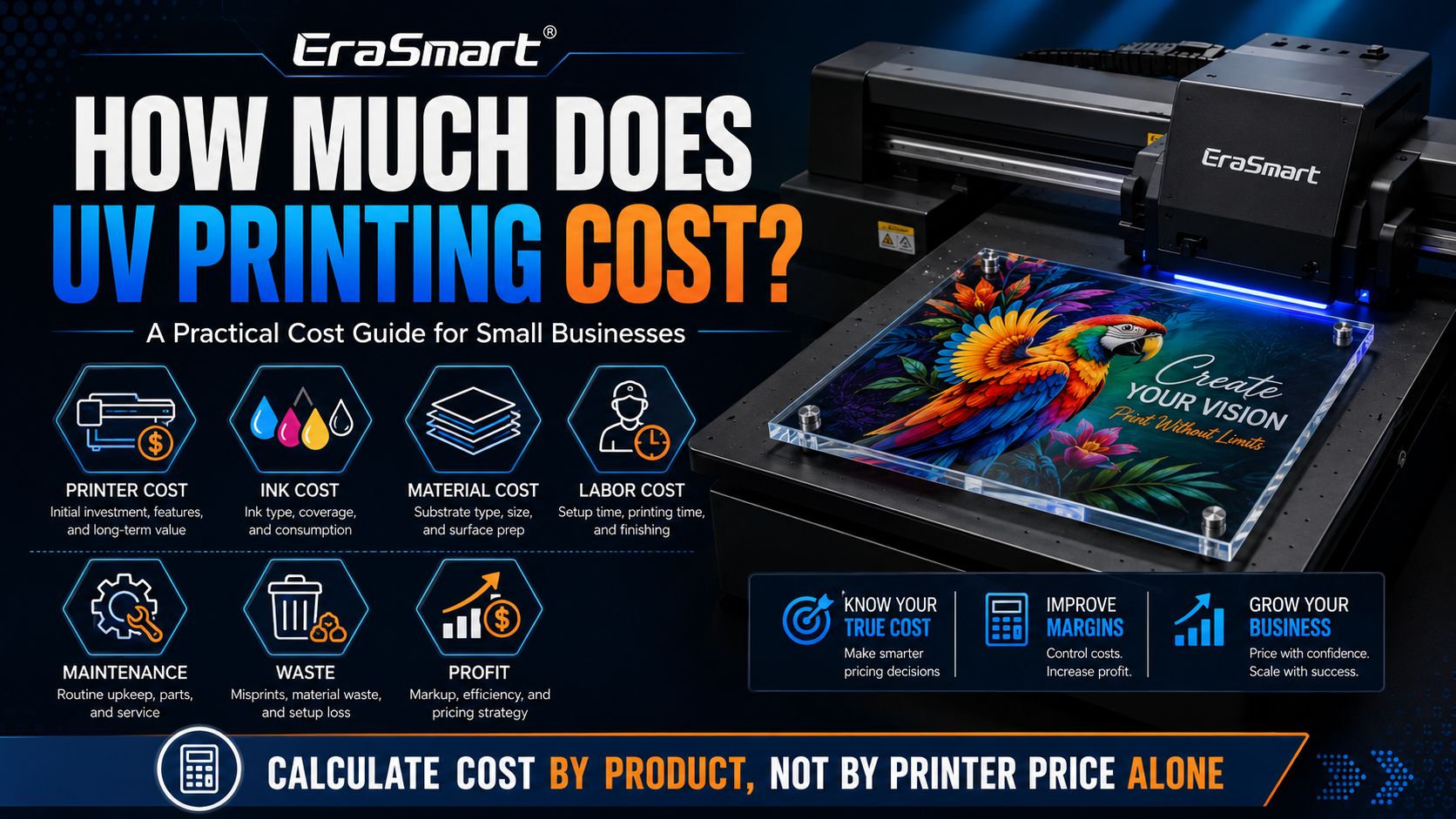
UV printing cost is not a single fixed number. It depends on the printer you choose, the product you print, ink coverage, white ink usage, varnish effects, material cost, labor time, maintenance, waste rate, and how you price the final product. For a small business, the real question is not only “How much does one print cost?” but “Can this product generate enough margin after all production costs are included?”
In many small and mid-size UV printing setups, cost is often estimated by square meter, by product, or by job. Public 2026 cost guides commonly model UV printing at around $5–$15 per m² for many normal jobs, while heavy ink coverage, premium materials, complex white ink layers, or high-end production setups can push the cost higher. This is a useful reference, but it should not be copied blindly into your pricing. Your real cost must be calculated from your own printer, material, ink usage, labor, and order volume.
For EraSmart customers, the better approach is simple: calculate UV printing cost by workflow, not by printer price alone. A UV printer can create high-value products such as acrylic plaques, phone cases, glass gifts, metal signs, packaging samples, leather accessories, wood panels, and promotional products. But the cost structure behind each product is different. That is why UV printing should be evaluated as a full business system, not only as a machine purchase.

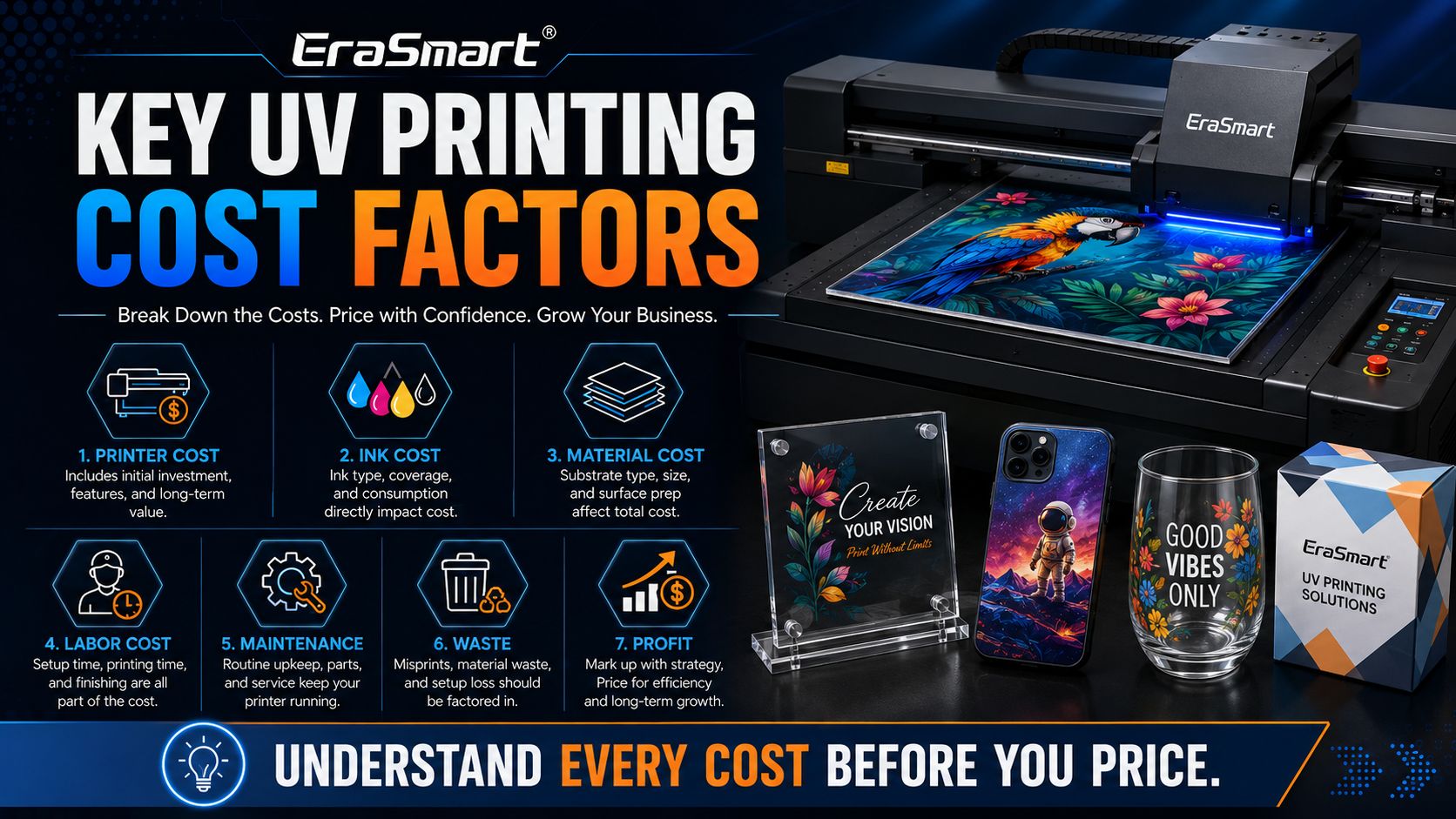
The main cost factors are:
| Cost Factor | What It Includes | Why It Matters |
|---|---|---|
| Printer cost | Machine purchase, depreciation, useful life | Determines long-term equipment cost per print |
| Ink cost | CMYK, white ink, varnish, cleaning fluid | Heavily affected by design coverage and print layers |
| Material cost | Acrylic, glass, metal, wood, phone cases, packaging blanks | Often the largest cost per product |
| Labor cost | Artwork setup, positioning, printing, finishing, packing | Affects small-batch and custom order profitability |
| Maintenance cost | Cleaning, nozzle checks, capping station care, UV lamp care | Protects print quality and reduces downtime |
| Waste cost | Misprints, failed adhesion, wrong positioning, material damage | Directly reduces profit |
| Workspace cost | Rent, electricity, ventilation, storage | Important for commercial studios |
| Software and workflow | RIP software, color setup, fixtures, templates | Controls repeatability and efficiency |
The most important point: material cost and labor often matter more than ink cost alone. A small UV print may use very little ink, but if the blank product is expensive or the setup time is long, the real cost per item can still be high.
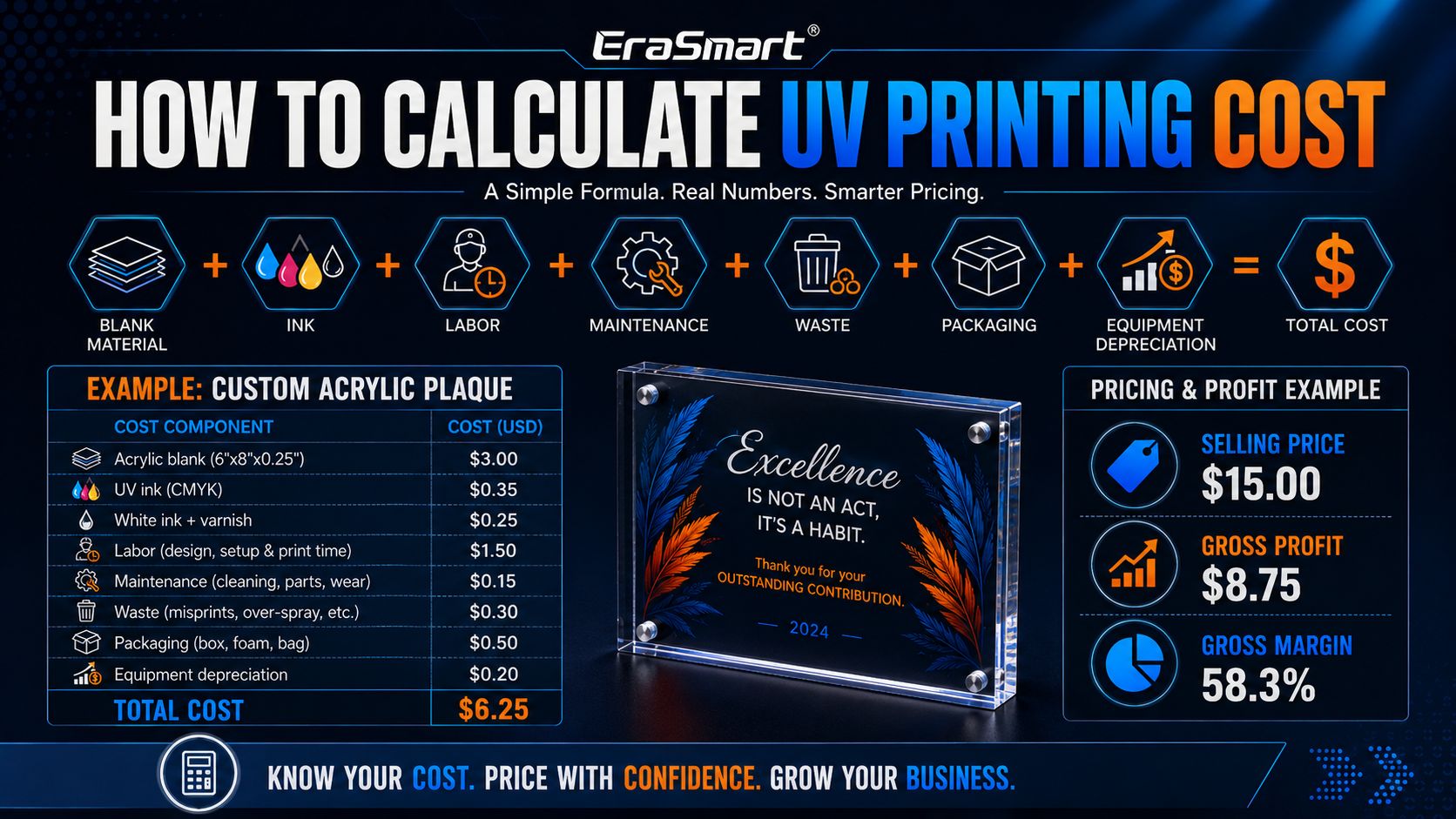
A practical UV printing cost formula looks like this:
Total Cost Per Product = Blank Material Cost + Ink Cost + Labor Cost + Maintenance Allowance + Waste Allowance + Packaging Cost + Equipment Depreciation
Then your selling price should be calculated like this:
Selling Price = Total Cost Per Product ÷ Target Cost Ratio
For example, if one custom product costs $4.00 to produce and you want a 50% gross margin, the selling price should be around $8.00.
If you want a 60% gross margin, the selling price should be around $10.00.
This is why UV printing businesses should not only ask, “How much does it cost to print?” They should ask, “How much profit does this product leave after every cost is counted?”
Related Read: UV Printer ROI Calculator

The UV printer is usually the largest upfront investment. But in real pricing, you should not place the entire machine cost into one order. You spread it across the useful production life of the printer.
A simple depreciation model:
Printer Cost Per Product = Printer Purchase Cost ÷ Estimated Total Products Printed During Useful Life
For example:
| Printer Investment | Expected Output Over Useful Life | Equipment Cost Per Product |
|---|---|---|
| $5,000 | 20,000 products | $0.25 |
| $10,000 | 50,000 products | $0.20 |
| $20,000 | 100,000 products | $0.20 |
This shows why the cheapest printer is not always the lowest-cost business choice. A more stable printer may cost more upfront, but if it prints more consistently, wastes fewer blanks, reduces downtime, and supports higher-value products, the real long-term cost can be better.
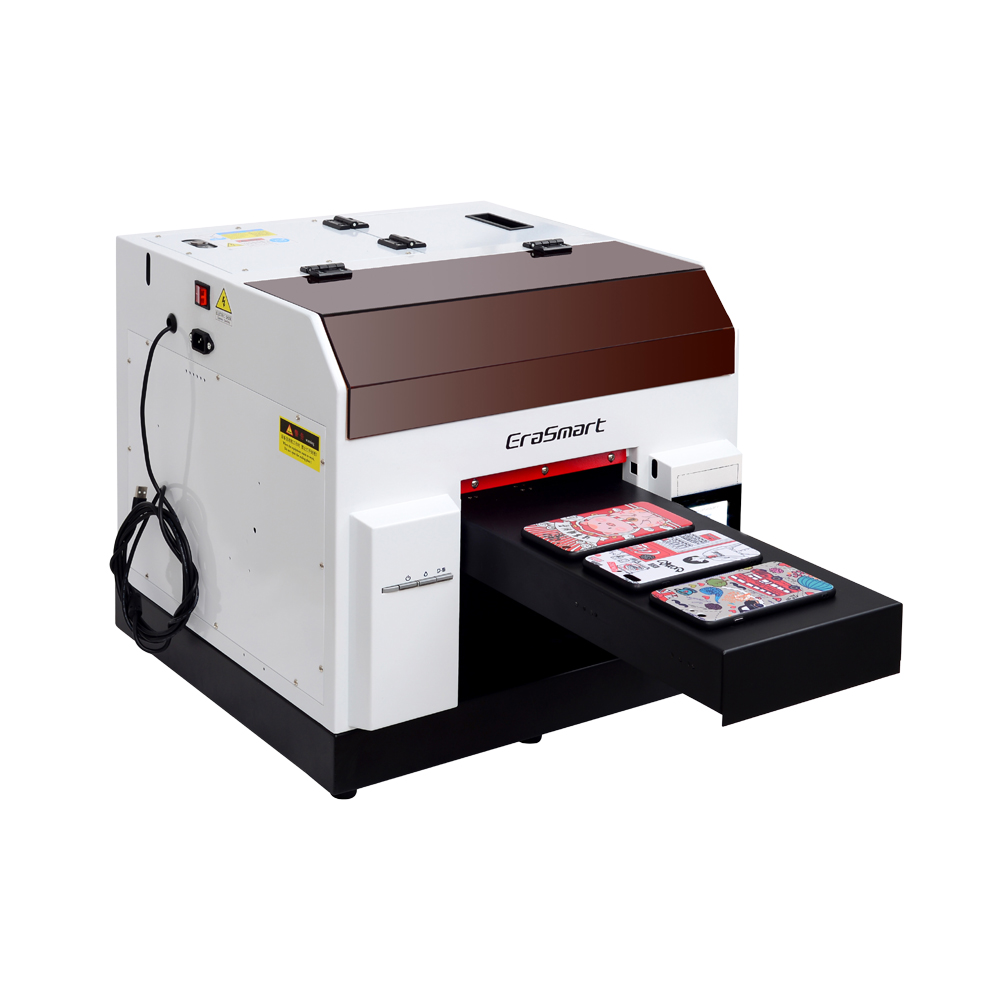
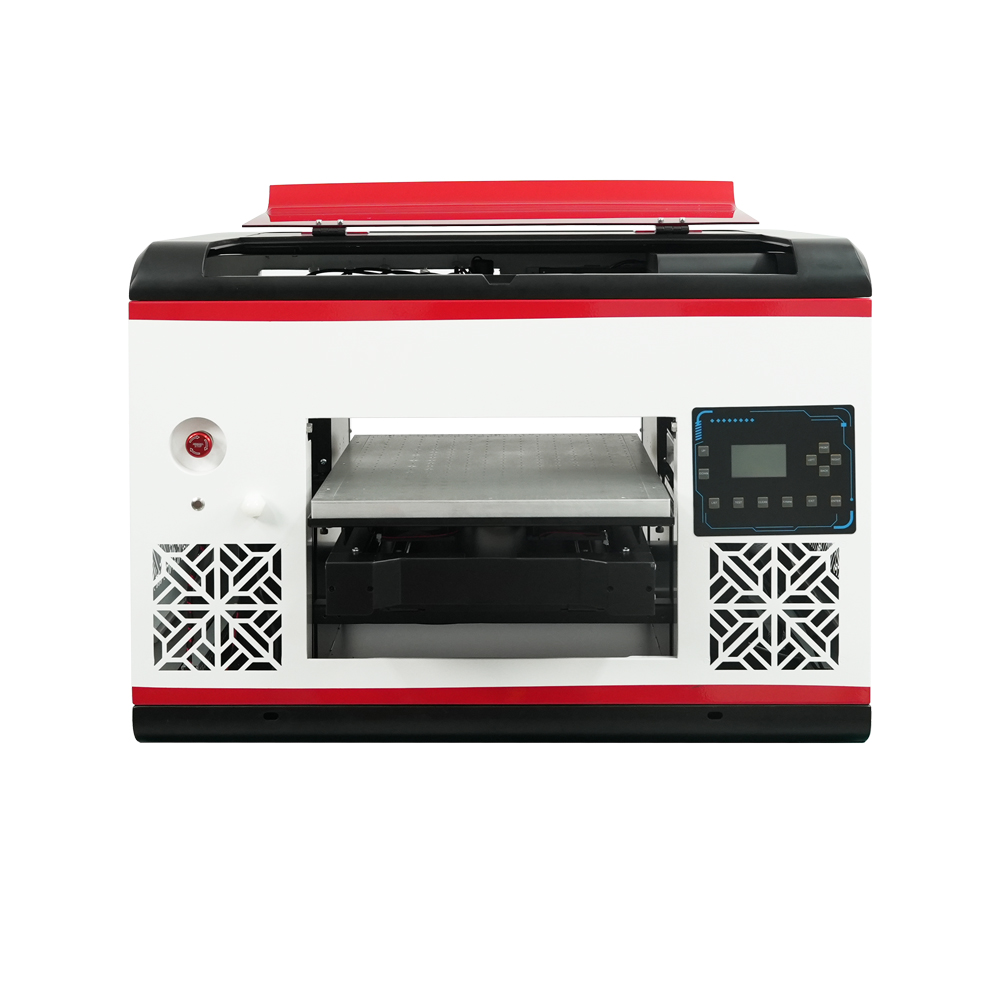
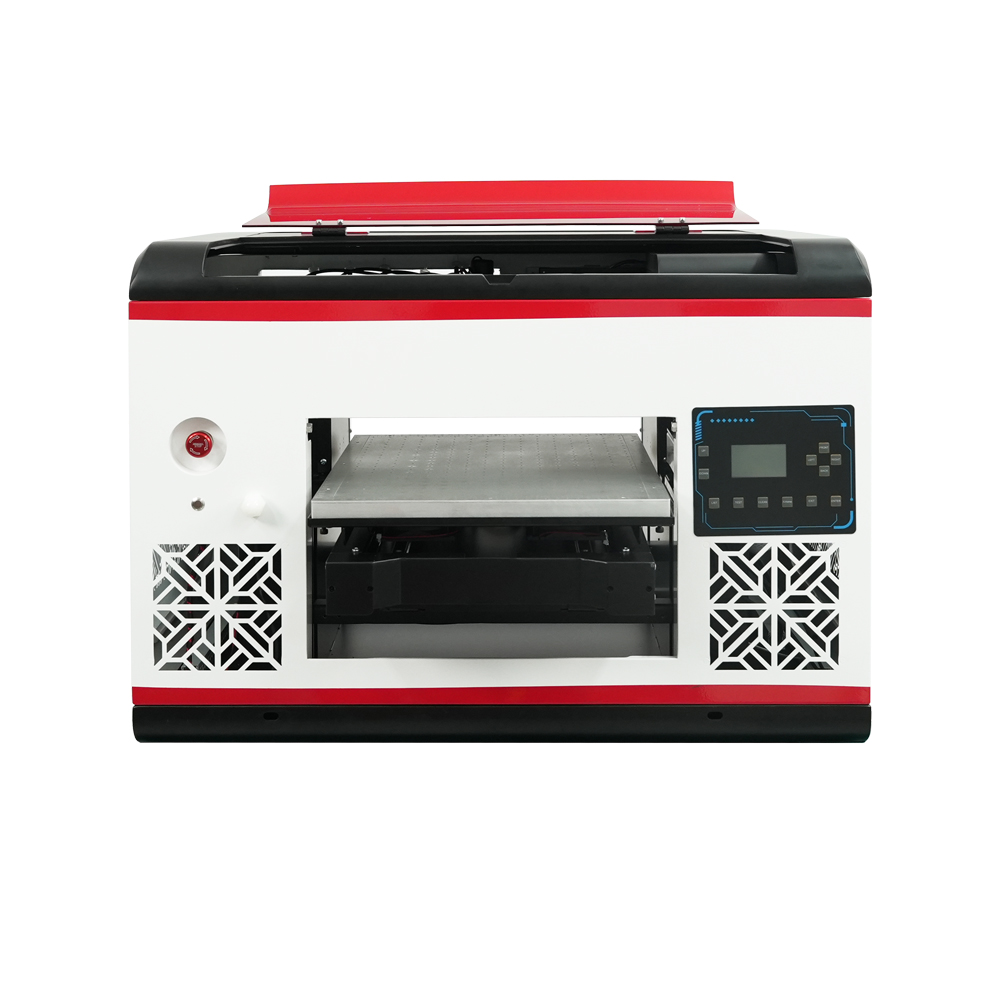
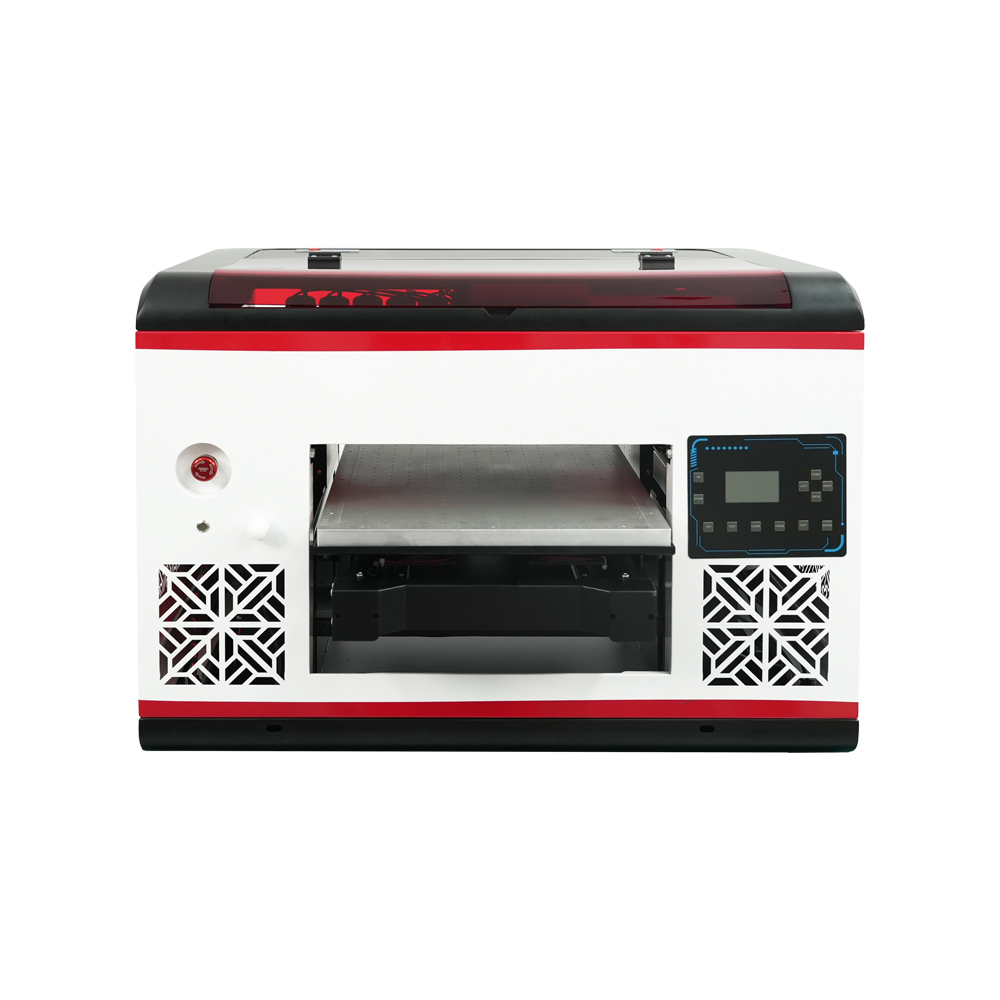
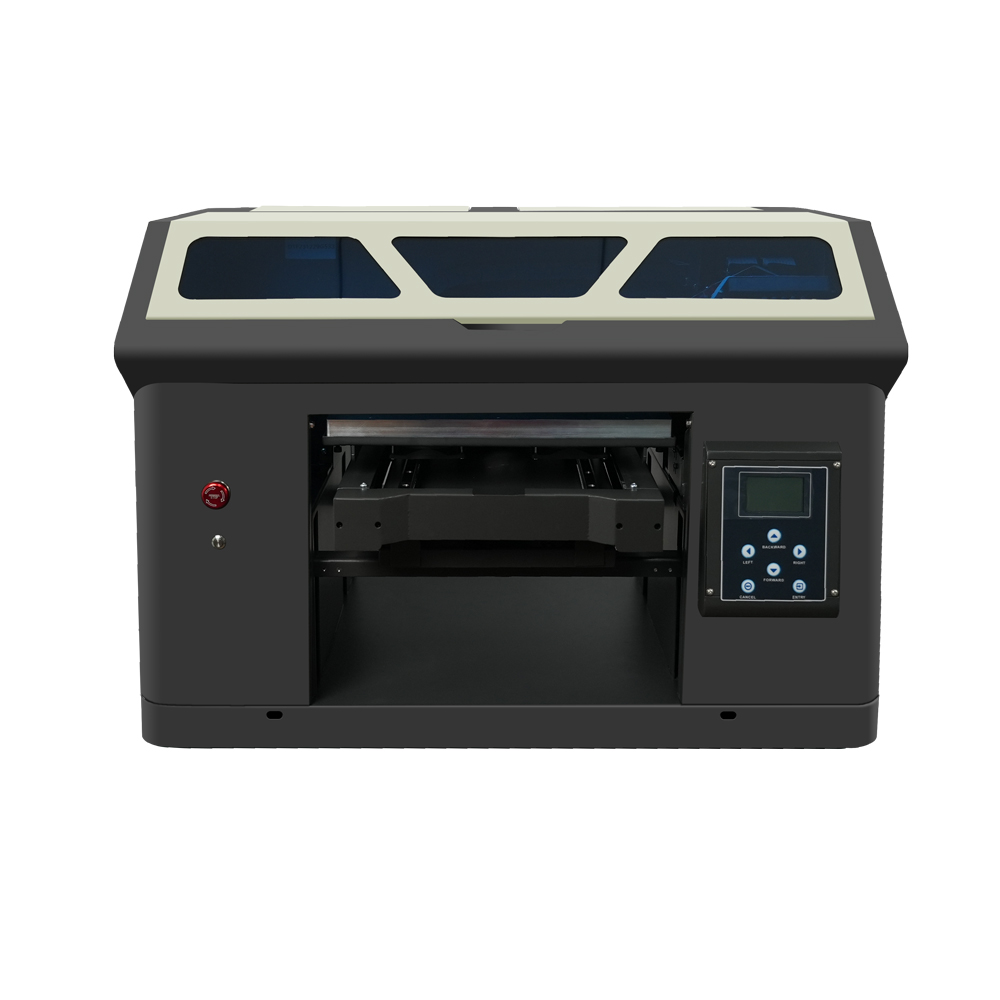
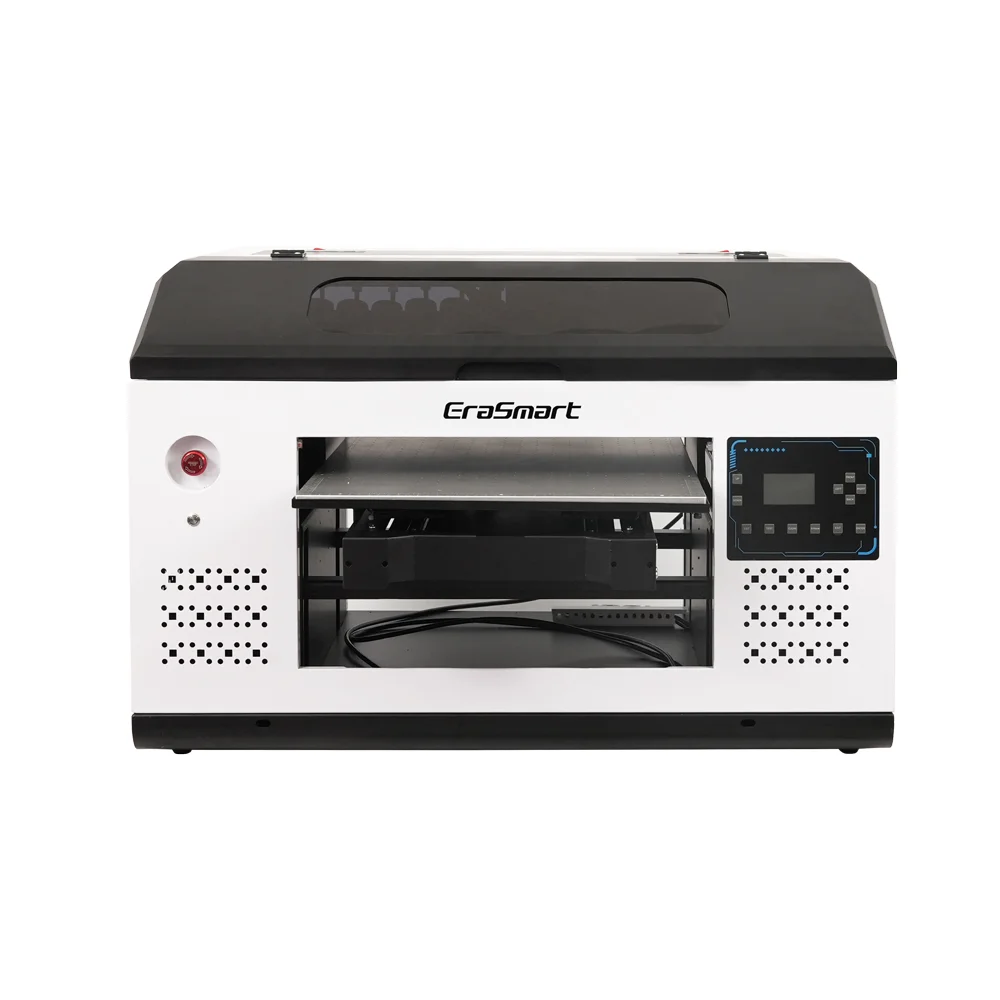
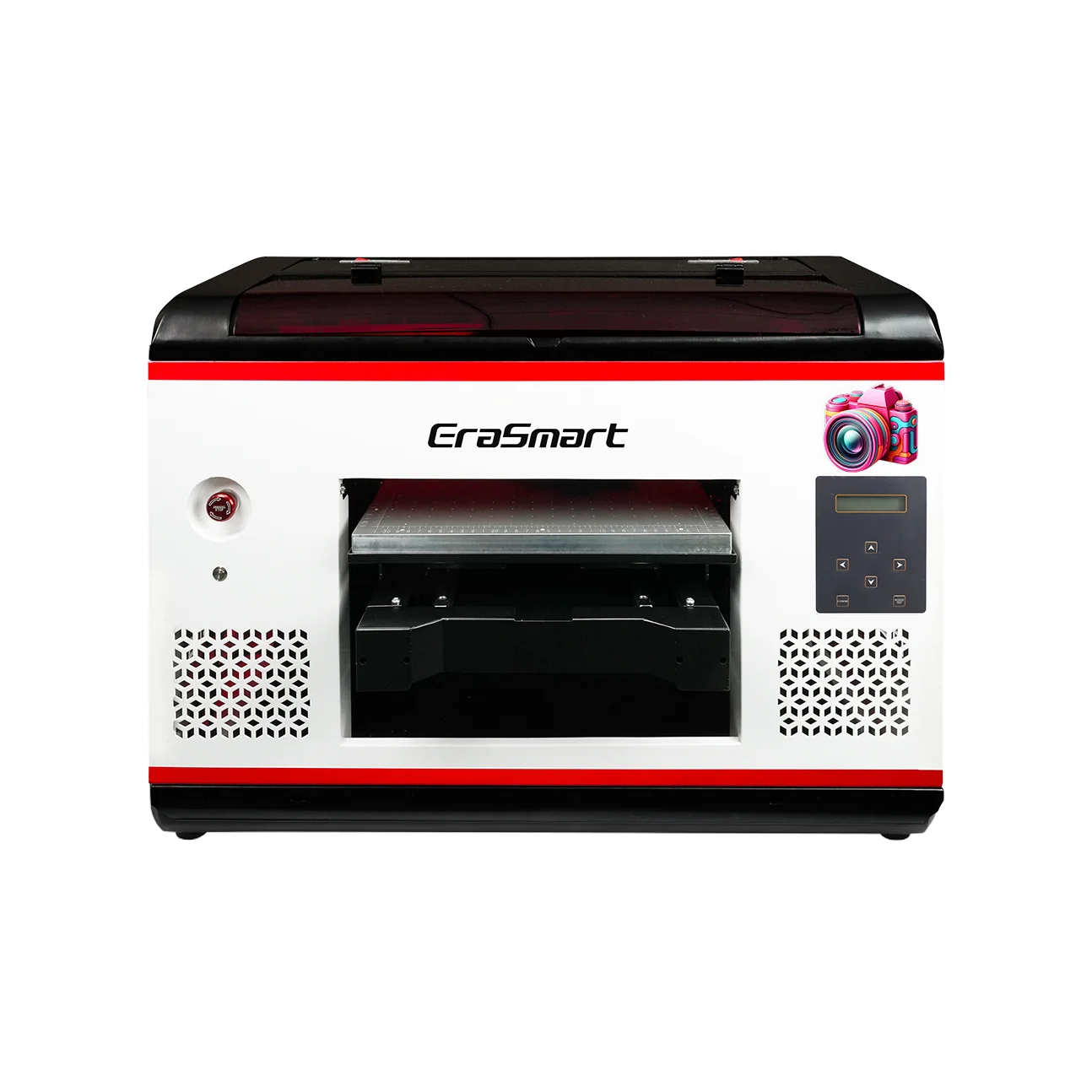
EraSmart’s UV printer range includes compact and larger-format options for different business stages, including A5, A4, A3 Max, A3 Pro, A2, and UV DTF solutions. The right choice should be based on product size, daily order volume, material type, and whether you need CMYK only, white ink, varnish, or a larger platform.
UV ink cost depends on print area, ink coverage, resolution, number of passes, white ink layer, and varnish layer. A small logo on a light material uses much less ink than a full-color print on transparent acrylic with white ink and varnish.
EraSmart’s UV ink guide explains the three main ink layers clearly:
CMYK creates full-color images, logos, text, gradients, and artwork.
White ink supports dark, colored, and transparent materials.
Varnish adds gloss, spot coating, raised texture, and premium surface effects.
This matters because a product with only CMYK may be cheaper to print, but it may not deliver the result your customer expects. For clear acrylic, glass, dark phone cases, colored plastics, and premium gifts, white ink is often necessary. For high-value decorative products, varnish may help justify a higher selling price.
| Print Type | Ink Usage | Cost Level |
|---|---|---|
| Small logo on white material | CMYK only | Low |
| Full-color design on light material | CMYK | Medium |
| Clear acrylic or glass | White + CMYK | Higher |
| Premium gift with raised gloss | White + CMYK + Varnish | Highest |
| Large full-coverage artwork | High ink coverage | Higher |
The goal is not always to reduce ink as much as possible. The goal is to use the right ink layers for the product value. A white ink and varnish effect may cost more, but it can also help sell a product at a much higher price.
For many UV printing businesses, the blank product costs more than the ink.
For example:
| Product Type | Main Cost Driver |
|---|---|
| Phone case | Blank case quality and model variety |
| Acrylic plaque | Acrylic thickness, size, and polishing |
| Glass gift | Glass quality, packaging, breakage risk |
| Metal sign | Metal sheet type and coating |
| Wood panel | Wood quality, surface preparation |
| Packaging sample | Box material, folding, surface coating |
| Leather accessory | Material quality and adhesion testing |
A small UV print on an expensive blank may still have a high total cost. A larger print on a low-cost material may have a lower total cost than expected. This is why product-level costing is more useful than only square-meter costing.
EraSmart’s UV printer material guide and UV ink guide both emphasize that different materials require different preparation, ink layers, and adhesion testing. For transparent, dark, or colored materials, white ink becomes especially important; for premium gifts and decorative panels, varnish may add more commercial value.
Labor is easy to ignore, but it can decide whether a small UV printing business is profitable.
Labor includes:
design adjustment
artwork checking
RIP setup
print positioning
product cleaning
fixture or jig setup
height adjustment
test printing
finished product inspection
packaging
customer communication
For one-off custom orders, labor cost can be higher than ink cost. For repeat products with templates and jigs, labor cost drops quickly.
| Job Type | Labor Requirement | Business Impact |
|---|---|---|
| One custom phone case | Artwork + positioning each time | Higher labor cost |
| 50 phone cases using same jig | Repeat setup | Lower labor cost per item |
| Personalized acrylic awards | Design and name changes | Medium to high labor |
| Standard packaging labels | Batch workflow | Lower labor per unit |
This is why small businesses should standardize product sizes, create print templates, use repeatable fixtures, and group similar orders together.
UV printers need regular maintenance. This includes nozzle checks, cleaning, white ink circulation, capping station care, platform cleaning, and UV lamp inspection. Maintenance is not just a technical task; it is a cost-control strategy.
EraSmart’s UV printer maintenance guideexplains that stable output depends on daily cleaning, white ink circulation, nozzle checks, capping station care, platform cleaning, UV lamp inspection, and long-idle protection.
Skipping maintenance may save a few minutes today but can create:
clogged nozzles
failed prints
wasted materials
unstable white ink
color inconsistency
downtime
printhead damage
For cost calculation, it is smart to add a small maintenance allowance to each product. This protects your pricing from being too optimistic.
Waste cost includes failed prints, wrong positioning, dust contamination, poor adhesion, incorrect height, color errors, and damaged blanks.
Even a small waste rate affects profit.
For example:
| Waste Rate | Meaning |
|---|---|
| 2% | Good control for repeat jobs |
| 5% | Common for mixed custom products |
| 10%+ | Needs workflow improvement |
If one blank product costs $8 and 1 out of 10 prints fails, your real average blank cost is not $8 anymore. It is closer to $8.89 before ink, labor, and packaging.
That is why UV printing businesses should test new materials before taking large orders. Surface cleaning, correct height adjustment, suitable ink layers, and fixture stability all reduce waste.
A home studio and a commercial workshop have different cost structures.
Workspace costs may include:
rent
electricity
ventilation
air filtration
storage
worktables
safety tools
cleaning supplies
RIP software
fixtures and jigs
packaging station
Public cost guides often include workspace, ventilation, software, and safety gear as part of the real UV printing business cost, not just the printer and ink.
For EraSmart customers, this is important because many buyers start with a compact UV printer and later expand into more structured production. A small workspace can work well at the beginning, but as order volume grows, layout efficiency becomes part of profitability.

Here is a simple example for a custom acrylic plaque.
| Cost Item | Example Cost |
|---|---|
| Acrylic blank | $3.00 |
| UV ink | $0.35 |
| White ink + varnish effect | $0.25 |
| Labor | $1.50 |
| Maintenance allowance | $0.15 |
| Waste allowance | $0.30 |
| Packaging | $0.50 |
| Equipment depreciation | $0.20 |
| Total Cost | $6.25 |
If you sell it for $15.00:
Gross Profit = $15.00 – $6.25 = $8.75
Gross Margin = 58.3%
This is a healthy product if demand is stable and production is repeatable.
Now compare that with a low-value product where the customer only pays $7.00. If the total cost is still $6.25, the margin is too low. The problem is not UV printing itself. The problem is poor product positioning.
| Product | Cost Level | Profit Potential | Notes |
|---|---|---|---|
| Simple logo sticker-style print | Low | Medium | Good for volume orders |
| Phone case | Medium | Medium to high | Model variety affects inventory |
| Acrylic plaque | Medium | High | Good premium product |
| Glass gift | Medium to high | High | Needs surface testing |
| Metal nameplate | Medium | Medium to high | Good for B2B orders |
| Packaging sample | Medium | High | Strong for short-run branding |
| Premium varnish gift | Higher | High | Higher selling price possible |
UV printing is most attractive when the product has high perceived value. A small amount of ink can turn a blank product into a personalized gift, brand item, or premium custom product.
Do not buy only by price. A printer that is too small may limit your product range. A printer that is too large may increase investment pressure before you have enough orders. Choose based on your product size, order volume, and material type.
White ink is essential for transparent, dark, and colored materials, but it should be used intelligently. Use the correct white layer only where needed. Avoid unnecessary full-area white layers when the product design does not require them.
Varnish adds cost, but it can also increase selling price. Use it for premium products such as acrylic signs, gift boxes, awards, nameplates, and luxury packaging samples.
Create standard sizes for phone cases, acrylic plaques, packaging samples, tags, and gifts. Standardization reduces setup time and mistakes.
Good positioning reduces waste. Templates and jigs are especially important for repeated product types.
Batching saves setup time, ink change pressure, and operator attention.
Regular nozzle checks, cleaning, and white ink circulation are cheaper than printhead problems and failed orders.
A custom acrylic award and a simple sticker may use similar ink quantities, but the customer value is different. UV printing businesses should price based on product value, use case, urgency, personalization, and finish.
UV printing can be expensive if you only compare it with mass-production methods for large identical orders. But for short-run customization, personalized gifts, premium hard-surface products, packaging samples, and low-MOQ branding, UV printing can be very cost-effective.
The reason is simple: UV printing reduces setup barriers. You can produce one custom product, ten samples, or a short personalized batch without the same tooling or plate-making process required by many traditional methods.
For small businesses, UV printing becomes more profitable when you focus on:
premium gifts
short-run branding
personalization
packaging samples
custom phone cases
acrylic plaques
glass and metal gifts
business nameplates
high-value promotional products
If the product is too low-value, UV printing may feel expensive. If the product has strong personalization and premium positioning, UV printing can deliver excellent margin.
If you are starting a UV printing business, choose your machine by product direction.
| Business Direction | Recommended Focus |
|---|---|
| Small gifts, phone cases, acrylic, samples | Compact A4 / A3 UV printer |
| Larger panels, signs, packaging samples | A3 Max / A2 UV printer |
| Cup wraps, stickers, labels, decals | UV DTF printer |
| Premium gifts with gloss and texture | UV printer with white ink and varnish |
| Mixed custom product business | UV flatbed + UV DTF workflow |
EraSmart’s UV printer category includes compact and larger systems for different production stages, while the UV DTF printer supports A3 350 mm width, CMYK + White + Varnish, up to 1440 dpi, powderless A/B film workflow, and cold lamination for decals, labels, and cup wraps.
UV printing cost depends on seven things: printer investment, ink usage, material cost, labor, maintenance, waste rate, and workspace cost.
For daily business decisions, the best method is not to rely on a universal price. Instead, calculate cost per product:
Blank + Ink + Labor + Maintenance + Waste + Packaging + Equipment Depreciation = Real Cost Per Product
Then price based on value, not only cost.
UV printing is most profitable when used for high-value custom products, premium gifts, short-run branding, packaging samples, acrylic signs, phone cases, glass items, metal plates, and personalized hard goods.
Need help estimating your UV printing cost and profit? Share your target products, material size, expected daily order volume, ink effect requirements, and budget range with EraSmart. Our team can help you choose the right UV printer, ink configuration, workflow, and ROI path for your custom product business.
Discover our comprehensive range of UV printers, engineered to deliver exceptional results on diverse materials. From compact A5 models to large-format A2 printers, find the perfect solution for your business.
Compact entry-level model with L800 print head, ideal for small items and hobby projects (120*210mm print size).
L800 print head with 210*290mm print size, perfect for small businesses and personalized gifts (0-130mm print height).
DX7 print head with 350*450mm print size, suction platform, and CMYK+WW+VV for high-volume production.
XP600 print head with 350*450mm print size, 5㎡/H speed, ideal for medium to large production runs.
Dual XP600 print heads with 5.5㎡/H speed, CMYK+WW+VVVVVV for enhanced color gamut and productivity.
Dual XP600 print heads with 350*450mm print size, designed for industrial-grade continuous production.
Large-format 420*600mm printer with dual XP600 heads, perfect for signage, panels and large materials.
Dual XP600 heads with automatic lamination, specialized for UV DTF film printing (width up to 350mm).
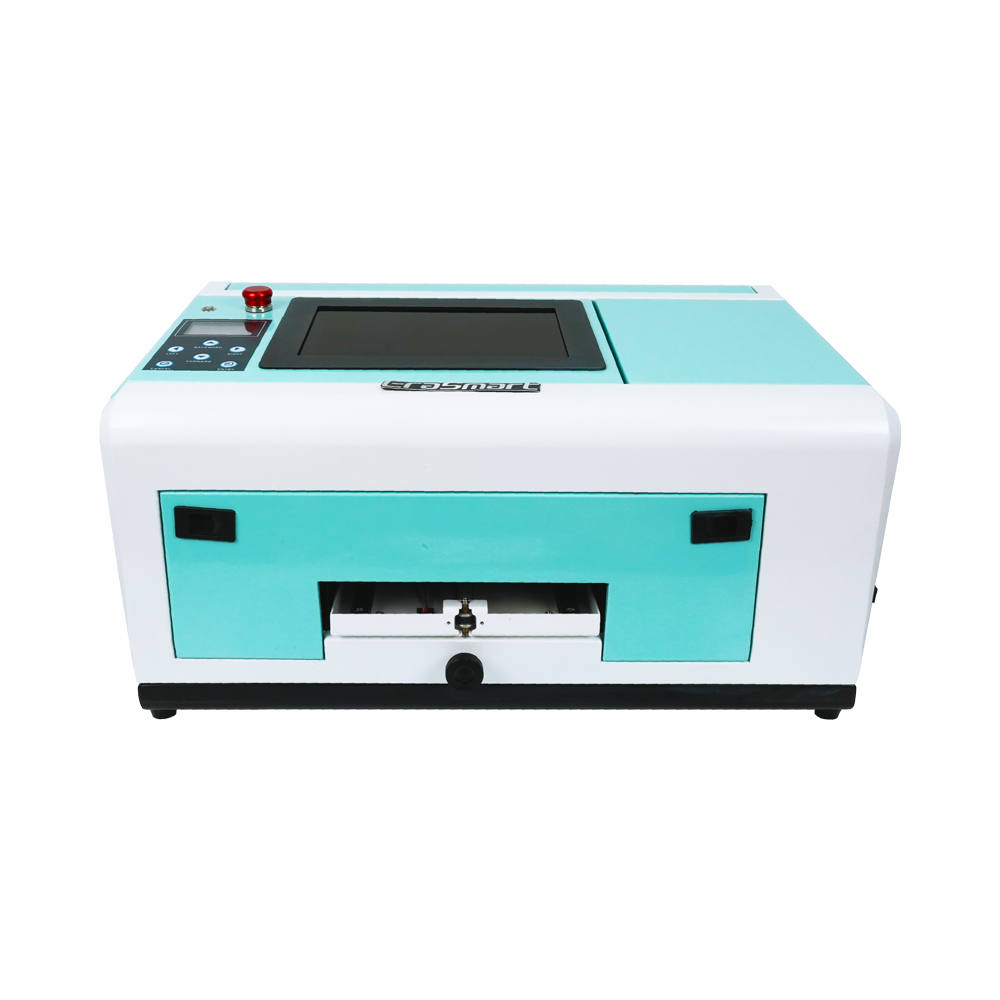
Specialized for phone cases (TPV/PVC/wood/metal), with 10-inch display and 0-10mm adjustable height.
uv printer
DTF printer
DTG printer
Heat press machine
Advertising printer
DTF oven
Hot Press
Carving machine
Mug heat transfer
Laminating machine
Printing INK
Cellphone case
Glass product
Cleaning fluid
Cotton swab
WhatsApp:+8618566233796
WeChat: +8618566233796
Mobile: +8618566233796
Web:www.erasmart.com
Shop:www.erasmartmall.com
WhatsApp us
Just provide a few details and we will help you get quick quotes!