Starting a T-shirt printing business can be relatively simple, but building one that consistently makes money requires more than purchasing a printer and uploading several designs.
A practical business plan must answer five questions:
Who will buy your shirts?
What products will you sell?
Which printing method fits those products?
How much does each order actually cost?
How will customers discover and trust your business?
New businesses often focus too heavily on equipment. They purchase a printer, heat press, blanks and consumables before confirming whether there is enough demand for the products they want to sell.
A safer approach is to validate a market first, start with a focused product range and invest in equipment gradually.
Market research and financial planning should come before major equipment purchases. The U.S. Small Business Administration similarly treats market research and a business plan as foundational steps for evaluating customers, competition and startup funding requirements.
This guide provides a practical framework for planning a T-shirt printing business, selecting a production method, calculating costs, setting prices, finding customers and deciding when to bring DTF printing in-house.
| Planning area | Main decision |
|---|---|
| Target market | Who will buy your shirts? |
| Product range | What styles, garments and order sizes will you offer? |
| Printing method | DTF, DTG, screen printing, HTV, sublimation or outsourcing |
| Startup model | Home studio, local shop, online store or trade supplier |
| Equipment | What must be purchased now and what can wait? |
| Pricing | How will you cover products, labor, overhead and profit? |
| Sales channel | Local customers, online marketplaces, social media or B2B |
| Fulfillment | How will orders be produced, checked, packed and shipped? |
| Growth plan | When should production be expanded or brought in-house? |
Your first business plan does not need to be a long formal document. A concise plan that reflects real customers, products and costs is more useful than an impressive document based on assumptions.
“People who want custom shirts” is too broad to be a useful target market.
A focused business is easier to market because its products, photography, pricing and messages can be designed for a specific customer.
Potential markets include:
Local small businesses
Schools and clubs
Sports teams
Family events
Weddings
Corporate events
Streetwear brands
Fitness communities
Musicians and creators
Restaurants and cafés
Construction and service companies
Charities and fundraisers
Tourism and souvenir businesses
Potential products include:
Staff T-shirts
Logo polos
Work shirts
Hoodies
Event apparel
Promotional giveaways
Advantages include repeat orders, larger quantities and fewer completely new designs.
Potential customers include:
Family reunions
Birthday parties
School events
Charity runs
Church groups
Corporate activities
These orders can be seasonal, but one customer may order several sizes at once.
A startup clothing brand may need:
Low minimum quantities
Frequent design changes
Premium garment options
Neck labels
Sleeve prints
Short production runs
Sampling before larger orders
This market may accept higher prices but usually expects strong print quality, consistent garment sourcing and professional branding.
Examples include:
Birthday shirts
Pet shirts
Family matching shirts
Name and number designs
Photo shirts
Memorial apparel
These orders may involve more customer communication and artwork preparation, so design labor must be included in the price.

Before purchasing significant inventory, test whether customers will pay for your idea.
Use the following process:
Select one audience.
Create three to five product samples.
Photograph the real products.
Publish a focused product offer.
Contact potential customers directly.
Accept preorders or small paid orders.
Record customer questions and objections.
Expand only after receiving genuine demand.
Likes and compliments are not the same as orders.
A niche is validated when customers are willing to pay enough to cover production, labor, marketing and profit.
A T-shirt business can operate under several different models.
You create designs and use an external supplier to print and ship the shirts.
Advantages:
Very low equipment investment
No blank inventory
No production workspace
Easy product testing
Limitations:
Lower margin
Less control over quality
Longer fulfillment chain
Limited garment and packaging options
This model is useful for testing designs but may not provide enough control for local or urgent orders.
You purchase ready-to-press DTF transfers and apply them with your own heat press.
You control:
Blank garments
Placement
Heat pressing
Quality inspection
Packaging
Customer service
The supplier handles:
DTF printing
White ink
Powder application
Powder curing
This is one of the most practical startup models because you can produce cotton, polyester, blended and dark-colored apparel without immediately operating a DTF printer.
The complete process is explained in Can You Start a DTF Business Without a DTF Printer?.
You produce transfers using your own DTF printer, ink, PET film, powder and curing equipment.
This gives you control over:
Transfer size
Gang sheet layout
Production timing
Color settings
White ink density
Urgent reprints
Transfer inventory
It also introduces:
Daily maintenance
White ink management
Consumable storage
Powder handling
Curing
RIP software
Printhead risk
Failed transfers
Modern DTF systems use CMYK and white ink, while white ink circulation and regular maintenance are important for stable production.
Instead of building a clothing brand, you print shirts for other people and organizations.
Potential customers include:
Local businesses
Schools
Clubs
Event planners
Graphic designers
Marketing agencies
Clothing brands
This model may generate repeat orders because customers need replacements, new staff sizes and updated designs.
You produce shirts or transfers for resellers.
Trade customers may expect lower per-unit prices, but they can provide:
Larger orders
Repeat production
Less consumer marketing
More predictable artwork
Clear policies are needed for minimum quantities, file quality, approvals, turnaround time and reprints.

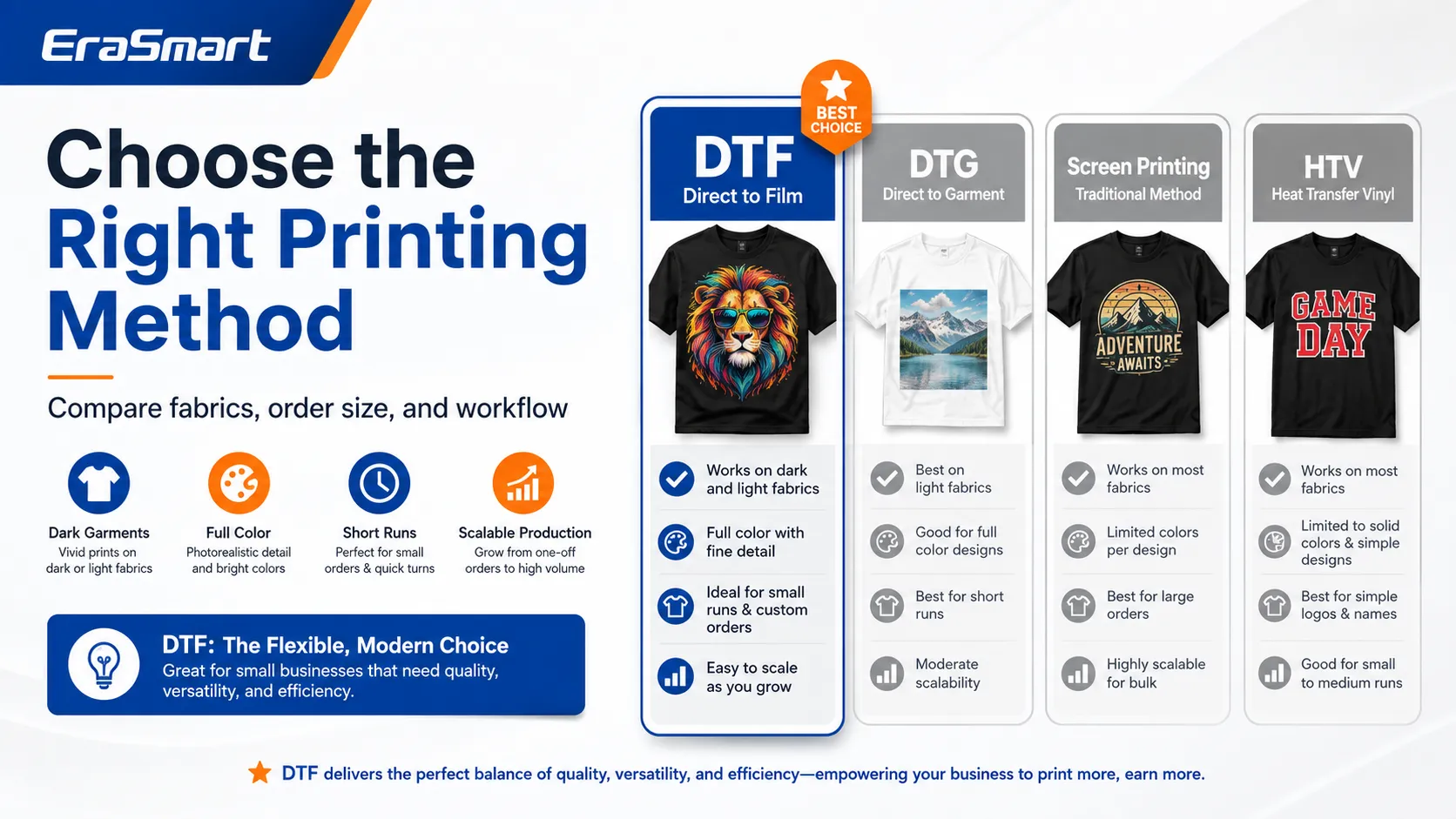
The best process depends on the garment, design, order size and production model.
| Method | Best for | Main advantages | Main limitations |
|---|---|---|---|
| DTF | Cotton, polyester, blends and dark garments | Broad fabric range, full color, small quantities | Transfer layer and white ink maintenance |
| DTG | Premium cotton apparel and detailed artwork | Direct printing and soft results on suitable fabrics | Pretreatment and fabric limitations |
| Screen printing | Repeated designs and larger quantities | Efficient at scale and durable | Setup time and limited flexibility |
| HTV | Names, numbers and simple graphics | Easy entry and strong specialty colors | Cutting and weeding labor |
| Sublimation | Light polyester garments | Soft print with no raised layer | Not suitable for normal cotton or dark shirts |
| Outsourced transfers | Beginners and irregular orders | Low equipment risk | Supplier dependence and higher transfer cost |
For a detailed comparison, see the EraSmart guide to DTF vs DTG vs screen printing vs HTV.
DTF is practical when you need:
Full-color artwork
Dark garments
Cotton and blends
Small or mixed quantities
Multiple garment colors
Short-run clothing brands
Personalized orders
Gang sheet production
DTF film production uses ink, a white underbase, hot-melt adhesive powder and heat transfer. It can be applied to a broader variety of textiles than a typical cotton-focused DTG workflow.
Screen printing may be more efficient when:
The design has a limited number of colors.
The same artwork is repeated many times.
The order quantity is high.
Setup cost can be spread across many units.
A specific screen-printed texture is preferred.
DTG may be suitable when:
Premium cotton garments are the main product.
The artwork contains detailed gradients or photographs.
A softer result is required.
Garment pretreatment and curing can be managed consistently.
Sublimation is appropriate when:
The shirts are white or light polyester.
The business focuses on sportswear.
The design should become part of the fabric.
All-over or highly breathable printing is required.
Buying equipment too early is one of the most expensive startup mistakes.
Use outsourcing when:
Order volume is unpredictable.
You are still testing your niche.
Workspace is limited.
You cannot maintain a printer daily.
You mainly need occasional transfers.
Cash is better spent on samples and marketing.
Consider in-house DTF production when:
Transfers are ordered every week.
Supplier lead times delay customer orders.
Shipping reduces profit.
Urgent reprints are common.
You need greater color control.
You want to sell transfers to other businesses.
Stable demand can support maintenance and equipment costs.
The decision should be based on actual monthly transfer volume, not excitement about owning a machine.
| Factor | Outsourced transfers | In-house DTF |
|---|---|---|
| Initial investment | Lower | Higher |
| Printer maintenance | Supplier handles it | Your responsibility |
| Production control | Limited | High |
| Urgent orders | Difficult | Easier |
| Transfer cost | Higher per unit | Potentially lower at volume |
| Color control | Supplier-controlled | In-house |
| Workspace | Minimal | Printer, curing and powder area |
| Best stage | Testing and early growth | Stable order volume |
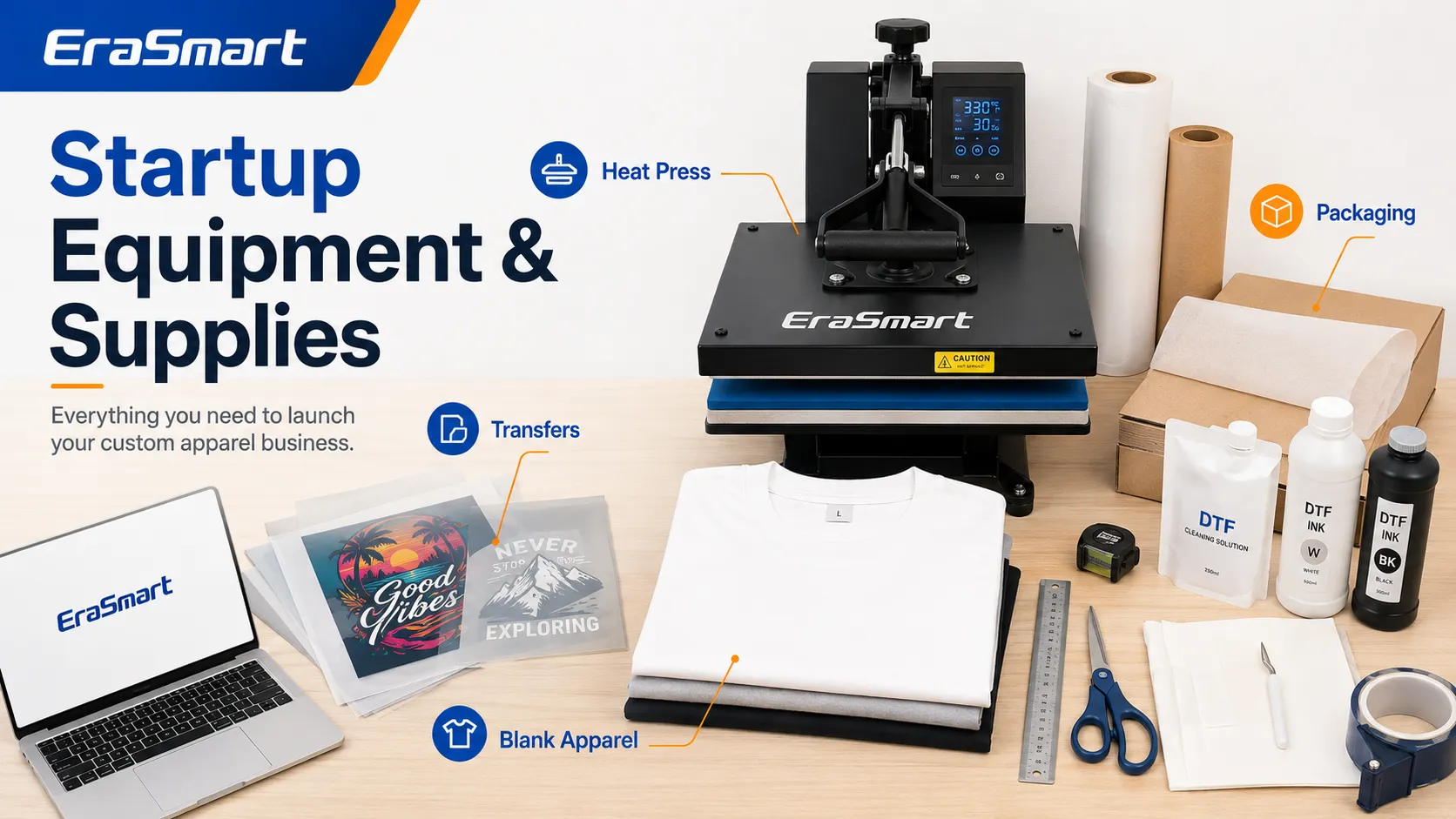
Do not budget only for the printer.
A realistic T-shirt printing startup budget should include four groups.
Depending on the business model:
Heat press
DTF printer
Curing oven
Powder shaker
Computer
RIP software
Design software
Cutting tools
Alignment tools
Worktable
Storage shelves
Ventilation
Possible items include:
DTF ink
PET film
Adhesive powder
Cleaning solution
Blank shirts
Hoodies
Tote bags
Protective paper
Heat-resistant tape
Packaging
Shipping labels
Possible expenses include:
Business registration
Domain name
Website
Online store
Photography
Sample production
Accounting
Insurance
Payment processing
Requirements vary by country and region, so local professional guidance may be necessary.
Reserve funds for:
Failed products
Reprints
Replacement blanks
Shipping delays
Maintenance parts
Advertising
Seasonal inventory
Customer refunds
Unexpected downtime
A business that spends its entire budget on equipment may not have enough cash left to acquire customers.
| Cost item | Quantity | Unit cost | Total |
|---|---|---|---|
| Heat press | |||
| Printer or outsourced transfer samples | |||
| Curing equipment | |||
| Computer and software | |||
| Initial blank garments | |||
| DTF consumables | |||
| Packaging | |||
| Website and domain | |||
| Product photography | |||
| Marketing | |||
| Maintenance reserve | |||
| Working capital |
Use supplier quotations and local costs rather than relying on a universal startup estimate.

A staged purchasing plan reduces risk.
Purchase:
Reliable heat press
Computer
Design software
Alignment ruler
Lint roller
Cutting tools
Protective sheets
Sample blanks
Packaging supplies
Outsourced DTF transfers
This setup allows you to accept paid apparel orders without operating a DTF printer.
Add:
Larger or auto-open heat press
Additional platen sizes
Label printer
Photography lighting
Better garment storage
More sample sizes
Repeat-design transfer inventory
Add:
DTF printer
RIP software
CMYK and white ink
PET film
Adhesive powder
Curing oven or powder shaker
Ventilation
Cleaning supplies
Spare maintenance components
Review the DTF printer buying checklist before comparing printer size, printhead configuration and production capacity.
Possible upgrades include:
Larger roll-fed printer
Automatic powder shaker and dryer
Additional heat press
Dedicated packing station
Improved workflow tables
Climate and humidity management
Backup production equipment
Upgrade only when an existing bottleneck is limiting profitable orders.
The cheapest shirt is not always the most profitable shirt.
Customers evaluate:
Fit
Fabric weight
Softness
Shrinkage
Color
Collar quality
Sizing consistency
Wash performance
A low-cost blank that causes complaints, inconsistent sizes or poor print performance can be more expensive than a reliable mid-range garment.
A beginner may start with:
One standard T-shirt
One premium T-shirt
One hoodie
One tote bag
Several common colors
Recommended initial shirt colors often include:
Black
White
Navy
Gray
A limited number of seasonal colors
Avoid stocking every size and color immediately.
Evaluate:
Heat resistance
Surface texture
Shrinkage
Dye migration
Press marks
Transfer adhesion
Wash performance
Record the successful settings for each garment model.
A small catalog is easier to manage and market.
Example launch catalog:
| Product | Options |
|---|---|
| Standard custom T-shirt | Front print or left-chest logo |
| Premium T-shirt | Full-front design |
| Business staff shirt | Logo front and back |
| Event shirt | Bulk size mix |
| Hoodie | Front or back print |
| Tote bag | Single-side print |
Avoid launching with dozens of unrelated products.
Each additional garment requires:
Size information
Photography
Pricing
Inventory
Testing
Product descriptions
Customer support
Bundles can increase order value.
Five staff T-shirts
Two logo hoodies
One sample approval
Saved artwork for future reorders
Group shirts
Mixed sizes
Personalized names
Delivery by event date
Several garment styles
Front and back prints
Neck-label samples
Packaging test
Artwork quality affects every production method.
Check:
Final print dimensions
Resolution
Transparent background
Color mode
Fine details
Font licensing
Correct spelling
Customer approval
Low-resolution screenshots cannot be converted into professional artwork simply by enlarging them.
Read What Is the Best DPI for Printing? when preparing customer graphics.
Create clear charges for:
Basic text setup
Background removal
Logo tracing
Color correction
Custom illustration
Multiple revisions
Rush artwork
Design work is part of the product cost.
Do not sell unlicensed:
Movie characters
Sports logos
Music artwork
Company trademarks
Celebrity images
Game characters
Other creators’ illustrations
Original visual art is generally protected when it is created and fixed in a tangible form, and using another creator’s work for reproduction normally requires permission. (copyright.gov)
Ask customers to confirm that they have permission to reproduce supplied logos and designs.

Your cost is more than the blank and transfer.
Include:
Blank garment
Transfer or ink
PET film
Adhesive powder
Printer cleaning
Heat press electricity
Design labor
Production labor
Failed products
Packaging
Payment fees
Marketplace fees
Advertising
Shipping supplies
Overhead
Unit cost = direct materials + direct labor + selling fees + overhead allocation + expected waste
Then calculate:
Selling price = unit cost + target profit
| Cost category | Example |
|---|---|
| Blank garment | T-shirt or hoodie |
| Printing | Transfer, ink, film and powder |
| Labor | Design, pressing and inspection |
| Packaging | Bag, label and care card |
| Fees | Payment and marketplace charges |
| Waste allowance | Failed transfers and garments |
| Overhead | Rent, software and utilities |
| Marketing | Advertising cost per sale |
Do not calculate profit using revenue minus the shirt blank alone.
Use a pricing structure that reflects order complexity.
Charge for:
Individual production
Personalization
Customer communication
Artwork setup
Offer quantity tiers, but ensure discounts come from genuine production efficiency.
Pricing may include:
Sample approval
Logo setup
Front and back printing
Size sorting
Individual packaging
Reorder storage
Rush work may require:
Supplier express shipping
Production rescheduling
Overtime
Priority handling
Charge accordingly.
Use:
Break-even quantity = fixed startup cost ÷ contribution margin per order
Contribution margin is:
Selling price − variable cost
For a more detailed model, use the EraSmart DTF ROI calculator.

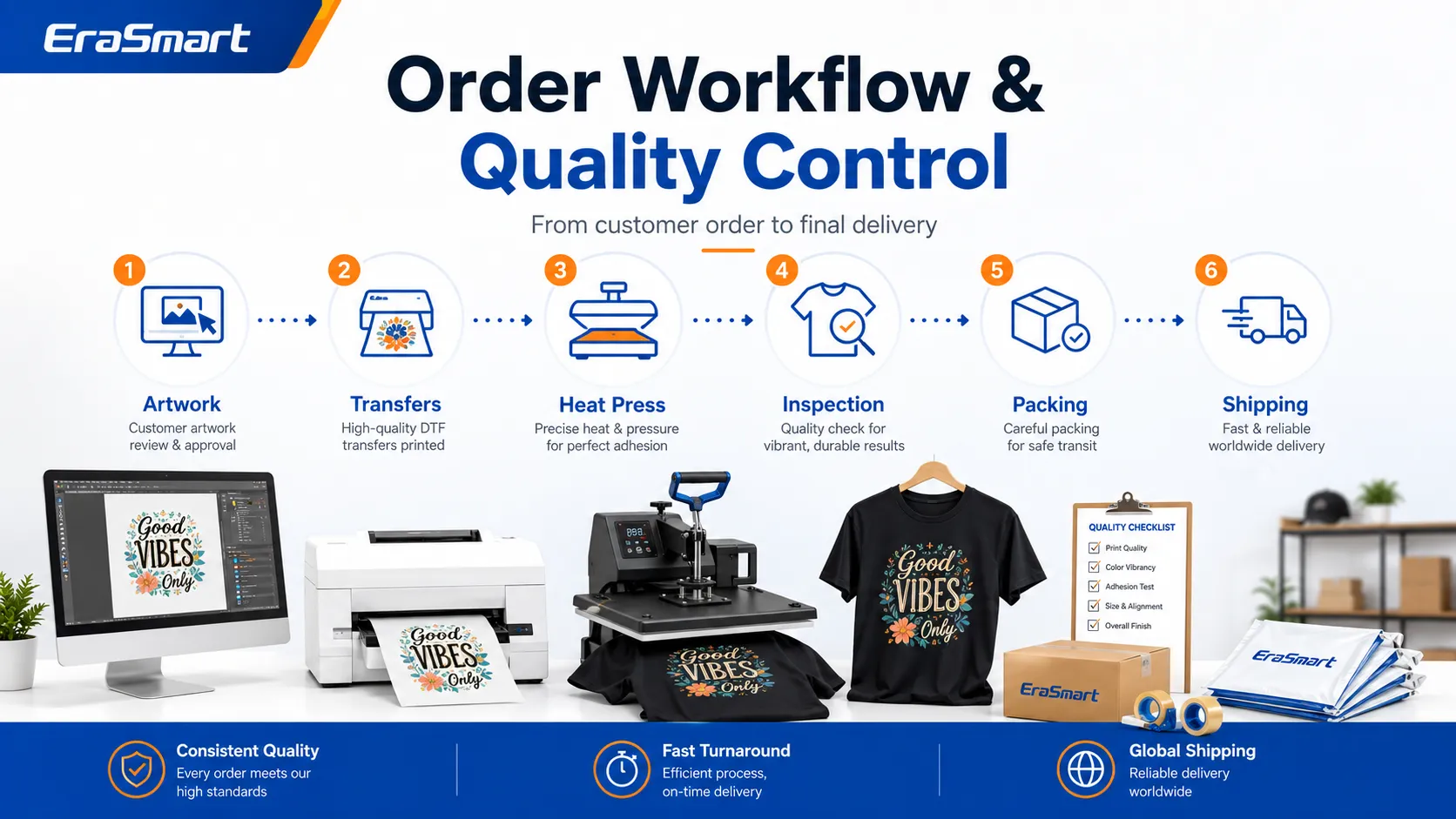
A simple DTF order workflow may include:
Receive the request.
Confirm garment, size and quantity.
Check the artwork.
Send a mockup.
Obtain written approval.
Collect payment or deposit.
Order blanks and transfers.
Inspect incoming materials.
Prepare garments.
Press the transfers.
Complete a finishing press if required.
Inspect every item.
Fold and package.
Ship or deliver.
Save order settings for reorders.
Documenting the process reduces mistakes as order volume grows.
Before packaging, check:
Correct garment
Correct size
Correct artwork
Correct placement
Print adhesion
Edge quality
Color
Press marks
Stains
Packaging label
For recurring customers, save:
Approved artwork
Print dimensions
Placement measurement
Garment model
Transfer supplier
Press settings
Packaging instructions
Do not rely on one platform.
Potential channels include:
Local business outreach
WooCommerce
Shopify
Etsy
TikTok
Local marketplaces
Craft fairs
School partnerships
Event planners
Marketing agencies
Create several professional samples for one industry.
For example, for restaurants:
Staff shirt
Manager hoodie
Promotional tote bag
Logo placement options
Then present a specific offer rather than a general “custom printing” service.
Create focused pages around specific customer needs:
Custom staff T-shirts
Family reunion shirts
School club shirts
Small-batch clothing brand printing
Custom logo hoodies
Event T-shirt printing
Specific pages are more relevant than one broad product page.
Useful content includes:
Blank-to-finished transformations
Transfer peeling
Order packing
Print close-ups
Wash-test results
Customer reorders
Behind-the-scenes production
Design preparation
Show the product quality and buying experience, not only the machine.
Define policies before problems occur.
Your policies should cover:
Artwork approval
Color variation
Garment sizing
Deposits
Cancellations
Revisions
Production time
Customer-supplied garments
Rush orders
Copyright responsibility
Reprints
Returns
Printing customer-owned garments creates additional risk because the product may be:
Heat-sensitive
Previously treated
Damaged
Difficult to replace
Incompatible with the transfer
Create a written policy explaining testing and replacement responsibility.
An in-house DTF printer must be maintained even when orders are slow.
Maintenance may include:
White ink circulation
Ink agitation
Nozzle checks
Printhead cleaning
Wiper cleaning
Capping station inspection
Waste ink management
Environmental monitoring
White pigment can settle, so printer manufacturers use circulation and scheduled maintenance functions to improve stability.
Before purchasing a printer, review the EraSmart DTF maintenance guide.
Budget for:
Cleaning solution
Dampers
Wipers
Capping stations
Waste containers
Failed prints
Replacement parts
Technical support

Complete:
Select one target market.
Review local and online competitors.
Interview potential customers.
Choose the initial product range.
Compare printing methods.
Draft the startup budget.
Decide whether to outsource transfers.
Deliverables:
Target-customer profile
Five initial products
Preliminary cost sheet
Business name shortlist
Production model
Complete:
Choose blank garments.
Order transfer samples.
Purchase the core equipment.
Test placement and pressing.
Perform wash tests.
Create product-care instructions.
Photograph finished samples.
Deliverables:
Tested blank catalog
Approved production settings
Product photographs
Pricing worksheet
Sample portfolio
Complete:
Register the business where required.
Purchase a domain.
Build basic product pages.
Configure payment methods.
Prepare order forms.
Write customer policies.
Set up packaging.
Deliverables:
Functional website or order system
Clear prices
Artwork approval process
Packaging system
Customer policies
Complete:
Contact local businesses.
Publish product content.
Run a small preorder campaign.
Approach schools or clubs.
Request customer feedback.
Record every production cost.
Deliverables:
First paid orders
Customer questions
Actual cost data
Initial reviews
Revised pricing
Complete:
Identify the best-selling product.
Remove weak products.
Improve pressing and packing time.
Create reusable design templates.
Build repeat-order records.
Develop one product bundle.
Deliverables:
More focused catalog
Faster production process
Repeat-order system
Improved product pages
Better margin data
Review:
Number of paid orders
Average order value
Contribution margin
Reprint rate
Customer acquisition cost
Repeat customers
Monthly outsourced-transfer cost
Production bottlenecks
Decide whether to:
Continue outsourcing
Stock repeat transfers
Purchase a compact DTF printer
Add another heat press
Expand into business orders
Delay equipment investment
| KPI | Why it matters |
|---|---|
| Conversion rate | Shows whether visitors become buyers |
| Average order value | Measures revenue per order |
| Contribution margin | Shows what remains after variable costs |
| Production time | Reveals workflow efficiency |
| Failure rate | Measures waste and quality problems |
| Repeat-order rate | Indicates customer satisfaction |
| Customer acquisition cost | Shows marketing efficiency |
| On-time delivery rate | Measures reliability |
| Transfer cost per month | Helps evaluate in-house printing |
| Profit per production hour | Compares product categories |
Revenue alone does not show whether the business is healthy.
The printer does not create demand.
Validate products before making a large investment.
A broad catalog creates unnecessary:
Inventory
Testing
Photography
Pricing
Packaging
Customer questions
Start narrow and expand based on orders.
Low pricing can attract difficult orders while leaving no margin for:
Mistakes
Artwork
Reprints
Customer service
Equipment maintenance
Compete through reliability, design quality, speed, small minimum quantities or niche expertise.
Customer files often require correction.
Include design time in the price.
Every new blank should be tested for heat resistance, adhesion and washing.
A DTF printer cannot be treated like an occasional office printer.
Buying an image from an unknown marketplace does not automatically provide commercial reproduction rights.
Allow time for:
Artwork approval
Blank sourcing
Transfer production
Printing
Reprints
Packaging
Shipping
Continue outsourcing while:
Orders are irregular.
Monthly transfer cost is low.
You lack maintenance capacity.
Workspace is limited.
Customers accept the current turnaround time.
Consider purchasing a printer when:
Transfer orders are consistent.
Supplier lead times cause lost sales.
Express shipping is frequent.
Reprints must be produced quickly.
In-house printing improves contribution margin.
You want to sell transfers.
You can maintain the machine regularly.
A compact DTF printer for small business may be suitable for short-run apparel production, while larger roll-fed systems are better suited to continuous commercial output.
A successful T-shirt printing business begins with customers and a cost model—not equipment.
Start by choosing a clear market, testing a small product range and deciding whether outsourcing or in-house printing fits your current order volume.
Your first priorities should be:
Market validation
Reliable blanks
Consistent print quality
Accurate pricing
Professional samples
Clear customer policies
Repeatable fulfillment
Careful cost tracking
Outsourced DTF transfers can reduce risk during the testing stage. Once demand becomes consistent, in-house DTF production may improve speed, control and long-term margins.
EraSmart offers compact and production-level DTF printer solutions for home studios, custom apparel shops and growing transfer-production businesses.
Choose equipment based on verified orders, available workspace, maintenance capacity and realistic production goals.
It can be profitable when product pricing covers materials, labor, waste, marketing, fees and overhead. Profitability depends on the niche, sales volume, production efficiency and repeat orders.
Start with a reliable heat press and outsourced ready-to-press DTF transfers. Purchase a printer only after demand becomes consistent.
A beginner generally needs a heat press, computer, design software, alignment tools, blank garments, transfers and packaging supplies.
DTF is suitable for small batches, full-color designs, dark garments and several fabric types. Outsourced transfers can also be used before purchasing a printer.
DTF is usually more flexible for small quantities and multicolor artwork. Screen printing can become more efficient for repeated designs in larger quantities.
A focused collection of approximately five to ten tested designs or product options is usually easier to market than a large untested catalog.
Keep only proven styles, colors and sizes in stock. Special garments can be ordered after receiving customer payment.
Include the garment, printing, labor, design, packaging, fees, waste, overhead and target profit.
Consider it when outsourced transfer costs and lead times consistently affect margins, delivery speed or accepted orders.
Only print designs that you created, licensed or have permission to reproduce. Ask customers to confirm their rights to supplied artwork.
Yes. The white ink underbase provides an opaque foundation that helps CMYK colors remain visible on black fabric.
Yes, a white underbase is normally required beneath the color image. White may also be used as a visible design color.
Yes. The image is normally printed in reverse because the printed side of the film faces the garment during transfer.
Use the settings specified for your film, powder, ink and garment. There is no single temperature suitable for every DTF system.
Yes. Black cotton T-shirts are a common DTF application.
Yes, but polyester should be tested for heat sensitivity and dye migration.
Common causes include weak white ink, missing white nozzles, incorrect white density, poor registration or black fabric showing through the transfer.
The white and CMYK layers may be misaligned, or the white underbase may need a small choke adjustment.
Possible causes include undercured powder, insufficient pressure, incorrect pressing settings, uneven garment surfaces or incompatible consumables.
Follow the film specification. DTF films may require hot, warm or cold peeling.
DTF film transfers generally do not require garment pretreatment.
Test the exact garment, use a compatible lower-temperature transfer system where available, minimize unnecessary heat exposure and inspect the sample again after it has rested.
uv printer
DTF printer
DTG printer
Heat press machine
Advertising printer
DTF oven
Hot Press
Carving machine
Mug heat transfer
Laminating machine
Printing INK
Cellphone case
Glass product
Cleaning fluid
Cotton swab
WhatsApp:+8618566233796
WeChat: +8618566233796
Mobile: +8618566233796
Web:www.erasmart.com
Shop:www.erasmartmall.com
WhatsApp us
Tell us your printing needs. Our team will reply within 24 hours.
Just provide a few details and we will help you get quick quotes!