Small Size Flatbed Inkjet Printer Manufacturer

Why Do DTF Prints Crack After Washing? Causes, Fixes & Prevention
DTF printing can produce colorful, detailed designs on T-shirts, hoodies, uniforms, tote bags, and other compatible textile products. However, one of the most frustrating problems for a printing business is discovering that a transfer has started cracking after washing or wearing.
Sometimes, the print looks perfect immediately after heat pressing but develops fine fractures after several washes. In other cases, cracks appear when the garment is stretched, even before the first wash.
DTF prints can crack when the printed transfer cannot tolerate the mechanical stress of stretching, wearing, or washing. Incorrect powder curing, unsuitable heat-press settings, excessive ink thickness, incompatible consumables, fabric characteristics, and harsh garment care can all contribute.
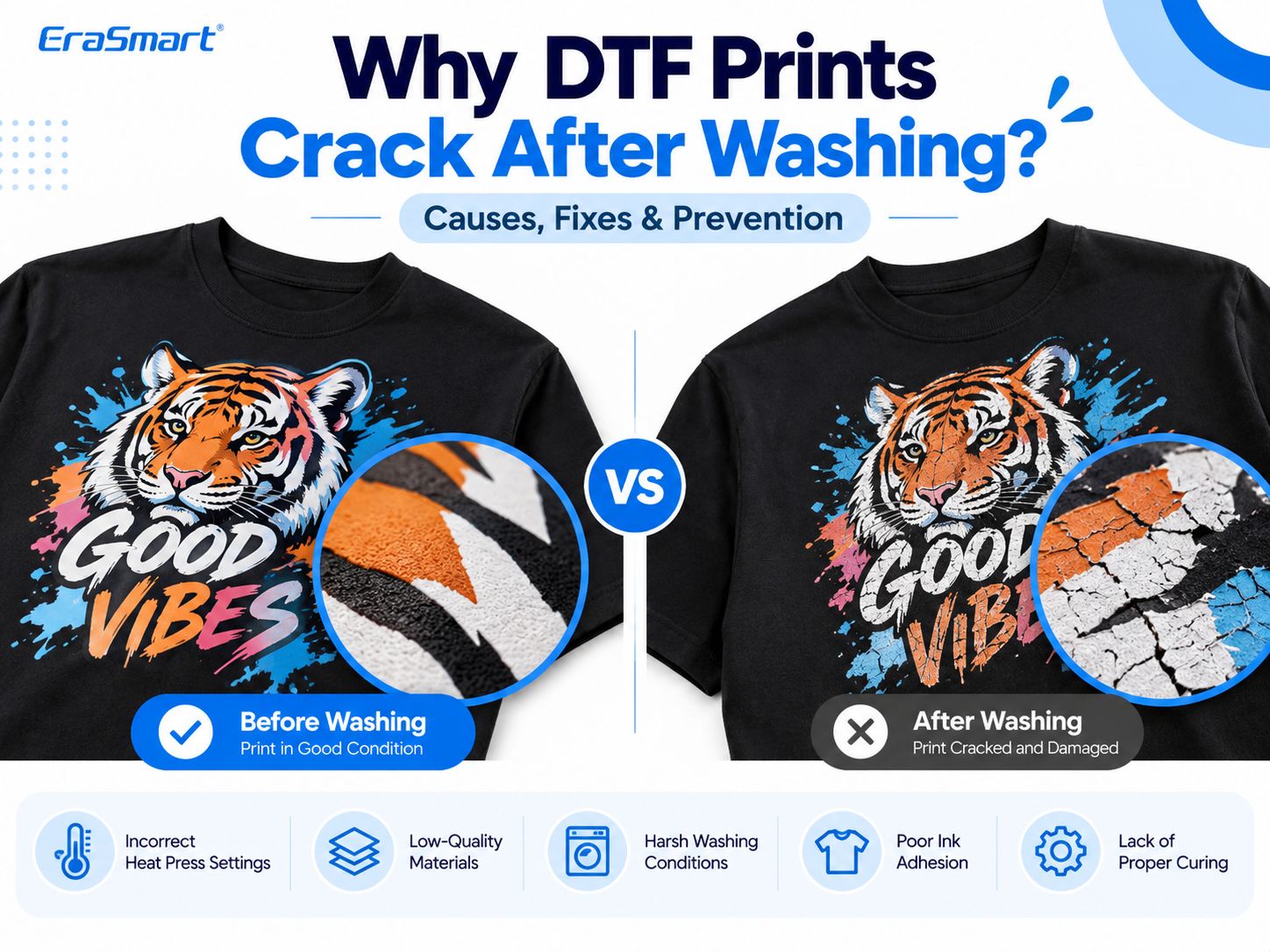
The important point is that cracking does not always mean the washing machine caused the problem.
Washing may simply expose a weakness already present in the transfer.
This guide explains how to identify DTF cracking, distinguish it from peeling and fading, investigate common causes, evaluate damaged garments, and build a more reliable production process.
Quick Answer: Why Do DTF Prints Crack?
The most common factors to investigate are:
- Incorrect adhesive powder curing.
- Incorrect heat-press temperature, pressure, or time.
- Excessively thick or inflexible printed layers.
- An unsuitable combination of DTF ink, film, powder, and fabric.
- Repeated stretching beyond the transfer’s flexibility.
- Excessive washing, drying, or abrasion stress.
- Poor process consistency between production batches.
A cracked DTF print should be diagnosed by examining when the damage appeared, where the cracks developed, and whether the graphic is also separating from the fabric.
For example:
| When the Problem Appears | What to Investigate |
|---|---|
| Immediately after pressing | Pressing conditions, curing, material compatibility |
| During the first stretch | Transfer thickness, flexibility, fabric elasticity |
| After the first wash | Initial adhesion, curing, pressing, washing conditions |
| After repeated washes | Wear, repeated flexing, laundering stress, material durability |
| Only on certain garments | Fabric type, coating, elasticity, garment construction |
| Only on one production batch | Ink, film, powder, settings, operator or environmental changes |
The objective is not simply to stop visible cracking on one shirt.
It is to identify the cause so the same failure does not happen across an entire customer order.
DTF Cracking vs Peeling vs Fading: What’s the Difference?
Before troubleshooting, identify the exact failure.
DTF cracking, peeling, and fading can occur together, but they are not the same problem.

DTF Cracking
Cracking means the printed graphic develops visible fractures.
Common signs include:
- Fine lines through the design.
- A broken or fragmented print surface.
- Cracks appearing when the garment is stretched.
- Sections of the design separating visually while remaining attached to the fabric.
Cracking is often associated with mechanical stress, insufficient flexibility, or a problem in the transfer-production process.
DTF Peeling
Peeling occurs when part of the transferred graphic lifts or separates from the textile.
Typical signs include:
- Edges lifting away from the fabric.
- Corners separating.
- Large portions of a design detaching.
- Adhesive failure between the transfer and garment.
Peeling is primarily an adhesion-related symptom.
Possible causes include incorrect pressing, insufficient adhesive coverage, incompatible fabric, or incomplete powder curing.
DTF Fading
Fading occurs when the colors become less vibrant or change appearance.
Possible symptoms include:
- Reduced color intensity.
- Washed-out artwork.
- Loss of contrast.
- Uneven color appearance.
Fading may involve ink performance, color stability, washing conditions, or gradual wear.
A faded print is not necessarily cracked, and a cracked print may retain much of its original color.
Why the Difference Matters
Each symptom requires a different troubleshooting approach.
If the graphic is cracking but still firmly attached, changing only the heat-press pressure may not solve the problem.
If the graphic is peeling from the fabric, improving color density will not necessarily restore adhesion.
If the print is fading, increasing adhesive powder may not address the cause.
Identify the failure before changing the production settings.
For broader diagnosis, visit the EraSmart DTF Troubleshooting Guide.
What Causes DTF Prints to Crack?
DTF printing is a multi-stage process.
A typical workflow includes:
Artwork → Printing on PET Film → Adhesive Powder → Curing → Heat Press Transfer → Garment
Each stage contributes to the final product’s flexibility, adhesion, and durability.

1. Incorrect Powder Curing
DTF adhesive powder must be processed under conditions suitable for the particular powder and production system.
If the powder is not cured sufficiently, its bonding behavior may be inconsistent.
Excessive heating may also negatively affect the adhesive or transfer structure, depending on its formulation.
Either condition can contribute to poor production performance.
2. Incorrect Heat-Press Settings
Incorrect temperature, pressure, or pressing time can affect how the transfer bonds to the garment.
Insufficient pressing may result in weak adhesion.
Excessive heat or pressing can damage some materials or negatively affect the finished transfer.
3. Excessive Ink Thickness
A thick, continuous printed layer may be less able to tolerate repeated bending than a more flexible, appropriately designed transfer.
This is especially relevant for large solid-color graphics on stretchy garments.
4. Incompatible Consumables
Not every DTF ink, PET film, and adhesive powder combination performs identically.
Material compatibility influences:
- Flexibility.
- Adhesion.
- Transfer feel.
- Curing behavior.
- Washing performance.
- Repeatability.
5. Fabric Stretch
A garment may stretch substantially during normal use.
If the printed layer cannot accommodate that movement, fractures may develop.
6. Harsh Washing Conditions
High mechanical agitation, inappropriate detergents, excessive heat, and aggressive drying may accelerate damage.
However, these conditions should be evaluated alongside the original transfer quality.
Why Do DTF Prints Become Brittle?
A flexible garment and its printed graphic do not always stretch or bend in the same way.
The textile is made from fibers and yarns that can move relative to one another.
A DTF graphic contains a continuous or partially continuous printed transfer structure bonded to the fabric.
When the garment stretches, the transfer must accommodate the resulting deformation.
If the transfer is too stiff for the intended application, cracks may develop.
Factors That Can Affect Flexibility
Ink and white underbase thickness
The amount and distribution of ink can influence the transfer’s thickness and feel.
Adhesive powder formulation
Different hot-melt adhesive systems may provide different combinations of adhesion, softness, and flexibility.
Powder coating amount
Too little adhesive can reduce bonding reliability. Excessive or uneven application can create an inconsistent transfer structure.
Curing and pressing
Thermal processing influences how the adhesive behaves.
Garment elasticity
A transfer suitable for a relatively stable cotton T-shirt may not perform identically on a highly elastic sports garment.
Design structure
A large, unbroken graphic may behave differently from artwork composed of smaller separated elements.
The final result depends on the complete combination of materials and processes.
How Fabric Stretch Can Cause DTF Cracking
Stretch is particularly important for:
- Sportswear.
- Activewear.
- Leggings.
- Compression garments.
- Stretch T-shirts.
- Garments containing elastane or spandex.
- Clothing with large graphics across high-movement areas.
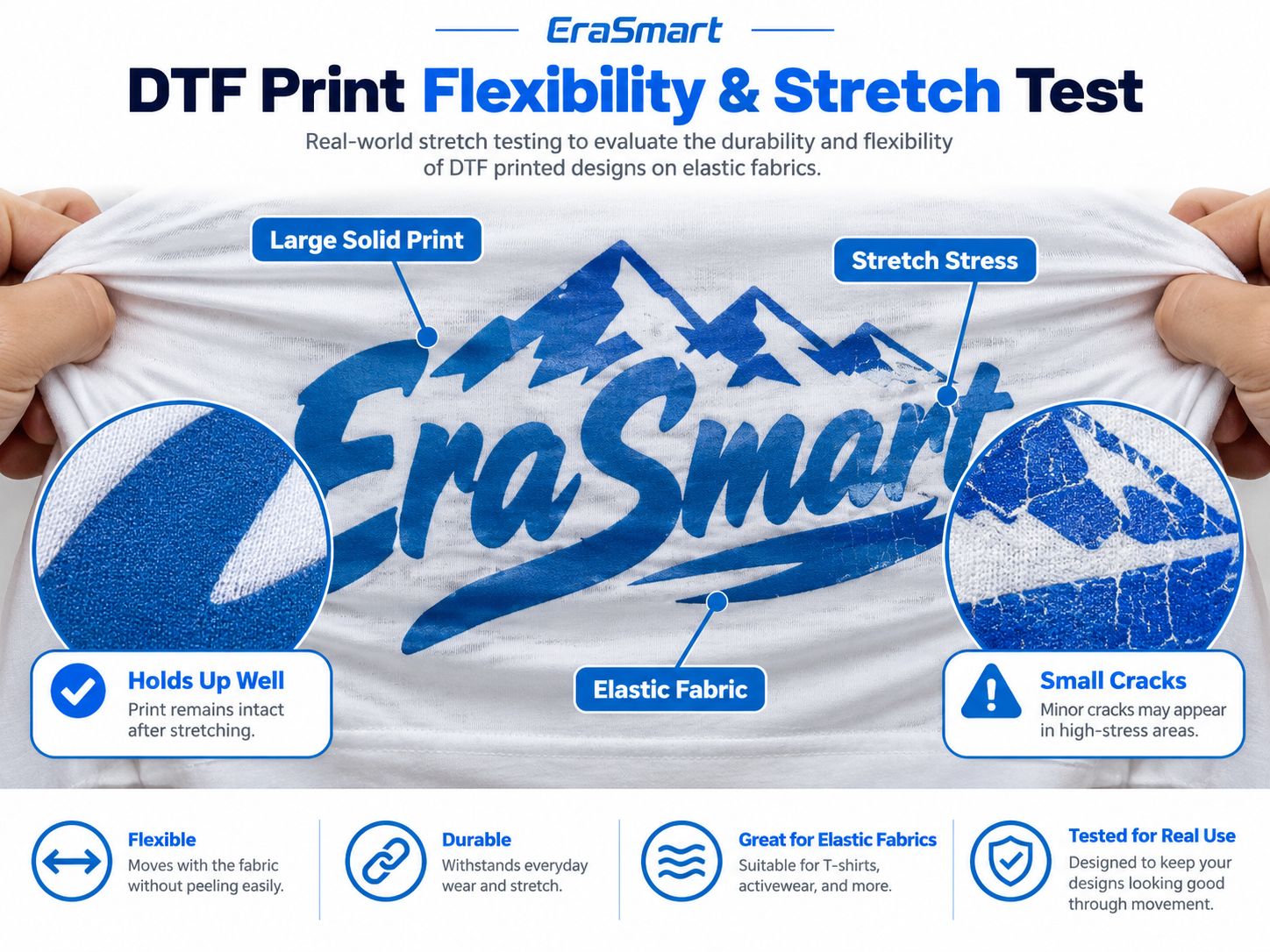
Large Solid Designs
A large block of continuous ink may need to deform across a wide area as the garment moves.
This can create visible stress in the printed layer.
Designs with more separation between elements may provide a different mechanical response.
However, breaking up the artwork does not automatically correct an unsuitable ink or adhesive system.
High-Stretch Areas
Consider where the graphic is located.
A print on the front of a relatively stable T-shirt may experience different forces from a print on:
- An elastic waistband.
- A tight-fitting sleeve.
- A highly stretched sports garment.
- A knee or elbow area.
How to Evaluate Stretch Performance
Use representative samples made from the intended production fabric.
- Print and transfer the approved artwork.
- Follow the specified curing and pressing process.
- Allow the transfer to reach the handling condition required by the consumable supplier.
- Stretch the garment to a level representative of actual use.
- Examine the graphic under normal and stretched conditions.
- Look for fractures, edge lifting, or permanent damage.
- Repeat the test as appropriate for the product’s intended use.
Avoid overstretching a sample far beyond the conditions a customer would reasonably encounter and then treating that extreme result as normal-use performance.
Under-Curing vs Over-Curing: How They Affect DTF Transfers
Curing is a critical production stage, but it is often misunderstood.
The adhesive powder must be processed correctly before the final transfer is applied to the garment.

What Is Under-Curing?
Under-curing means the powder has not received sufficient thermal processing for the intended workflow.
Possible warning signs include:
- Incompletely melted adhesive particles.
- Inconsistent adhesive coverage.
- Poor bonding in later transfer tests.
- Irregular surface appearance.
Not all under-cured transfers will look identical.
Visual appearance alone is not a complete quality test.
What Is Over-Curing?
Over-curing refers to excessive thermal exposure relative to the recommended process.
Depending on the adhesive and film system, excessive heat or time may negatively affect:
- Adhesive behavior.
- Film condition.
- Transfer flexibility.
- Subsequent bonding performance.
A cracked final print does not, by itself, prove the powder was over-cured.
How to Check Curing Problems
Start with the manufacturer’s recommended process for your actual powder and curing equipment.
Then check:
- Whether heating is even across the transfer.
- Whether the adhesive is processed consistently.
- Whether the conveyor speed or dwell time has changed.
- Whether the heater temperature is accurately controlled.
- Whether a new powder batch or formulation has been introduced.
- Whether the finished transfer passes adhesion and flexibility tests.
Keep the curing conditions consistent during comparison tests.
Do Not Confuse Curing Temperature with Heat-Press Temperature
These are different stages.
| Process | Purpose |
|---|---|
| Print Room Temperature | Maintains the operating environment for printer, ink, film, and powder |
| Powder Curing Temperature | Processes the adhesive powder on the printed film |
| Garment Heat-Press Temperature | Bonds the prepared transfer to the textile |
The correct settings depend on the actual printer, film, powder, fabric, and equipment.
Do not apply a single universal curing temperature to every DTF system.
For a wider explanation of environmental control, see How Temperature and Humidity Affect DTF Printing.
How Heat-Press Settings Affect Cracking and Peeling
The heat press is the final bonding stage in the DTF transfer process.
A suitable pressing process must provide the required combination of:
- Temperature.
- Pressure.
- Contact time.
- Consistent contact across the graphic.
- Correct peel procedure.
Insufficient Temperature or Time
If the adhesive does not receive the intended pressing conditions, bonding may be incomplete.
This can lead to peeling or other durability problems that become visible during stretching or washing.
Excessive Temperature or Time
Excessive exposure can negatively affect certain transfer systems and fabrics.
Do not assume that increasing pressing temperature is always the correct way to improve wash durability.
Uneven Pressure
Uneven pressure can cause some parts of a transfer to bond differently from others.
Potential contributing factors include:
- An uneven garment surface.
- Seams.
- Buttons or zippers.
- Wrinkles.
- Inconsistent platen contact.
- Incorrect positioning.
Incorrect Peel Procedure
Some films use a hot-peel process, while others require warm or cold peeling.
Follow the instructions for the particular film.
Peeling too early or using the wrong procedure may damage the transfer.
Better Pressing Practice
When investigating durability issues:
- Check the actual platen temperature.
- Confirm the applied pressure and contact time.
- Inspect garment positioning.
- Verify the film’s peel requirements.
- Compare an approved control sample with the defective sample.
- Adjust one variable at a time.
- Repeat adhesion, stretch, and washing tests.
The goal is a validated process, not simply the highest possible temperature or pressure.
Can Too Much White Ink Cause DTF Cracking?
Excessive ink buildup may contribute to a thicker, less flexible transfer structure.
However, white ink is also essential for many DTF applications, especially printing bright colors onto dark garments.
The objective is not to eliminate white ink.
It is to use the appropriate amount for the artwork, fabric, and production system.
White Ink Underbase
White ink supports color opacity and visibility.
If the white layer is too weak, colors may look dull on dark fabric.
If the overall printed structure is unnecessarily thick, flexibility and hand feel may be affected.
What Should You Check?
- White ink nozzle condition.
- Underbase consistency.
- RIP settings.
- Overall ink coverage.
- Transfer thickness.
- Finished garment flexibility.
Do not arbitrarily reduce white ink density without checking the resulting opacity and transfer quality.
For additional guidance, read the White Ink Printing Guide.
Can the Wrong DTF Powder Cause Cracking?
Adhesive powder is one of the most important components of a DTF transfer.
It helps bond the printed image to the fabric.
But different adhesive formulations can behave differently.
Powder Selection Matters
A powder may be selected according to:
- Fabric composition.
- Required flexibility.
- Finished hand feel.
- Pressing conditions.
- Intended end use.
For example, a highly elastic garment may require a different material evaluation from a relatively stable promotional cotton T-shirt.
Powder Amount Matters
Uneven or excessive powder application can create problems in transfer consistency.
Insufficient powder may leave some areas with inadequate adhesive.
The correct application should follow the recommended consumable workflow.
Powder Condition Matters
Moisture exposure, contamination, or powder clumping can also affect production consistency.
For an in-depth explanation, see Why Is DTF Powder Clumping?.
Film, Ink, and Powder Must Work Together
A change to only one consumable may change the performance of the complete transfer.
Before switching powders, evaluate the compatibility of:
Ink + PET Film + Adhesive Powder + Curing + Fabric + Heat Press
Learn more in the DTF Consumables Guide.
Why Do DTF Prints Crack After the First Wash?
Cracking after the first wash is especially frustrating because customers often assume the print was defective from the beginning.
In some cases, that concern may be justified.
A transfer can look visually acceptable immediately after pressing while still having problems with:
- Adhesive bonding.
- Flexibility.
- Curing.
- Ink-film compatibility.
- Fabric compatibility.
The washing process exposes the graphic to repeated movement, moisture, detergent, and other stresses.
If the transfer was already marginal, visible damage may appear quickly.
What Should You Check First?
1. Inspect an unwashed sample
Does a sample from the same production batch show cracks during stretching?
2. Review the curing record
Were the powder-curing settings correct and consistent?
3. Review the pressing record
Were time, temperature, pressure, and peeling performed correctly?
4. Check the garment
Was it the same fabric and garment construction as the approved sample?
5. Check washing conditions
Were the customer care instructions followed?
6. Compare other garments from the same batch
If several products fail under similar conditions, investigate the shared production process.
If only one garment fails, consider differences in fabric, handling, and laundering as well.
Do not conclude that one factor caused the failure without investigating the evidence.
Why Do DTF Prints Crack After Several Washes?
Some graphics perform well initially but deteriorate gradually.
Possible contributing factors include:
- Repeated stretching and flexing.
- Mechanical abrasion.
- Wash-cycle intensity.
- Detergent compatibility.
- Drying temperature.
- Gradual wear.
- Transfer formulation and application quality.
A graphic that is repeatedly stretched may show fatigue differently from one on a relatively stable part of the garment.
It is also important to distinguish normal long-term wear from unusually rapid failure.
If prints begin cracking much sooner than expected for the intended product, carry out controlled comparison testing.
Can You Fix an Already Cracked DTF Print?
It depends on the type and extent of the damage.
Fine Surface Cracks
Once the printed layer has physically fractured, reheating does not reliably restore the original artwork.
A heat press may change the appearance of some damaged areas, but it should not be treated as a guaranteed repair procedure.
Peeling Edges
If the problem is edge lifting rather than cracking, there may be a different recovery consideration.
However, re-pressing should only be attempted when permitted by the transfer supplier and after investigating the original adhesion problem.
Even if the edge appears to bond again, the product may still require durability testing.
Severely Cracked Graphics
For commercial customer orders, replacement or reprinting is often the more reliable solution.
Trying to disguise a severely damaged transfer can lead to further complaints.
Before Reprinting
Identify the likely cause.
Otherwise, the replacement may fail in exactly the same way.
Fix the process before replacing the product.
How to Prevent DTF Prints from Cracking
Prevention starts before printing and continues through final product testing.

Step 1: Prepare Suitable Artwork
Use artwork at the intended dimensions and resolution.
Consider the mechanical requirements of the design.
Large solid graphics on high-stretch garments should be evaluated for flexibility.
Step 2: Maintain Consistent Ink Output
Run appropriate nozzle checks.
Check white ink circulation and output consistency.
Use compatible ink and established print settings.
Step 3: Apply Powder Evenly
Confirm that adhesive powder is distributed consistently over the printed image.
Avoid contaminated, heavily clumped, or unsuitable powder.
Step 4: Cure According to the Consumable Requirements
Use the validated process for the specific adhesive powder, film, and curing equipment.
Do not rely on one universal temperature and time.
Step 5: Press Correctly
Confirm:
- Temperature.
- Pressure.
- Time.
- Garment positioning.
- Film peeling requirements.
Avoid making several changes at once.
Step 6: Test the Finished Transfer
Evaluate:
- Adhesion.
- Flexibility.
- Stretch performance.
- Washing durability.
- Appearance after drying.
Record successful settings so that production can be repeated consistently.
DTF Cracking Troubleshooting Chart
The following chart provides a starting point for identifying common problems.

| Symptom | Possible Causes | First Checks | Recommended Direction |
|---|---|---|---|
| Cracks after the first wash | Curing, pressing, flexibility, washing | Unwashed control sample, production records | Test the complete transfer workflow |
| Cracks when stretched | Transfer too stiff for application, material mismatch | Ink thickness, fabric elasticity, consumables | Evaluate flexible transfer combinations |
| Print feels hard or brittle | Thick structure, adhesive formulation, thermal processing | Powder type, ink coverage, curing | Compare validated materials and settings |
| Graphic edges peel | Adhesive bonding problem | Powder coverage, press settings, fabric | Investigate adhesion separately from cracking |
| Some areas crack, others remain intact | Uneven printing, curing, pressing, or garment stress | Coverage uniformity, platen contact | Improve consistency and retest |
| Color fades without cracking | Color performance, washing, abrasion | Print profile, ink, laundering | Investigate color stability |
| Cracks appear only on one fabric | Fabric stretch or surface differences | Fabric construction, coating, elasticity | Validate the transfer for that fabric |
| Entire batch fails | Shared production problem | Consumable batches, settings, equipment | Hold production and investigate common variables |
Use this chart to guide diagnosis, not to assign a guaranteed cause from one visible symptom.
How to Test DTF Wash and Stretch Durability
Testing is one of the most reliable ways to prevent customer complaints.
A good test procedure should reflect the garments, production workflow, and intended use.
1. Prepare Representative Samples
Use the actual:
- Fabric.
- DTF ink.
- PET film.
- Adhesive powder.
- Curing conditions.
- Heat-press settings.
For meaningful comparisons, keep these variables consistent.
2. Inspect the Initial Transfer
Before washing, record:
- Print appearance.
- Edge adhesion.
- Flexibility.
- Color.
- Surface condition.
Photographs can be helpful for comparing changes later.
3. Perform a Controlled Stretch Test
Stretch the garment within a range representative of actual use.
Look for:
- Fine cracks.
- Permanent fractures.
- Edge lifting.
- Changes in appearance.
Test relevant garment areas rather than only pulling the sample in one direction.
4. Perform Repeatable Washing Tests
Establish a consistent laundering procedure.
Record:
- Wash temperature.
- Washing program.
- Detergent.
- Load conditions.
- Drying method.
- Number of cycles.
Use the same procedure when comparing different ink, powder, or pressing conditions.
For formal textile testing, ISO 6330:2021 — Textiles: Domestic Washing and Drying Procedures for Textile Testing provides standardized laundering procedures.
However, using a specified laundering procedure does not by itself certify that a DTF print is crack-proof. The finished graphic still needs to be assessed against appropriate durability criteria.
5. Inspect After Each Test Stage
Look for:
- Cracking.
- Peeling.
- Color change.
- Distortion.
- Surface wear.
Document when the first defect appears.
6. Compare Against the Approved Reference
A useful production test compares:
Reference Sample vs New Material or New Setting
For example, if you are testing a new adhesive powder, keep the other variables as consistent as possible.
This makes the results easier to interpret.
7. Record and Standardize the Successful Process
Once a transfer passes the relevant checks, document the approved production conditions.
Keep records of:
- Ink and batch.
- Film and batch.
- Powder and batch.
- Fabric.
- Artwork.
- RIP settings.
- Curing process.
- Pressing conditions.
- Wash-test observations.
- Stretch-test observations.
This creates a more repeatable production process.
How Should Customers Wash DTF-Printed Garments?
Proper garment care can help reduce avoidable stress on printed graphics.
Care instructions should be based on the fabric, ink, adhesive, and completed garment.
Common recommendations for suitable DTF garments may include:
- Turn the garment inside out before washing.
- Use a gentle washing program.
- Avoid unnecessarily high wash temperatures.
- Use a suitable mild detergent.
- Avoid aggressive bleaching unless the finished product is specifically approved for it.
- Limit excessive mechanical abrasion.
- Follow the garment’s approved drying instructions.
- Avoid applying a hot iron directly onto the printed design unless the process is specifically approved.
The correct laundering instructions should be validated for the complete product.
Careful washing helps, but it cannot compensate for a transfer that was incorrectly produced.
If a print cracks quickly despite appropriate garment care, investigate the printing and transfer process.
Why Consistent DTF Production Matters More Than One Successful Sample
A print that passes one initial inspection is not proof of consistent long-term production.
For example, a shop may produce a successful test using:
- One powder batch.
- One ink supply.
- One film type.
- One garment material.
Later, the operator changes the powder, increases production speed, or switches garment suppliers.
The printing process may still appear similar, but the finished transfer performance can change.
This is why DTF quality control should include both:
Process Consistency
and
Finished-Product Testing
Changes to materials or equipment settings should trigger appropriate revalidation.
For broader workflow guidance, see Common DTF Printing Problems.
Final Answer: How Do You Stop DTF Prints from Cracking?
DTF cracking is usually a sign that the printed transfer is not performing adequately under the mechanical and environmental conditions of its intended use.
The most important factors to investigate are:
- Transfer flexibility.
- Ink and white ink coverage.
- Adhesive powder compatibility.
- Powder curing.
- Heat-press settings.
- Fabric characteristics.
- Stretching and washing conditions.
When cracking occurs, use a controlled troubleshooting process:
Identify the Symptom → Inspect the Transfer → Check Materials → Review Curing → Review Pressing → Test → Standardize
Do not assume every crack is caused by insufficient heat.
Do not assume every durability failure is caused by the washing machine.
And do not attempt to solve all DTF problems by increasing ink, powder, temperature, or pressure.
The best results come from matching the complete transfer system to the intended garment and validating that combination through realistic testing.
For further guidance, explore:
- DTF Troubleshooting Guide
- DTF Consumables Guide
- Why Is DTF Powder Clumping?
- How Temperature and Humidity Affect DTF Printing
- DTF Printing Guide
Frequently Asked Questions
Why do my DTF prints crack after washing?
Possible causes include insufficient flexibility, incorrect powder curing, unsuitable pressing conditions, incompatible materials, and harsh laundering. Check the complete production process rather than assuming washing is the only cause.
Why do DTF prints crack after the first wash?
The first wash may reveal weaknesses in the transfer’s adhesion or flexibility. Compare the washed garment with an unwashed sample from the same production batch.
Can DTF prints crack when stretched?
Yes. If the printed structure cannot tolerate the deformation of the garment, visible fractures may develop. This is especially relevant for highly elastic fabrics or large continuous graphics.
Is DTF cracking the same as peeling?
No. Cracking involves fractures through the graphic. Peeling involves the graphic lifting or separating from the fabric.
Does too much white ink cause DTF cracking?
Excessively thick ink layers may affect flexibility, but white ink is necessary for many DTF applications. Review the complete ink structure rather than reducing white ink without testing.
Can under-cured DTF powder cause durability problems?
Yes. Incomplete adhesive processing can contribute to inconsistent bonding and transfer performance. Verify curing conditions for the actual powder and equipment.
Can over-curing cause DTF cracking?
Excessive thermal exposure may negatively affect certain transfer systems. However, cracking alone does not prove over-curing. Compare validated processing conditions and test the finished transfer.
Can incorrect heat-press pressure cause cracking?
Incorrect pressure can affect transfer bonding and may contribute to durability problems. Check temperature, pressure, time, garment positioning, and film requirements together.
Why does my DTF print feel hard?
A stiff transfer may result from its ink coverage, adhesive formulation, design structure, or processing conditions. Compare the finished feel with an approved reference sample.
Why do DTF prints crack on polyester or stretch fabric?
Different fabrics have different elasticity and surface characteristics. The transfer must be suitable for the actual garment and expected movement.
Can I fix a cracked DTF print with a heat press?
A physically fractured printed layer is not reliably restored by reheating. Re-pressing may be considered for certain adhesion problems only when supported by the transfer supplier, but it is not a guaranteed repair for cracking.
Should I use more powder to prevent cracking?
Not automatically. Excessive or uneven adhesive application can create other problems. Use the appropriate powder and coverage for the intended transfer system.
Does washing temperature affect DTF durability?
Washing temperature, agitation, detergent, and drying conditions may influence long-term performance. Follow care instructions validated for the finished garment.
How many washes should a DTF print last?
There is no universal number that applies to every DTF ink, film, powder, fabric, and production process. Wash-durability claims should be based on actual testing.
How do I test DTF prints before selling them?
Use representative garments, controlled stretch testing, repeatable laundering conditions, and visual inspections for cracking, peeling, fading, and other changes.
How do I prevent DTF cracking in commercial production?
Standardize compatible consumables, ink coverage, curing, pressing, garment selection, and quality testing. Revalidate the process whenever important materials or production settings change.
Build a More Reliable DTF Printing Workflow with EraSmart
If your DTF production is experiencing:
- Cracking after washing.
- Peeling transfers.
- Poor flexibility.
- Inconsistent powder curing.
- Weak wash durability.
- Excessively stiff graphics.
- Batch-to-batch quality variation.
The best starting point is to evaluate the entire production system.
EraSmart provides DTF printing equipment and workflow solutions for customized apparel and compatible textile applications.
Explore the EraSmart DTF Printer range to compare printing equipment for your production requirements.
When discussing a durability problem, the following information can help identify the likely cause:
- DTF printer model.
- Ink and powder type.
- PET film type.
- Fabric composition.
- Curing process.
- Heat-press settings.
- Washing conditions.
- Photographs of the damaged print.
MAY BE YOU LIKE ALSO
Copyright 2020 © EraSmart. | Sitemap